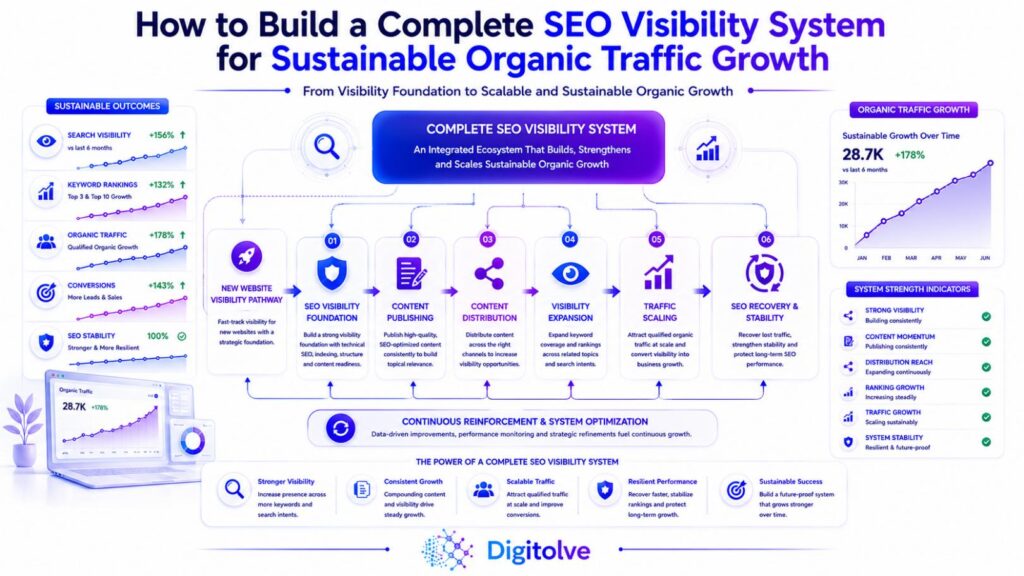
SEO visibility system :
Sustainable organic traffic is rarely the result of one successful SEO tactic, one high-ranking page, or a single content strategy. Businesses may optimize their websites, publish consistently, and target relevant keywords, yet still struggle to create predictable long-term traffic growth. The problem is often not a lack of SEO activity—it is the absence of a connected system that allows every visibility effort to strengthen the others.
A complete SEO visibility system approaches organic growth differently. Instead of treating technical readiness, content publishing, website structure, distribution, authority, traffic expansion, and recovery as separate activities, it connects them within one broader traffic execution architecture. Each system plays a different role, but together they create the conditions required for sustainable search visibility and organic growth.
This distinction becomes increasingly important as a website matures. New websites need strong visibility foundations. Growing websites need consistent publishing and effective content distribution. Established websites may need to expand beyond existing search opportunities, while websites experiencing traffic decline require structured visibility recovery. Not every business follows exactly the same path, but each challenge belongs within the same interconnected visibility ecosystem.
The goal, therefore, is not simply to perform more SEO activities. It is to understand how the different systems behind organic traffic work together—and how businesses can progress from isolated execution toward a structured, repeatable, and scalable traffic architecture.
This guide explores the complete Traffic Execution System at an ecosystem level, connecting six core execution systems into one strategic architecture. You will see how businesses can build, execute, expand, scale, recover, stabilize, and ultimately systemize their approach to organic traffic without relying on disconnected tactics.
Because sustainable organic traffic does not come from doing more SEO in isolation.
It comes from building a visibility system where every part continuously strengthens and reinforces the others over time.
Explore the Complete Traffic Execution System
Sustainable organic traffic is built through multiple connected execution systems. Explore each part of the Digitolve Traffic Execution System to understand the strategic framework that matches your current visibility and traffic growth stage.
Build Your SEO Visibility Foundation
Learn how interconnected visibility systems create the foundation for consistent organic traffic growth.
How to Build an SEO Visibility System That Consistently Increases Organic Traffic
Create a Consistent Content Publishing System
Discover why structured publishing creates stronger long-term traffic momentum than disconnected content activity.
How to Create a Content Publishing System That Builds Traffic Consistently
Build New Website Visibility From Day One
Understand the visibility foundations a new website needs to support discoverability and sustainable organic growth from launch.
How to Build SEO Visibility for a New Website From Day One
Expand Content Reach Through Strategic Distribution
Explore how a connected content distribution system expands reach, strengthens discovery, and reinforces long-term visibility.
How to Build a Content Distribution System That Increases Content Reach
Scale Organic Traffic Beyond Growth Plateaus
Learn why organic growth eventually reaches a ceiling and how continuous visibility expansion creates new opportunities for sustainable traffic growth.
How to Scale Website Traffic After SEO Growth Stalls
Recover Lost Search Visibility and Organic Traffic
Understand how structured SEO recovery rebuilds weakened search visibility and creates the foundation for sustainable organic traffic recovery.
How to Recover Lost Organic Traffic With a Structured SEO Recovery Plan
Table of Contents
What Is a Complete SEO Visibility System?
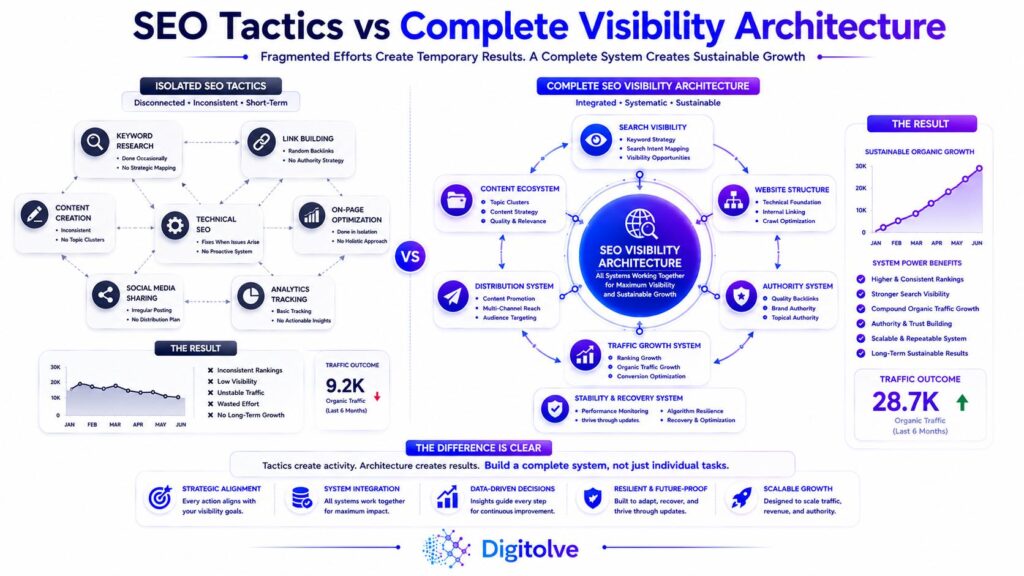
A complete SEO visibility system is an interconnected architecture designed to help a website become discoverable, build stronger search presence, expand organic reach, and sustain traffic growth over time. Rather than treating SEO as a collection of separate activities, it connects the systems responsible for visibility, content, distribution, authority, growth, and recovery.
The objective is not simply to rank individual pages. It is to build an ecosystem where every SEO and content activity contributes to the website’s broader ability to be discovered across relevant search opportunities.
SEO Visibility Is More Than Rankings
Rankings are an important part of organic search performance, but they represent only one layer of visibility. A website may rank for several keywords while still having limited overall search reach if its content ecosystem, topical coverage, discoverability, or authority remains narrow.
True SEO visibility develops when more relevant pages become discoverable across a broader range of valuable search queries. As this visibility expands, the website gains more opportunities to attract qualified organic traffic instead of depending on a small number of rankings.
Why Organic Traffic Growth Requires Connected Systems
Organic traffic is influenced by multiple systems working together. Website structure supports discoverability. Search intent guides content direction. Publishing expands the content ecosystem. Distribution increases opportunities for discovery. Authority strengthens competitive visibility, while continuous optimization and recovery help protect long-term performance.
When these activities operate independently, growth often becomes fragmented. But when they reinforce one another, each improvement can strengthen the broader visibility ecosystem.
The Difference Between SEO Activity and SEO Architecture
SEO activity focuses on individual actions—publishing an article, optimizing a page, targeting a keyword, or building a link.
SEO architecture focuses on how those activities connect.
Instead of asking only whether an individual SEO action worked, a systems-based approach considers whether that action strengthened the website’s overall visibility, expanded its search opportunities, reinforced existing content, or contributed to sustainable organic growth.
This shift transforms SEO from a collection of isolated tasks into a structured traffic execution system.
How the Traffic Execution System Works
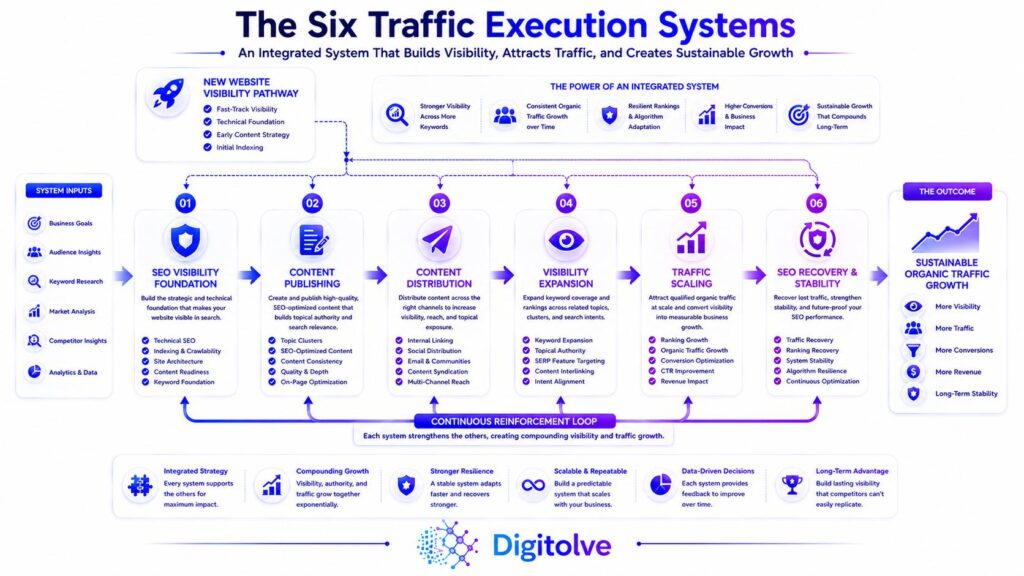
The Digitolve Traffic Execution System brings together six connected execution areas: building SEO visibility foundations, creating consistent publishing systems, establishing new website visibility where relevant, expanding content reach through distribution, scaling traffic through visibility expansion, and recovering lost search performance when decline occurs.
These systems are not a rigid sequence that every business must follow in exactly the same order. A new website may begin with launch visibility foundations, while an established website may need traffic scaling or SEO recovery. Each system addresses a different stage or challenge within the broader organic growth ecosystem.
What This Means for Sustainable Growth
Sustainable organic traffic requires more than continuously performing SEO tasks. It requires an architecture where visibility systems evolve and reinforce one another as the website grows.
The stronger these connections become, the less organic growth depends on isolated rankings or temporary wins. Instead, the website develops a broader visibility ecosystem capable of supporting discovery, expansion, recovery, and long-term traffic growth.
The goal is not simply to generate more traffic today. It is to build a visibility system capable of strengthening organic growth over time.
System 1 — Build the SEO Visibility Foundation
Sustainable organic traffic begins with visibility. Before a website can consistently attract visitors from search, it needs a foundation that helps search engines discover, understand, and connect its content with relevant search intent.
A strong SEO visibility foundation goes beyond optimizing individual pages or targeting isolated keywords. It creates the underlying architecture that allows content, website structure, search intent, and visibility signals to work together as one connected system.
Search Discoverability Comes Before Sustainable Organic Traffic
A website cannot generate consistent organic traffic if its pages are difficult to discover or its content does not align clearly with what users are searching for. Visibility creates the bridge between the website’s content and the search opportunities capable of bringing qualified visitors.
This means the first objective is not simply to increase traffic. It is to create a stronger search presence that gives more relevant pages opportunities to appear across valuable searches.
Visibility Requires More Than Rankings
Individual keyword rankings can generate traffic, but sustainable visibility depends on a broader search presence. Websites that rely heavily on a limited number of keywords or high-performing pages may struggle to maintain consistent growth when those rankings fluctuate.
A visibility system creates a wider foundation by connecting relevant content, search intent, topical coverage, and website architecture. This broader ecosystem reduces dependence on isolated rankings and creates more pathways through which users can discover the website.
Search Intent and Content Architecture Strengthen Visibility
Search intent determines what users expect to find, while content architecture determines how effectively a website addresses those expectations across related topics.
When content is strategically connected around relevant search needs, each page becomes part of a larger visibility ecosystem rather than an isolated piece of content. Over time, this structure can strengthen topical relevance and expand the website’s ability to compete across related search opportunities.
For a deeper strategic framework, explore How to Build an SEO Visibility System That Consistently Increases Organic Traffic.
Website Structure Supports Discoverability
The way pages are organized and connected also influences the strength of the visibility foundation. Clear website architecture helps users navigate related information while enabling search engines to better understand relationships between important pages and topics.
When website structure and content architecture reinforce one another, the entire visibility ecosystem becomes more coherent.
Weak Foundations Limit Future Organic Growth
Publishing more content or increasing SEO activity cannot fully compensate for a weak visibility foundation. If search intent, content architecture, website structure, and visibility signals remain disconnected, future growth can become increasingly difficult to scale.
This is why building sustainable traffic begins by strengthening the system beneath it.
A strong SEO visibility foundation does not guarantee immediate traffic growth. Instead, it creates the conditions that allow publishing, distribution, authority development, visibility expansion, and future traffic growth to work more effectively together.
System 2 — Create a Consistent Content Publishing System
Publishing content consistently can support organic growth, but consistency alone does not create sustainable traffic. A website can publish frequently for months and still struggle to expand its search visibility if every new article operates as an isolated piece of content.
A strong content publishing system connects publishing strategy, search intent, topical relevance, content quality, and continuous reinforcement. Instead of measuring success by how often content is published, it focuses on whether every new content asset strengthens the broader visibility ecosystem.
Publishing Activity Is Not the Same as a Publishing System
Publishing activity means creating and releasing content.
A publishing system determines why that content should exist, which search opportunity it supports, how it connects with existing topics, and how it contributes to long-term visibility.
Without this strategic structure, businesses may create large volumes of content without building meaningful search momentum. A structured publishing system ensures that content creation supports a broader organic growth objective rather than simply increasing the number of pages on a website.
Random Publishing Creates Fragmented Visibility
When businesses publish across unrelated topics without a clear content architecture, their website can develop fragmented topical coverage. Individual articles may perform temporarily, but they often fail to reinforce one another or strengthen the website’s broader search presence.
Strategically connected publishing creates a different outcome. Related content can collectively expand topical coverage, address multiple layers of search intent, and strengthen the overall visibility ecosystem over time.
Search Intent Gives Publishing Strategic Direction
Every piece of content should serve a clear search purpose. Understanding what users are trying to discover, learn, compare, or solve helps businesses create content that aligns more closely with relevant search opportunities.
When search intent guides publishing decisions, content becomes part of a structured visibility strategy rather than an isolated publishing activity.
For a deeper strategic framework, explore How to Create a Content Publishing System That Builds Traffic Consistently.
Every New Content Asset Should Reinforce Existing Visibility
A strong publishing system does more than create new opportunities for traffic. It also strengthens the website’s existing content ecosystem.
New articles can expand related topics, support important pages, deepen topical coverage, and create stronger connections across the website. As these relationships develop, individual content assets begin working together instead of competing for visibility in isolation.
Consistent Publishing Creates Momentum When the System Is Connected
Publishing frequency becomes valuable when it operates within a structured system.
When each new article aligns with search intent, supports relevant topical areas, and reinforces the broader content architecture, consistency can gradually create stronger visibility momentum.
The goal, therefore, is not simply to publish more often.
It is to build a repeatable publishing system where every new piece of content contributes to the website’s long-term ability to be discovered, understood, and trusted across relevant search opportunities.
System 3 — Build New Website Visibility From Day One
New websites face a unique visibility challenge. Unlike established websites, they begin without historical search signals, established topical authority, or an existing content ecosystem. This makes the early foundation especially important for creating sustainable search visibility over time.
New Website Visibility is a specialized entry pathway within the broader Traffic Execution System. It is not a mandatory third step for every business. Instead, it provides new websites with the foundational architecture they need before moving deeper into publishing, distribution, visibility expansion, and long-term organic growth.
New Websites Require Their Own Visibility Architecture
Launching a website makes it available online, but it does not automatically make it visible in search.
From the beginning, a new website needs a clear structure that helps search engines understand what the website covers, how its pages relate to one another, and which search needs its content is designed to address.
Without this foundation, businesses may begin publishing and optimizing without creating a coherent visibility ecosystem.
Technical Visibility Readiness Supports Discoverability
Before sustainable organic growth can develop, search engines need to be able to access, crawl, and understand the website effectively.
Technical visibility readiness creates the underlying conditions for discovery. It ensures that future content and SEO efforts are built on a foundation capable of supporting stronger search visibility rather than being limited by structural barriers.
Search Intent Alignment Creates Strategic Direction
A new website has an opportunity to align its content architecture with search intent from the beginning.
Instead of creating pages first and trying to optimize them later, businesses can build their initial visibility foundation around the problems, questions, and needs their target audience is already searching for.
This creates clearer strategic direction for both the website structure and its future content ecosystem.
For a deeper strategic framework, explore How to Build SEO Visibility for a New Website From Day One.
Content and Website Structure Build the Foundation
The earliest pages of a website help establish its initial topical direction. When these pages are strategically organized around connected topics and supported by clear website architecture, they create a stronger foundation for future visibility expansion.
As the website grows, new content can reinforce this structure rather than developing as a collection of disconnected pages.
Early Authority Development Supports Future Growth
Authority is not built instantly, but the foundation for it can begin from day one.
Consistently publishing relevant content, building topical depth, creating strong internal relationships, and developing trustworthy website signals can gradually strengthen how the website is understood within its subject area.
New Website Visibility Is a Specialized Entry Path
Not every business entering the Traffic Execution System needs to begin here. Established websites may already have a visibility foundation and instead require stronger publishing, distribution, scaling, or recovery systems.
For new websites, however, building visibility correctly from the beginning can reduce future structural problems and create a stronger foundation for sustainable organic growth.
The objective is not to achieve instant rankings.
It is to build a search-ready visibility architecture that gives every future SEO and content effort a stronger foundation to grow from.
System 4 — Expand Content Reach Through Strategic Distribution
Publishing valuable content is only one part of building sustainable organic visibility. Even high-quality content can struggle to reach its full potential if it remains dependent on search engines to generate discovery on its own.
A structured content distribution system extends the reach of published content by connecting it with relevant channels, audiences, and visibility opportunities. Instead of treating distribution as occasional promotion, it becomes a repeatable execution system that continuously reinforces content discovery and long-term reach.
Publishing Does Not Guarantee Discovery
Creating and publishing content makes it available, but availability is not the same as visibility.
Many businesses invest heavily in content creation but give little attention to what happens after an article is published. Without structured distribution, valuable content may receive limited exposure, reducing its ability to reach relevant audiences and contribute fully to the broader visibility ecosystem.
Strategic Distribution Expands Content Reach
Content distribution creates additional pathways through which people can discover and engage with published content.
Rather than relying on a single source of visibility, a structured approach connects content with appropriate channels and audience touchpoints. This helps extend the reach of individual content assets while supporting the website’s broader discovery strategy.
Channel Alignment Strengthens Distribution
Not every piece of content belongs on every distribution channel.
Effective distribution depends on aligning content with the platforms, formats, and audience environments where it is most relevant. Strategic channel alignment helps businesses focus their efforts on meaningful visibility opportunities instead of spreading content across channels without a clear purpose.
For a deeper strategic framework, explore How to Build a Content Distribution System That Increases Content Reach.
Content Reinforcement Extends Visibility
Distribution should not be viewed as a one-time promotional activity immediately after publishing.
Content can be reinforced through multiple relevant touchpoints over time, creating repeated opportunities for discovery. This continuous reinforcement can extend the useful lifespan of content and prevent valuable assets from disappearing from audience attention shortly after publication.
Multi-Channel Visibility Creates More Discovery Pathways
A connected distribution system allows content to reach audiences through multiple relevant environments rather than depending entirely on one discovery source.
These additional touchpoints can strengthen brand exposure, introduce content to new audiences, and create broader pathways that support the overall visibility ecosystem.
Distribution Connects Publishing With Visibility Expansion
Publishing creates the content asset.
Distribution expands its opportunity to be discovered.
When these two systems work together, businesses can move beyond a publish-and-wait approach toward a more deliberate visibility strategy.
The objective is not simply to promote every article everywhere. It is to build a repeatable distribution system that strategically expands content reach, reinforces discovery, and supports the broader journey toward sustainable organic visibility.
System 5 — Scale Organic Traffic Through Visibility Expansion
Organic traffic growth does not continue indefinitely through the same SEO activities. As a website matures, existing rankings stabilize, established content captures much of its current search potential, and traffic growth can gradually reach a plateau.
At this stage, maintaining existing SEO performance remains important, but maintenance alone rarely creates significant new growth. Scaling organic traffic requires expanding the website’s visibility ecosystem so it can compete across new search opportunities, strengthen topical coverage, and reach audiences beyond its existing search footprint.
Successful Websites Eventually Reach Traffic Plateaus
A traffic plateau does not necessarily mean SEO has stopped working.
In many cases, the website continues ranking, attracting visitors, and maintaining relatively stable search performance. The challenge is that its current visibility system has reached a growth ceiling.
When the same keywords, topics, and high-performing pages continue generating most of the traffic, there are fewer new opportunities available within the existing SEO footprint.
Optimization Maintains Performance, Expansion Creates Growth
Optimization and expansion serve different purposes within a sustainable traffic system.
Optimization strengthens what already exists.
Visibility expansion creates new opportunities for growth.
Businesses that focus exclusively on improving existing pages may successfully maintain rankings without significantly increasing their overall organic reach. Sustainable scaling requires looking beyond current visibility and systematically expanding the website’s presence across relevant search opportunities.
New Search Opportunities Expand the Visibility Ecosystem
Long-term traffic growth depends on continuously creating new pathways through which audiences can discover the website.
This may involve expanding topical coverage, addressing additional layers of search intent, strengthening related content ecosystems, and identifying relevant opportunities beyond the website’s existing keyword footprint.
For a deeper strategic framework, explore How to Scale Website Traffic After SEO Growth Stalls.
Content Ecosystem Expansion Supports Sustainable Scaling
As the website expands into relevant search opportunities, its content ecosystem must grow strategically alongside it.
New content should not exist as isolated additions. It should strengthen existing topical areas, deepen coverage, and create meaningful connections that reinforce the broader visibility architecture.
This allows expansion to strengthen the entire website rather than simply increasing the number of published pages.
Authority Reinforcement Strengthens Visibility Expansion
Expanding into new search opportunities becomes more effective when the website’s authority grows alongside its content ecosystem.
As topical depth, relevance, and connected visibility signals strengthen, the website becomes better positioned to compete across a broader range of searches. Authority reinforcement therefore supports the transition from maintaining existing traffic to building scalable organic growth.
Visibility Expansion Breaks Organic Growth Ceilings
Breaking through a traffic plateau is not simply about publishing more content or targeting more keywords.
It requires systematically expanding the visibility ecosystem while ensuring that new opportunities reinforce the website’s existing strengths.
The goal is to move beyond dependence on current rankings and create a system where new search opportunities continue emerging over time.
Businesses that continuously expand their visibility ecosystem do not simply maintain organic traffic—they create the conditions for sustainable growth that can compound as the website matures.
How the Six Traffic Execution Systems Work Together
Sustainable organic traffic is not created by any single execution system working in isolation. SEO visibility, content publishing, website foundations, distribution, traffic scaling, and recovery each solve a different challenge—but their greatest value emerges when they operate as parts of one connected traffic architecture.
The Traffic Execution System brings these individual systems together so that every stage of visibility growth can reinforce the broader ecosystem. Businesses may enter the architecture at different points depending on their current needs, but long-term organic growth becomes stronger when the relevant systems continuously support one another.
SEO Visibility Foundation Creates Discoverability
The SEO visibility foundation creates the conditions required for search engines to discover, understand, and connect a website with relevant search opportunities.
Without this foundation, publishing, distribution, and growth efforts may operate on an unstable base. Strong visibility architecture gives every future execution system a clearer foundation from which to grow.
Content Publishing Expands the Content Ecosystem
Once a visibility foundation exists, structured publishing continuously expands the website’s ability to address relevant topics and search intent.
Each strategically connected content asset can strengthen topical coverage, support existing pages, and create additional opportunities for search discovery.
Publishing therefore becomes more than content production—it becomes an ongoing mechanism for expanding the visibility ecosystem.
Content Distribution Expands Discovery and Reach
Publishing creates content, but distribution helps that content reach broader audiences.
A structured distribution system reinforces published assets across relevant channels and touchpoints, creating additional opportunities for discovery while extending the lifespan and potential reach of valuable content.
Together, publishing and distribution create a stronger connection between content creation and visibility expansion.
Visibility Expansion Unlocks New Search Opportunities
As a website matures, sustainable growth increasingly depends on expanding beyond its existing search footprint.
Visibility expansion creates new opportunities by broadening relevant topical coverage, addressing additional search intent, and strengthening the connections between existing and emerging content areas.
This prevents the website’s growth potential from remaining limited to the keywords and pages that already perform well.
Traffic Scaling Breaks Existing Growth Ceilings
When existing visibility begins reaching its natural limits, the traffic scaling system helps shift the focus from maintaining performance to creating new growth opportunities.
Scaling becomes possible when visibility expansion, content growth, and authority reinforcement work together to increase the website’s overall search footprint.
Rather than depending indefinitely on existing rankings, the website develops a system capable of supporting continued organic growth.
SEO Recovery Restores Weakened Performance
Not every website needs continuous expansion at every moment.
When search visibility or organic traffic declines, recovery becomes the priority. The SEO recovery system focuses on rebuilding weakened visibility before the website returns to expansion and scaling.
This creates an important distinction within the architecture:
Plateau → Expand and Scale
Decline → Recover and Stabilize
The correct execution system depends on the problem the website is currently experiencing.
New Website Visibility Provides a Specialized Foundation Pathway
New Website Visibility sits slightly differently within the architecture.
It is not a mandatory sequential stage between publishing and distribution. Instead, it acts as a specialized entry pathway for websites that are building their search presence from the beginning.
A new website can enter through this pathway to establish technical readiness, search intent alignment, content foundations, website structure, and early authority signals before connecting with the broader Traffic Execution System.
Continuous Reinforcement Connects the Entire Architecture
The complete system can be understood as:
SEO Visibility Foundation
↓
Content Publishing
↓
Content Distribution
↓
Visibility Expansion
↓
Traffic Scaling
↓
SEO Recovery & Stability
With New Website Visibility serving as a specialized foundation pathway for new websites.
These systems should not be viewed as isolated steps that end once completed. They continuously interact and reinforce one another.
Publishing expands visibility. Distribution strengthens discovery. Expanded visibility creates new traffic opportunities. Scaling extends growth. Recovery protects weakened performance. Stability creates a stronger foundation for future expansion.
The result is not simply a collection of SEO activities.
It is a connected Traffic Execution System designed to build, expand, recover, and strengthen sustainable organic traffic over time.
Why Sustainable Organic Traffic Requires Continuous Reinforcement
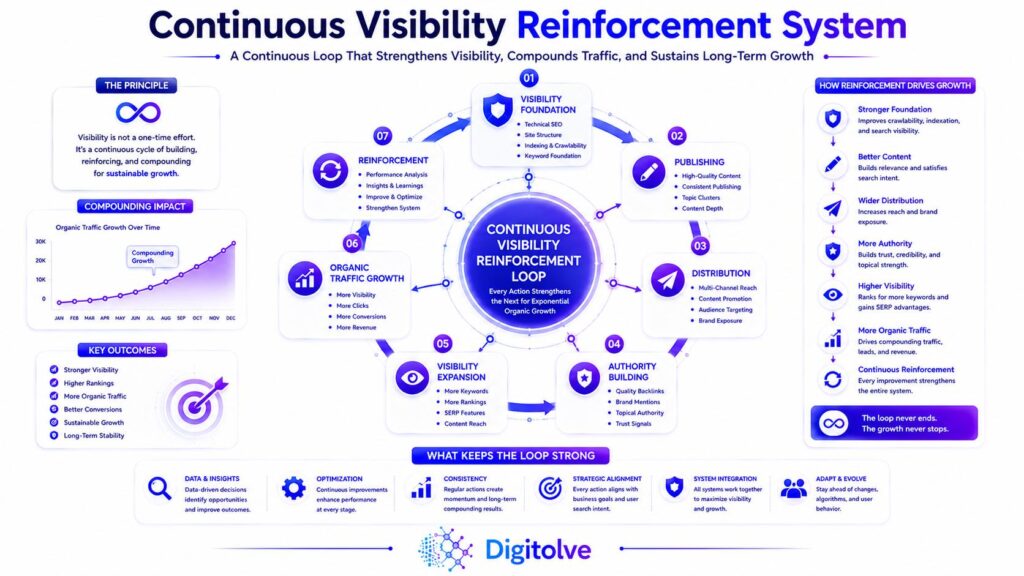
Sustainable organic traffic is not built once and then maintained automatically. Search behavior changes, competition evolves, content ages, and new visibility opportunities continuously emerge. Even a well-designed SEO visibility system can gradually lose momentum if its individual components stop evolving and reinforcing one another.
This is why long-term organic growth requires continuous reinforcement. Visibility foundations, publishing, distribution, authority, expansion, scaling, and recovery must remain connected as the website develops. When these systems continuously strengthen one another, the website becomes better positioned to maintain visibility while creating new opportunities for future growth.
Organic Traffic Growth Is Not Linear
Organic traffic rarely follows a perfectly predictable upward path.
Periods of growth may be followed by slower expansion, temporary fluctuations, traffic plateaus, or visibility declines. These changes do not always indicate that the entire SEO strategy has failed. Instead, they may signal that one part of the visibility ecosystem needs to evolve, expand, or recover.
A systems-based approach helps businesses respond to these changes strategically rather than reacting to every fluctuation with disconnected SEO tactics.
Every Visibility System Must Continue Evolving
The systems that create organic growth at one stage may need to become stronger as the website matures.
Content publishing may need broader topical coverage. Distribution may require new discovery pathways. Visibility expansion may need additional search opportunities. Established content may require reinforcement, while declining performance may require structured recovery.
Continuous evolution allows the visibility architecture to adapt instead of becoming dependent on strategies that worked only during an earlier stage of growth.
Weak Systems Create Growth Bottlenecks
Because the Traffic Execution System is interconnected, weakness in one area can eventually limit the performance of others.
Strong publishing without effective distribution may restrict content reach. Expanding content without a clear visibility architecture can create fragmentation. Attempting to scale traffic without creating new search opportunities can lead to growth plateaus.
Identifying and strengthening these bottlenecks helps protect the overall system from becoming limited by its weakest component.
Connected Systems Create Compounding Visibility
The greatest advantage of a connected traffic architecture is reinforcement.
New content can expand topical coverage. Distribution can create additional discovery opportunities. Stronger visibility can attract more organic traffic. Growing authority can support future content, while continuous expansion creates additional pathways into the website.
Over time, these interactions can create compounding visibility because each system contributes to the strength of the broader ecosystem rather than operating independently.
Google’s Search Essentials also emphasizes building technically accessible websites and creating helpful, reliable, people-first content—foundations that support sustainable participation in Google Search over time.
Continuous Reinforcement Protects Long-Term Growth
The objective of continuous reinforcement is not simply to prevent traffic loss. It is to keep the entire visibility ecosystem capable of adapting, expanding, and recovering as conditions change.
A sustainable system continuously strengthens what already works while creating room for new opportunities.
This transforms organic growth from a collection of temporary SEO wins into a long-term execution architecture capable of supporting visibility across different stages of a website’s journey.
Sustainable organic traffic grows when every part of the SEO visibility system strengthens and reinforces the others over time.
From Individual SEO Activities to a Complete Traffic Execution System
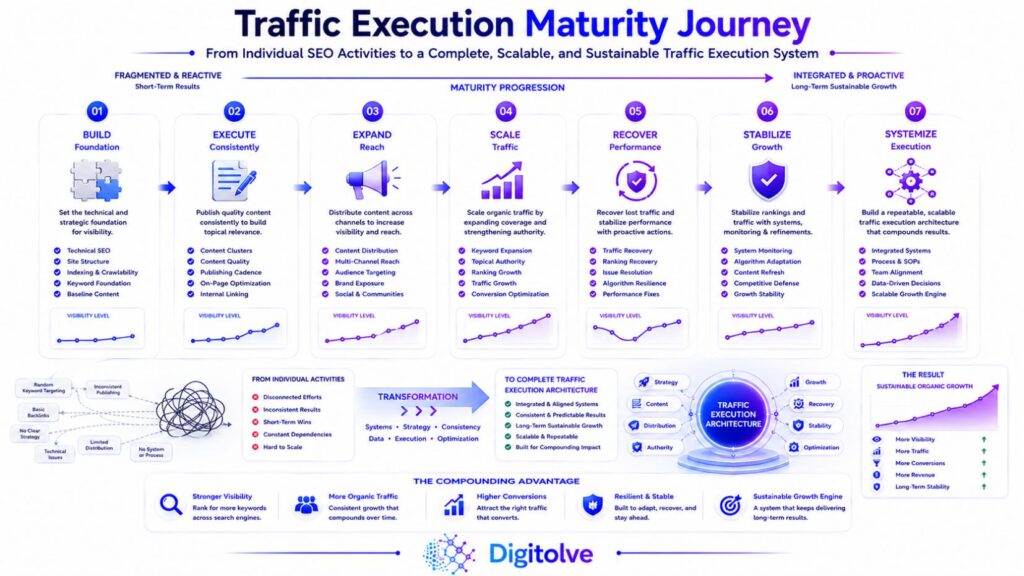
Many businesses begin their SEO journey with individual activities. They optimize pages, publish articles, target keywords, improve technical elements, and distribute content whenever opportunities arise. Each activity can create value, but isolated execution often becomes difficult to scale because there is no broader system connecting one action to the next.
A mature traffic strategy moves beyond individual SEO tasks and transforms them into a structured execution architecture. This evolution does not happen through one tactic or one campaign. It develops as businesses learn to build strong foundations, execute consistently, expand visibility, scale successful systems, recover weakened performance, stabilize results, and eventually systemize the entire process.
Build — Establish the Visibility Foundation
The journey begins by building the systems required for discoverability.
Search intent, website structure, content architecture, technical readiness, and visibility signals create the foundation on which future organic growth depends.
At this stage, the priority is not simply generating immediate traffic. It is creating an environment where future publishing, distribution, and expansion efforts have a stronger foundation from which to grow.
Execute — Turn Strategy Into Consistent Systems
Once the foundation exists, execution transforms strategic direction into repeatable activity.
Content publishing becomes structured rather than random. Visibility efforts become connected rather than isolated. Businesses begin operating through defined systems that consistently support their broader organic growth objectives.
The shift from occasional SEO activity to repeatable execution creates greater consistency across the visibility ecosystem.
Expand — Create New Visibility Opportunities
As execution becomes more consistent, businesses can begin expanding their reach.
Content distribution creates additional discovery pathways. Broader topical coverage increases search opportunities. New content strengthens existing visibility while extending the website into relevant areas of search demand.
Expansion moves the website beyond dependence on its original content and keyword footprint.
Scale — Move Beyond Existing Growth Ceilings
Eventually, successful SEO systems may reach the limits of their current visibility potential.
Scaling requires businesses to systematically expand beyond those limits by creating new search opportunities, strengthening authority, and growing the broader content ecosystem.
At this stage, the focus shifts from maintaining existing success to building a visibility architecture capable of supporting continued organic traffic growth.
Recover — Restore Weakened Search Performance
Growth is not always continuous.
If search visibility or organic traffic begins declining, businesses need to shift from expansion to recovery. Rather than continuing to scale a weakened system, the priority becomes identifying where visibility has deteriorated and restoring the foundations that previously supported organic performance.
Recovery allows the traffic architecture to regain strength before returning to future growth.
Stabilize — Reinforce Long-Term Performance
Recovering traffic or achieving growth does not automatically create long-term stability.
The systems responsible for visibility, content, authority, distribution, and performance must continue reinforcing one another. Stabilization reduces dependence on temporary wins and creates a more resilient foundation for sustainable search performance.
A stable traffic system is better equipped to respond to changing search environments without requiring constant reactive fixes.
Systemize — Build a Repeatable Traffic Execution Architecture
The final stage of maturity is systemization.
At this point, SEO is no longer managed as a collection of disconnected tasks. Visibility building, publishing, distribution, expansion, scaling, recovery, and stabilization operate within a broader execution architecture.
Processes become repeatable. Strategic decisions become clearer. Each system has a defined role while contributing to the same long-term objective: sustainable organic traffic growth.
The complete maturity journey becomes:
Build
↓
Execute
↓
Expand
↓
Scale
↓
Recover
↓
Stabilize
↓
Systemize
Businesses do not always move through these stages in a perfectly linear order. A growing website may need to return to foundation building, while an established website may temporarily shift from scaling to recovery.
The goal is not to follow a rigid sequence.
It is to build a Traffic Execution System capable of adapting to the website’s current needs while continuously strengthening the broader visibility architecture.
From Diagnosis to Execution: The Smart Solve Lab → Digitolve Ecosystem
Building sustainable organic traffic becomes easier when businesses clearly separate two different stages of problem-solving: understanding what is wrong and implementing the system required to solve it.
This distinction forms the connection between Smart Solve Lab and Digitolve. The two brands serve different roles within the broader growth journey. Smart Solve Lab provides diagnostic clarity, while Digitolve transforms that clarity into structured execution.
Smart Solve Lab — Diagnose Before You Build
When traffic declines, visibility weakens, content stops performing, or growth becomes inconsistent, the first challenge is often uncertainty.
Businesses may see the symptoms without understanding the underlying cause.
Smart Solve Lab focuses on this diagnostic stage:
Detect → Diagnose → Interpret → Prioritize
Its role is to answer:
Why is this happening?
Through diagnostic assessments, signal interpretation, gap analysis, root-cause mapping, and prioritization, the objective is to help businesses understand what is preventing growth before they invest time and resources into implementation.
The outcome is clarity.
Digitolve — Turn Clarity Into Execution
Once the underlying problem is understood, the next challenge is execution.
Knowing that visibility is weak does not automatically build a visibility system. Identifying inconsistent publishing does not create a publishing workflow. Recognizing a traffic plateau does not generate new search opportunities.
Digitolve focuses on this execution stage:
Build → Execute → Optimize → Scale
Its role is to answer:
How do we build a system that solves it?
Through strategic frameworks, execution blueprints, workflows, planning tools, and repeatable systems, Digitolve helps transform diagnostic clarity into structured action.
The outcome is execution.
The Golden Boundary Between Diagnosis and Execution
The distinction is simple:
Smart Solve Lab identifies what is broken and why.
↓
Digitolve provides the system for what to build next.
This boundary prevents diagnosis and execution from becoming mixed together while allowing both ecosystems to support the same broader customer journey.
A business experiencing an unclear traffic problem may begin with diagnosis. Once the underlying issue becomes clear, it can move into the Digitolve execution system that directly addresses that challenge.
One Problem Can Lead to Different Execution Paths
Not every traffic problem requires the same solution.
A business with weak search visibility may need to strengthen its SEO visibility foundation.
A business publishing inconsistently may need a structured content publishing system.
A new website may need a dedicated launch visibility architecture.
Content with limited reach may require stronger distribution.
A website experiencing a growth plateau may need visibility expansion and traffic scaling.
A website losing previously established traffic may need structured SEO recovery.
Diagnosis helps identify the right problem.
Execution provides the appropriate system.
A Connected Customer Journey
The broader ecosystem therefore follows a natural progression:
Problem
↓
Smart Solve Lab Diagnosis
↓
Clarity
↓
Digitolve Execution
↓
Implementation
↓
Optimization
↓
Scale
This creates a cleaner path from uncertainty to action without forcing businesses into an execution framework before they understand what they actually need.
Smart Solve Lab and Digitolve therefore do not compete for the same role.
They complete different parts of the same journey:
SSL = Diagnose problems before solving them.
Digitolve = Turn clarity into repeatable execution systems.
Building the Next Stage of Your Traffic Growth System
A complete Traffic Execution System is not built at the same level for every business. A new website establishing its first visibility foundation has different execution needs from an established website attempting to scale organic traffic or recover from a significant visibility decline.
For this reason, the Digitolve ecosystem is designed as a progressive product architecture. Businesses can enter at the level that matches their current challenge, implement the system they need, and move toward more advanced growth infrastructure as their visibility ecosystem becomes more mature.
Mini Execution Blueprints — Build Focused Systems
Mini Execution Blueprints address specific execution challenges that require a clear, structured starting point.
At this level, businesses may need to build an SEO visibility foundation, create a repeatable publishing process, establish visibility for a new website, or improve how content is distributed and discovered.
These focused blueprints help transform strategic direction into structured execution without requiring businesses to build an enterprise-level system immediately.
Within the Traffic Execution System, this includes:
SEO Visibility Blueprint
Content Publishing Blueprint
New Website Visibility Blueprint
Content Distribution Framework
Each product addresses a distinct execution need while connecting naturally with the broader visibility architecture.
Core Execution Frameworks — Solve More Complex Growth Challenges
As websites mature, their traffic challenges often become more complex.
An established website may no longer struggle with basic visibility but instead face a growth plateau. Another may experience declining search performance and need to restore visibility before attempting further expansion.
Core Execution Frameworks address these broader system-level challenges.
Within this ecosystem, the Sustainable Traffic Growth Framework focuses on expanding visibility beyond existing growth ceilings, while the SEO Recovery Framework focuses on restoring weakened search visibility and recovering lost organic traffic.
These frameworks move businesses from focused execution toward more advanced traffic system management.
Traffic Execution Architecture — Connect the Systems
As individual execution systems mature, the next stage is integration.
Instead of managing visibility, publishing, distribution, scaling, and recovery as separate initiatives, businesses can begin connecting them within a broader Traffic Execution Architecture.
At this level, the objective is not to add another isolated framework.
It is to understand how existing execution systems reinforce one another and how each system contributes to sustainable organic traffic growth.
This pillar represents that architecture at the strategic level.
Premium Systems — Strengthen Growth and Stability
More mature businesses may require systems that operate across multiple execution areas simultaneously.
The future Traffic Growth System can support advanced visibility expansion and scalable organic growth, while the SEO Stability System can focus on protecting search performance, strengthening resilience, and reducing repeated visibility decline.
These Premium systems build on the foundations established by the Mini and Core products rather than replacing them.
Elite Integrated Growth System — Unify the Execution Ecosystem
At the Elite level, individual growth systems can become part of a broader integrated architecture.
Visibility, content, distribution, traffic growth, recovery, stability, and other digital growth functions can operate as interconnected components of one strategic system.
The objective shifts from solving individual execution challenges to managing the complete growth ecosystem.
Future Software — Systemize and Automate Execution
The final evolution is systemization through software.
Processes that previously depended on manual planning, monitoring, analysis, and execution can gradually become supported by integrated tools and automation.
Future software can help businesses monitor visibility signals, manage workflows, identify growth opportunities, track system performance, and support more efficient execution across the broader ecosystem.
The complete progression becomes:
Mini Execution Blueprints
↓
Core Execution Frameworks
↓
Traffic Execution Architecture
↓
Premium Traffic Growth & SEO Stability Systems
↓
Elite Integrated Growth System
↓
Future Software
Businesses do not need to begin at the same point or purchase every level in sequence.
The right entry point depends on the website’s current visibility challenge, traffic maturity, and execution needs.
The purpose of the ecosystem is to provide a clear path forward—from building individual execution systems today to creating a more integrated, scalable, and systemized organic growth architecture over time.
Conclusion — Build a Traffic System, Not a Collection of SEO Tactics
Sustainable organic traffic is not built through one successful ranking, one publishing strategy, or a collection of isolated SEO tactics. Long-term growth develops when the systems responsible for visibility, publishing, distribution, expansion, scaling, recovery, and stability work together as part of one connected architecture.
A strong SEO visibility foundation creates the conditions for discoverability. Structured publishing expands the content ecosystem. Strategic distribution increases opportunities for discovery and reach. Visibility expansion unlocks new search opportunities, while traffic scaling helps mature websites move beyond existing growth ceilings. When performance declines, structured SEO recovery rebuilds weakened visibility and creates a stronger foundation for long-term stability.
Not every business will enter this system at the same point. A new website may need to establish its visibility architecture from day one. An established website may need to expand its search footprint, while another may need to recover lost traffic before attempting further growth.
What matters is understanding which system your website needs—and how that system connects with the broader organic growth architecture.
The goal is not to continuously add more SEO activities.
The goal is to build a connected Traffic Execution System where every relevant activity has a clear purpose and every system contributes to stronger long-term visibility.
Build the foundation. Execute consistently. Expand visibility. Scale traffic. Recover lost performance. Stabilize the system.
Businesses that build connected visibility systems don’t simply generate traffic—they create an organic growth architecture designed to strengthen and compound over time.
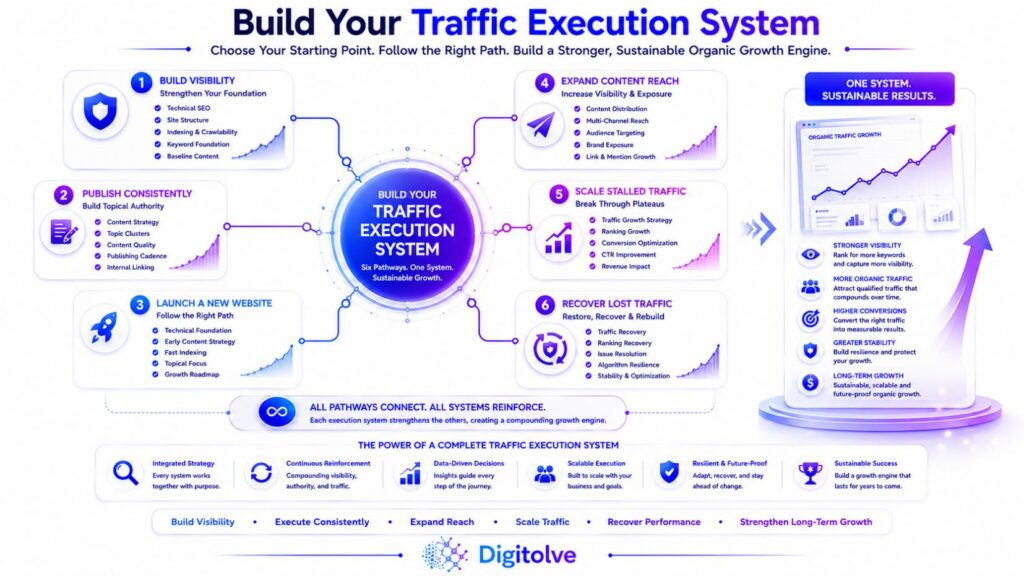
Build Your Traffic Execution System
Every business enters the organic growth journey at a different stage. Some websites need stronger visibility foundations, while others need consistent publishing, broader content reach, traffic scaling, or structured SEO recovery.
The right execution system depends on the challenge your website is facing today.
Choose the path that best matches your current stage:
Build SEO Visibility
If your website needs a stronger foundation for search discoverability and consistent organic traffic, start by building a connected visibility system.
SEO Visibility Blueprint
Designed to help you build the foundational SEO visibility system required for sustainable organic traffic growth.
Publish Content Consistently
If your publishing efforts feel random or fail to create consistent traffic momentum, build a structured system that connects every new content asset with your broader visibility strategy.
Content Publishing Blueprint
Designed to turn content publishing into a repeatable system that supports long-term search visibility and traffic growth.
Launch a New Website With Strong Visibility Foundations
If you are building or launching a new website, establish the right visibility architecture from the beginning.
New Website Visibility Blueprint
Designed to help new websites build structured SEO foundations for discoverability, search visibility, and sustainable organic growth from day one.
Expand Your Content Reach
If you are publishing valuable content but struggling to get it discovered by a wider audience, strengthen the system responsible for distribution and reach.
Content Distribution Framework
Designed to create a repeatable distribution system that expands content reach, reinforces discovery, and strengthens long-term visibility.
Scale Stalled Organic Traffic
If your SEO is working but organic traffic has reached a growth ceiling, shift from maintaining existing rankings toward expanding your visibility ecosystem.
Sustainable Traffic Growth Framework
Designed to help businesses systematically create new search opportunities, expand visibility, and scale organic traffic beyond existing growth plateaus.
Recover Lost Organic Traffic
If your website has lost visibility and previously established organic traffic is declining, recovery should come before further scaling.
SEO Recovery Framework
Designed to systematically rebuild search visibility, recover lost organic traffic, and strengthen long-term SEO stability.
Choose the System Your Website Needs Now
You do not need to implement every system at once.
Start with the execution challenge that is currently limiting your website, strengthen that part of the architecture, and expand into additional systems as your organic growth needs evolve.
The objective is not simply to do more SEO.
It is to build the right system at the right stage—and gradually connect those systems into a complete Traffic Execution Architecture capable of supporting sustainable organic growth.
Frequently Asked Questions
What Is an SEO Visibility System?
An SEO visibility system is a connected architecture that helps a website become discoverable across relevant search opportunities. It brings together elements such as search intent, content architecture, website structure, publishing, distribution, authority, and continuous reinforcement to support sustainable organic visibility.
How Does an SEO Visibility System Increase Organic Traffic?
An SEO visibility system increases organic traffic by creating more relevant pathways through which users can discover a website in search. As content coverage expands, visibility signals strengthen, and connected systems reinforce one another, the website can compete across a broader range of relevant search opportunities.
What Is the Difference Between SEO Visibility and SEO Rankings?
SEO rankings describe where individual pages appear for specific search queries. SEO visibility represents the broader presence of a website across relevant search opportunities. Strong sustainable growth depends on expanding overall visibility rather than relying exclusively on a small number of high-ranking keywords.
Why Doesn’t Publishing More Content Automatically Increase Organic Traffic?
Publishing more content does not automatically increase traffic if new articles are disconnected from search intent, topical strategy, or the existing content ecosystem. Sustainable growth is more likely when publishing operates within a structured system where each new content asset contributes to broader search visibility.
How Do Content Publishing and Distribution Support SEO Visibility?
Content publishing expands the website’s content ecosystem and creates new opportunities for search discovery. Distribution extends the reach of those content assets across relevant channels and audience touchpoints. When connected strategically, both systems can reinforce broader visibility and long-term content performance.
Why Does Organic Traffic Eventually Stop Growing?
Organic traffic can reach a plateau when a website approaches the limits of its existing search visibility. Rankings may remain stable, but growth slows because few new search opportunities are being created. Continued growth often requires visibility expansion rather than relying solely on existing rankings and optimization.
How Can I Scale Organic Traffic After SEO Growth Stalls?
Scaling stalled organic traffic requires moving beyond maintenance toward systematic visibility expansion. This involves creating new search opportunities, expanding relevant topical coverage, strengthening authority, and building a visibility ecosystem capable of supporting growth beyond existing traffic ceilings.
How Do I Recover Lost Organic Traffic?
Recovering lost organic traffic begins by understanding where search visibility has weakened. A structured SEO recovery approach focuses on rebuilding visibility signals, restoring search performance, and strengthening the broader system before attempting to scale traffic again.
How Do I Build a Sustainable Organic Traffic System?
A sustainable organic traffic system connects the systems responsible for visibility foundations, content publishing, distribution, expansion, scaling, recovery, and stability. Rather than relying on isolated SEO tactics, the goal is to create an interconnected architecture where each system continuously strengthens the others over time.
Recommended Reading
Continue exploring the Traffic Execution System with these strategic guides:
Build Your SEO Visibility Foundation
Learn how to create a connected visibility system that supports consistent search discovery and sustainable organic traffic growth.
How to Build an SEO Visibility System That Consistently Increases Organic Traffic
Scale Organic Traffic Beyond Growth Plateaus
Understand why SEO growth eventually reaches a ceiling and how visibility expansion creates new opportunities for sustainable traffic growth.
How to Scale Website Traffic After SEO Growth Stalls
Recover Lost Organic Traffic and Search Visibility
Explore how a structured SEO recovery system helps rebuild weakened search visibility, recover lost organic traffic, and strengthen long-term SEO stability.
How to Recover Lost Organic Traffic With a Structured SEO Recovery Plan