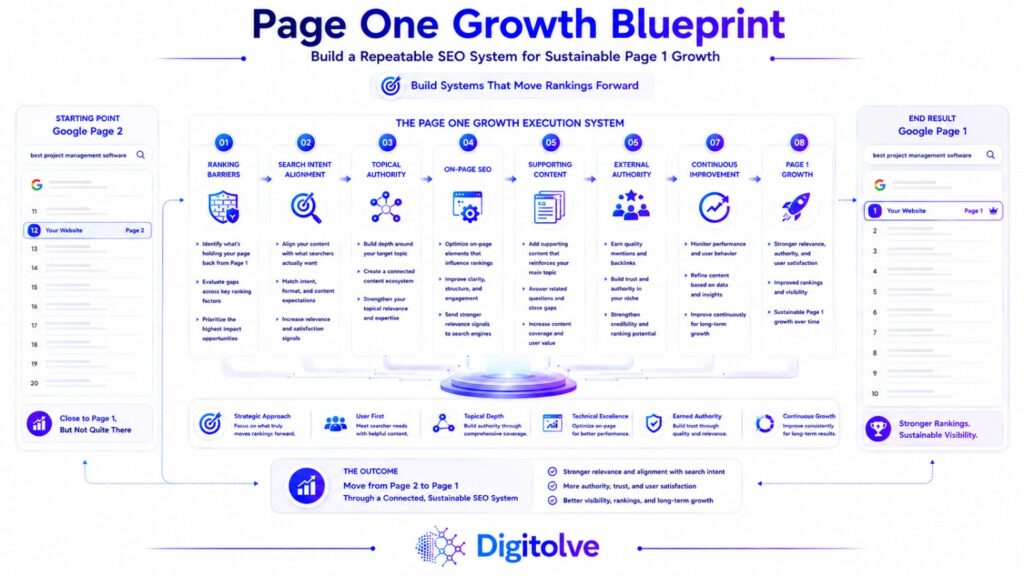
website from page 2 to page 1
Reaching page 2 of Google is not the same as being invisible.
In many cases, a page sitting on page 2 has already demonstrated that it is relevant enough to appear for the search opportunity. The challenge is moving from that position into the more competitive page 1 results.
This is where many SEO efforts become unfocused.
A business sees a page sitting on page 2 and responds by adding more keywords, increasing word count, changing titles repeatedly, publishing more content, or making several SEO changes at once.
But more SEO activity does not automatically create better ranking performance.
The more useful question is:
What does the page actually need to strengthen before it has a better opportunity to compete for page 1?
Page 2 Is a Position to Build From
A page on page 2 already provides useful strategic information.
It means the page has some level of search visibility and has entered the competitive search landscape.
Instead of treating page 2 as a complete failure, treat it as a position that can be evaluated and improved.
The objective is not to promise that every page 2 result will reach page 1.
Different search results have different levels of competition, intent, authority, and content quality.
The objective is to create a structured process for identifying improvement opportunities and strengthening the systems surrounding the page.
Moving Toward Page 1 Requires More Than One Optimization
A page rarely moves upward because of one isolated change.
Search intent, content relevance, topical authority, on-page signals, supporting content, external authority, and ongoing improvement can all contribute to the overall strength of a ranking asset.
That creates a connected execution path:
Search Intent → Content Relevance → Topical Authority → On-Page SEO → Supporting Content → External Authority → Continuous Improvement
The goal is not to manipulate one ranking factor.
It is to strengthen the page’s overall position within a connected SEO system.
Diagnose Before You Change Your Strategy
Before implementing improvements, it is important to understand what may actually be limiting the page.
If a page has remained on page 2 despite consistent SEO effort, changing everything at once can make it difficult to understand what helped and what did not.
A more structured approach begins with identifying the relevant ranking barriers.
🔵 SSL Bridge — Page 2 Escape Toolkit
If your website has been stuck on page 2 of Google despite consistent SEO effort, first diagnose the underlying ranking barriers with the Page 2 Escape Toolkit before changing your execution strategy. Once the barriers are clear, return here to implement a structured path toward page 1 using the Page One Growth Blueprint.
From Page 2 Position to Page 1 Growth System
Once the underlying barriers are clear, execution can become much more deliberate.
Instead of asking:
“What SEO tactic should we try next?”
the better question becomes:
“Which part of the ranking system should we strengthen next?”
This guide follows that approach.
We will examine how to strengthen search intent alignment, improve content relevance, build topical authority, reinforce on-page SEO signals, create supporting content, develop external authority signals, and continuously improve the system around an important ranking page.
Page 1 growth is not about chasing a ranking position. It is about systematically strengthening the signals, content, authority, and supporting systems that give a page a better opportunity to compete.
The goal is therefore not simply to reach page 1 once.
It is to build a more sustainable system for improving ranking potential over time.
Table of Contents
Why Reaching Page 2 Is Progress—But Not the Final Goal
A page appearing on the second page of Google is often a sign that it has already entered the search landscape for its target query.
It has visibility.
It has relevance.
And, in some cases, it has already demonstrated enough value or alignment to compete with other pages in the results.
But page 2 is not the final destination.
The strategic opportunity is to understand what separates the current position from stronger page 1 competition and then strengthen the areas that genuinely need improvement.
Page 2 Shows Existing Ranking Potential
When a page reaches page 2, the situation is different from having no search visibility at all.
The page may already have:
- Relevant content
- Some search intent alignment
- Existing topical relevance
- Internal support
- External references or authority
- Search visibility for related queries
These existing signals provide a foundation to build upon.
Rather than immediately replacing the page or creating another article, evaluate what the existing ranking asset already does well and where additional strength may be needed.
Page 1 and Page 2 Represent Different Competitive Positions
The difference between page 2 and page 1 is not simply a matter of adding more words or inserting additional keywords.
The search results are competitive environments.
Pages already occupying page 1 may have stronger combinations of relevance, content usefulness, topical coverage, authority, internal support, or other signals.
Therefore, moving upward requires understanding the overall competitive context, not applying one universal optimization tactic.
The strategic process becomes:
Current Position → Competitive Context → Improvement Opportunities → Structured Execution
Avoid Treating Page 2 as a Failure
A page that remains on page 2 can provide useful information.
It tells you that the page is already being considered within the search results, while also showing that there may be room to strengthen its competitive position.
This creates a more useful mindset:
Not:
“Google does not like this page.”
Instead:
“This page has established some visibility. What can we strengthen to make it more competitive?”
That shift prevents unnecessary changes and encourages more deliberate SEO execution.
More SEO Activity Does Not Automatically Mean Better Rankings
One of the biggest mistakes is responding to a page 2 position by changing everything simultaneously.
A business may:
- Rewrite the title
- Add more keywords
- Increase article length
- Publish several supporting posts
- Change internal links
- Build new backlinks
- Rewrite sections of the page
all at the same time.
The problem is not that these activities are always wrong.
The problem is that without a structured system, there is no clear understanding of which improvement was actually needed.
A better approach is to identify the relevant improvement area first and then execute deliberately.
Page 2 should be treated as a position to understand and strengthen—not simply a ranking failure to react to.
Once that foundation is clear, the next step is identifying the specific ranking barriers keeping the page on page 2.
Identify the Ranking Barriers Keeping Your Page on Page 2
Once a page has reached page 2, the next step is not to change everything.
It is to identify which areas may be limiting its ability to compete more strongly.
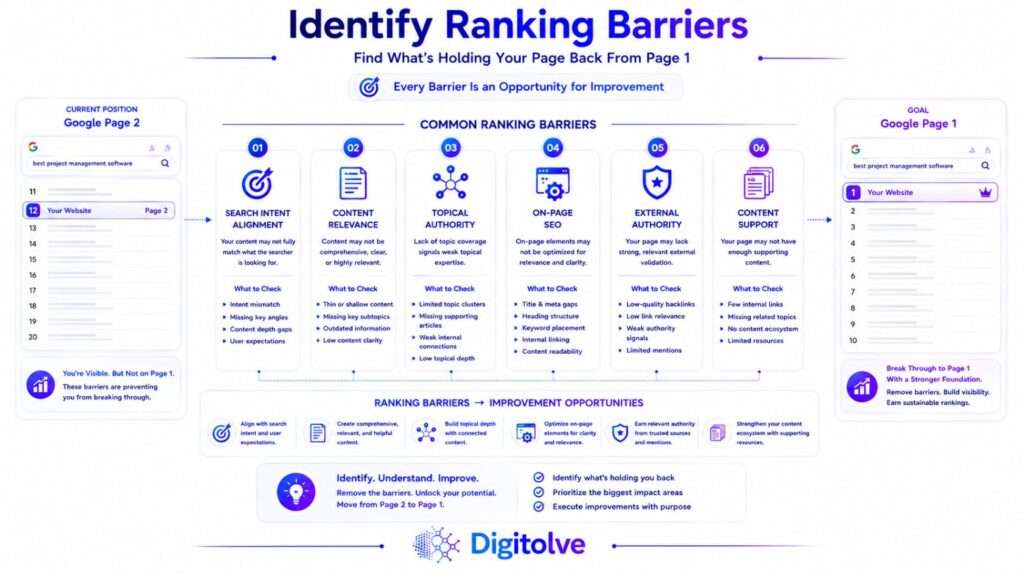
A page can remain on page 2 for different reasons. Its search intent may not be fully aligned, its content may lack sufficient depth, its topical context may be weak, its page-level signals may need strengthening, or competing pages may have stronger authority and supporting ecosystems.
The goal is to evaluate these areas systematically rather than assume that one ranking factor explains everything.
Evaluate Search Intent Alignment
The first question is whether the page genuinely satisfies the searcher’s objective.
Ask:
- Does the page answer the main question behind the query?
- Does its content format match what searchers expect?
- Is the primary purpose of the page clear?
- Does the page remain focused on the intended search opportunity?
If the page targets a keyword but serves a different purpose from what searchers expect, additional optimization may not address the underlying issue.
Examine Content Relevance and Coverage
A page can be well-written while still lacking the information necessary to fully satisfy the search opportunity.
Evaluate whether the content:
- Covers the important aspects of the topic
- Addresses meaningful related questions
- Provides useful context
- Demonstrates practical understanding
- Remains focused on the primary search intent
The objective is not to make the page unnecessarily longer.
It is to make the content more complete and relevant for the searcher’s actual need.
Assess Topical Support Around the Page
Important pages rarely exist completely in isolation.
Supporting content can help establish stronger relationships around a broader topic and provide additional context through internal connections.
Review whether the target page is supported by relevant content or whether it sits alone within the website.
A useful structure is:
Primary Page
↓
Related Supporting Content
↓
Internal Topic Relationships
↓
Broader Topical Coverage
This is one reason internal linking and supporting content should be planned strategically rather than added randomly after publication.
For a deeper look at internal structure, see Why Your Internal Linking Is Not Helping Your SEO (And What Your Structure Is Missing).
Review Page-Level SEO Signals
The page itself should communicate its purpose clearly.
Review elements such as:
- Page title
- Main heading
- Heading hierarchy
- Content structure
- Semantic relevance
- Internal links
- Page purpose
These signals should work together rather than being treated as disconnected checklist items.
The question is not:
“Have we optimized every possible SEO element?”
The better question is:
“Does the page clearly communicate what it is about and why it satisfies this search opportunity?”
Consider the Competitive Environment
Ranking position is relative.
Your page does not compete against an abstract ranking score. It competes against the pages currently appearing around it.
Review the competitive landscape to understand:
- What type of content ranks on page 1?
- How closely does it satisfy the search intent?
- What topics and questions do competing pages cover?
- How strong is their supporting content?
- What authority signals surround those pages?
This does not mean copying competitors.
It means understanding the level of competition your page is entering and identifying meaningful areas where your own content and SEO system can become stronger.
Turn Ranking Barriers Into Improvement Priorities
After reviewing these areas, avoid creating a huge list of unrelated SEO tasks.
Group the findings into meaningful improvement priorities.
For example:
Intent → Relevance → Topical Support → On-Page Signals → Authority → Continuous Improvement
Then determine which area deserves attention first.
This creates a much clearer execution path than making multiple changes without a defined purpose.
The objective is not to find one magical ranking factor. It is to identify the most relevant barriers and strengthen the systems that support the page’s competitive position.
Once those barriers are understood, the next step is to strengthen one of the most important foundations: search intent alignment and content relevance.
Strengthen Search Intent Alignment and Content Relevance
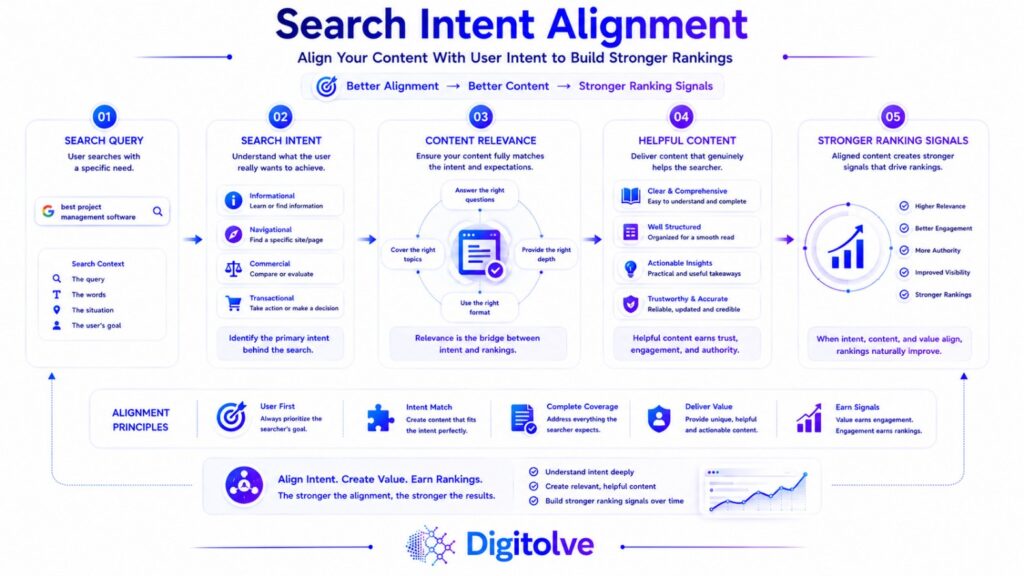
Once the main ranking barriers have been identified, the next step is to strengthen the relationship between what people are searching for and what your page actually delivers.
A page can contain useful information and still struggle to move higher if its purpose does not closely match the expectations behind the search query.
Search intent and content relevance should therefore work together.
Search Intent → Content Purpose → Relevant Coverage → Stronger Page
Match the Page With the Searcher’s Actual Objective
Start by looking beyond the target keyword itself.
Ask what the person searching is actually trying to accomplish.
Are they looking for an explanation?
A practical guide?
A comparison?
A solution?
A specific resource?
The page should be structured around that underlying objective rather than simply repeating the keyword throughout the content.
When the content directly addresses the searcher’s purpose, the page has a clearer reason to exist within the search results.
Strengthen Content Relevance Without Keyword Stuffing
Improving relevance does not mean repeatedly inserting the target keyword.
Instead, strengthen the content by naturally covering the concepts, questions, examples, and context that genuinely belong to the topic.
A stronger relevance structure can look like:
Primary Topic
↓
Core Search Need
↓
Important Supporting Concepts
↓
Practical Answer
↓
Complete User Experience
This creates depth through useful information rather than repetition.
Improve Content Coverage Where It Matters
A page does not need to answer every possible question about a broad subject.
It needs to provide sufficient coverage for the specific search opportunity it is targeting.
Review the page and identify meaningful gaps:
- Is an important part of the searcher’s question missing?
- Are key concepts explained clearly?
- Does the page answer the obvious follow-up questions?
- Are important sections too shallow?
- Does the conclusion actually resolve the reader’s need?
Prioritize gaps that improve usefulness and relevance rather than adding content simply to increase word count.
Keep Content Focused on One Clear Search Purpose
Comprehensive content can still become unfocused.
Adding unrelated information may dilute the page’s central purpose and make it harder to understand what the page is actually designed to satisfy.
Keep the primary search opportunity visible throughout the structure.
The page should have a clear relationship between:
Keyword → Intent → Page Purpose → Content
Every major section should contribute to that relationship.
Connect Relevance With the Broader Topic
A strong page should satisfy its immediate search intent while also fitting naturally into the website’s broader topical structure.
This is where content relevance connects with topical authority.
The target page can be strengthened by related content that explores supporting aspects of the broader subject, while internal relationships make those connections clear.
This creates a progression from:
Individual Page Relevance
↓
Related Topic Coverage
↓
Connected Content Ecosystem
↓
Stronger Topical Authority
Improve Existing Content Before Automatically Creating New Content
If a page is already ranking on page 2, consider whether strengthening that existing asset makes more sense than creating another page targeting the same opportunity.
Review the current page first.
Improve the areas that genuinely need more clarity, relevance, depth, or usefulness.
This helps preserve the ranking asset while making the SEO strategy more efficient.
For related guidance on content that remains visible but fails to maintain strong ranking performance, see Why Your Content Doesn’t Stay Ranked (Even After Reaching Top Positions).
Stronger rankings begin with stronger alignment: the right search intent, the right page purpose, and content that genuinely satisfies the searcher’s need.
Once search intent and content relevance are strengthened, the next opportunity is to build the broader topical authority that supports the primary page.
Build Topical Authority Around Your Target Keyword
Strengthening one page is important, but a page does not exist independently from the rest of your website.
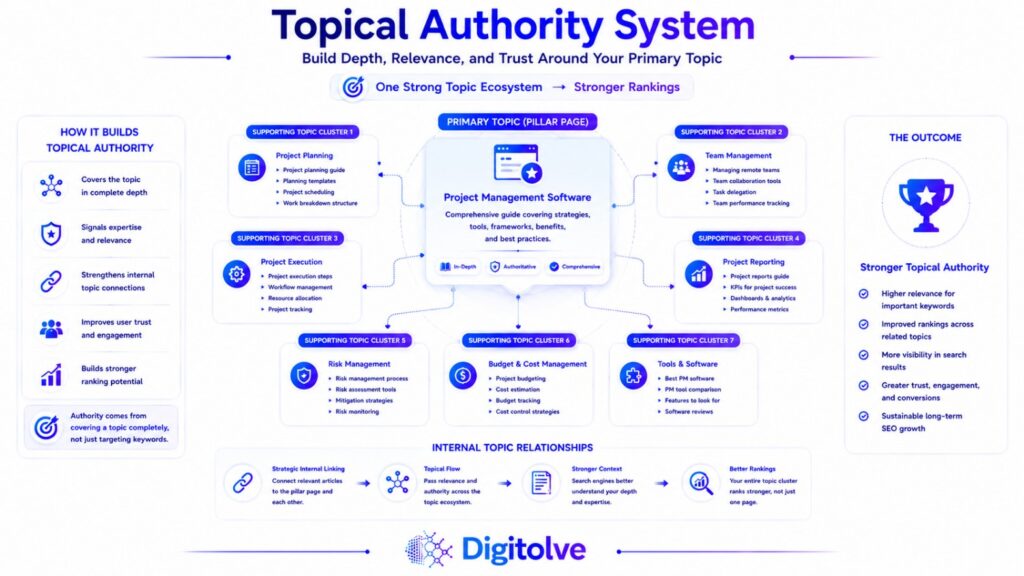
When several relevant pages contribute to the same broader subject, they can create a stronger topical structure around the primary page.
The objective is not to publish as many supporting articles as possible.
It is to build meaningful topical relationships that make the primary page part of a broader, useful content ecosystem.
Define the Core Topic Around Your Primary Keyword
Start by identifying the broader subject represented by your target keyword.
Your primary page should have a clear role within that subject.
Then identify the important subtopics that naturally support it.
The structure can look like:
Core Topic
↓
Primary Page
↓
Supporting Subtopics
↓
Related Content
This prevents supporting content from becoming a collection of unrelated articles.
Identify Supporting Topics That Strengthen the Primary Page
Supporting content should answer questions or explore concepts that naturally connect with the primary topic.
Ask:
- What related questions would the target audience have?
- What important subtopics deserve deeper explanation?
- Which aspects cannot be covered adequately on the primary page?
- Which supporting topics would make the overall content ecosystem more useful?
The goal is to create strategic coverage, not content volume.
Connect Supporting Content Through Internal Relationships
Once supporting pages exist, connect them naturally to the primary page and to other relevant resources.
Internal linking should help readers move between related information while also making the relationships between pages clearer.
A simplified architecture might look like:
Primary Ranking Page
↙ ↓ ↘
Supporting Page A — Supporting Page B — Supporting Page C
↓
Related Supporting Resources
This gives the primary page a stronger position within the broader content structure.
Avoid Creating Supporting Content Just for SEO
Topical authority should not become an excuse to publish dozens of thin or repetitive articles.
Every supporting page should have a genuine purpose.
Before creating one, ask:
Does this topic serve a meaningful search need?
Does it add information that the primary page cannot reasonably provide?
Does it strengthen the broader topic?
Can it connect naturally with the existing content ecosystem?
If the answer is no, creating another page may not improve the strategy.
Strengthen the Relationship Between Primary and Supporting Pages
The primary page should remain the central asset for its main search opportunity.
Supporting content should reinforce that position rather than compete unnecessarily with it.
This creates a clear hierarchy:
Primary Search Opportunity
↓
Primary Page
↓
Supporting Topics
↓
Supporting Pages
↓
Internal Connections
The structure gives each page a defined strategic role.
Build Authority Through Depth, Not Volume
A website does not become topically authoritative simply because it has published many articles about the same broad subject.
Authority-building is stronger when content demonstrates meaningful coverage, clear relationships, and useful information across the topic.
The objective is therefore:
Relevant Coverage → Connected Content → Stronger Topical Structure
rather than:
More Articles → More Keywords → More Pages
Topical authority is built by creating meaningful coverage around an important subject and connecting that coverage into a coherent content ecosystem.
Once the broader topical structure is established, the next step is to strengthen the page-level SEO signals that clearly communicate the purpose and relevance of the primary page.
Strengthen On-Page SEO Signals That Support Higher Rankings
Once search intent, content relevance, and topical authority are aligned, the next step is to make the page itself communicate its purpose clearly.
On-page SEO signals should reinforce the relationship between the search opportunity and the content.
The goal is not to optimize every possible element simply because it exists. The goal is to create a page whose structure makes its topic, purpose, relevance, and important information clear.
For Google’s broader guidance on creating search-friendly websites and improving the way search engines understand your content, see Google Search Central’s SEO Starter Guide.
Align the Title With the Page’s Search Purpose
The title is one of the first signals that communicates what the page is about.
It should accurately represent the page’s main purpose while remaining useful and understandable to searchers.
Avoid forcing multiple variations of the target keyword into the title.
Instead, make the primary topic clear and ensure the title accurately reflects what the page delivers.
Build a Clear Heading Structure
Headings should create a logical hierarchy for the content.
The structure should allow readers to understand:
What is this page about?
↓
What major questions does it answer?
↓
How are those questions connected?
A clear H1 establishes the main subject, while H2 and H3 headings organise the supporting information.
This improves content clarity without turning headings into a keyword checklist.
Strengthen Contextual Relevance Across the Page
Important concepts should appear naturally throughout the content where they genuinely contribute to the topic.
This includes:
- Relevant terminology
- Closely related concepts
- Supporting explanations
- Useful examples
- Contextual internal links
- Clear relationships between sections
The objective is to build a coherent semantic context around the primary topic rather than repeatedly inserting an exact keyword.
Make Important Information Easy to Understand
Ranking-focused optimization should never come at the expense of usability.
Important information should be easy to find, understand, and navigate.
Use:
- Clear headings
- Shorter paragraphs where appropriate
- Logical content progression
- Helpful lists
- Relevant examples
- Descriptive links
A page that communicates its information clearly creates a stronger experience for the people it is intended to serve.
Keep On-Page Optimization Connected to Search Intent
On-page SEO should support the page’s underlying search purpose.
For example, changing a title or heading should make the page clearer—not simply create another opportunity to insert a keyword.
The relationship should remain:
Search Intent
↓
Page Purpose
↓
Content Structure
↓
On-Page Signals
When these elements reinforce one another, optimization becomes part of the overall SEO system rather than an isolated checklist.
Review the Page as a Complete System
Before making individual changes, review the page from beginning to end.
Ask:
Is the main purpose immediately clear?
Does the structure match the searcher’s expectations?
Are the important concepts covered naturally?
Do the title and headings accurately represent the content?
Are internal links supporting relevant topic relationships?
Does every major element contribute to the page’s purpose?
This holistic review helps prevent unnecessary optimization and keeps changes focused on genuine improvements.
Strong on-page SEO is not about adding more optimization. It is about making the page’s purpose, relevance, structure, and content easier to understand and more closely aligned with the search opportunity.
With the primary page strengthened, the next step is to expand its supporting ecosystem through strategic supporting content and internal relationships.
Create Supporting Content That Reinforces Your Primary Page
A page that is already ranking on page 2 may benefit from stronger support around its broader topic.
Supporting content can help expand topical coverage, answer related search needs, and create meaningful internal relationships around the primary page.
The goal is not to publish more content simply to create more URLs.
The goal is to build supporting content with a clear strategic relationship to the page you want to strengthen.
Identify Supporting Content Opportunities
Start with the primary page and identify the important related topics it cannot reasonably cover in depth.
Look for:
- Closely related questions
- Supporting subtopics
- Specific problems within the broader topic
- Related informational searches
- Topics that naturally lead back to the primary page
Each supporting article should have its own useful purpose while contributing to the broader topic.
Give Every Supporting Page a Clear Role
Supporting content should not compete with the primary page for the same search opportunity.
Instead, each page should have a distinct role.
For example:
Primary Page
→ Main search opportunity
Supporting Page A
→ Related question
Supporting Page B
→ Specific subtopic
Supporting Page C
→ Practical supporting problem
This creates a content ecosystem where pages complement one another rather than unnecessarily competing.
Connect Supporting Content to the Primary Page
Once relevant supporting content exists, create contextual internal relationships between the pages.
The links should make sense to the reader and help them move naturally between related information.
A useful structure is:
Supporting Content
↓
Relevant Contextual Link
↓
Primary Page
This can strengthen the relationship between the supporting topic and the main ranking asset while also improving navigation across the website.
For deeper guidance on internal structure, see Why Your Internal Linking Is Not Helping Your SEO (And What Your Structure Is Missing).
Avoid Publishing Supporting Content Too Quickly
More supporting pages do not automatically create more authority.
Before publishing another article, ask:
Does this topic represent a meaningful search opportunity?
Does it add something genuinely useful?
Does it support the primary topic?
Does it have a clear relationship with the primary page?
If several pages provide almost identical information, creating additional content may simply increase overlap.
Quality and strategic relevance should come before volume.
Use Supporting Content to Expand the Topic
The strongest supporting content answers questions that naturally surround the primary search opportunity.
This creates a broader structure:
Primary Topic
↓
Primary Ranking Page
↓
Supporting Questions
↓
Supporting Content
↓
Internal Topic Connections
As this structure develops, the primary page becomes part of a more comprehensive content ecosystem.
Reinforce the Primary Page Without Making Every Link Exact-Match
Internal links should use descriptive, natural anchor text that tells the reader what they will find on the destination page.
There is no need to force the exact target keyword into every anchor.
The priority should be:
Context → Relevance → Useful Navigation
rather than repetitive keyword placement.
Supporting content becomes valuable when every additional page has a clear purpose and strengthens the broader topic surrounding the primary ranking asset.
Once the content ecosystem is stronger, the next layer is to consider external authority signals that can reinforce the credibility and competitive position of the page.
Build External Authority Signals That Reinforce Page 1 Rankings
Once the page, content, and supporting internal structure are strengthened, the next consideration is the authority that exists beyond your own website.
External authority signals can help strengthen the broader credibility and competitive position of a page, but they should be approached as part of a sustainable SEO system rather than as a shortcut to higher rankings.
The objective is not to collect as many links as possible.
It is to develop relevant, trustworthy signals that naturally support the value and authority of your content.
Understand the Role of External Authority
External references can provide additional context about how a website or page is positioned within its broader online environment.
Relevant references from trustworthy sources can be more meaningful than a large number of unrelated links.
Consider:
Relevance
Does the referring source operate within a related subject or industry?
Credibility
Is the source trustworthy and genuinely useful to its audience?
Context
Does the reference make sense within the surrounding content?
Natural Value
Would the reference still make sense if search engines were not involved?
These questions help keep authority building focused on quality rather than quantity.
Prioritize Relevant Authority Over Link Volume
A common mistake is treating backlinks as a numbers game.
More links do not automatically mean stronger authority.
A smaller number of relevant, editorially meaningful references may provide greater strategic value than a large collection of unrelated links.
Focus on opportunities such as:
- Industry-relevant publications
- Expert contributions
- Useful resources
- Genuine partnerships
- Original research or data
- High-quality editorial mentions
- Content that naturally earns references
The goal is to create reasons for credible sources to reference your work.
Create Content Worth Referencing
External authority becomes easier to build when your content provides something genuinely useful to other websites and their audiences.
Consider developing resources such as:
- Original frameworks
- Practical research
- Useful data
- Detailed guides
- Expert insights
- Unique tools
- Comprehensive resources
When content provides a clear reference value, external mentions can develop more naturally.
Avoid Manipulative Link-Building Tactics
External authority should never depend on deceptive or manipulative practices.
Avoid building a strategy around:
- Irrelevant link exchanges
- Low-quality link networks
- Purchased links intended to manipulate rankings
- Automated backlink generation
- Unrelated directory submissions
- Excessive exact-match anchor text
These approaches can create activity without building genuine authority.
The stronger principle is:
Create Value → Earn Relevant Attention → Develop Trustworthy References
Connect External Authority With the Rest of the SEO System
External authority should not operate independently.
Its role becomes stronger when it reinforces a page that already has:
Clear Search Intent
↓
Relevant Content
↓
Topical Authority
↓
Strong On-Page Signals
↓
Supporting Content
↓
External Authority
↓
Continuous Improvement
This keeps authority building connected to the broader ranking system rather than treating backlinks as a standalone SEO tactic.
Focus on Sustainable Authority
The objective is not to manufacture a sudden increase in links.
Build relationships and content assets that can continue generating legitimate references over time.
This creates a more durable approach:
Useful Content → Genuine Recognition → Relevant References → Stronger Authority Foundation
External authority is most valuable when it reflects genuine relevance and credibility rather than simply increasing the number of links pointing to a page.
With the page, content ecosystem, and authority signals working together, the next step is to track ranking progress and continuously improve the SEO system over time.
Track Ranking Progress and Continuously Improve Your SEO System
Moving a page from page 2 toward page 1 is not a single optimization event.
Once improvements are implemented, the next step is to observe how the page responds, identify meaningful changes, and use those insights to guide future decisions.
The objective is not to obsess over daily ranking fluctuations.
It is to build a repeatable improvement cycle that becomes more informed over time.
Establish a Clear Ranking Baseline
Before making significant changes, record the page’s current position and surrounding context.
Your baseline can include:
- Target keyword
- Current ranking position
- Search intent
- Target page
- Relevant supporting pages
- Existing content status
- Important SEO changes already implemented
This creates a reference point for evaluating future movement.
Without a baseline, it becomes difficult to determine whether later improvements actually changed the page’s competitive position.
Track Meaningful Ranking Movement
Ranking positions can fluctuate for many reasons.
Instead of reacting to every small movement, look for meaningful patterns over time.
Consider:
Is the page gradually moving upward?
Is visibility expanding across related searches?
Are rankings becoming more stable?
Did a major change coincide with a meaningful performance shift?
The purpose of tracking is not simply to collect numbers.
It is to understand whether the overall SEO system is moving in a stronger direction.
Review Changes Before Making More Changes
One of the most important habits in SEO execution is allowing enough time to understand the impact of meaningful changes.
If you change the title, rewrite the content, add supporting pages, alter internal links, and build external authority simultaneously, it becomes difficult to understand what influenced the outcome.
A more structured cycle is:
Baseline → Improvement → Observation → Evaluation → Next Decision
This creates clearer learning from each round of SEO work.
Look for New Ranking Opportunities
Improvement can reveal opportunities that were not obvious when the page was first created.
As the page develops visibility, you may discover:
- Related queries
- New search variations
- Supporting topics
- Additional content gaps
- Pages that could strengthen the topic
- Opportunities to improve existing sections
These discoveries can feed back into the broader SEO system.
The process becomes:
Ranking Data → New Insights → Strategic Decisions → Further Improvement
Improve the System, Not Just the Position
A ranking position is an outcome.
The underlying SEO system is what you can continuously improve.
Instead of asking only:
“Did we reach page 1?”
also ask:
“Did our content become more relevant?”
“Did the page become more useful?”
“Did our topical structure become stronger?”
“Did our supporting content improve?”
“Did our authority foundation develop?”
These questions create a more sustainable approach because they focus on the systems contributing to ranking potential.
Avoid Chasing Every Ranking Fluctuation
Google rankings can move up and down.
A temporary change does not necessarily mean the entire strategy needs to be rebuilt.
Avoid making major decisions based on isolated fluctuations.
Look for meaningful patterns and evaluate changes within the broader context of the page, topic, competition, and implemented improvements.
This prevents reactive SEO.
Create a Continuous Improvement Cycle
A mature SEO system continuously feeds learning back into execution.
The cycle becomes:
Track → Evaluate → Learn → Improve → Track Again
Each cycle should make the next decision more informed.
Over time, this creates a stronger process for managing important ranking assets rather than repeatedly starting from scratch.
The goal of ranking tracking is not to chase every position change. It is to understand what is improving, what still needs attention, and how the SEO system can become stronger over time.
Once this continuous improvement process is in place, the final step is to bring all of these elements together into a sustainable Page 1 SEO system instead of chasing rankings one page at a time.
Build a Sustainable Page 1 SEO System Instead of Chasing Rankings
Reaching page 1 should not depend on repeatedly applying isolated SEO tactics whenever rankings move.
A stronger approach is to connect the major elements that support the page into one repeatable system.
The objective is not simply to reach page 1 once.
It is to build a process that continuously strengthens the page’s relevance, authority, supporting ecosystem, and overall competitive position.
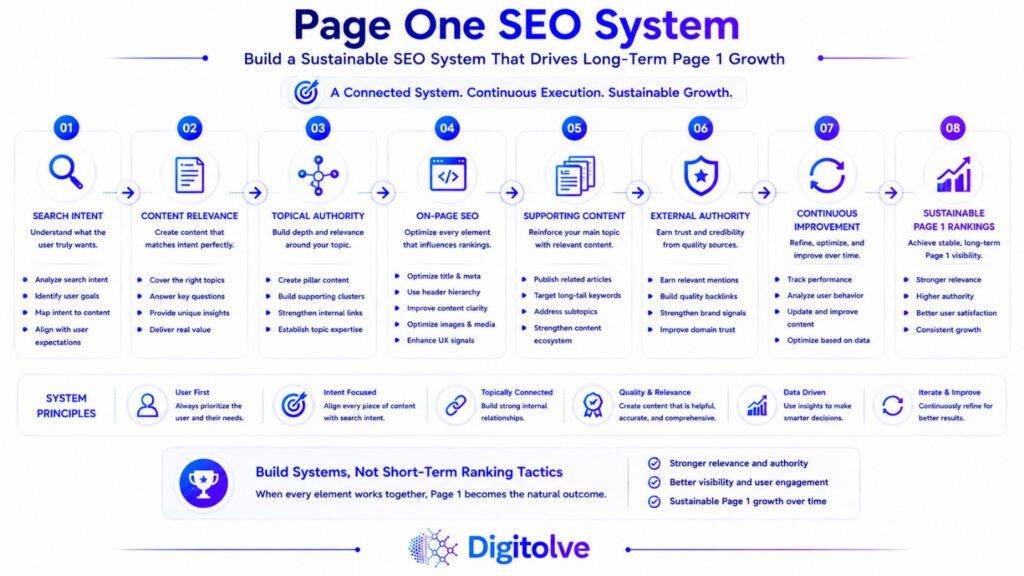
Connect the Major SEO Systems
The complete execution structure can be viewed as:
Search Intent
↓
Content Relevance
↓
Topical Authority
↓
On-Page SEO
↓
Supporting Content
↓
External Authority
↓
Continuous Improvement
Each component has a different role, but the strongest strategy connects them.
Search intent establishes the foundation.
Content relevance ensures the page satisfies that intent.
Topical authority provides broader context.
On-page SEO clarifies the page’s purpose.
Supporting content strengthens the surrounding topic.
External authority reinforces credibility.
Continuous improvement keeps the system responsive over time.
Build Around Important Ranking Assets
Not every page on a website needs the same level of strategic investment.
Identify the pages that are particularly important to your SEO objectives and build stronger systems around them.
These may include:
- Important commercial pages
- Core educational resources
- High-value organic landing pages
- Pages already showing ranking potential
- Strategic pillar content
The goal is to allocate effort where stronger SEO execution can create meaningful strategic value.
Avoid Chasing Rankings With Constant Changes
A ranking-focused strategy can become reactive when every movement triggers another optimization.
One week the title changes.
The next week the content is rewritten.
Then internal links are changed.
Then another article is published.
Then external authority efforts begin.
This creates activity, but not necessarily a system.
A sustainable process instead uses deliberate cycles:
Evaluate → Prioritize → Improve → Observe → Refine
Each cycle should have a clear purpose.
Make Supporting Content Part of the System
Supporting content should not be treated as a separate publishing exercise.
Each supporting page should have a defined relationship with an important primary page.
This creates an ecosystem where content contributes to broader topic coverage while helping users navigate naturally between related resources.
The structure becomes:
Primary Ranking Asset
↓
Supporting Content
↓
Internal Relationships
↓
Broader Topic Coverage
This approach also helps prevent random content expansion.
Treat External Authority as a Long-Term Process
Authority should be developed gradually through valuable content, relevant relationships, and legitimate references.
It should not become a short-term campaign designed only to push one page upward.
When external authority is combined with strong content and a connected internal structure, it becomes part of a broader SEO system.
Build a Repeatable Page 1 Workflow
The complete process can now be simplified into a repeatable workflow:
Identify
Find the pages already showing ranking potential.
↓
Align
Strengthen search intent and content relevance.
↓
Build
Develop topical authority and supporting content.
↓
Strengthen
Improve on-page and external authority signals.
↓
Track
Observe meaningful ranking progress.
↓
Improve
Use what you learn to guide the next cycle.
This creates a system that can be applied to multiple important ranking assets without relying on a completely new strategy every time.
Page 1 growth becomes more sustainable when ranking improvement is treated as a connected system of relevance, authority, content, and continuous improvement—not as a collection of isolated SEO tactics.
The next step is to bring the entire framework together and reinforce the central principle: move toward page 1 by strengthening the system around the page, not by chasing the ranking position itself.
Conclusion
Moving a website from page 2 to page 1 is not about discovering one secret SEO tactic.
It is about identifying where the current page can become stronger and then improving the systems that support its ranking potential.
A page already appearing on page 2 has an important foundation. The next step is to strengthen that foundation deliberately.
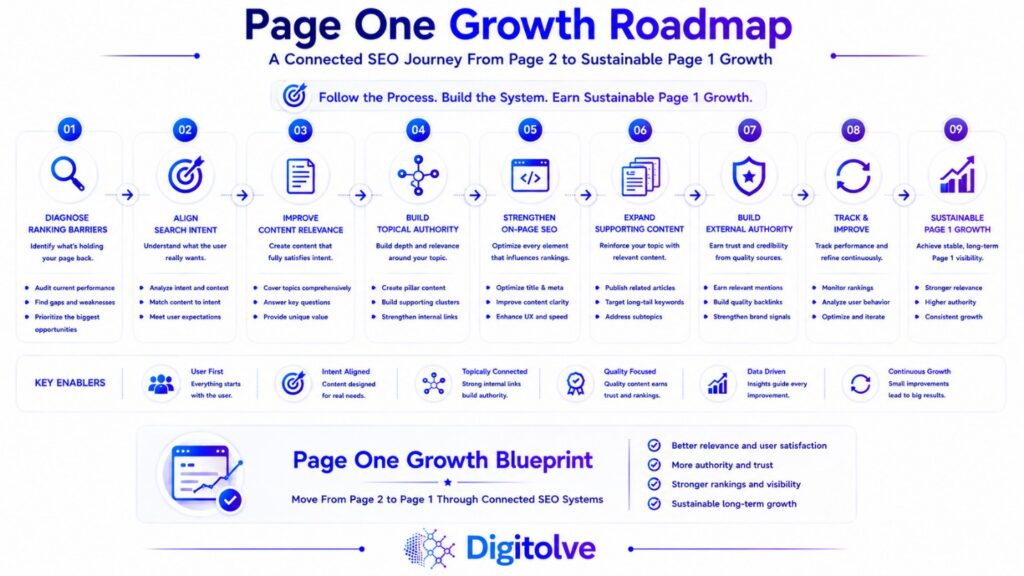
The complete process is:
Identify Ranking Barriers
↓
Strengthen Search Intent & Content Relevance
↓
Build Topical Authority
↓
Strengthen On-Page SEO Signals
↓
Create Supporting Content
↓
Build External Authority
↓
Track & Improve
↓
Sustainable Page 1 Growth
Each stage contributes something different.
Search intent ensures the page serves the right search need.
Content relevance makes the page genuinely useful for that need.
Topical authority connects the page with a broader content ecosystem.
On-page signals make the page’s purpose and structure clearer.
Supporting content strengthens the surrounding topic.
External authority develops credibility beyond the website.
Continuous improvement allows the system to evolve as search performance changes.
The objective is not to guarantee a page 1 position—because rankings depend on many factors outside any single SEO process.
The objective is to create a structured, repeatable approach for strengthening a page’s ability to compete.
Don’t chase page 1 as a position. Build the SEO system that gives your important pages a stronger opportunity to reach and sustain higher rankings.
Build Your Page 1 SEO System
Reaching page 1 requires more than making isolated changes whenever rankings fluctuate.
The Page One Growth Blueprint provides a structured execution framework for strengthening the systems around an important ranking page—from search intent and content relevance to topical authority, supporting content, on-page SEO, external authority, and continuous improvement.
Use the framework to turn:
Page 2 Position → Strategic Evaluation → Structured Improvements → Continuous SEO Execution
Inside the blueprint, the focus is on creating a repeatable process rather than chasing a guaranteed ranking position.
What the Page One Growth Blueprint Helps You Do
- Identify the areas that deserve improvement
- Strengthen search intent and content relevance
- Build supporting topical coverage
- Improve page-level SEO signals
- Create strategic supporting content
- Develop sustainable authority-building direction
- Track progress and refine your process over time
If you already have a page sitting on page 2 and want a structured way to work toward stronger ranking potential, the Page One Growth Blueprint gives you the execution direction to move forward systematically.
Product: Page One Growth Blueprint
Level: Mini
Focus: Page 2 → Page 1 SEO Execution
Build the system around the page—not just the ranking position.
Frequently Asked Questions (FAQs)
Can a website move from page 2 to page 1 on Google?
Yes, a page already appearing on page 2 can potentially improve its position. However, there is no guaranteed timeframe or ranking outcome. Progress depends on factors such as search intent, content relevance, competition, authority, and the overall strength of the SEO system.
Why is my website stuck on page 2 of Google?
A page can remain on page 2 for different reasons, including incomplete search-intent alignment, content gaps, limited topical support, weaker on-page signals, competitive differences, or insufficient authority. The appropriate improvement depends on the specific situation.
Should I rewrite a page that is already ranking on page 2?
Not necessarily. First evaluate what the existing page is already doing well and identify the areas that genuinely need improvement. Sometimes strengthening the existing page is more appropriate than replacing it completely.
Does adding more keywords help a page move from page 2 to page 1?
Adding keywords alone does not guarantee better rankings. Keywords should be used naturally where they improve relevance and help satisfy the searcher’s need. Search intent, content usefulness, topical coverage, and overall page quality should remain the priority.
How important is search intent for page 1 rankings?
Search intent is fundamental because the page needs to satisfy what users are actually looking for. A page can contain extensive information but still be poorly aligned if its purpose or format does not match the searcher’s expectations.
Can supporting content help strengthen a page 2 ranking?
Relevant supporting content can contribute to a stronger topical structure when it has a genuine purpose and connects naturally with the primary page. The objective should be meaningful topic coverage rather than publishing large quantities of repetitive content.
Do backlinks guarantee page 1 rankings?
No. External authority signals are only one part of a broader SEO system. Relevant and trustworthy references can contribute to authority, but they do not guarantee a particular ranking position.
How long does it take to move from page 2 to page 1?
There is no universal timeline. Ranking movement depends on the query, competition, website, content, authority, search environment, and the improvements being made. It is better to track meaningful progress over time than rely on a fixed ranking deadline.
Should I change several SEO elements at the same time?
Making too many major changes simultaneously can make results difficult to interpret. A structured process is generally more useful: identify an improvement area, implement meaningful changes, observe performance, and use the results to guide the next decision.
What is the best way to improve page 2 rankings?
Start by understanding the current ranking position and potential barriers. Then strengthen search intent alignment, content relevance, topical authority, on-page signals, supporting content, and relevant authority signals while continuously reviewing performance.
Recommended Reading
1. Why Your Content Doesn’t Stay Ranked (Even After Reaching Top Positions)
Learn why ranking improvements can weaken over time and how stronger content relevance and ongoing SEO improvement can support ranking durability.
2. Why Your Internal Linking Is Not Helping Your SEO (And What Your Structure Is Missing)
Explore how internal relationships can support important pages and create a stronger connected website structure.
3. How to Build an SEO Ranking System That Consistently Improves Google Rankings
Learn how search intent, content relevance, on-page signals, internal authority, and continuous reinforcement can work together as a broader ranking system.