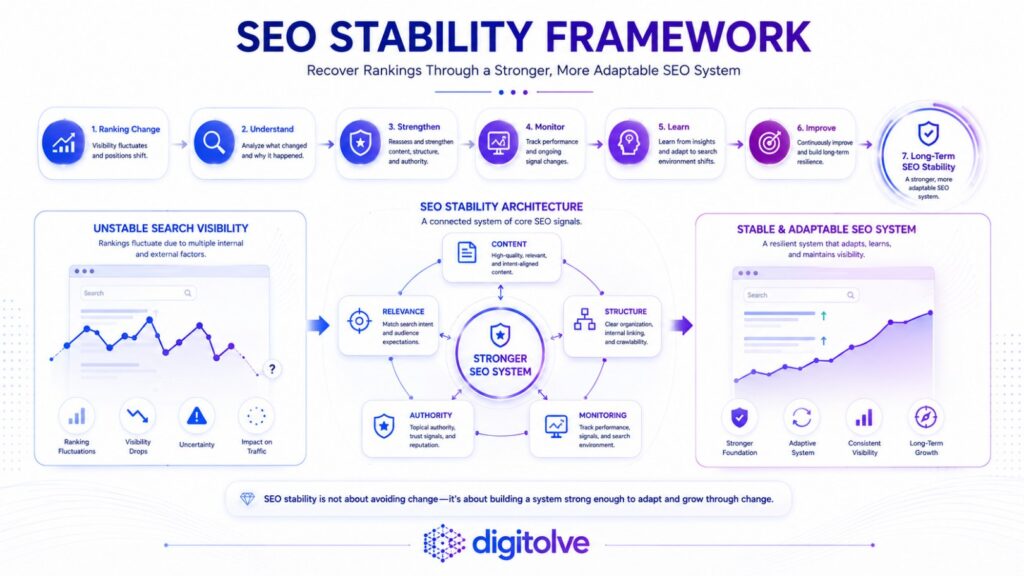
recover Google rankings :
A sudden drop in Google rankings can be unsettling—especially when your website was performing well and you have not made any obvious changes.
The natural reaction is often to start changing everything at once: rewrite the content, adjust keywords, add more internal links, build backlinks, or publish new pages.
But ranking recovery should not begin with random changes.
A ranking decline is a signal to understand what changed and what may need strengthening.
The bigger challenge is that recovering a lost ranking position is not necessarily the same as building a more stable SEO system. A page may regain visibility and later experience another decline if the underlying weaknesses remain unresolved.
A stronger approach looks beyond the immediate ranking position and asks:
What changed?
What does the current search environment expect?
Which parts of the SEO system may need strengthening?
How can future changes be handled more intelligently?
This shifts the goal from simply:
“Get my rankings back.”
to:
“Build a stronger SEO system that can recover, learn, and adapt.”
If your rankings have recently dropped and the underlying cause is still unclear, it is important to diagnose the ranking loss before deciding what recovery actions to take.
🔵 SSL Bridge — Ranking Drop Analyzer
The distinction matters:
SSL → Diagnose the ranking loss
Digitolve → Build the long-term recovery and stability approach
This article focuses on the second layer: understanding what sustainable ranking recovery requires and how recovery can become part of a broader SEO stability system.
Table of Contents
Understand the Difference Between Ranking Recovery and Ranking Stability
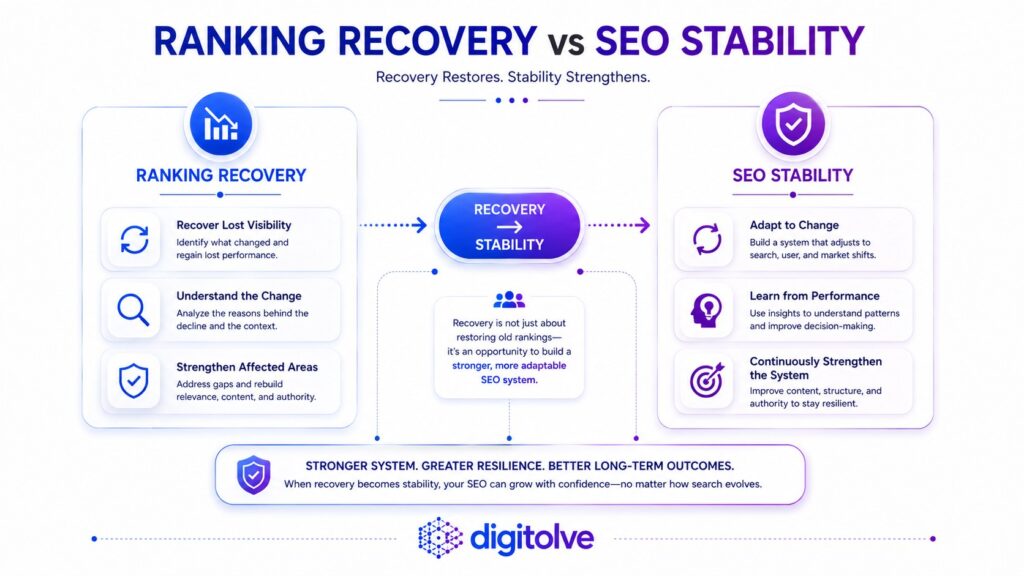
Ranking recovery and ranking stability are connected, but they are not the same objective.
Ranking recovery focuses on a more immediate question:
How can lost search visibility be recovered?
Ranking stability asks a broader question:
How can the SEO system become more resilient when search conditions change?
Recovering a previous ranking can be an important goal, but simply returning to an old position does not necessarily mean the underlying system has become stronger.
A page may regain visibility and later experience another decline if important weaknesses remain unaddressed.
Ranking Recovery Focuses on Regaining Lost Visibility
When rankings decline, the immediate concern is naturally the lost visibility.
The focus may be on understanding the affected page, reassessing its relevance, and identifying areas that may need strengthening.
But recovery should not automatically mean returning the page to exactly the way it was before.
The search environment may have changed.
Competitors may have improved.
Search intent may have evolved.
Content expectations may have shifted.
Therefore, recovery should consider the current environment, not only the previous ranking position.
Ranking Stability Focuses on the Strength of the System
Stability is a longer-term perspective.
It asks whether the website has a connected SEO foundation that can respond intelligently when conditions change.
That foundation can involve:
Search Intent
↓
Content Relevance
↓
Topical Coverage
↓
Internal Structure
↓
Authority
↓
Ongoing Observation
The objective is not to make rankings permanently immune to change—that would be unrealistic.
Instead, the objective is to create a system that can recognize change, learn from it, and respond more intelligently.
Recovery Can Become an Opportunity to Strengthen the System
A ranking decline does not have to be viewed only as a setback.
It can also reveal where the existing SEO system may need greater attention.
For example, a decline may encourage you to reassess whether:
- the page still satisfies search intent,
- the content remains genuinely relevant,
- supporting topic coverage is strong,
- internal relationships are clear,
- authority signals remain relevant,
- or the SEO process is being monitored effectively.
This changes the mindset from:
Ranking Drop → Restore Position
to:
Ranking Drop → Understand → Strengthen → Adapt
Ranking recovery addresses the immediate loss. Ranking stability addresses the system that needs to remain adaptable after recovery.
That distinction becomes important before examining what actually changed and deciding whether a ranking movement requires intervention.
Identify What Changed Before Changing Your SEO
When rankings decline, the first instinct is often to start making changes immediately.
But changing the page before understanding what actually changed can create unnecessary work—and make it harder to determine which improvements genuinely helped.
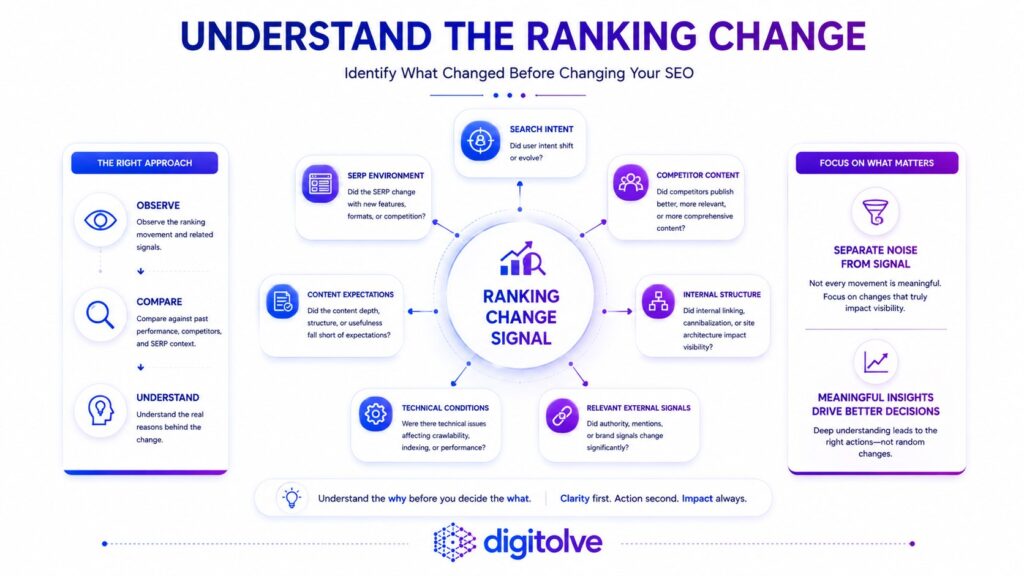
A more useful starting point is to observe the ranking environment first.
Review the Ranking Movement
Begin by understanding the scope of the change.
Look at:
- Which keywords declined
- Which pages were affected
- How significant the movement was
- Whether the decline happened gradually or suddenly
- Whether the change is isolated to one page or visible across multiple pages
A single keyword moving temporarily is different from several important pages losing visibility at the same time.
The pattern matters.
Compare the Before-and-After Environment
Ranking performance does not exist in isolation.
Compare the search environment before and after the decline.
Consider whether there have been meaningful changes in:
- Search intent
- SERP composition
- Competitor content
- Content expectations
- Internal site structure
- Technical conditions
- Relevant external signals
The purpose is not to assume that one factor caused the decline.
It is to understand whether the environment surrounding the ranking has changed.
Separate a Meaningful Signal From a Temporary Fluctuation
Not every ranking movement requires immediate intervention.
Search visibility can fluctuate, and reacting to every short-term movement can lead to unnecessary changes.
Instead, look for meaningful patterns.
Ask:
Is the decline persistent?
Are multiple related queries affected?
Are other pages experiencing similar movement?
Has the search environment changed noticeably?
These questions help create a more measured response.
Understand the Change Before Choosing the Recovery Direction
Once you have a clearer picture of what changed, you can make more informed decisions about what deserves attention.
The sequence should be:
Observe → Compare → Understand → Decide
rather than:
Ranking Drop → Change Everything
If the cause of the ranking loss is still unclear, the Ranking Drop Analyzer can be used as the diagnostic layer before moving into broader recovery planning.
The goal at this stage is not to fix everything. It is to understand the change well enough to know what deserves attention.
This image should visually reinforce:
Observe → Compare → Understand
without turning the section into an SSL diagnostic-tool visual.
Reassess Search Intent and Content Relevance
Once you have a clearer understanding of what changed, the next question is whether the affected page still matches what searchers currently expect to find.
A page can lose visibility even when the content has not been deliberately changed. Search results evolve, competitors improve, and the meaning or expectations behind a query can shift over time.
The goal is therefore not to automatically rewrite the page. It is to determine whether its search intent, relevance, and usefulness still align with the current search environment.
Check Whether Search Intent Has Shifted
Start by looking at the current search results for the affected query.
Consider:
- What type of content is now appearing?
- What questions are those pages answering?
- What format do searchers seem to expect?
- Has the dominant purpose of the query changed?
- Does your page still serve that purpose clearly?
The important point is to compare the page with the current search landscape, rather than relying only on what worked previously.
Reassess Content Relevance
Next, examine whether the page still provides information that directly satisfies the searcher’s need.
Ask:
- Does the page answer the core question?
- Does it cover the important aspects of the topic?
- Is the information still useful and accurate?
- Are important sections now missing?
- Does the page provide enough context for the reader to accomplish what they came to do?
Relevance is not about adding more words.
It is about making sure the content remains meaningfully connected to the search opportunity.
Strengthen the Page Without Automatically Rebuilding It
A ranking decline does not automatically mean the entire page needs to be rewritten.
Start by identifying the genuine gaps.
Some pages may need clearer explanations.
Others may need updated information, stronger topic coverage, or better alignment with the current search intent.
The principle is:
Identify the Relevance Gap → Strengthen What Matters
rather than:
Ranking Drop → Rewrite Everything
This keeps recovery focused and protects useful content that is already performing valuable work.
Reconnect the Page With the Broader Topic
Search relevance does not exist only within one page.
The affected page should also make sense within the broader topic covered by the website.
Relevant supporting content, clear internal relationships, and meaningful topical connections can help create a more coherent information structure.
This becomes especially important when a ranking asset is part of a larger content ecosystem.
Ranking recovery should begin with reassessing whether the page still satisfies the current search need—not with automatically changing everything on the page.
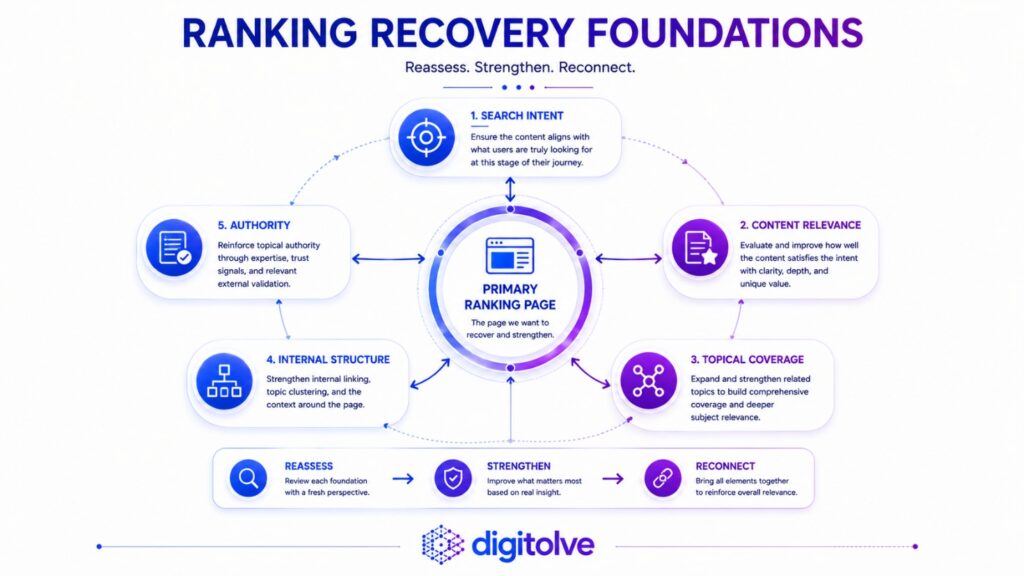
This image should visualize the relationship between:
Search Intent → Content Relevance → Topical Coverage → Internal Structure → Authority
without revealing the Core product’s implementation tools.
Strengthen Content Quality and Topical Coverage
Ranking recovery should not be reduced to adding more keywords or increasing the word count of an existing page.
The stronger question is whether the content still provides meaningful coverage of the topic and genuinely helps the searcher accomplish what they came to find.
Identify Genuine Content Gaps
Review the page for information that is important to the searcher’s need but is missing, unclear, outdated, or insufficiently developed.
Look for gaps in:
- Important concepts
- Supporting explanations
- Practical context
- Relevant questions
- Current information
- Useful examples
Prioritize gaps that directly improve the usefulness and relevance of the page.
Improve Depth Where It Matters
More content is not automatically better content.
A stronger page may need a clearer explanation rather than another thousand words.
Focus on areas where additional depth genuinely helps the reader understand the topic or make a decision.
The principle is:
Useful Depth → Better Coverage
rather than:
More Words → Better Rankings
Connect the Page to Its Broader Topic
An important ranking page should not necessarily operate as an isolated asset.
Relevant supporting content can expand the broader topic while allowing the primary page to remain focused on its main search purpose.
The relationship can look like:
Primary Page
↓
Related Subtopics
↓
Supporting Content
↓
Connected Topic Structure
This creates a more meaningful content ecosystem without requiring every related idea to be forced into one article.
Keep Supporting Content Relevant
Supporting pages should have a genuine reason to exist.
Before creating or linking another article, consider:
Does it address a meaningful related need?
Does it add useful information?
Does it strengthen the broader topic?
Does the relationship make sense to the reader?
This keeps topical expansion strategic rather than turning it into unnecessary content volume.
Strengthen What the Reader Actually Needs
The ultimate test is simple:
If someone arrives through the target search query, does the page give them a clear, useful, and sufficiently complete response?
If not, strengthen the missing areas.
If yes, avoid changing the content simply because rankings have moved.
The ultimate test is simple:
If someone arrives through the target search query, does the page give them a clear, useful, and sufficiently complete response?
If not, strengthen the missing areas.
If yes, avoid changing the content simply because rankings have moved. For more on why content can lose ranking stability over time, see Why Your Content Doesn’t Stay Ranked.
Content recovery is strongest when it improves genuine usefulness and topical coverage rather than simply adding keywords, length, or repetitive information.
This is a natural point to connect with the broader issue of content losing ranking stability:
Strengthen the Internal SEO Structure Around Important Pages
A ranking recovery strategy should not depend entirely on the strength of one isolated page.
When an important page is supported by relevant content and meaningful internal relationships, the broader website structure can provide clearer context around the topic.
The objective is not to add links simply because a page has lost rankings. Internal linking should strengthen genuine relationships between related content.
Strengthen Relevant Internal Relationships
Review the connections between the affected page and other relevant pages on your website.
Ask:
- Which pages genuinely support this topic?
- Which pages provide useful additional context?
- Where would an internal link help the reader continue their journey?
- Does the anchor text accurately describe the destination?
The strongest internal links are created because the relationship is useful—not because another URL needs a link.
Review Supporting Content
Supporting pages should have a meaningful relationship with the primary ranking page.
Consider whether they are:
- Relevant to the same broader topic
- Useful to the intended audience
- Current enough to remain valuable
- Connected naturally to the primary page
If supporting content is outdated, irrelevant, or repetitive, adding more links will not solve the underlying structural issue.
Reduce Structural Confusion
A website can also become weaker when several pages target essentially the same search intent without clear differentiation.
Review whether multiple pages are competing for the same opportunity.
Each important page should have a reasonably clear role within the site’s content architecture.
A healthy structure looks like:
Primary Topic
↓
Primary Page
↓
Relevant Supporting Pages
↓
Natural Internal Relationships
Use Internal Links to Support the Reader Journey
Internal links should help someone move naturally from one relevant piece of information to another.
For example:
Current Question
→ Deeper Explanation
→ Related System
→ Next Useful Resource
This creates value for the reader while also strengthening the relationships between relevant pages.
For a deeper look at structural problems that can prevent internal links from contributing effectively to SEO, see Why Your Internal Linking Is Not Helping Your SEO.
Evaluate Authority as Part of the Recovery Picture
External authority can be relevant to a website’s ability to compete, but ranking recovery should not become a race to acquire backlinks.
The first priority is to understand whether relevant authority signals are actually part of the situation before deciding that more external links are needed.
Evaluate Relevant Authority Signals
Consider whether the affected page and website have meaningful recognition from relevant sources within the broader topic.
Look at the context rather than simply counting links.
Ask:
- Are external references relevant to the topic?
- Do they come from credible sources?
- Do they provide genuine value to their audiences?
- Is there a meaningful reason for those sources to reference the page?
The purpose is to understand the authority picture—not to assume that every ranking decline requires a backlink campaign.
Strengthen Content Worth Referencing
A sustainable authority approach begins with creating something genuinely useful.
Potential assets can include:
- Original insights
- Useful resources
- Credible research
- Practical frameworks
- Expert contributions
- Valuable data
The stronger the resource, the more legitimate reasons other relevant sources may have to reference it.
Prioritize Relevance and Quality Over Volume
A large number of unrelated references does not automatically create stronger authority.
Instead, focus on:
Relevance → Credibility → Context → Genuine Value
This keeps authority development connected to the quality of the content and the needs of the audience.
Treat Authority as One Part of the Recovery Picture
External authority should not be treated as an isolated solution.
A stronger recovery approach considers it alongside:
Search Intent
↓
Content Relevance
↓
Topical Coverage
↓
Internal Structure
↓
Relevant Authority Signals
The evidence should determine whether authority needs attention—not the assumption that more backlinks are always better.
Authority should be evaluated as part of the broader SEO picture, and strengthened where relevant evidence supports it—not treated as a guaranteed lever for recovering rankings.
Use Google’s official guidance on spam policies when discussing manipulative or unnatural link-building practices.
Prioritize Recovery Around Evidence and Impact
Once the major areas affecting a ranking decline have been considered, the next challenge is deciding what deserves attention first.
Not every possible SEO improvement has the same importance. A sustainable recovery approach avoids making changes simply because they are easy to implement or commonly recommended.
Instead, recovery should be guided by evidence and strategic importance.
Start With Evidence
Before prioritizing an improvement, consider what information supports the need for that change.
For example:
- Is there a clear content gap?
- Has search intent changed?
- Is the page structurally isolated?
- Is supporting content weak or outdated?
- Is there meaningful evidence that authority needs attention?
The stronger the evidence, the more confidently an improvement can be considered.
Consider Impact and Relevance
After identifying potential improvements, consider how strongly each one relates to the ranking problem.
A useful strategic principle is:
Evidence → Impact → Relevance → Feasibility → Strategic Value
This does not need to become a rigid scoring formula.
It is simply a way to avoid treating every possible SEO task as equally important.
Think in Broad Action Categories
Recovery decisions can be viewed at a high level:
Address First
High-impact weaknesses supported by meaningful evidence.
Strengthen Next
Important improvements that require additional work.
Develop Over Time
Broader supporting-content and authority opportunities.
Continue Monitoring
Areas where the available evidence is not yet strong enough to justify major intervention.
This creates direction without turning the article into a detailed operational prioritization system.
Avoid Changing Everything at Once
A ranking decline can create pressure to make multiple changes simultaneously.
But if everything changes at the same time, it becomes harder to understand which improvements actually contributed to subsequent performance.
A more thoughtful approach is to make meaningful changes based on the strongest available evidence, then observe what happens.
Good recovery decisions are not based on doing more SEO. They are based on identifying which improvements have the strongest evidence and strategic relevance.
The detailed prioritization process belongs inside the SEO Stability Framework, where these principles can be translated into a practical execution system.
Measure Recovery as a Learning Process
Once meaningful recovery priorities have been identified, the next step is to observe what happens after improvements are made.
Measurement should support learning, not encourage constant reactions to every ranking fluctuation.
Establish a Clear Recovery Baseline
Before evaluating progress, understand the starting point.
Know:
- Which pages were affected
- Which important queries declined
- The approximate ranking position before the decline
- The current ranking position
- What major SEO changes have already been made
This creates context for interpreting future movement.
Observe Meaningful Patterns
Rankings can fluctuate for many reasons, so avoid treating every small movement as a definitive result.
Instead, look for broader patterns.
Consider:
Is visibility gradually improving?
Are related queries responding similarly?
Is the affected page becoming more stable?
Did meaningful movement follow a substantial improvement?
The goal is to understand direction rather than obsess over individual daily positions.
Connect Changes With Outcomes
When meaningful improvements are implemented, pay attention to what happens afterward.
This does not mean assuming that every ranking movement was caused by one specific change.
Instead, document the relationship between major actions and subsequent observations.
The strategic learning cycle becomes:
Change → Observe → Learn → Refine
Over time, this creates a better understanding of which types of improvements appear to strengthen important ranking assets.
Avoid Reactive SEO
Measurement becomes counterproductive when every fluctuation triggers another major change.
A short-term decline does not automatically mean the previous improvement failed.
Likewise, a temporary increase does not necessarily prove that one change caused the improvement.
Use evidence over time to guide decisions.
Turn Performance Into Strategic Learning
The real value of measurement is not the number itself.
It is what the observation teaches you about the SEO system.
A useful question is:
What did this performance change teach us about the page, the search environment, or the broader SEO system?
That insight can then inform future improvements.
The purpose of recovery measurement is not to chase rankings every day. It is to learn from meaningful changes and use those lessons to strengthen future SEO decisions.
Turn Ranking Recovery Into a Long-Term Stability System
Recovering lost rankings is valuable, but the larger opportunity is to build an SEO system that can respond more intelligently when search conditions change again.
Long-term stability does not mean making rankings permanently immune to fluctuations. Search results, competitors, user expectations, and websites themselves continue to evolve.
The goal is to create a stronger system for understanding change, strengthening important areas, and learning from performance over time.
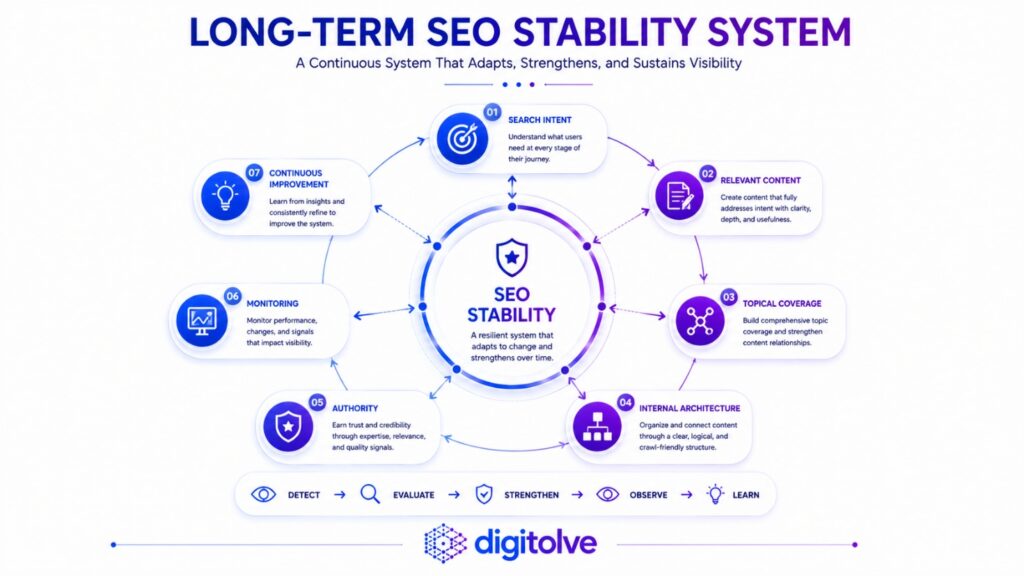
Connect the Major SEO Foundations
A sustainable stability approach brings several SEO dimensions together:
Search Intent
↓
Relevant Content
↓
Topical Coverage
↓
Internal Architecture
↓
Authority
↓
Monitoring
↓
Continuous Improvement
These elements should not be treated as completely separate activities.
A weakness in one area can affect how effectively the broader system performs, while improvements in one area may reveal opportunities elsewhere.
Build a System That Can Adapt
A resilient SEO approach should be able to respond when the search environment changes.
The strategic mindset becomes:
Ranking Change → Understand → Strengthen → Observe → Learn
Rather than:
Ranking Drop → Panic → Random Changes
This does not mean every ranking change requires intervention.
It means the SEO process should have a clear way of learning from meaningful changes instead of repeatedly starting from scratch.
Use Recovery as a Source of Learning
A ranking decline can reveal information about the website’s broader SEO system.
It may highlight:
- Content weaknesses
- Relevance gaps
- Structural limitations
- Missing topical support
- Authority considerations
- Gaps in ongoing observation
The important point is not to assume that every decline has the same cause.
Instead, use meaningful ranking changes as opportunities to understand where the system may become stronger.
Think Beyond Restoring the Previous Position
Returning to a previous ranking can be an important recovery milestone, but it should not automatically be treated as the final objective.
A stronger long-term perspective asks:
Is the content still useful?
Is the page aligned with the current search need?
Is the broader topic well supported?
Are internal relationships meaningful?
Is the website learning from performance changes?
These questions shift the focus from one ranking position toward the strength and adaptability of the system behind it.
Keep Stability as an Ongoing Process
SEO stability is not something that can be permanently completed.
It is an ongoing process of observing the environment, making thoughtful improvements, and learning from meaningful outcomes.
The high-level cycle is:
Understand → Strengthen → Observe → Learn → Adapt
That cycle can continue as the search environment evolves.
The goal of SEO stability is not to prevent every ranking change. It is to build a system that can understand change, respond intelligently, and become stronger through what it learns.
This brings the recovery framework together: understand the change, strengthen the areas that genuinely need attention, and use what you learn to build a more adaptable SEO system.
Conclusion
Google ranking recovery should not be approached as a race to restore a single lost position.
A meaningful recovery begins by understanding what changed, reassessing whether the page still satisfies the current search environment, and strengthening the areas that genuinely need attention.
The broader process is:
Understand the Change
↓
Reassess Search Intent & Relevance
↓
Strengthen Content & Topical Coverage
↓
Improve Internal Structure
↓
Evaluate Relevant Authority Signals
↓
Prioritize Based on Evidence
↓
Measure Meaningful Recovery
↓
Learn & Adapt
The goal is not to promise that rankings will never fall again. Search results constantly evolve, and no SEO system can control every external factor.
The goal is to build a stronger process for responding to change, learning from performance, and continuously strengthening important ranking assets.
The strongest ranking recovery strategy does not simply try to restore yesterday’s rankings. It uses ranking changes as signals for building a stronger, more adaptable SEO system.
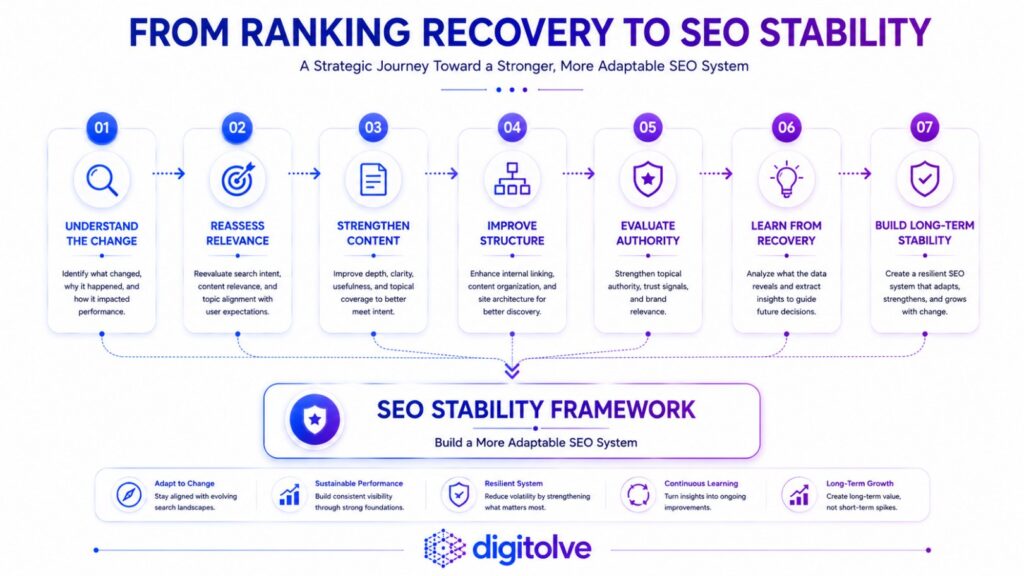
This is the final visual summary of the entire article:
Understand → Reassess → Strengthen → Improve → Evaluate → Learn → Stabilize
Call to Action
Ranking recovery becomes more effective when it is treated as a structured process rather than a collection of isolated SEO changes.
The SEO Stability Framework is designed to help turn the strategic principles discussed in this article into a practical recovery and stability process.
Instead of simply asking:
“How do I get my rankings back?”
the framework helps you approach the broader question:
“How can I systematically strengthen the SEO system behind important ranking assets and improve how I respond to future changes?”
What the SEO Stability Framework Is Designed to Help With
- Understanding the areas that may need attention
- Structuring recovery decisions
- Strengthening important SEO foundations
- Connecting content and internal structure
- Evaluating relevant authority considerations
- Learning from meaningful ranking changes
- Building a more consistent long-term improvement process
The blog explains what sustainable ranking recovery requires and why stability matters.
The SEO Stability Framework provides the structured implementation layer for putting those principles into practice.
Blog → Strategic Understanding
Framework → Structured Execution
Recover the ranking, strengthen the system, and build a process that can adapt as search evolves.
Recommend reading
Why Your Content Doesn’t Stay Ranked
Explore why ranking improvements can weaken over time and why ongoing content and SEO strengthening can matter for long-term visibility.
Why Your SEO Results Are Inconsistent
Understand why SEO performance can feel unstable and how a more connected approach can create a stronger foundation for consistent improvement.
How to Build an SEO Ranking System That Consistently Improves Google Rankings
Learn how connected SEO systems can support ranking improvement through a structured and continuous approach rather than isolated tactics.