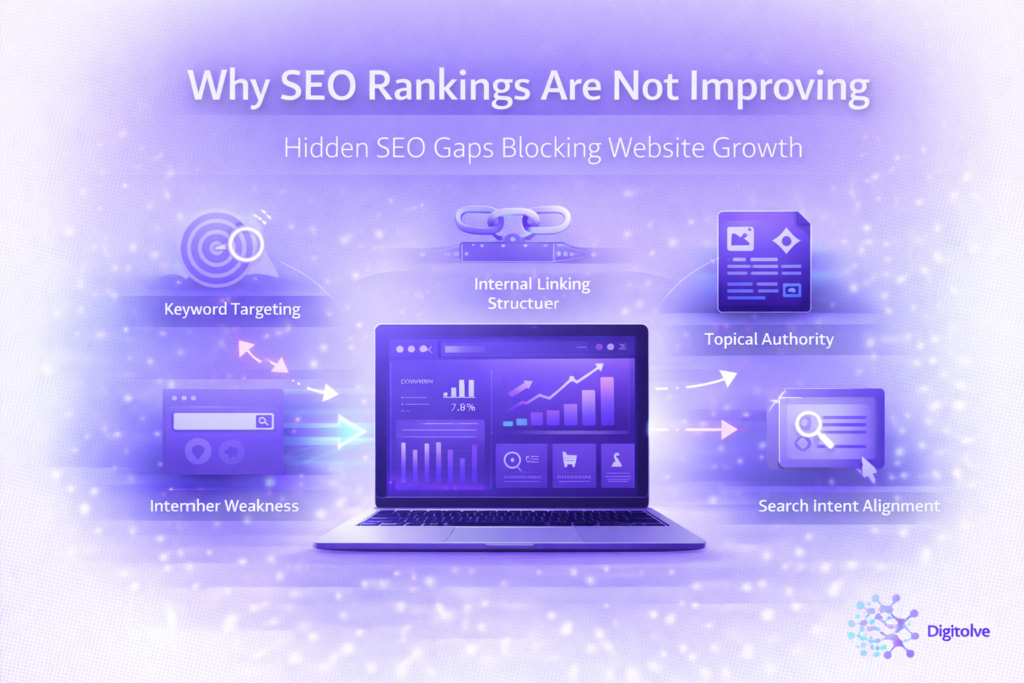
Many website owners feel frustrated when their SEO rankings are not improving even after publishing content consistently.
They write blog posts, optimize titles, add keywords, and sometimes even update older articles. Yet their pages remain stuck on page three, four, or even deeper in search results.
This situation creates a confusing question.
If the content exists and SEO work is being done, why is the website still not ranking on Google?
The truth is that most ranking problems are not caused by effort. They are caused by hidden structural gaps inside a website’s SEO system.
These gaps are often invisible to creators because they are not obvious technical errors. Instead, they appear in subtle ways such as weak keyword targeting, missing topic authority, poor internal linking, or content that search engines cannot properly interpret.
Many websites unknowingly publish large amounts of content without realizing that the SEO system supporting the content is incomplete.
As a result, search engines struggle to understand the website’s topical authority and relevance.
Research from HubSpot marketing research shows that simply producing more content does not guarantee search visibility if the underlying SEO structure is weak.
This explains why some websites publish dozens of articles yet continue experiencing SEO rankings not improving month after month.
Another important factor is that search engines evaluate websites as content ecosystems rather than isolated pages. When articles lack strong relationships with each other, search engines may struggle to recognize the overall authority of the site.
For example, a blog may publish helpful posts but fail to build a structured visibility system that connects topics and signals expertise.
This is why many creators begin asking questions such as:
Why is my SEO not working
Why is my website not ranking on Google
Why are my blog posts getting no traffic
These questions often lead back to the same root cause.
Hidden SEO gaps.
In fact, many websites unknowingly miss important ranking signals that search engines expect to see when evaluating content quality and relevance.
Understanding these gaps is essential because SEO improvement rarely happens through random optimization efforts. It happens when the underlying SEO structure of the website becomes stronger.
For example, websites that build strong topical clusters, maintain clear internal linking pathways, and align content with search intent often see significantly better visibility.
This is also why content visibility and SEO performance are closely connected. When a website improves its visibility architecture, search engines can more easily understand and rank its content.
You may have already noticed this pattern in the earlier discussion about content visibility systems.
In this guide, we will explore the most common hidden SEO gaps that prevent websites from improving their rankings.
You will learn
• why SEO rankings stagnate
• what signals search engines actually evaluate
• which structural gaps hold websites back
• how to diagnose your own SEO system
By the end, you will understand why your SEO efforts may not be producing results and how to identify the missing elements that search engines need in order to rank your content.
And if you want a practical way to detect and fix these gaps, you can later use the SEO Gap Audit Toolkit, which provides worksheets and planners designed to help website owners identify ranking problems step by step.
Table of Contents
The Most Common SEO Gaps That Block Rankings
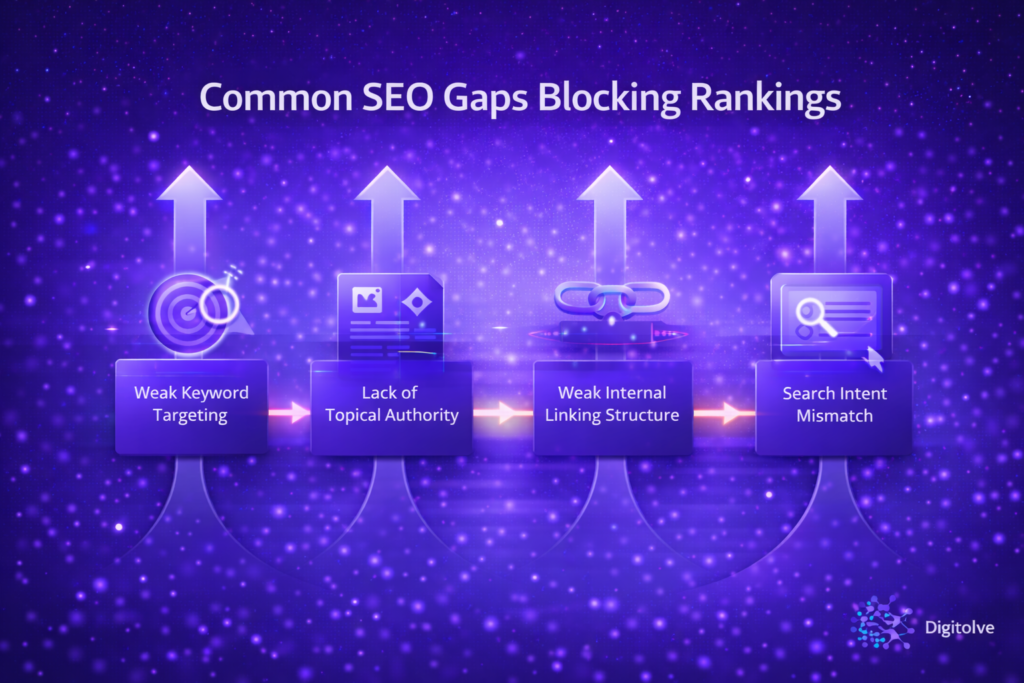
Many ranking problems are not caused by a lack of content but by structural gaps within a website’s SEO system. Weak keyword targeting, missing topical authority, poor internal linking, and search intent mismatch can disrupt how search engines interpret the value of a website’s content.
After understanding that hidden structural problems often block SEO growth, the next step is identifying the specific gaps that prevent websites from improving their rankings.
Many creators assume that SEO success depends only on adding more keywords or publishing more content. In reality, search engines evaluate multiple signals that determine how a website’s content should appear in search results.
When these signals are incomplete or weak, websites often experience the same frustrating pattern: consistent effort but SEO rankings not improving.
Below are the most common SEO gaps that quietly block many websites from gaining visibility in search results.
SEO Gap 1
Weak Keyword Targeting
One of the most common SEO problems is targeting keywords that do not match real search intent.
Website owners often create content around topics they believe are useful, but the chosen keywords may not reflect the exact phrases people are searching for. When keyword targeting is weak, search engines struggle to connect the content with relevant search queries.
Research from Ahrefs SEO research shows that many pages fail to rank simply because they target overly broad or unclear keyword topics.
Strong SEO content begins with identifying keywords that match both user intent and topic relevance. Without that alignment, even high-quality content may remain invisible.
SEO Gap 2
Lack of Topical Authority
Another major reason SEO rankings stagnate is the absence of topical authority.
Search engines try to determine whether a website consistently publishes information about a specific subject. If a website covers many unrelated topics without building depth in one area, search engines may struggle to recognize the expertise of the website.
For example, a site might publish a few articles about SEO but never expand the topic further with supporting content. As a result, the search engine cannot clearly interpret the website as a reliable source in that field.
This is why many digital growth systems emphasize building structured topic ecosystems instead of isolated posts.
When content is connected through structured topic relationships, search engines can more easily recognize the authority of the website.
According to Google Search documentation, topic relevance and site structure play an important role in how search engines understand and rank content.
SEO Gap 3
Weak Internal Linking Structure
Internal linking plays a crucial role in helping search engines understand how content connects within a website.
When articles remain isolated without internal links guiding search engines toward related topics, the overall structure of the website becomes difficult to interpret.
This weak structure prevents search engines from identifying the most important pages on a site.
For example, a website may have valuable articles but fail to build the internal pathways that connect those pages into a clear knowledge system.
This is why modern SEO strategies increasingly focus on building structured growth systems rather than publishing random article.
When internal linking networks become stronger, search engines can more easily understand which pages carry the most authority.
Insights from Search Engine Journal SEO studies also highlight that strong internal linking structures significantly improve content discoverabilit.
SEO Gap 4
Search Intent Mismatch
Even when the correct keywords are targeted, rankings can still struggle if the content does not match the user’s search intent.
Search intent refers to the reason behind a user’s search query.
Some searches are informational, while others are transactional or problem-focused. If the content fails to answer the specific problem the user is trying to solve, search engines may interpret the page as less relevant.
For example, someone searching for “why SEO rankings are not improving” expects a clear explanation of possible causes and practical solutions.
If the content provides only general SEO advice instead of diagnosing the issue, search engines may struggle to see the page as the best answer for that query.
This is why modern digital strategies emphasize aligning content creation with long-term growth system.
Understanding search intent ensures that content answers the exact problem users are trying to solve.
Research from Content Marketing Institute research shows that organizations with clearly defined content strategies are significantly more likely to achieve consistent traffic.
These SEO gaps are extremely common across many websites.
The good news is that once these gaps are identified, they can be corrected with a structured SEO diagnosis process.
In the next section, we will introduce the framework that helps website owners systematically detect these hidden SEO gaps and understand exactly where their ranking problems originate.
The SEO Gap Detection Framework
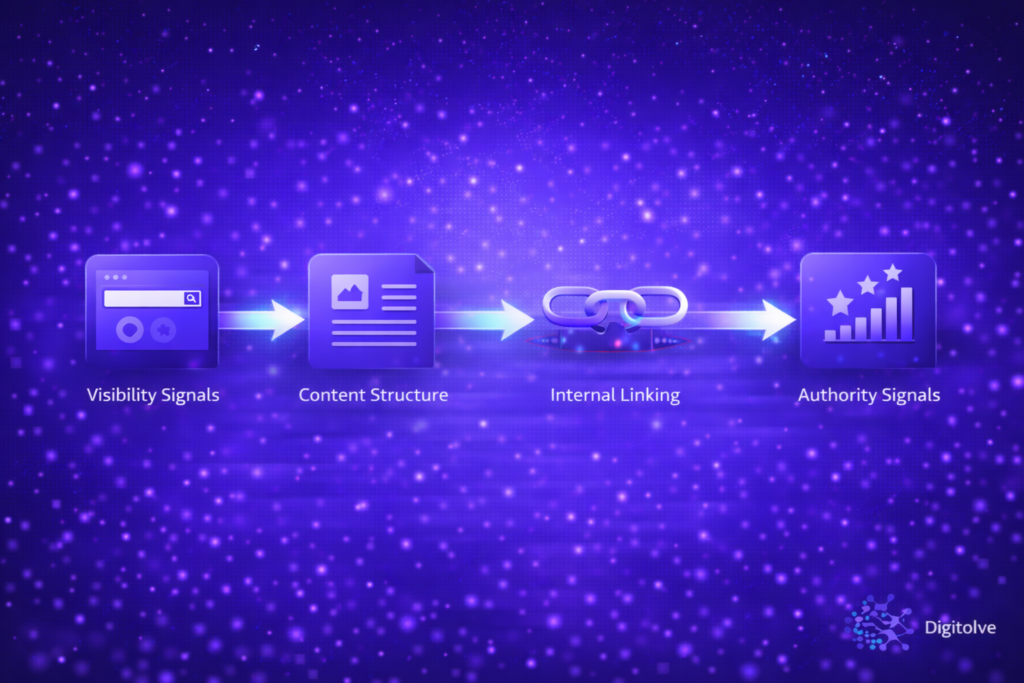
Identifying ranking problems requires a systematic approach. By analyzing visibility signals, content architecture, internal linking patterns, and authority signals, website owners can diagnose the root causes behind weak search performance and develop more effective SEO strategies.
Once the most common SEO gaps are understood, the next step is learning how to detect them inside your own website.
Many creators try to fix SEO problems by making random changes. They adjust keywords, update headlines, or add more content without identifying the real structural issue.
This approach rarely produces consistent results.
SEO improvement becomes much easier when you use a clear framework that helps diagnose where your visibility system is weak.
Research from HubSpot marketing research shows that businesses that follow structured marketing frameworks grow significantly faster than those relying on isolated tactics.
The SEO Gap Detection Framework helps website owners identify weaknesses across four key areas that influence search rankings.
Step 1 — Visibility Signal Analysis
The first step is evaluating the visibility signals that search engines use to understand your website.
Search engines analyze signals such as topic relevance, internal linking pathways, content structure, and authority indicators. If these signals are weak or inconsistent, search engines may struggle to determine how your content should rank.
Many websites experience ranking stagnation because the underlying structure supporting their content has never been intentionally designed.
This is often connected to a missing digital systems architecture that organizes how content, strategy, and growth signals interact.
When a website develops stronger structural signals, search engines can interpret the expertise and relevance of its content more clearly.
Insights from Ahrefs SEO research also show that websites with clear structural signals outperform sites that publish disconnected content.
Step 2 — Content Structure Diagnosis
The next step is diagnosing how content is organized across the website.
Search engines prefer websites that demonstrate clear topical depth. When a website publishes scattered articles across unrelated subjects, it becomes difficult for search engines to identify the main area of expertise.
In contrast, websites that organize their content into structured topic clusters send stronger authority signals.
This is where a well-defined digital growth strategy becomes important because it aligns content topics with long-term authority building.
When content is organized around clear topic clusters, search engines can interpret the website as a reliable source within that subject area.
According to Google Search documentation, strong site structure improves both crawl efficiency and search visibility.
Step 3 — Strategy Alignment Check
SEO performance also depends on whether the website’s strategy aligns with its execution.
Many businesses develop marketing plans but fail to translate them into structured systems that guide content production and visibility signals.
This disconnect often creates the gap between strategy and real results.
A strong digital systems strategy ensures that every piece of content contributes to the larger authority system of the website.
When strategy and execution align, content creation becomes part of a long-term growth system instead of isolated publishing efforts.
Research from Content Marketing Institute research shows that organizations with documented strategies achieve stronger traffic growth and more consistent visibility.
Step 4 — SEO Strategy Effectiveness
The final stage of the SEO Gap Detection Framework focuses on evaluating the effectiveness of the current SEO strategy.
Some websites apply small optimization tactics but never build a comprehensive SEO system.
When SEO becomes part of a broader digital growth system, websites gradually strengthen their authority signals across multiple related topics.
Studies from Search Engine Journal SEO studies confirm that long-term SEO success depends on strategic consistency rather than isolated optimization tactics.
The SEO Gap Detection Framework helps website owners move beyond guesswork.
Instead of randomly adjusting SEO settings, this framework provides a structured method for identifying the exact problems preventing rankings from improving.
In the next section, we will examine how website owners can perform a practical SEO gap audit to diagnose their website and identify the most critical issues affecting their search visibility.
The SEO Gap Audit Process
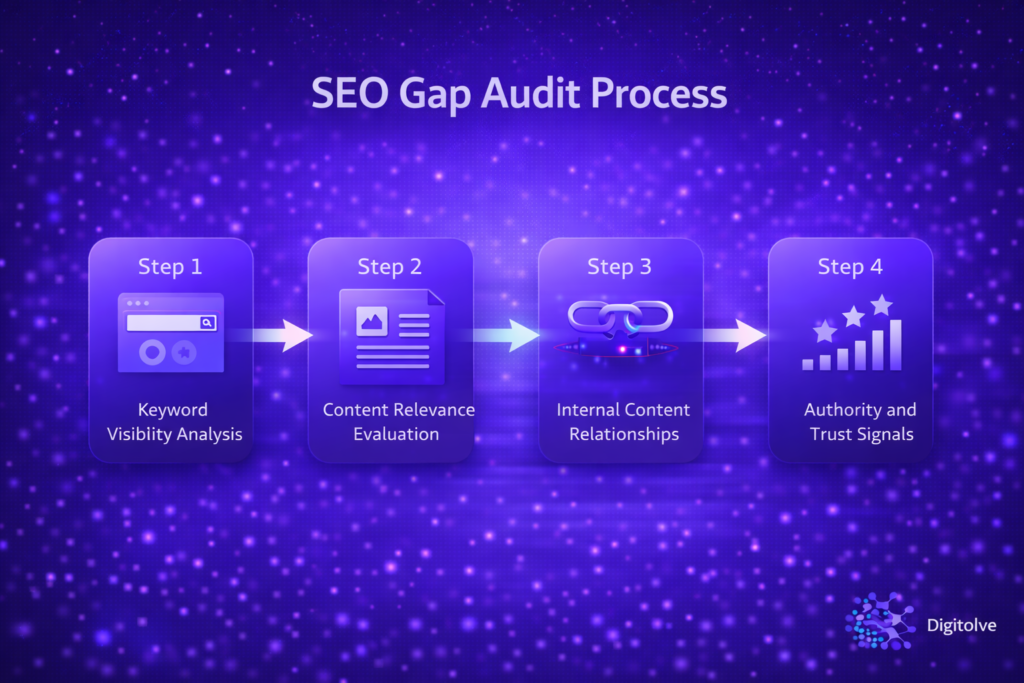
An SEO gap audit evaluates how well a website aligns with search demand. This process usually includes analyzing keyword visibility, evaluating content relevance, reviewing internal content relationships, and identifying authority signals that influence search engine trust.
Once the major SEO gaps are understood and the detection framework is clear, the next step is performing a practical SEO gap audit.
An SEO gap audit is a structured process used to identify the exact weaknesses preventing a website from improving its search rankings.
Instead of guessing why SEO performance is slow, the audit helps website owners examine their site through the same signals search engines evaluate.
Research from Google Search documentation explains that search engines analyze multiple factors such as site structure, relevance, and content relationships when determining how pages appear in search results.
A structured audit helps reveal whether these signals are strong, weak, or completely missing.
Step 1 — Analyze Your Current Keyword Visibility
The first step of an SEO gap audit is understanding how your website currently appears in search results.
Many creators publish content without tracking which keywords their pages actually rank for. Without this visibility data, it becomes difficult to identify whether the problem is keyword targeting, content relevance, or site authority.
Website owners should review their current keyword rankings and identify pages that receive impressions but fail to generate traffic.
This early signal often indicates a mismatch between keyword targeting and search intent.
A structured SEO strategy for brands in 2026 usually begins by analyzing keyword visibility before creating additional content.
According to insights shared in Ahrefs SEO research, identifying keyword gaps between your website and competitors is one of the most effective ways to uncover new ranking opportunities.
Step 2 — Evaluate Content Relevance
After reviewing keyword visibility, the next step is evaluating whether existing content truly answers the search intent behind targeted queries.
Search engines prioritize content that provides clear and direct answers to user problems.
If a page discusses a topic broadly but does not address the specific search question users are asking, search engines may rank competing pages instead.
This is why many websites produce helpful content yet fail to gain visibility.
A strong content marketing strategy in 2026 focuses on aligning every article with a specific search problem that users want solved.
I
Research from Content Marketing Institute research shows that content aligned with clear user intent performs significantly better in search results.
Step 3 — Review Internal Content Relationships
Another critical step in the SEO gap audit is analyzing how pages connect with each other across the website.
Search engines use internal links to understand topic relationships and determine which pages represent the most important resources within a website.
When content exists without internal linking pathways, search engines may struggle to interpret how different pages support each other.
This is why websites with strong internal knowledge networks often perform better than sites that publish isolated articles.
Developing a strong internal structure is part of building a scalable digital systems architecture that supports long-term content growth.
I
SEO studies referenced by Search Engine Journal research confirm that structured internal linking helps search engines understand page importance and improves crawl efficiency.
Step 4 — Identify Authority and Trust Signals
The final step in the SEO gap audit is examining whether the website sends strong authority and trust signals.
Search engines look for indicators that a website demonstrates expertise and credibility within a particular topic.
These signals may include consistent topical coverage, strong content structure, and clear strategy alignment.
When these signals are missing, search engines may hesitate to rank the website higher even if individual pages contain useful information.
Building authority requires more than publishing content. It requires aligning content with a larger digital growth system.
This is why many successful websites develop a structured digital transformation strategy that connects content, visibility systems, and long-term authority growth.
Insights from HubSpot marketing research also show that websites with consistent strategic systems experience stronger long-term growth compared to those relying on isolated tactics.
An SEO gap audit provides a clear picture of where a website’s visibility system is failing.
Once these gaps are identified, website owners can begin fixing the structural issues that prevent their content from ranking.
In the next section, we will explore how to systematically close these gaps and strengthen the SEO foundation of a website.
How to Close SEO Gaps and Strengthen Your Ranking Signals
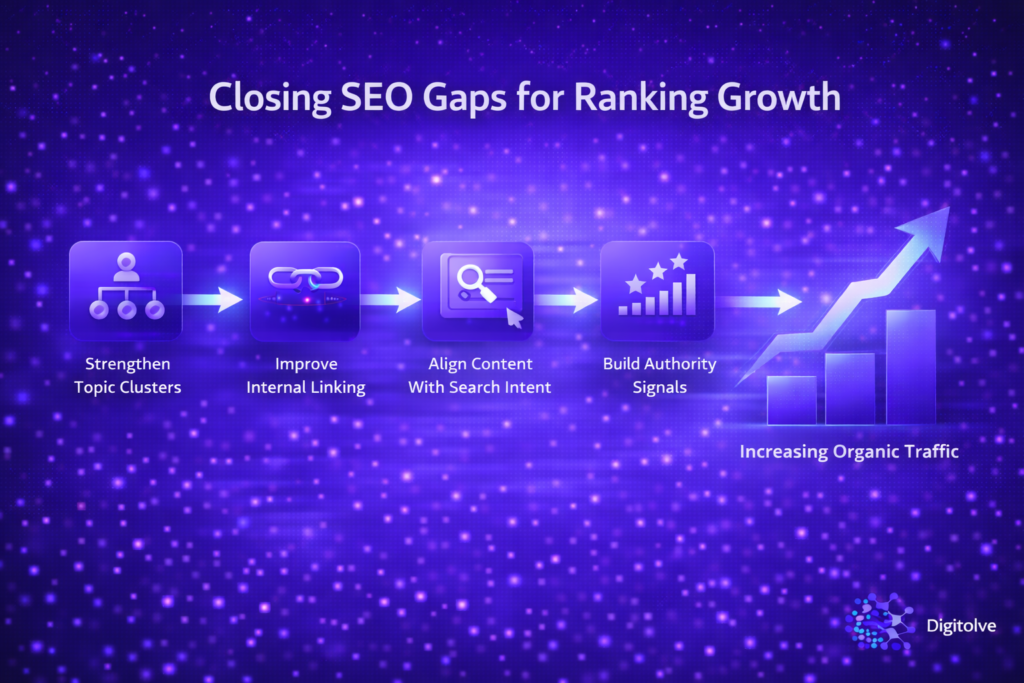
Once SEO gaps are identified, the next step is strengthening the website’s growth system. This may involve building topic clusters, improving internal linking systems, aligning content with search intent, and developing stronger authority signals across the website.
After identifying the structural issues affecting your website’s search visibility, the next step is systematically closing those gaps.
Many website owners stop at the diagnosis stage. They recognize that their SEO system has weaknesses but are unsure how to correct them in a structured way.
Closing SEO gaps requires strengthening the signals that search engines rely on to interpret content relevance, authority, and structure.
Research from Google Search documentation explains that search visibility improves when websites consistently strengthen content relevance, site structure, and topic relationships.
The following actions help transform a weak SEO structure into a stronger ranking system.
Strengthen Topic Clusters
One of the most effective ways to close SEO gaps is by expanding topic coverage around important subjects.
Instead of publishing isolated articles, websites should develop topic clusters where multiple pieces of content support a central theme.
This approach helps search engines understand that the website consistently publishes information about a specific subject.
When topic clusters grow, authority signals become stronger.
A well-defined content marketing strategy in 2026 often uses topic clusters to build both trust and traffic over time.
I
Studies referenced in Ahrefs SEO research show that websites covering topics in depth often outperform sites publishing disconnected articles.
Improve Internal Linking Systems
Internal links help search engines interpret how different pieces of content relate to each other.
When articles link to supporting topics, search engines can better understand the structure of the website and identify which pages carry the most authority.
Many websites fail to improve rankings simply because their internal linking structure is weak or inconsistent.
Strengthening internal pathways helps distribute authority signals across important pages.
This process is often part of building a scalable digital systems architecture that connects content and growth strategies.
SEO studies referenced by Search Engine Journal research confirm that strong internal linking networks significantly improve content discoverability.
Align Content With Search Intent
Another key step in closing SEO gaps is aligning content with user search intent.
Search engines attempt to provide results that best answer the user’s question. If a page does not clearly address the specific problem behind a search query, it may struggle to rank.
For example, someone searching for “why SEO rankings are not improving” expects an explanation of potential causes and actionable solutions.
If the content only provides general advice instead of diagnosing the issue, search engines may prefer other pages that better match the query.
A well-planned digital growth strategy helps ensure that content aligns with real user problems rather than generic topics.
Research from Content Marketing Institute research also shows that content aligned with user intent consistently performs better in search results.
Build Long-Term Authority Signals
SEO improvement rarely happens instantly.
Search engines gradually evaluate whether a website demonstrates expertise and reliability within a specific subject area.
Websites that consistently publish relevant content, maintain strong internal linking structures, and align their strategy with long-term growth signals often experience steady improvements in search visibility.
This is why modern SEO strategies focus on developing sustainable authority systems instead of relying on short-term optimization tactics.
Many businesses achieve this by implementing structured digital transformation strategies that connect content, growth systems, and authority building.
Insights from HubSpot marketing research highlight that companies with consistent strategic systems achieve stronger long-term growth compared to those relying on isolated marketing.
Closing SEO gaps is not about applying random optimization techniques.
It is about strengthening the structural signals that search engines use to interpret content authority, relevance, and relationships.
When these signals become stronger, search visibility gradually improves and rankings begin to move upward.
In the next section, we will explore how website owners can implement a structured SEO improvement roadmap to ensure long-term growth.
The SEO Improvement Roadmap for Long-Term Growth
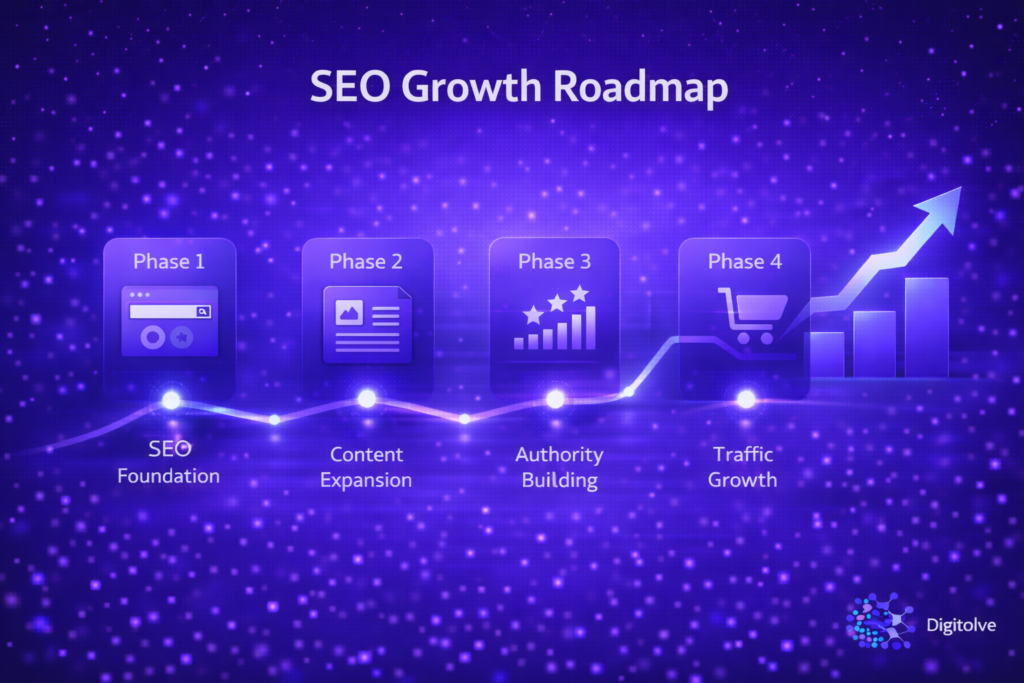
Sustainable SEO growth rarely happens instantly. Instead, it develops gradually through a structured roadmap that begins with a strong foundation, expands content authority, strengthens linking relationships, and eventually results in steady organic traffic growth.
Once the major SEO gaps have been identified and corrective actions are clear, the next step is implementing a structured roadmap for long-term improvement.
Many websites attempt to improve rankings through isolated actions such as updating titles, publishing more articles, or adjusting keywords. While these steps can help, they rarely produce consistent results when applied without a clear system.
SEO growth becomes much more reliable when improvements follow a structured roadmap that strengthens visibility signals over time.
Research from HubSpot marketing research shows that businesses using structured growth systems achieve more consistent traffic expansion than those relying on random marketing activities.
The SEO improvement roadmap focuses on strengthening four key areas that influence long-term search visibility.
Phase 1 — Establish a Clear SEO Foundation
The first phase focuses on building a stable SEO foundation.
This includes improving keyword targeting, aligning content with search intent, and strengthening the internal structure of the website.
Without a strong foundation, additional content rarely improves rankings because the underlying system supporting search visibility remains weak.
A well-structured SEO strategy for brands in 2026 often begins by strengthening the foundational elements of search visibility before expanding content production.
According to insights shared in Google Search documentation, search engines rely heavily on site structure and relevance signals when determining how pages should appear in search results.
Phase 2 — Build Topic Authority
After establishing a solid SEO foundation, the next phase focuses on expanding topical authority.
Search engines tend to favor websites that consistently publish information around a defined subject area.
Instead of creating scattered content across unrelated topics, websites should gradually build clusters of related articles that strengthen authority signals.
This approach allows search engines to recognize the website as a reliable source within that topic.
Developing this structure often requires a clear digital systems strategy that connects content planning with long-term authority growth.
Research from Ahrefs SEO research also indicates that websites covering topics comprehensively often outperform those publishing isolated articles.
Phase 3 — Strengthen Content Relationships
Once topic clusters begin to grow, the next step is strengthening relationships between articles.
Internal links help search engines interpret how different pieces of content support one another within a broader knowledge system.
When these relationships become clearer, search engines can more easily identify the most valuable pages and understand the expertise of the website.
This is why scalable content ecosystems often rely on a structured digital growth strategy that connects content planning with authority development.
Insights from Search Engine Journal SEO studies show that websites with strong internal linking systems often achieve better indexing efficiency and improved rankings.
Phase 4 — Maintain Strategic Consistency
The final phase focuses on maintaining consistency.
SEO improvement rarely occurs through one-time optimization efforts. Instead, search engines gradually evaluate whether a website continues to demonstrate expertise and relevance over time.
Websites that maintain consistent publishing schedules, clear topic structures, and strong internal linking systems often experience gradual and sustainable growth in search visibility.
Many organizations achieve this by aligning their content strategy with a broader digital transformation strategy that connects marketing systems with long-term authority development.
Research from Content Marketing Institute research confirms that organizations with documented strategies and consistent execution achieve significantly stronger long-term traffic growth.
The SEO improvement roadmap transforms random optimization efforts into a structured growth system.
By strengthening foundations, building topic authority, connecting content relationships, and maintaining strategic consistency, websites gradually improve their search visibility.
In the next section, we will explore the key signals search engines evaluate when determining whether a website deserves higher rankings in search results.
Conclusion — Fixing the SEO System
If your SEO rankings are not improving, the problem is rarely a lack of effort.
Most websites struggle because the underlying SEO system supporting their content is incomplete.
Throughout this guide we examined the hidden structural gaps that often prevent websites from gaining search visibility. These gaps may appear in the form of weak keyword targeting, scattered content structures, missing internal linking pathways, or content that does not fully align with user search intent.
When these signals remain weak, search engines struggle to understand how your website should appear in search results.
This is why many websites publish valuable content yet still experience slow growth in rankings and traffic.
SEO success rarely comes from isolated optimization tactics.
Instead, it emerges from strengthening the entire visibility system that supports your content.
When websites build clear topic clusters, maintain structured internal linking networks, and align content with real search intent, search engines can more easily recognize the relevance and authority of the site.
This approach transforms SEO from a collection of random actions into a structured growth system.
Many modern growth frameworks emphasize this type of structural approach because search engines evaluate websites as connected knowledge ecosystems rather than individual pages.
Developing a scalable digital growth strategy helps ensure that every piece of content contributes to a larger visibility system.
Insights from HubSpot marketing research also highlight that organizations using structured marketing systems experience more consistent traffic growth compared to those relying on isolated tactics.
Once these structural gaps are identified, the next step is implementing a clear process for diagnosing and fixing them across your website.
This is exactly where a practical SEO audit becomes valuable.
Instead of guessing what might be wrong with your rankings, a structured audit helps identify the exact issues blocking your search visibility.
If you want to systematically detect and fix these hidden SEO gaps, the SEO Gap Audit Toolkit provides worksheets, planners, and checklists designed to guide you through the entire process step by step.
By identifying structural weaknesses and strengthening the signals search engines rely on, you can gradually transform your SEO performance from inconsistent results into sustainable long-term growth.
FAQs About SEO Rankings and Digital Growth Systems
Many website owners experience slow SEO growth because they focus only on individual tactics instead of understanding the larger system behind search visibility. The following questions address some of the most common concerns related to SEO rankings not improving and how a structured digital growth system helps websites achieve sustainable traffic growth.
Why are my SEO rankings not improving even after publishing regular content?
Publishing content consistently does not automatically improve rankings if the underlying SEO structure is weak. Many websites publish articles without strong keyword targeting, internal linking systems, or clear topical authority. Search engines evaluate websites as connected knowledge systems rather than isolated pages. When content is not supported by a structured digital growth system, search engines may struggle to interpret the relevance and authority of the website.
How long does it take for SEO rankings to start improving after fixing SEO gaps?
SEO improvement rarely happens instantly. Once structural gaps such as weak keyword targeting, missing internal links, or poor topic coverage are corrected, search engines gradually reevaluate the website. In many cases, websites begin seeing noticeable improvements within several weeks to a few months as stronger signals are detected across the content system. Consistency and clear strategy are essential for long-term growth.
What are the most common reasons why a website gets traffic but no search ranking growth?
One of the most common reasons is that traffic sources may come from social platforms or referrals rather than organic search. Another major reason is weak topical authority. If a website publishes scattered content across many unrelated subjects, search engines may struggle to recognize expertise within a particular topic. Developing structured topic clusters within a broader digital growth system helps search engines understand the website’s authority more clearly.
How does a digital growth system improve SEO visibility?
A digital growth system connects multiple elements of a website into a structured ecosystem. It aligns content planning, keyword targeting, internal linking, and topic clusters so that each article contributes to a larger authority structure. When search engines recognize these structured relationships, they can more easily interpret the expertise of the website, which improves long-term search visibility.
What is the best way to diagnose hidden SEO gaps that prevent rankings from improving?
The most effective approach is performing a structured SEO gap audit. Instead of guessing what might be wrong, a gap audit analyzes keyword visibility, content structure, internal linking pathways, and authority signals across the website. Identifying these gaps allows website owners to correct structural weaknesses and strengthen the signals search engines rely on when ranking content.
Recommended Reading for Building a Strong Digital Growth System
If you want to understand how SEO, content visibility, and long-term digital growth systems work together, the following guides will help you explore the broader strategy behind sustainable search traffic and authority building.
Digital Systems Architecture: The Missing Foundation Behind Scalable Digital Growth
This guide explains how structured digital systems help businesses build scalable growth instead of relying on isolated marketing tactics.
Content Marketing Strategy in 2026: How Brands Build Trust and Traffic
This article explores how modern brands combine content strategy, visibility systems, and trust-building to create sustainable traffic growth.
Why Most Digital Strategies Fail in 2026 (And the Exact System That Works)
This guide explains why many marketing strategies fail without a structured digital system and how businesses can design strategies that produce consistent results.