
Many website owners struggle with a common content discovery problem.
They spend hours writing articles, optimizing headlines, and publishing consistently, yet their content still fails to get discovered online. This happens because visibility on the internet depends on more than just publishing content. Without a structured content discovery system, even high-quality articles can remain invisible.
Days pass. Then weeks.
But when you check your analytics, the numbers barely move.
Your content exists online, yet it feels almost invisible.
This is one of the most frustrating experiences for creators, bloggers, and businesses trying to grow their digital presence. You know the content is helpful. You know people are searching for the topic. Yet somehow your article never seems to appear where the audience can find it.
This problem leads many creators to ask the same question.
Why is my content not getting discovered?
At first, the assumption is usually simple: perhaps the article needs better keywords, more backlinks, or additional promotion. While these factors can influence visibility, the real reason many articles remain invisible is often much deeper.
The problem is not always the content itself.
The problem is the discovery system behind the content.
Search engines and digital platforms do not simply rank or recommend content based on effort. They evaluate signals that help them understand what the content is about, how it connects to other information, and whether it deserves visibility within a larger topic ecosystem.
When those signals are weak or missing, even valuable content can remain buried beneath thousands of competing pages.
In many cases, creators focus heavily on writing content but overlook the structural elements that help search engines and discovery algorithms interpret that content.
For example, an article may address a useful topic but fail to connect with related pages on the website. Another piece of content may target a subject people care about but lack the signals that help search engines recognize its relevance.
Over time, this creates a situation where websites accumulate content but fail to build a visibility system that supports discovery.
The result is predictable.
Articles remain hidden.
Traffic grows slowly or not at all.
And creators begin to wonder whether their content strategy is working.
Understanding why content remains undiscovered is the first step toward fixing this problem.
Once the structural gaps behind discovery are identified, it becomes much easier to design a system that helps search engines and audiences find your content more easily.
In this guide, we will explore why many articles struggle to gain visibility online and what structural factors often prevent good content from being discovered.
More importantly, you will begin to understand how discovery systems work and why building the right signals around your content is just as important as writing the content itself.
Table of Contents
The Content Discovery Problem
Many creators assume that once content is published online, search engines and audiences will naturally find it.
In reality, the internet contains an enormous amount of content competing for attention. Every day thousands of new articles, blog posts, videos, and guides are published across different platforms. Within this environment, simply publishing content is rarely enough to guarantee visibility.
For search engines and digital platforms, the challenge is deciding which content deserves to be discovered first.
To make that decision, algorithms rely on signals that help them interpret the relevance, quality, and structure of each piece of content.
When those signals are strong, content is easier for algorithms to understand and distribute. When those signals are weak or unclear, content may remain buried even if the information itself is useful.
This is where the content discovery problem begins.
Many websites focus heavily on creating content but overlook the structural signals that allow that content to be discovered. As a result, articles exist online but never receive the visibility they deserve.
The discovery problem usually appears in a few common ways.
First, some content is written around topics that people rarely search for. Even well-written articles struggle to attract attention if the topic does not align with real search behavior.
Second, content may address an important topic but fail to provide the depth or structure that search engines expect. When competing pages offer clearer explanations or stronger organization, algorithms may prefer those pages instead.
Third, many websites publish articles that remain isolated from the rest of the website’s content. Without internal connections that help search engines understand how different pages relate to one another, the overall topic authority of the website becomes difficult to interpret.
Finally, some websites publish content without building the broader signals that indicate expertise within a subject area. Search engines often look for patterns of consistency and topical depth when deciding which websites deserve greater visibility.
When these signals are missing, the result is content that exists online but rarely appears where audiences can find it.
Creators often interpret this situation as a failure of the content itself, but the issue is frequently structural rather than informational.
In other words, the problem is not always what the content says. The problem is how the content fits into a system that allows it to be discovered.
Recognizing this difference is important because it shifts the focus from writing more content to building the signals that support visibility.
Once these discovery gaps become clear, it becomes easier to understand why some websites consistently attract traffic while others remain difficult to find.
In the next section, we will examine the core framework behind how content discovery actually works and why certain signals determine whether your content becomes visible or remains hidden.
The Content Discovery system Framework
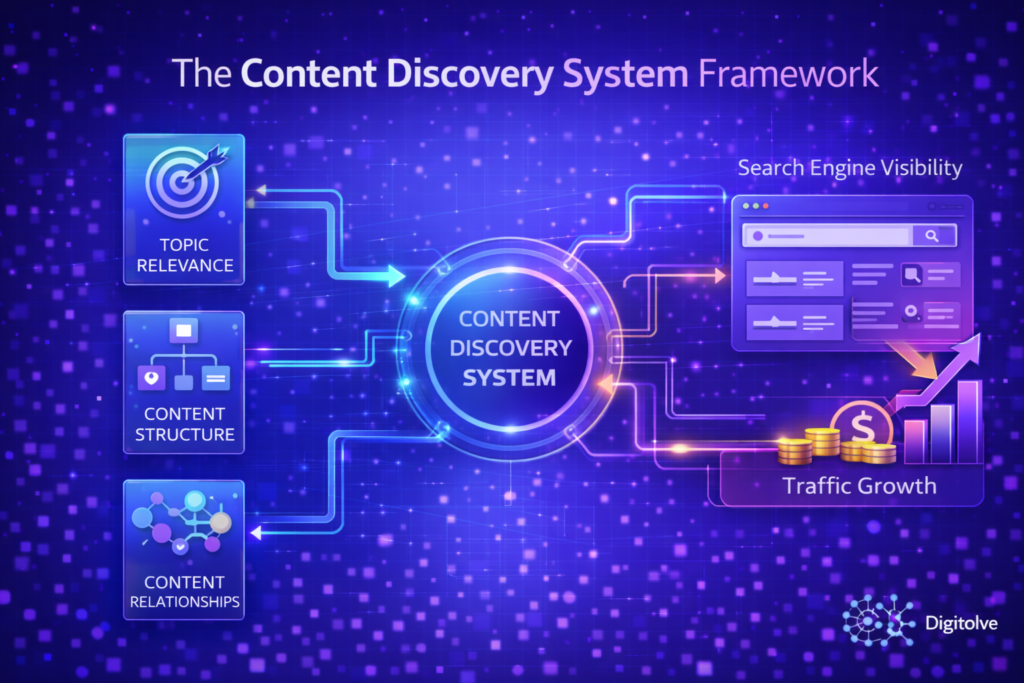
Search engines rely on multiple signals to discover and evaluate content. A strong content discovery system organizes content into meaningful topic structures, builds relationships between pages, and strengthens authority signals that support search visibility.
Once we understand why content often remains invisible, the next step is understanding how discovery actually works.
Search engines and digital platforms do not evaluate content randomly. They rely on a set of signals that help them interpret whether a page deserves visibility within a topic.
These signals act like indicators that help algorithms determine how relevant, useful, and trustworthy a piece of content might be.
When these signals are clear and aligned, content becomes easier to discover. When they are weak or disconnected, even well-written articles may struggle to appear in search results.
The content discovery framework can be understood through four key signals.
Topic Relevance
The first signal is topic relevance.
Search engines attempt to understand what your content is about and whether it directly answers a user’s search query. If the topic of the article clearly matches the search intent behind a keyword, the content becomes easier for algorithms to categorize.
Many websites struggle with discovery because their content does not align closely enough with the actual questions people search for online.
Understanding how topic relevance affects visibility is closely connected to the broader idea of SEO visibility systems.
When topic relevance is strong, search engines can more confidently match your content with the queries users are entering.
Content Structure
The second signal is content structure.
Well-structured articles help both readers and search engines understand information more clearly. Clear headings, logical sections, and organized explanations make it easier for algorithms to interpret the content.
Poorly structured content, even when informative, may be harder for search engines to analyze.
Many modern digital strategies emphasize structured content systems rather than isolated posts.
When structure improves, both readability and discovery often improve as well.
Research discussed in Search Engine Journal studies shows that well-structured content is easier for search engines to interpret and rank.
Content Relationships
The third signal involves the relationships between pages on your website.
Search engines analyze how articles connect with one another to understand the broader knowledge structure of a website. When pages support each other through internal linking, they create stronger topic signals.
Without these connections, articles may appear isolated, making it harder for algorithms to recognize the overall expertise of the website.
Building these connections is often part of a larger digital systems architecture that supports scalable content growth.
According to Google Search documentation, internal links help search engines discover relationships between pages and understand site structure.
Authority Signals
The final signal involves authority.
Search engines attempt to determine whether a website demonstrates consistent expertise within a particular topic. Websites that repeatedly publish related content within a structured topic area gradually build stronger authority signals.
When authority signals become stronger, search engines gain greater confidence in recommending that website’s content to users.
Studies shared in Ahrefs SEO research highlight that websites with deeper topical coverage tend to achieve stronger visibility in competitive search results.
Understanding these four signals helps explain why some content becomes highly visible while other content remains hidden.
Most discovery problems are not caused by a lack of effort. They are caused by missing signals within the visibility system surrounding the content.
Recognizing these signals is important because it shifts the focus from simply publishing more articles to strengthening the structure that supports discovery.
In the next section, we will examine why many websites continue producing content yet still struggle with visibility.
Why Good Content Still Gets Ignored Online
Many creators believe that producing high-quality content should automatically lead to visibility.
The assumption seems logical. If an article is useful, well written, and informative, it should eventually attract traffic and appear in search results.
However, the digital ecosystem does not always work this way.
Search engines and content platforms evaluate millions of pages competing for attention. Within this environment, visibility depends not only on the quality of the content but also on the signals that help algorithms understand and prioritize that content.
When these signals are incomplete, good content can remain invisible.
This explains why many websites publish helpful articles but still struggle with discovery.
Content Without Visibility Signals
One of the most common reasons good content gets ignored is the absence of strong visibility signals.
For example, an article may explain an important concept but fail to connect with related topics on the website. Without these connections, search engines may struggle to interpret how the article fits into the broader knowledge structure of the site.
In other cases, content may exist within a website that lacks a clear growth system guiding how articles relate to one another.
Many businesses face this challenge when their content strategy exists without a structured digital growth strategy connecting topics and visibility signals.
When these systems are missing, content can appear isolated even if it provides valuable information.
Publishing Without a Discovery System
Another common issue is publishing content without a clear discovery system.
Creators often focus on producing articles but overlook how those articles will be discovered by search engines and audiences. Without a system that strengthens visibility signals, each new piece of content must compete on its own.
Over time this leads to a website filled with content that lacks a unified struMany organizations eventually recognize that their marketing efforts need stronger coordination through a structured digital transformation strategy that connects content creation with long-term growth systems.
When strategy and discovery systems align, content begins to support a broader visibility architecture rather than existing as isolated posts.
The Competition Factor
Another reason content is often ignored is the level of competition surrounding popular topics.
Search engines aim to provide the most relevant and helpful answers for each query. If competing pages provide clearer explanations, stronger topic coverage, or deeper expertise, algorithms may prefer those pages even if your article is useful.
Research discussed in Content Marketing Institute reports highlights that content depth and topical authority strongly influence which pages gain visibility in competitive search environments.
Discovery Requires More Than Content
Understanding why good content gets ignored is important because it shifts the focus away from simply producing more articles.
The real challenge is not only creating content but building the system that allows that content to be discovered.
When websites strengthen their visibility signals, connect related topics, and develop a clearer structure, search engines can interpret their content more effectively.
In the next section, we will examine the discovery gap that prevents many websites from achieving consistent visibility.
The Discovery Gap Most Websites face
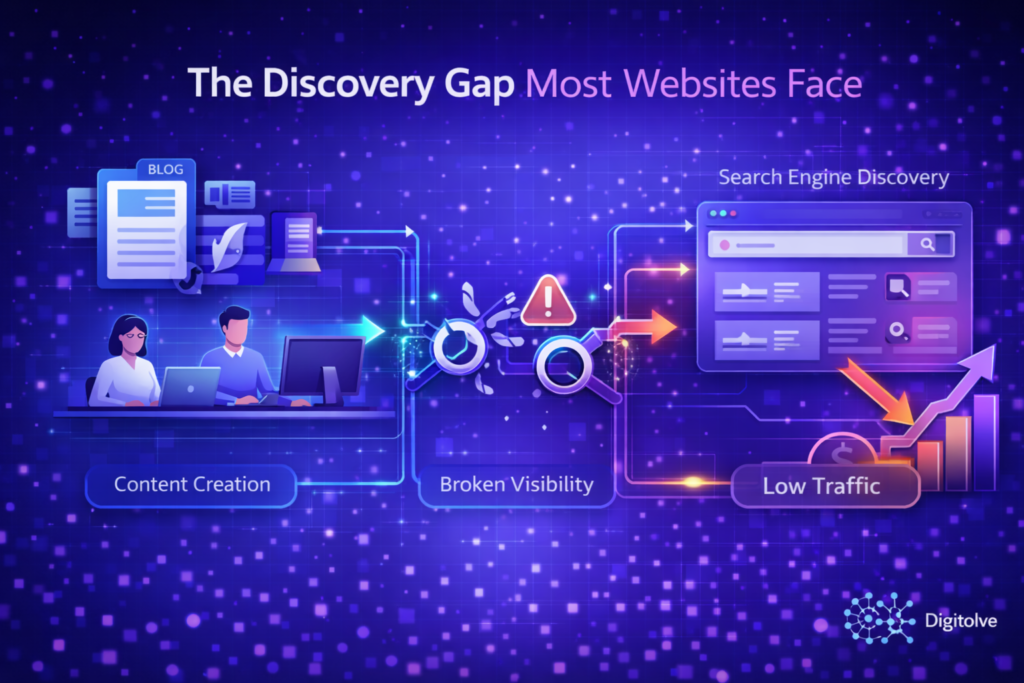
Many websites assume that publishing more articles will automatically generate traffic. However, when the discovery signals are weak, search engines struggle to understand the importance of the content. This creates a content discovery gap where articles exist but remain invisible to potential readers.
Many websites publish content consistently but still fail to gain meaningful visibility. This situation often confuses creators because the effort appears to be correct: articles are written, topics are researched, and content is uploaded regularly.
Yet traffic remains limited.
The reason usually lies in what can be called the discovery gap.
The discovery gap is the difference between publishing content and building the signals that help search engines and audiences find that content. When this gap exists, websites accumulate articles but fail to create a system that supports visibility.
Understanding this gap is important because it explains why some websites grow steadily while others remain difficult to discover.
Publishing Without Structural Signals
One of the most common causes of the discovery gap is publishing content without strong structural signals.
Articles may exist on the website, but they are not clearly connected to each other. Search engines rely on relationships between pages to understand how topics are organized across a site.
When those relationships are weak, the content may appear fragmented.
Instead of forming a clear knowledge structure, the website becomes a collection of isolated posts. This makes it harder for search engines to interpret expertise and relevance.
Many websites experience this issue when their content strategy is not supported by a broader system guiding how topics connect and expand over time.
Content Without Topic Expansion
Another part of the discovery gap appears when websites publish content without expanding topics over time.
Search engines tend to reward websites that demonstrate consistent depth within a subject area. If a site only publishes a few isolated articles about a topic, it may struggle to build authority.
Topic expansion helps search engines recognize patterns of expertise. When multiple articles support a central subject, the visibility of the entire topic cluster can improve.
Without this expansion, individual articles may struggle to compete against websites that cover the topic more comprehensively.
Research discussed in Ahrefs SEO studies shows that websites with stronger topical coverage tend to perform better in competitive search environments.
Why Many Websites Stay Invisible
When structural signals and topic expansion are missing, a website can remain invisible even if the content itself is helpful.
This is why many creators feel as though their content is “lost” online.
The issue is rarely the effort invested in writing. More often, it is the absence of a discovery system that helps search engines understand how the content fits within a broader topic ecosystem.
Recognizing this discovery gap is important because it shifts the focus away from simply publishing more content and toward building the signals that allow that content to be discovered.
In the next section, we will explore the concept of a content discovery system and why it plays a critical role in making online content visible.
The Content Discovery System Concept
After understanding the discovery gap, the next step is recognizing how a content discovery system helps solve this problem.
Many websites approach content creation as a publishing activity. Articles are written and uploaded regularly, but little attention is given to how those articles will be discovered by search engines and audiences.
A content discovery system changes this approach.
Instead of focusing only on producing content, the system focuses on building the signals that help search engines interpret and distribute that content more effectively.
When these signals are aligned, articles become easier for search engines to understand and recommend.
Content as Part of a System
One of the most important ideas behind content discovery is that articles should not exist in isolation.
Each piece of content contributes to a larger structure that helps search engines recognize expertise within a topic. When multiple articles support each other through topic relationships and internal connections, the entire system becomes stronger.
This approach transforms a website from a collection of individual posts into a connected knowledge structure.
Many successful websites grow their visibility by gradually developing this type of content ecosystem.
Visibility Signals That Support Discovery

Content visibility does not depend on a single article alone. Search engines evaluate how pages connect through topic clusters, internal links, and authority indicators. These signals guide search engines toward discovering and ranking the most relevant pages.
Content discovery depends on signals that help search engines interpret how useful and relevant a page might be.
These signals include topic clarity, structured content, internal connections between related pages, and consistent coverage of a subject area.
When these signals become stronger, search engines gain more confidence in recommending the content to users.
Research highlighted in Search Engine Journal studies explains that structured content systems often improve how search engines interpret and rank pages.
Discovery Requires Intentional Structure
A discovery system rarely appears automatically.
It develops when websites intentionally organize their content around clear topics and relationships. Instead of publishing articles randomly, creators begin thinking about how each new article strengthens the overall visibility system of the website.
This shift from random publishing to structured discovery is one of the most important transitions a website can make.
Many businesses eventually realize that content growth becomes more sustainable when supported by a broader digital systems architecture designed to connect strategy, content, and visibility signals.
/
From Content Creation to Content Discovery

The journey from content creation to search discovery involves multiple structural elements. When websites organize content strategically and strengthen discovery signals, search engines can more easily interpret relevance and deliver that content to the right audience.
Understanding the concept of a discovery system helps explain why some websites consistently attract traffic while others struggle to gain visibility.
Successful websites rarely rely on content creation alone. Instead, they develop systems that help search engines and audiences find their content more easily.
Once these systems begin to strengthen, content visibility often improves over time.
In the next section, we will summarize the key insights from this guide and explain why strengthening discovery systems can dramatically improve how your content is found online.
Why Discovery Systems Matter for Content Visibility
Throughout this guide, we explored one of the most common frustrations creators face online: publishing valuable content that remains difficult to discover.
Many websites assume that visibility will naturally follow once content is published. However, as we have seen, discovery rarely happens automatically.
Search engines rely on signals that help them interpret how relevant, structured, and authoritative a piece of content may be. When these signals are weak or disconnected, even useful articles can remain buried beneath competing pages.
This is why many websites experience a gap between content creation and content discovery.
Understanding this gap changes the way we think about digital growth. Instead of focusing only on producing more articles, the focus shifts toward strengthening the systems that support visibility.
When content is organized around clear topics, connected through meaningful relationships, and supported by strong structural signals, search engines can interpret the website’s expertise more effectively.
Many businesses eventually recognize that consistent growth requires more than isolated marketing actions. It requires aligning content with a broader digital growth strategy that connects publishing, visibility signals, and long-term authority development.
Insights discussed in Google Search Central documentation emphasize that clear site structure and topic relationships help search engines understand and rank content more effectively.
The key takeaway is simple.
Content becomes discoverable when the system surrounding that content becomes stronger.
Recognizing this principle is often the first step toward transforming scattered publishing efforts into a structured visibility strategy.
In the next section, we will answer several common questions about why content remains invisible and how creators can improve their chances of being discovered online.
Frequently Asked Questions About Content Discovery
Why is my content not getting discovered on Google?
There are several reasons why content may struggle to gain visibility in search results. In many cases, the issue is not the quality of the article but the signals surrounding it.
Search engines analyze factors such as topic relevance, internal linking relationships, and overall site authority when determining which pages deserve visibility.
If these signals are weak or disconnected, even useful content may remain difficult to discover.
Many creators encounter similar issues when their website publishes content without a structured SEO strategy guiding keyword targeting and topic organization.
How long does it take for content to start getting discovered?
Content discovery usually takes time because search engines need to evaluate new pages and understand how they relate to other information on the web.
Some articles may begin receiving impressions within days, while others may take weeks or months before gaining consistent visibility.
The speed of discovery often depends on factors such as topic competition, internal linking, and the authority signals of the website.
Does publishing more content help with discovery?
Publishing more content can help if the articles contribute to a clear topic structure.However, publishing large amounts of disconnected content rarely improves visibility.Search engines tend to favor websites that demonstrate consistent expertise within a subject area. When content expands topics in a structured way, the overall visibility system becomes stronger.
Why do some websites rank quickly while others struggle?
Some websites gain visibility faster because they already have strong authority signals within a topic.
Established websites often have larger content ecosystems, stronger internal linking structures, and clearer topic coverage. These signals help search engines interpret new content more quickly.
External referenceResearch discussed in Ahrefs SEO studies highlights that topical authority plays an important role in how search engines evaluate content.External link sourceAhrefs Blog
What is the most important factor for improving content discovery?
The most important factor is building a system that supports visibility.
Instead of focusing only on producing articles, creators benefit from strengthening the signals that help search engines understand how their content fits within a broader topic structure.
When topic relationships, content structure, and authority signals become stronger, discovery often improves naturally.
Recommended Reading
If you want to understand digital visibility and content growth more deeply, the following guides expand on several ideas discussed in this article. These resources explore how structured systems, strategy, and SEO foundations work together to improve long-term digital growth.
These articles will help you explore the deeper systems behind digital visibility, SEO performance, and sustainable content growth.