
Digital growth rarely fails because organizations lack effort or ideas. Most companies invest continuously in digital channels, content, platforms, and campaigns. Activity increases, yet results often remain unstable.
The core issue is structural. Sustainable digital growth does not come from isolated actions. It emerges from architecture.
Digital systems architecture defines how digital activities connect and reinforce each other. It explains how visibility builds authority, how authority supports conversion, and how learning improves performance over time.
Without this structure, digital initiatives remain fragmented. With it, digital capability becomes coordinated and scalable.
This distinction explains why some organizations grow consistently while others repeat cycles of effort without lasting progress. The difference lies in how their digital environment is structured.
Architecture converts activity into capability.
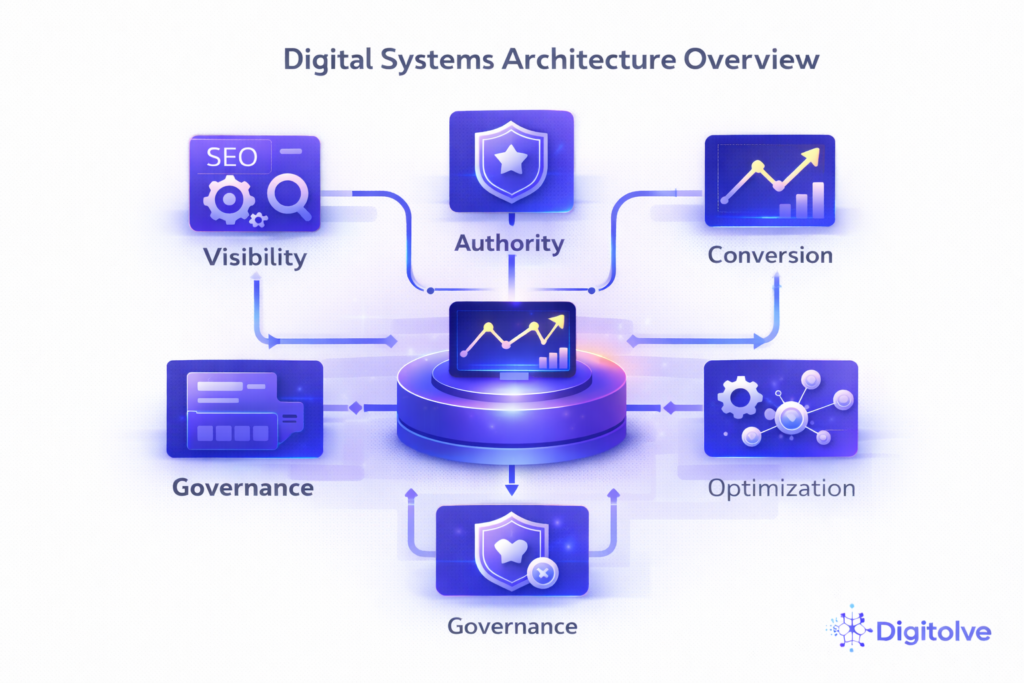
Table of Contents
The Strategy–Execution Gap in Digital Environments
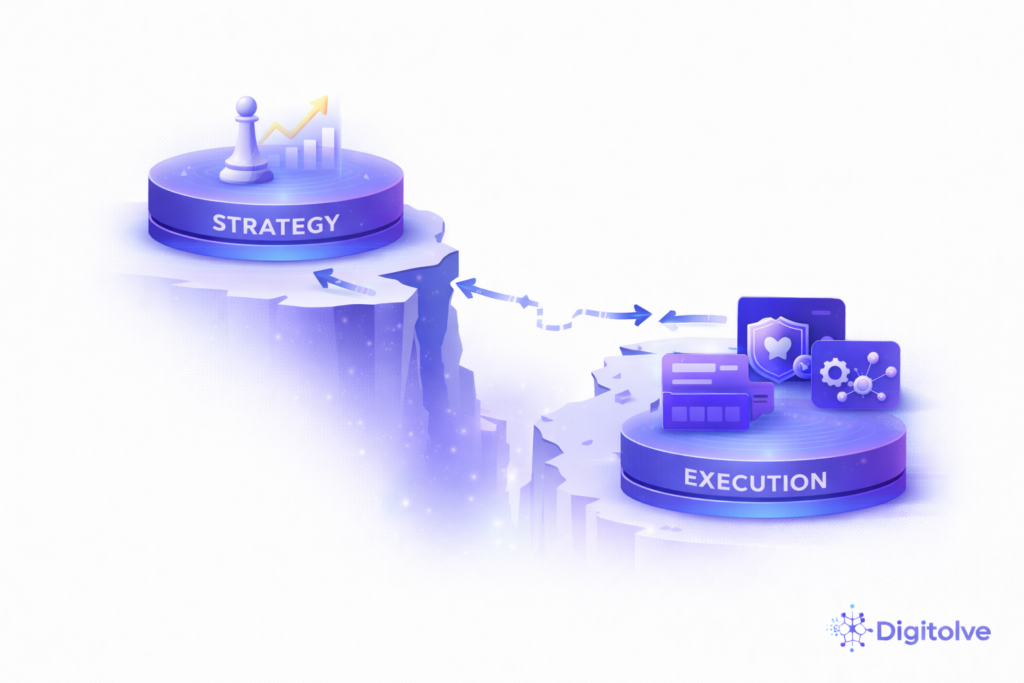
In most organizations, strategy and execution exist as separate layers. Leadership defines direction and positioning. Teams implement campaigns, content, and channels.
Between these layers lies an unstructured space. This is where coordination and reinforcement should occur. When this layer is missing, strategy cannot become capability.
Execution then behaves as isolated initiatives. Each campaign begins with limited connection to previous efforts. Channels pursue their own goals instead of contributing to shared growth pathways.
Learning remains localized. Insights from one area rarely influence others. Optimization improves fragments rather than the system.
These patterns appear repeatedly across digital environments.
Initiatives restart instead of scaling. Progress from one cycle does not carry forward into the next.
Channels operate independently. Search, content, social, and conversion lack structural alignment.
Knowledge stays siloed. Teams learn, but the organization does not.
Optimization stays local. Improvements do not strengthen overall capability.
Results fluctuate. Effort continues, yet growth remains unstable.
These outcomes are not primarily strategic failures. Most organizations possess adequate strategic direction.
The real problem is architectural absence between intent and action.
Without a connecting system layer, execution cannot reinforce strategy. Learning cannot accumulate. Growth resets repeatedly.
The Missing Layer Between Strategy and Results
Between strategy and measurable outcomes sits a critical structural layer. This layer is digital systems.
Digital systems translate direction into coordinated capability. They connect channels, content, processes, and tools into a unified environment.
They transform positioning into repeatable execution. Instead of episodic campaigns, organizations create consistent structures across channels.
They integrate digital functions into flow. Visibility, authority, and conversion become stages of one pathway.
They enable learning to circulate. Performance insight moves through the system instead of staying isolated.
They stabilize performance across cycles. Progress persists instead of resetting.
Without this layer, strategy remains conceptual and execution remains fragmented.
With it, execution becomes structured capability.
This shift from activity to system is fundamental. Activities can produce outputs. Only systems produce sustained outcomes.
From Digital Activities to Digital Architecture
Many organizations attempt digital growth through activity expansion. They publish more content, add channels, adopt tools, or run more campaigns.
Output increases. Structure does not.
Activity growth without alignment often amplifies fragmentation. More actions occur, but they do not reinforce each other.
Architecture thinking changes this perspective. Digital growth becomes a structured environment composed of layers.
Organizations stop asking what to produce next. They begin designing how each function contributes to the system.
Channels become coordinated pathways. Search visibility supports authority. Authority supports conversion. Conversion informs optimization.
Content becomes a knowledge layer. Topics connect and reinforce positioning. Authority accumulates over time.
Optimization becomes systemic learning. Insight influences architecture, not just isolated assets.
Tools become infrastructure. Technology supports processes instead of defining them.
Through architecture thinking, digital growth becomes engineered rather than improvised.
How Digital Systems Enable Compounding Growth
The primary advantage of digital systems architecture is compounding. When digital functions operate within structure, each action strengthens previous ones.
Growth accelerates without proportional increase in effort.
Visibility generates attention. Attention reinforces authority. Authority improves conversion. Conversion data informs optimization.
Optimization then improves future visibility and conversion. The loop strengthens continuously.
Because each cycle builds on prior learning, organizations gain cumulative advantage. Content continues generating visibility. Authority persists across time. Optimization remains embedded.
Performance improves without restarting from zero.
In fragmented environments, this loop breaks. Gains dissipate after each initiative. Organizations rebuild repeatedly.
Effort stays high. Growth stays unstable.
Compounding growth depends on structural continuity. Systems preserve and amplify learning across cycles.
Why Digital Maturity Depends on Systems
Digital maturity is often measured by channel presence or technology adoption. Organizations evaluate progress by platforms used, tools implemented, or content volume.
These indicators reflect activity expansion. They do not guarantee capability.
True digital maturity reflects systems architecture development. As layers integrate and learning circulates, growth becomes stable.
Early stages show fragmented initiatives. Channels operate independently. Optimization remains local.
Growth occurs sporadically.
Intermediate stages introduce coordination. Channels align. Insights influence multiple functions.
Growth stabilizes but still needs active management.
Advanced stages show integrated architecture. Visibility, authority, conversion, and optimization function as one system.
Learning circulates continuously. Performance compounds over time.
Growth persists independent of campaigns. Structure sustains it.
Digital maturity equals system maturity.
Organizations progress not by doing more but by structuring better.
The Core Layers of Digital Systems Architecture
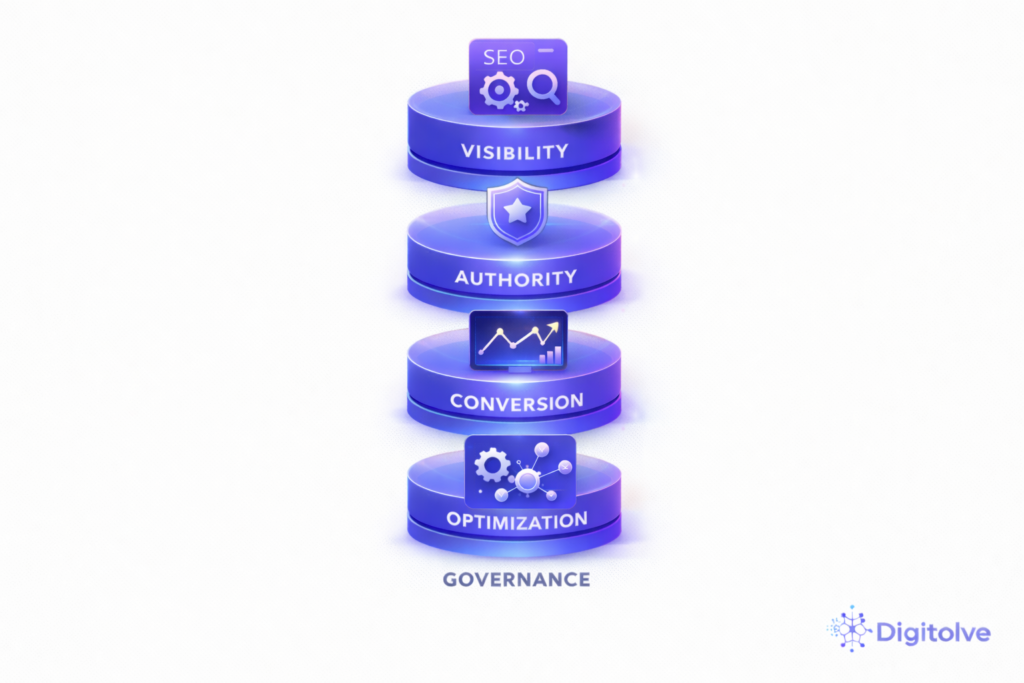
Digital systems architecture is not a single mechanism. It is a layered structure where each layer performs a distinct growth function. When these layers operate together, digital capability becomes stable and scalable.
The first layer is visibility. This layer determines how audiences discover the organization across search, content, and digital channels. It defines reach, discoverability, and entry points into the system.
The second layer is authority. This layer builds credibility through expertise signals, knowledge depth, and consistent positioning. It determines whether attention converts into trust.
The third layer is conversion. This layer transforms trust and attention into measurable outcomes such as leads, clients, or revenue. It defines how value is captured from visibility and authority.
The fourth layer is optimization. This layer interprets performance data and improves system effectiveness over time. It ensures learning influences future execution rather than remaining isolated.
The fifth layer is governance. This layer maintains alignment, standards, and structural coherence across all digital initiatives. It ensures the architecture remains consistent as the organization grows.
When these layers integrate, digital growth becomes self-reinforcing. Visibility attracts attention. Authority sustains trust. Conversion captures value. Optimization improves performance. Governance preserves alignment.
Organizations lacking any layer experience instability. Growth may occur temporarily but cannot sustain. Only integrated layers create durable expansion.
How Visibility Systems Connect to Authority
Visibility alone does not produce growth. Many organizations achieve reach yet fail to build influence. This occurs when visibility operates without structural connection to authority.
In a coherent architecture, visibility channels direct audiences into authority assets. Search traffic flows into structured knowledge content. Social discovery leads to expertise signals. Content exposure reinforces positioning depth.
Each visibility touchpoint therefore strengthens perceived expertise rather than existing as isolated exposure.
When this connection is absent, visibility produces shallow attention. Audiences encounter content without understanding capability. Traffic increases, yet trust remains weak. Growth stagnates despite reach.
Digital systems architecture ensures that visibility always feeds authority. Discovery becomes the first stage of trust formation rather than an endpoint.
How Authority Systems Enable Conversion
Authority transforms attention into credibility. Without authority, conversion relies on persuasion. With authority, conversion arises from trust.
In a structured system, authority signals prepare audiences before conversion interaction occurs. Expertise content, frameworks, insights, and positioning create confidence in capability.
By the time conversion pathways appear, resistance is reduced. Decisions become easier because trust already exists.
When authority is missing, organizations compensate with promotional intensity. Messaging pushes rather than attracts. Conversion becomes unstable and inconsistent.
Digital systems architecture ensures authority precedes conversion. Trust becomes structural rather than situational. Conversion stabilizes because it rests on credibility rather than persuasion.
The Conversion Layer as System Output
Conversion is often treated as an isolated objective. Organizations optimize pages, funnels, or calls-to-action independently from the rest of the digital environment. This approach limits effectiveness.
Within architecture, conversion is not a standalone mechanism. It is the output of preceding layers. Visibility delivers attention. Authority builds trust. Conversion captures value from both.
When conversion struggles, the issue often lies upstream. Visibility may be weak. Authority may be insufficient. Trust may be shallow. Optimizing conversion alone cannot compensate for structural deficiencies above it.
Digital systems architecture therefore positions conversion as an integrated layer rather than an isolated tactic. Outcomes improve when preceding layers strengthen.
Optimization as System Learning
Optimization in fragmented environments improves isolated elements. Organizations test headlines, adjust campaigns, or refine pages. These changes may increase local performance but rarely influence overall capability.
Within architecture, optimization functions as system learning. Performance insight flows through layers and informs structural refinement. Improvements affect visibility, authority, and conversion simultaneously.
Learning accumulates across cycles. Knowledge about audience behavior, positioning effectiveness, and content performance shapes future architecture decisions.
This systemic optimization creates compounding advantage. Each cycle improves the entire environment rather than a single asset.
Digital systems architecture therefore converts optimization from tactical adjustment into structural evolution.
Governance as Structural Stability
As digital environments expand, fragmentation risk increases. Teams create content independently. Channels diverge in messaging. Standards vary. Without governance, architecture deteriorates.
Governance provides structural stability. It defines positioning consistency, content standards, optimization priorities, and system alignment across initiatives.
Governance does not restrict creativity. It preserves coherence. It ensures every activity reinforces the same architecture rather than creating parallel structures.
Organizations lacking governance often experience drift. Visibility messaging diverges from authority positioning. Conversion pathways conflict with brand perception. Optimization priorities scatter.
Digital systems architecture requires governance to maintain integrity over time. Growth remains stable only when structure remains consistent.
Why Layer Integration Creates Compounding Capability
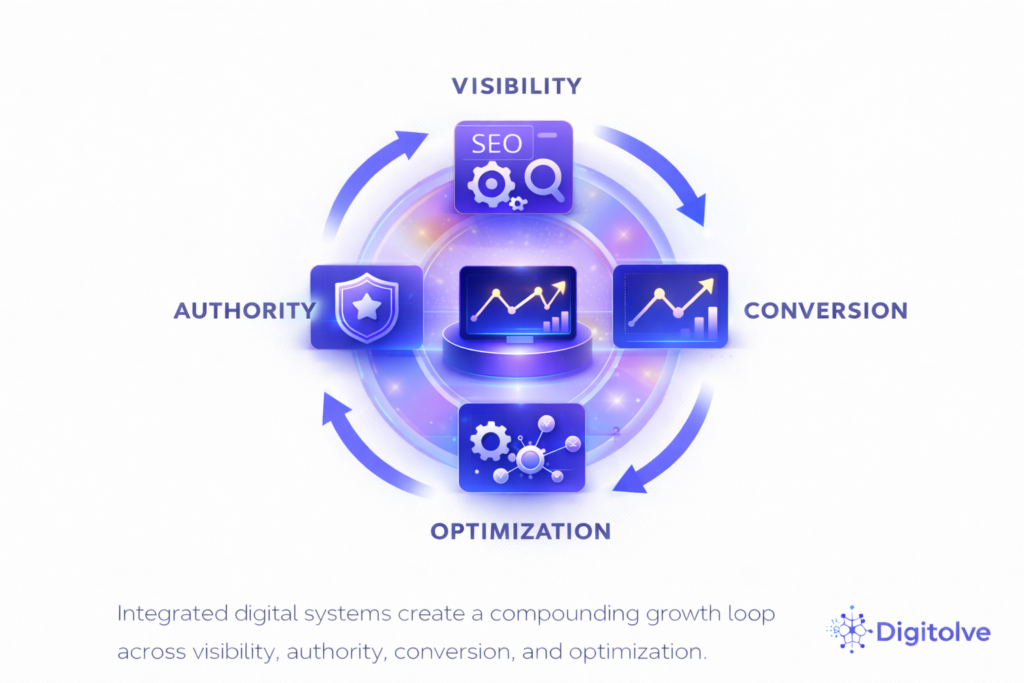
The power of digital systems architecture lies not in individual layers but in their integration. Each layer strengthens and depends on the others.
Visibility attracts audiences into the system. Authority converts attention into trust. Conversion captures value from trust. Optimization improves effectiveness across layers. Governance preserves coherence.
This interconnected loop creates compounding capability. Improvements in one layer elevate the others. Visibility gains increase authority exposure. Authority gains improve conversion readiness. Conversion insight informs optimization. Optimization strengthens visibility and authority.
The system evolves as a whole.
Fragmented environments cannot achieve this compounding effect. Layers operate independently. Improvements remain localized. Capability grows slowly despite effort.
Integrated architecture accelerates growth because every improvement multiplies across layers.
Digital Systems Architecture as Competitive Advantage
Most organizations compete at the level of tactics. They produce more content, run more campaigns, or adopt more tools. These advantages are temporary because competitors can replicate activities.
Architecture is difficult to replicate. It reflects structural design, integration depth, and accumulated learning. It evolves over time and becomes embedded in capability.
Organizations with mature digital systems architecture operate with efficiency others cannot easily match. Their visibility compounds faster. Their authority deepens continuously. Their conversion stabilizes. Their optimization accelerates improvement.
Competitors may imitate individual tactics but cannot quickly replicate architecture maturity.
Digital systems architecture therefore becomes a durable competitive advantage. It transforms digital presence from activity execution into structural capability.
From Digital Presence to Digital Capability
Many organizations possess digital presence without digital capability. They maintain websites, channels, and content, yet growth remains unstable. Presence reflects activity. Capability reflects structure.
Digital systems architecture converts presence into capability. It connects channels into pathways. It transforms content into authority. It aligns conversion with trust. It embeds optimization loops. It maintains governance coherence.
The organization moves from performing digital actions to operating a digital system.
Capability differs from activity in one key way. Activity requires continuous effort to sustain results. Capability produces results through structure even when effort fluctuates.
This transition marks true digital maturity. The organization no longer depends solely on campaigns. Its architecture continuously generates growth conditions.
The Role of Architecture in Scalable Growth
Scalability requires stability. Without stable structure, growth increases complexity faster than capability. Channels multiply, content expands, and tools accumulate. Coordination becomes harder. Results fragment.
Digital systems architecture enables scalable growth by maintaining coherence as scale increases. New channels integrate into existing pathways. Additional content strengthens authority layers. Expanded visibility feeds established conversion systems.
Architecture absorbs scale without losing alignment.
Organizations lacking architecture experience breakdown as they grow. Fragmentation increases faster than coordination. Complexity overwhelms capability. Growth stalls or reverses.
Scalable digital growth therefore depends on architecture first. Scale without structure amplifies instability. Structure allows scale to compound.
Architecture as the Foundation of Digital Transformation
Digital transformation is often interpreted as technology adoption or channel expansion. These changes may increase activity but do not guarantee capability.
True digital transformation occurs when systems architecture changes. The organization redesigns how digital functions connect and operate. Structure replaces fragmentation. Learning loops embed. Layers integrate.
Technology then supports architecture rather than defining it.
Digital systems architecture therefore forms the foundation of transformation. It converts digital presence into digital capability. It stabilizes growth. It enables scalability. It creates competitive advantage.
Without architecture, transformation remains superficial. With it, digital capability becomes structural and enduring.
Designing Digital Systems Architecture in Practice
Digital systems architecture is not created through isolated improvements. It requires deliberate structural design. Organizations must define how digital layers connect, reinforce each other, and evolve over time.
The process begins by mapping the full digital growth pathway. This pathway describes how audiences discover the organization, how trust forms, how engagement deepens, and how conversion occurs. Every stage must connect structurally rather than exist as separate initiatives.
Visibility pathways should lead into authority assets. Authority layers should prepare audiences for conversion. Conversion interactions should generate insight for optimization. Optimization should refine visibility and authority continuously.
When this pathway is defined, architecture replaces fragmentation.
The next step is layer definition. Each core layer must have clear structural purpose within the system.
Visibility systems define discoverability channels and entry points.
Authority systems define knowledge depth and credibility signals.
Conversion systems define value capture mechanisms.
Optimization systems define learning and refinement loops.
Governance systems define alignment and standards.
Clarity at this level ensures that every digital activity reinforces the same architecture rather than creating parallel structures.
Embedding Learning Loops into the Architecture
A defining feature of mature digital systems architecture is embedded learning. Performance insight must circulate across layers rather than remain isolated within channels or campaigns.
Every conversion interaction reveals trust signals. Every visibility interaction reveals discovery patterns. Every content interaction reveals authority perception. These signals should inform system refinement.
When learning loops are embedded, the architecture evolves continuously. Visibility improves based on authority insight. Authority strengthens based on conversion behavior. Conversion improves based on visibility quality.
This circulation creates compounding improvement.
Organizations without embedded learning remain static. They repeat similar activities without structural evolution. Performance fluctuates rather than improves across cycles.
Learning loops therefore transform digital systems from static structures into adaptive capability.
Aligning Digital Systems with Strategic Positioning
Architecture must express positioning consistently across all layers. Visibility messaging, authority content, and conversion narratives should reinforce the same expertise identity.
When positioning aligns structurally, audiences experience coherence. Discovery, trust formation, and decision readiness occur within the same conceptual frame. Perception stabilizes.
Misalignment disrupts architecture. Visibility may attract broad attention while authority signals remain unclear. Conversion messaging may emphasize different value than authority content. Trust weakens.
Digital systems architecture ensures that positioning is not merely stated but structurally embedded. Every layer communicates the same expertise identity.
This alignment strengthens authority perception and conversion confidence simultaneously.
The Transition from Campaign Thinking to System Thinking
Many organizations remain anchored in campaign thinking. Growth is pursued through periodic initiatives designed to produce temporary spikes in visibility or conversion.
Campaigns can generate activity but rarely produce structural capability. Once the campaign ends, momentum declines. Learning dissipates. Results reset.
System thinking replaces episodic growth with continuous capability. Instead of isolated launches, organizations operate persistent visibility pathways, authority layers, and conversion systems.
Activity becomes ongoing system operation rather than temporary effort.
This transition changes the nature of digital growth. Results become more stable. Performance accumulates across time. Learning compounds. Optimization strengthens structure rather than single initiatives.
System thinking therefore marks the shift from marketing activity to digital capability.
Digital Systems Architecture as the Core of Digital Transformation
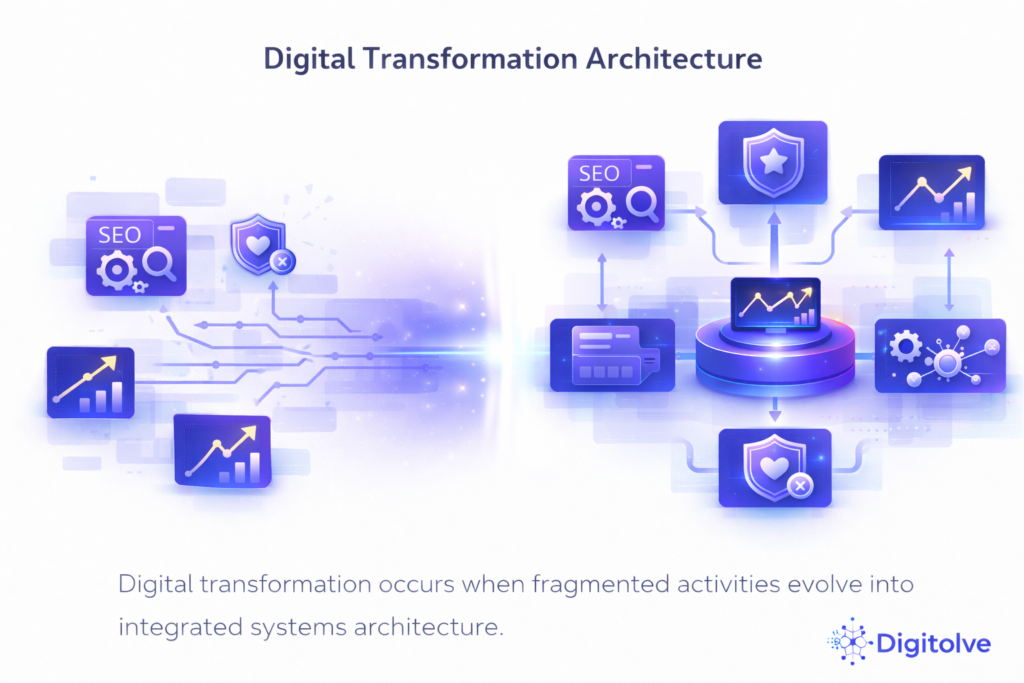
Digital transformation is often described through technology adoption or channel expansion. These changes may increase digital presence but do not automatically create capability.
True transformation occurs when the organization redesigns how digital functions connect and operate. Systems replace fragmentation. Layers integrate. Learning loops embed. Governance stabilizes alignment.
Technology then supports architecture rather than defining it.
This structural transformation changes how growth occurs. Visibility compounds. Authority deepens. Conversion stabilizes. Optimization accelerates. Governance preserves coherence.
Digital capability becomes structural rather than situational.
Organizations that undergo this transformation no longer depend on isolated initiatives for growth. Their architecture continuously generates growth conditions.
From Digital Capability to Sustainable Growth
Sustainable digital growth emerges when architecture, learning, and positioning align across layers. The organization operates as a coherent system rather than a collection of activities.
Visibility continuously attracts aligned audiences. Authority continuously reinforces expertise perception. Conversion continuously captures value from trust. Optimization continuously improves performance. Governance continuously maintains alignment.
Growth persists even as scale increases. Complexity expands, yet coherence remains.
This stability defines mature digital capability. The organization does not merely perform digital actions. It operates digital systems.
Digital systems architecture therefore represents the missing foundation behind scalable digital growth. Without it, organizations remain trapped in cycles of effort and reset. With it, growth becomes structural, compounding, and sustainable.
Digital system FAQs
What is digital systems architecture
Digital systems architecture is the structural design that connects visibility, authority, conversion, optimization, and governance into a unified digital growth system. It defines how digital activities reinforce each other and produce compounding outcomes.
Why do digital initiatives fail without architecture
Digital initiatives fail without architecture because activities remain fragmented. Visibility does not build authority, authority does not stabilize conversion, and learning does not accumulate. Results therefore fluctuate instead of compounding.
How does digital systems architecture support digital transformation
Digital systems architecture supports digital transformation by redesigning how digital layers connect and operate. It replaces isolated initiatives with integrated capability, enabling stable growth and scalable performance.
What is the difference between digital presence and digital capability
Digital presence reflects activity across channels and content. Digital capability reflects structural integration of systems that produce sustained outcomes. Architecture converts presence into capability.
Why is architecture more important than digital tactics
Architecture is more important than tactics because tactics create temporary results that competitors can replicate. Architecture creates structural capability that compounds over time and is difficult to imitate. Sustainable growth therefore depends on architecture rather than isolated actions.