Most digital strategies don’t fail because they are wrong. They fail because they are disconnected.
Brands invest in SEO, content, funnels, ads, automation, and tools — yet results stay inconsistent, fragile, and dependent on constant effort.
Not because the strategy is weak.But because the system underneath it doesn’t exist.
This is the missing layer in modern digital growth: Digital Systems Strategy.
The discipline of designing how strategy, execution, content, channels, data, and decisions connect into a unified operating system — not isolated tactics.
Because in digital growth, results don’t come from what you plan. They come from what your system continuously produces.
And most businesses don’t have one.
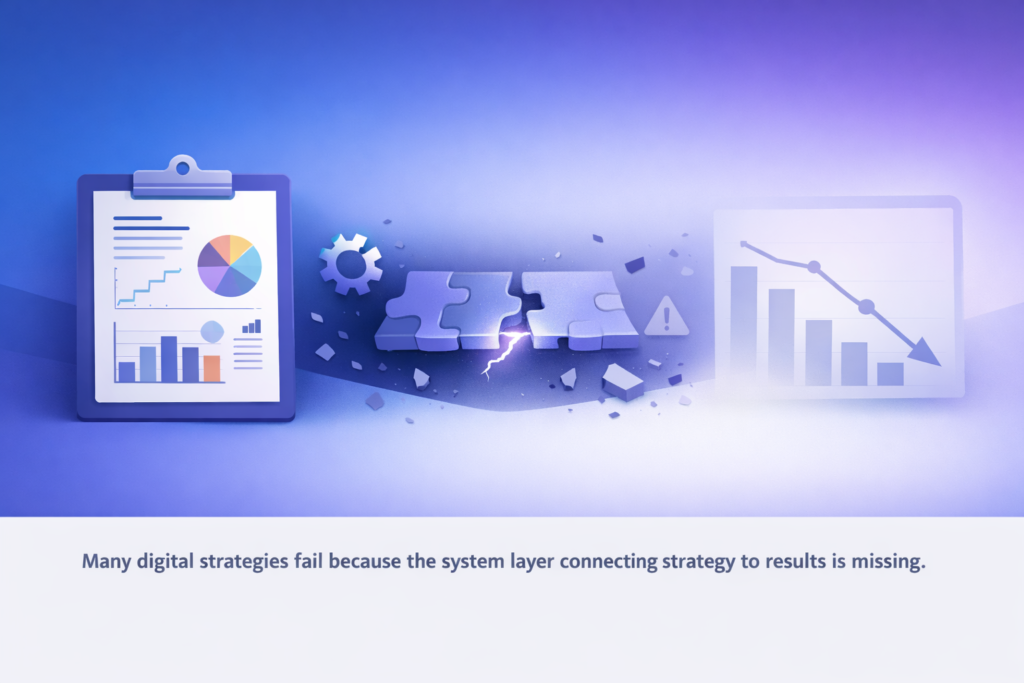
Table of Contents
Strategy Isn’t Failing — It’s Fragmented
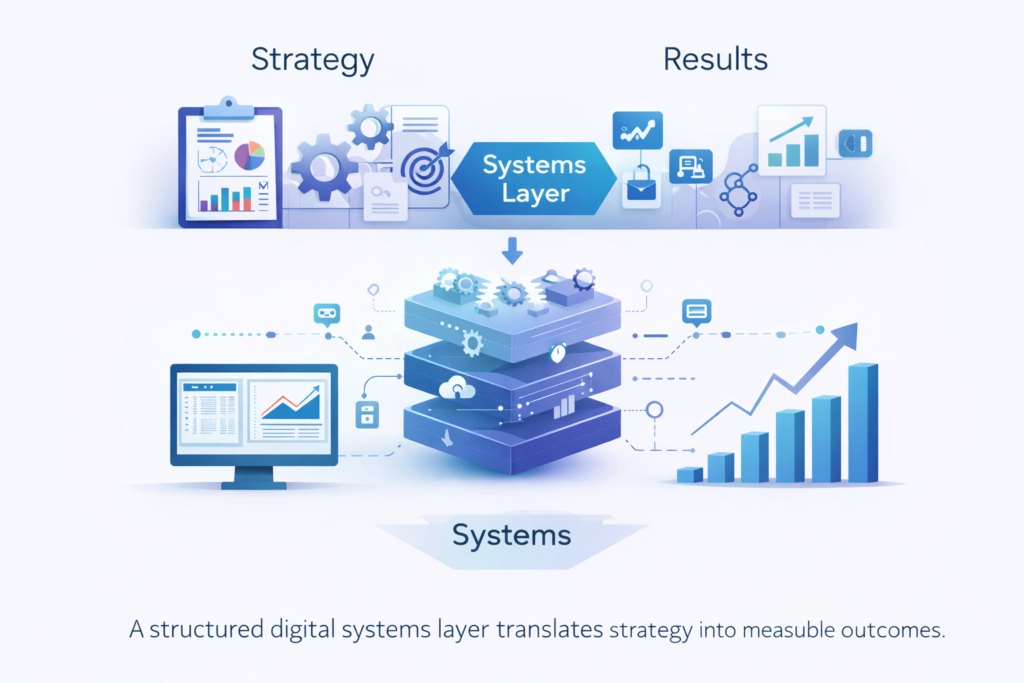
Most strategies don’t fail because they are wrong — they fail because they are disconnected from execution systems.
Businesses today rarely lack ideas.
They have content plans. SEO plans. Social plans. Funnels. Campaigns. Calendars.
But these elements live in separate silos.
Content doesn’t inform SEO. SEO doesn’t guide product pages. Analytics doesn’t shape content. Funnels don’t connect to brand messaging.
So each initiative works alone —. and performance stays unstable.
This is the strategy- execution gap most teams feel but can’t diagnose.
Not a lack of tactics. A lack of connection.
And connection is a systems problem — not a marketing one.
What Is Digital Systems Strategy?
- how content feeds visibility
- how visibility feeds authority
- how authority feeds conversion
- how conversion feeds insight
- how insight feeds strategy
The Missing Layer Between Strategy and Results
- execution becomes manual
- content becomes inconsistent
- SEO becomes accidental
- messaging drifts
- performance resets every cycle
Why Businesses Feel Constant Effort Without Compounding
- More posts.
- More campaigns.
- More launches.
- More ads.
- More work.
- content into search equity
- traffic into audience memory
- data into decisions
- messaging into positioning
The Core Components of a Digital Growth System
From Campaign Thinking to System Thinking
Digital Systems Strategy as Competitive Advantage
Everyone uses SEO. Everyone uses content. Everyone uses ads. Everyone uses automation.
But very few integrate them structurally.
So advantage shifts from tools to architecture.
The brand with the stronger system wins — even with similar tactics.
Because consistency beats intensity in digital growth.
The Digitolve Digital Systems Framework
While many businesses understand the need for strategy and execution, very few know how to structurally connect them.
Digitolve defines digital growth as a system — not a set of channels.
The Digitolve Digital Systems Framework™ is built on one core principle:
Sustainable digital growth happens when visibility, authority, conversion, and optimization operate as one connected system.
This framework explains how modern brands move from fragmented marketing to scalable digital infrastructure.
Because real growth doesn’t come from isolated tactics —it comes from integrated systems
The 4 Layers of the Digitolve System
Digitolve structures digital growth into four connected layers that continuously reinforce each other.
1️⃣ Visibility Layer — Demand Capture
This layer ensures the brand is discoverable where demand already exists.
It includes:
- search visibility (SEO)
- topic authority coverage
- intent-aligned content
- discoverability pathways
Visibility is not traffic generation. It is demand capture architecture.
2️⃣ Authority Layer — Trust Infrastructure
Visibility brings attention. Authority converts attention into trust.
This layer includes:
- expert positioning
- educational depth
- consistent narrative
- problem ownership
Authority transforms content from information into credibility.
3️⃣ Conversion Layer — Decision Systems
Trust alone does not create growth.Decisions do.
The conversion layer structures how users move through the customer journey from awareness to decision.
The conversion layer structures how users move from awareness to action.
It includes:
- offer alignment
- journey clarity
- messaging triggers
- friction reduction
Conversion becomes predictable when decisions are designed, not hoped for.
4️⃣ Optimization Layer — Compounding Engine
Growth stabilizes only when feedback shapes the system.
This layer includes:
- analytics loops
- performance insights
- content iteration
- structural refinement
Optimization converts activity into learning — and learning into scale.
How the Layers Work as One System

The power of the Digitolve model is not in the layers individually — but in their connection.
Visibility brings the right audience. Authority builds belief. Conversion enables action. Optimization improves everything.
Then insights refine visibility again.
This creates a continuous loop:
Visibility → Authority → Conversion → Optimization → Stronger Visibility
When this loop operates consistently, growth compounds.
When it breaks, performance resets.
Why Most Brands Never Reach System-Level Growth
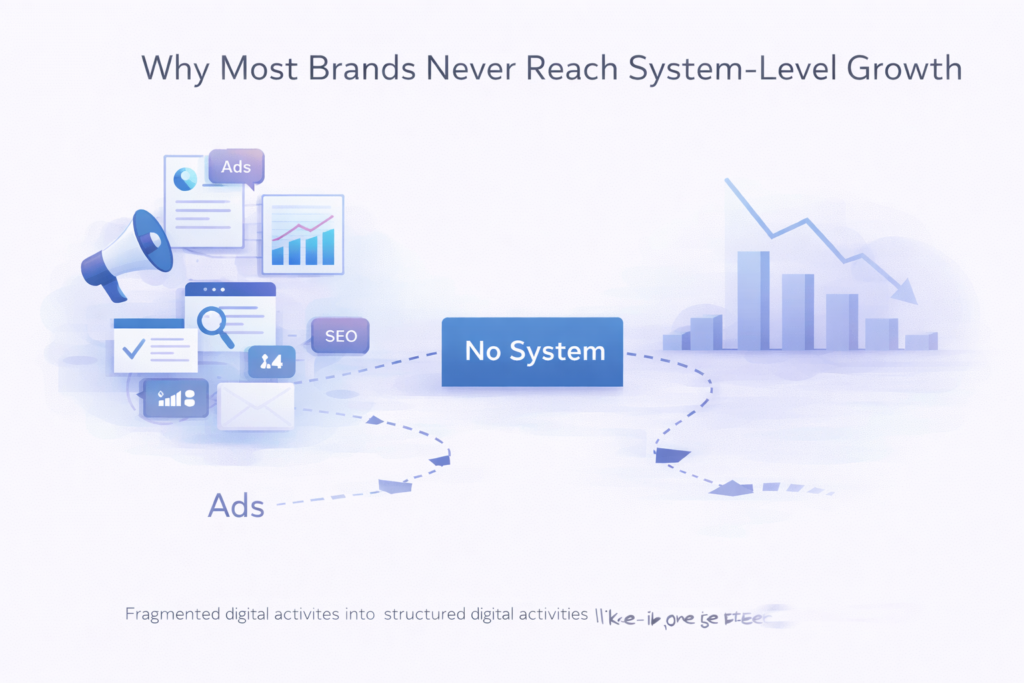
Most businesses operate only in fragments of this framework.
Some focus only on visibility (SEO/content). Some only on conversion (funnels/ads). Some only on branding. Some only on analytics.
But without integration, each layer underperforms.
This is why brands feel:
- unstable traffic
- inconsistent leads
- weak authority
- low conversion
- sconstant effort
They are not failing. They are incomplete.
System-level growth requires structural connection — not more tactics.
From Digital Activity to Digital Infrastructure
The Digitolve framework shifts brands from doing marketing to building systems.
Instead of:
- posting content
- running campaigns
- launching funnels
- testing ads
Brands begin constructing:
- visibility architecture
- authority ecosystems
- conversion pathways
- optimization loops
This is the transition from digital activity to digital infrastructure.
And infrastructure — unlike activity — scales.
The Future of Digital Growth Is Systems

As digital environments become more saturated and algorithmic, isolated tactics lose power.
Channels change. Algorithms shift. Formats evolve.
The brands that win in the next phase of digital growth will not be those producing the most content or running the most campaigns.
They will be those whose systems continuously generate visibility, trust, and decisions.
Digital Systems Strategy is no longer optional.
It is the operating model of scalable digital growth.