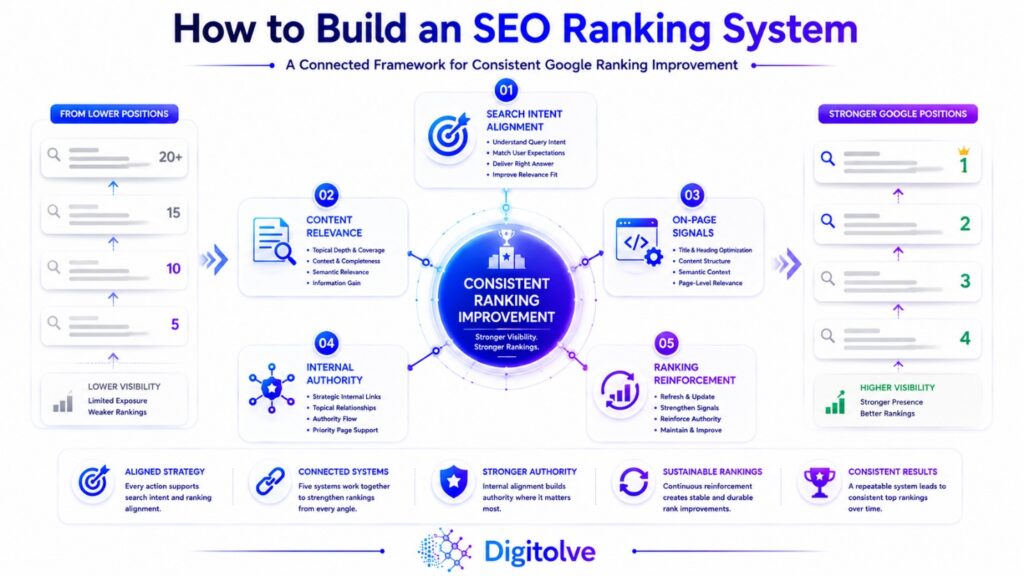
SEO ranking system :
Improving Google rankings is often treated as a series of individual SEO tasks. Businesses optimize titles, target keywords, update existing content, add internal links, and improve individual pages—yet ranking performance can still remain inconsistent.
The problem with this approach is that rankings are not supported by one optimization in isolation. They develop through multiple signals working together. Search intent determines what the page needs to satisfy. Content relevance strengthens its relationship with the topic. On-page signals clarify its purpose. Internal authority reinforces its importance within the website. Continuous reinforcement helps those signals remain relevant as search competition evolves.
This is where an SEO ranking system becomes different from simply performing SEO activities.
Instead of asking which individual tactic might improve a page, a ranking system connects the elements responsible for ranking performance into a repeatable execution architecture. Each component has a specific role, but its value becomes stronger when it reinforces the others.
Ranking once is not the same as building a ranking system.
A page may reach a strong position after optimization, but sustainable ranking improvement requires a process capable of strengthening relevance, authority, and page-level signals repeatedly across important content assets.
In this guide, we will explore how to structure that process around five connected systems:
Search Intent Alignment → Content Relevance → On-Page Signals → Internal Authority → Ranking Reinforcement
Together, these systems create a strategic foundation for improving Google rankings more consistently without relying on disconnected optimization tactics.
The objective is not to chase individual ranking movements.
It is to build a structured system where every SEO improvement contributes to stronger, clearer, and more sustainable ranking performance over time.
Table of Contents
What Is an SEO Ranking System?
An SEO ranking system is a structured approach that connects the signals responsible for improving a page’s position in search results. Instead of optimizing keywords, content, headings, internal links, and other elements independently, the system aligns them around the same search objective.
The purpose is not to guarantee a specific ranking position. Search rankings are influenced by many factors and can change over time. The purpose is to create a repeatable process for strengthening the relevance, clarity, and authority signals that support ranking performance.
Rankings Are the Outcome of Multiple Connected Signals
Google rankings are not determined by one isolated optimization.
A page may have a well-optimized title but weak content relevance. Another may contain comprehensive information but fail to satisfy the actual search intent. A strong page may also receive limited internal support from the rest of the website.
A ranking system connects these elements:
Search Intent
↓
Content Relevance
↓
On-Page Signals
↓
Internal Authority
↓
Ranking Reinforcement
Each component supports a different part of the ranking architecture, while together they create a stronger foundation for consistent improvement.
Why Individual SEO Optimizations Produce Inconsistent Results
Individual SEO improvements can be useful, but disconnected optimization makes it difficult to build repeatable ranking progress.
Updating a title may improve page clarity. Adding internal links may strengthen page relationships. Expanding content may increase topical depth. But if these actions are performed without considering search intent and the broader ranking architecture, they may not reinforce the same objective.
A system-based approach changes the question from:
“Which SEO tactic should we try next?”
to:
“Which connected signals should we strengthen to improve this page’s ranking potential?”
That creates a more deliberate execution process.
The Difference Between Ranking Tactics and Ranking Architecture
Ranking tactics are individual actions.
Ranking architecture determines how those actions work together.
For example, keyword optimization is a tactic. Within a ranking architecture, the keyword is connected to search intent, the content is structured around that intent, headings reinforce the page purpose, related pages provide contextual support, and the page is strengthened over time as its relevance evolves.
The individual tactics still matter, but they operate as components of a larger system rather than isolated SEO tasks.
How a Structured Ranking System Works
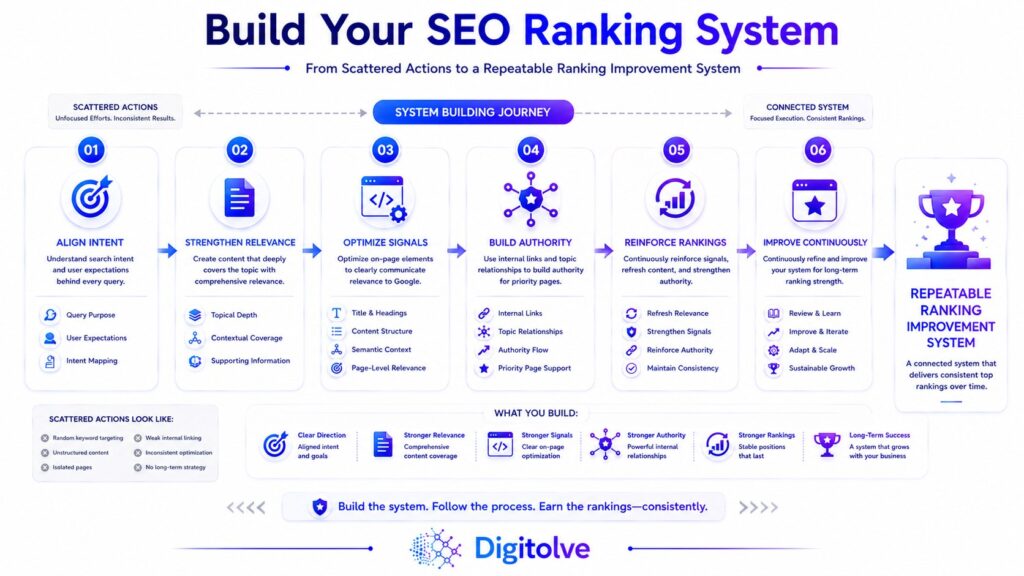
A structured ranking system begins by aligning the page with the searcher’s objective. It then strengthens the content required to satisfy that objective, clarifies page-level relevance through on-page signals, builds internal authority around important pages, and reinforces ranking assets as search conditions evolve.
This creates a repeatable execution cycle:
Align Intent → Strengthen Relevance → Optimize Signals → Build Authority → Reinforce Rankings → Improve Continuously
The process can then be applied systematically across strategically important pages instead of reinventing the SEO approach for every piece of content.
What This Means for Long-Term Google Rankings
Consistent ranking improvement is less about repeatedly searching for new SEO tactics and more about building stronger connections between the signals that already influence search performance.
As those signals become better aligned, each optimization can reinforce the broader ranking architecture.
The goal is therefore not simply to optimize a page once.
It is to build an SEO ranking system capable of strengthening important pages through coordinated, repeatable execution over time.
The Five Systems Behind Consistent Ranking Improvement
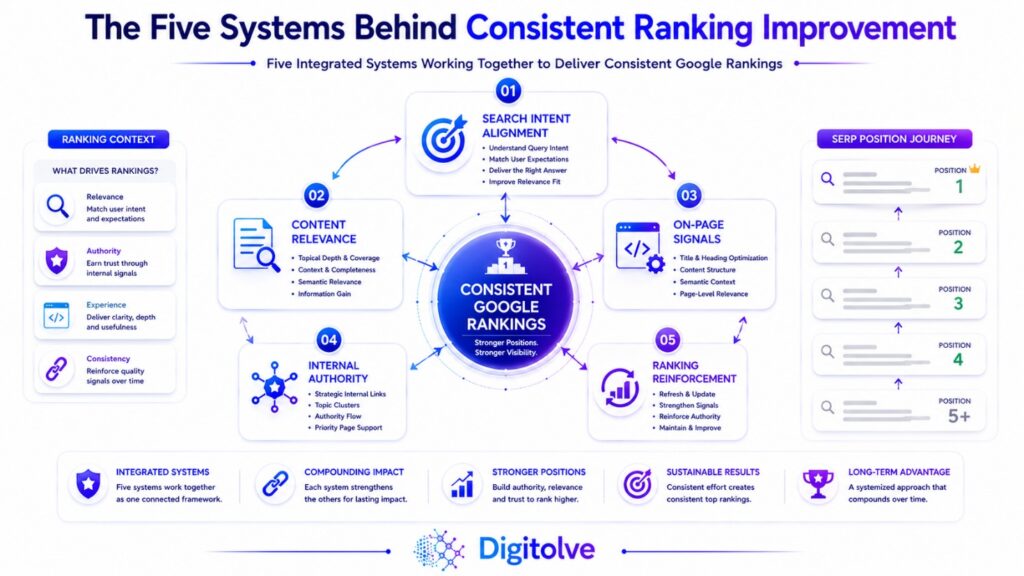
Consistent ranking improvement is rarely created by strengthening one SEO element alone. Search intent, content relevance, on-page signals, internal authority, and ongoing reinforcement each contribute a different layer to ranking performance.
The SEO Ranking Blueprint connects these elements into five execution systems. Rather than treating them as separate optimization tasks, the goal is to make each system strengthen the next.
1. Search Intent Alignment System
Every ranking process begins with understanding what the searcher actually wants to accomplish.
Keywords identify the query, but search intent provides the context behind it. A structured intent alignment system connects the target query with the page purpose, content direction, and information the searcher expects to find.
This creates the foundation for every ranking signal that follows.
2. Content Relevance System
Once intent is clear, the content must provide sufficient relevance around that search need.
A Content Relevance System focuses on building useful topical depth, contextual coverage, and supporting information rather than simply repeating target keywords.
The objective is to create content that comprehensively supports the page’s purpose while fitting naturally within the website’s broader topic ecosystem.
3. On-Page Signal System
Relevant content also needs clear page-level signals.
Titles, headings, content hierarchy, contextual language, and page structure help communicate what the page is about and how its information is organized.
The On-Page Signal System ensures these elements reinforce the same search intent and content purpose instead of being optimized independently as a checklist.
4. Internal Authority System
Important pages should not operate as isolated assets.
An Internal Authority System strategically connects related content and priority pages through meaningful internal relationships. This creates clearer topic connections across the website while directing stronger internal support toward strategically important ranking assets.
Internal authority therefore becomes part of the ranking architecture rather than an afterthought added after publishing.
5. Ranking Reinforcement System
Ranking improvement does not end when a page reaches a stronger position.
Content relevance can change, competitors can strengthen their pages, and search expectations can evolve. Ranking assets therefore need periodic reinforcement to remain aligned with the search environment.
At the Mini level, this system remains intentionally simple: review important pages, refresh weakening relevance, strengthen necessary signals, and reinforce priority assets when needed.
More advanced monitoring and optimization belong within the future SEO Ranking System — Core.
How the Five Systems Connect
The complete architecture becomes:
Search Intent Alignment
↓
Content Relevance
↓
On-Page Signals
↓
Internal Authority
↓
Ranking Reinforcement
These systems should not operate as five independent SEO checklists.
Search intent gives content direction. Relevant content gives on-page signals meaning. Clear page signals strengthen ranking clarity. Internal authority reinforces strategically important pages. Continuous reinforcement helps preserve and strengthen those assets over time.
The strongest ranking performance develops when these systems reinforce one another rather than operating as isolated SEO activities.
How Search Intent Creates the Foundation for Rankings
Every strong ranking system begins with search intent. A keyword tells you what someone searched for, but it does not always explain what that person expects to find after clicking a result.
A structured SEO ranking system uses search intent to establish the purpose of the page before content, on-page signals, and internal authority are optimized. When these elements are aligned around the same search objective, they create a clearer and more coherent foundation for ranking improvement.
Keywords Identify Queries, Intent Explains Expectations
Keywords provide useful information about search demand, but two similar queries can represent very different user expectations.
A searcher may want to learn about a topic, compare alternatives, solve a specific problem, or find a particular resource. The page should therefore be designed around the objective behind the query rather than simply incorporating the keyword throughout the content.
This changes keyword targeting from a placement exercise into a strategic content decision.
Align Content With the Searcher’s Real Objective
Once the intent behind a query is understood, the page should be structured to satisfy that objective as clearly as possible.
The content format, depth, examples, headings, and supporting information should all reflect what the searcher needs from the page.
For example, an informational query generally requires useful explanation and context, while a query with stronger comparison intent may require clearer distinctions between available options.
The execution principle is simple:
Identify the search objective → Define the page purpose → Build the content around that purpose
If you’re targeting relevant keywords but struggling to strengthen their ranking performance, Why Your Keywords Are Not Ranking (Even With Strong Content & SEO) explores the broader ranking challenges that can exist beyond keyword targeting.
Connect Search Intent With Page Purpose
Every strategically important page should have a clearly defined purpose within the ranking architecture.
That purpose should determine which search intent the page serves, what information belongs on the page, and how it differs from other related content on the website.
Clear page purposes also reduce the risk of creating multiple pages that compete for the same search opportunity.
Instead of asking:
“Which keyword should this page contain?”
A stronger ranking workflow asks:
“Which search need should this page satisfy?”
The keyword then supports that purpose rather than defining the entire strategy.
Build Intent Alignment Into the Ranking Workflow
Search intent should not be checked once and forgotten.
It should influence the ranking workflow from the beginning:
Target Query
↓
Search Intent
↓
Page Purpose
↓
Content Direction
↓
On-Page Signals
This creates continuity between what the searcher wants and what the page communicates.
As the ranking system develops, content relevance, headings, page structure, and internal support can all reinforce the same intent instead of sending disconnected signals.
Search intent therefore becomes more than an SEO research step.
It becomes the strategic foundation on which the rest of the ranking system is built.
How Content Relevance Strengthens Ranking Potential
Search intent establishes what a page needs to accomplish, but intent alignment alone is not enough. The content itself must provide sufficient relevance, context, and topical coverage to satisfy that search objective.
Within an SEO ranking system, content relevance is not about making an article longer or repeating a target keyword more frequently. It is about building a page that addresses the search need comprehensively while connecting naturally with the broader topic ecosystem of the website.
Build Content Around Complete Search Needs
Strong ranking content should address the primary search objective while also providing the supporting information necessary to understand or act on that topic.
This requires thinking beyond a single keyword.
A page should consider the core question, closely related concepts, supporting questions, and contextual information that collectively make the content useful and complete.
The execution flow becomes:
Search Intent → Primary Need → Supporting Context → Relevant Coverage → Stronger Content Asset
This creates deeper relevance without adding unnecessary information simply to increase content length.
Strengthen Topical Context Instead of Keyword Repetition
Keyword usage can help establish page context, but repetition does not automatically create stronger relevance.
A better approach is to develop the topic naturally through related concepts, explanations, examples, and supporting terminology. This gives the page broader contextual depth while keeping the content focused on the original search intent.
The goal is not to mention the target phrase as often as possible.
The goal is to make the page clearly and comprehensively about the subject the searcher wants to understand.
Connect Supporting Content Around Priority Topics
Individual pages become more valuable when they exist within a connected content ecosystem.
Supporting articles can explore related questions, narrower subtopics, or complementary concepts while strategically connecting back to important priority pages. This allows multiple content assets to reinforce a broader topic instead of operating independently.
Over time, these relationships can create stronger topical structure across the website and provide important ranking pages with relevant contextual support.
Keep Important Content Relevant Over Time
Content relevance can weaken as topics evolve, information becomes outdated, or search expectations change.
Important ranking assets should therefore be reviewed periodically to ensure their information still reflects the search need they were created to serve.
This does not mean constantly rewriting successful pages.
It means strengthening content when there is a meaningful reason to do so—such as outdated information, incomplete coverage, or a significant change in what searchers expect from the query.
Reinforce Existing Pages Instead of Publishing and Forgetting
Publishing should not be the final stage of a ranking workflow.
Strategically important pages can continue to gain support through relevant content updates, stronger contextual relationships, improved internal connections, and new supporting content.
This creates an important shift:
Publish → Rank → Forget
becomes
Publish → Evaluate → Reinforce → Strengthen
A page that reaches a strong search position may still require continued relevance reinforcement as the competitive environment evolves. Why Your Content Doesn’t Stay Ranked (Even After Reaching Top Positions) explores this ranking durability challenge in greater detail.
Content relevance therefore acts as the bridge between search intent and ranking execution.
Search intent defines what the page needs to accomplish. Content relevance builds the substance required to accomplish it. The next layer—on-page signals—then helps communicate that purpose and structure more clearly.
How On-Page Signals Strengthen Ranking Clarity
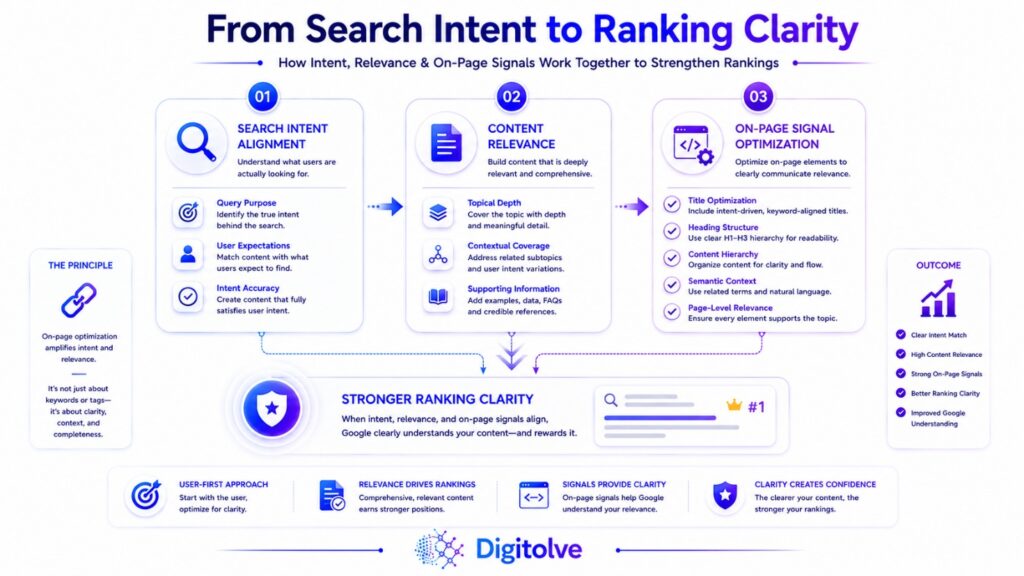
Strong content relevance creates the substance of a ranking asset, but search engines and users also need a clear structure that communicates what the page is about and how its information is organized.
On-page signals provide that clarity.
Within an SEO ranking system, titles, headings, page hierarchy, contextual language, and related page-level elements should not be optimized independently. They should reinforce the same search intent and content purpose established earlier in the ranking workflow.
Align Titles and Headings With Page Purpose
A page title and its major headings should communicate a consistent topic and purpose.
The title establishes the primary direction of the page, while headings organize the supporting ideas required to satisfy the searcher’s objective. When these elements are aligned, the page creates a clearer relationship between the target query, search intent, and actual content.
This does not require placing the exact keyword into every heading.
Instead, headings should naturally reflect the concepts and questions necessary to cover the topic effectively.
Build a Clear Content Hierarchy
Content hierarchy helps organize information according to importance and relationship.
The main topic should remain clearly identifiable, while supporting sections progressively explain the ideas underneath it. H2 and H3 headings can create this structure by separating major concepts from their supporting details.
A logical hierarchy makes complex content easier to navigate while preventing important information from becoming buried inside an unstructured page.
The execution pattern is:
Page Purpose
↓
Primary Topic
↓
Major Supporting Concepts
↓
Supporting Details
This creates a coherent page architecture instead of a collection of loosely connected sections.
Strengthen Contextual Relevance Across the Page
On-page relevance extends beyond titles and headings.
The explanations, terminology, examples, supporting concepts, and relationships between sections should collectively reinforce the subject of the page.
Instead of repeatedly inserting the same keyword, businesses can strengthen contextual relevance by covering the topic naturally and comprehensively.
This allows on-page optimization to support the Content Relevance System rather than becoming a separate keyword-placement exercise.
Make Important Search Signals Easy to Interpret
A well-structured page should make its central purpose clear.
Titles establish direction. Headings organize major ideas. Supporting sections deepen the topic. Contextual language connects related concepts.
When these elements consistently reinforce one another, the page communicates a more coherent topic structure.
The objective is not to manipulate rankings through excessive optimization. It is to remove ambiguity and make the relationship between query → intent → content → page structure as clear as possible.
Keep On-Page Optimization Connected to Intent
Every on-page decision should ultimately trace back to the search objective established at the beginning of the ranking workflow.
Before changing a title, adding a section, restructuring headings, or expanding contextual coverage, ask whether that change strengthens the page’s ability to satisfy its intended search need.
This keeps optimization purposeful.
The complete relationship becomes:
Search Intent
↓
Content Relevance
↓
On-Page Clarity
↓
Stronger Ranking Signals
On-page optimization works best when it reinforces search intent and content relevance rather than operating as an isolated checklist.
This is what turns individual page optimizations into a connected component of the broader SEO ranking system.
Why Internal Authority Matters for Ranking Improvement
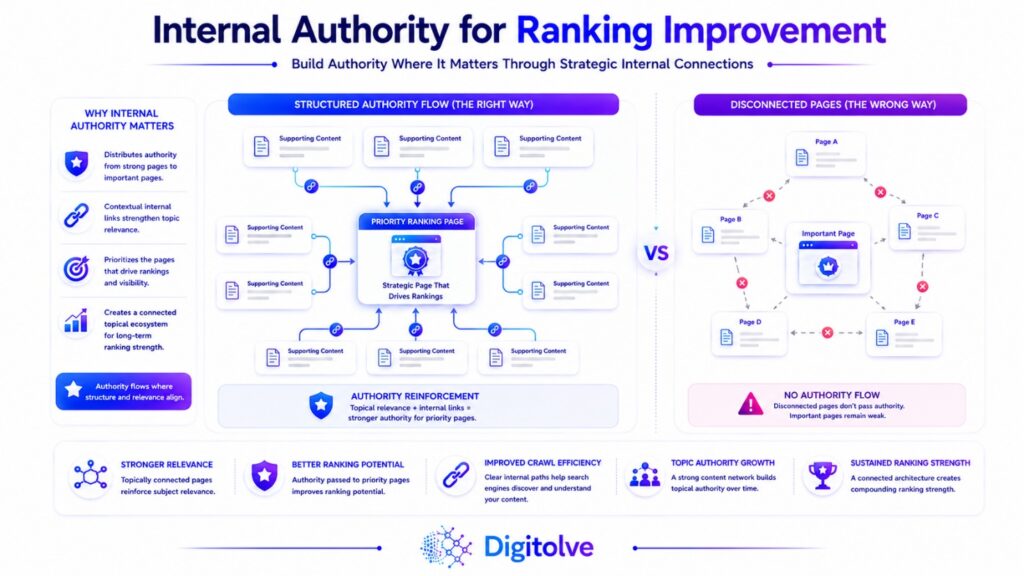
A well-aligned and optimized page still exists within a larger website ecosystem. Its ranking potential is influenced not only by what appears on the page itself, but also by how that page connects with related content across the site.
Internal authority provides this connection. Through strategic internal links and clear content relationships, businesses can reinforce important pages, establish stronger topic structures, and help priority ranking assets receive meaningful support from the wider website.
Pages Do Not Rank in Isolation
Every page belongs to a broader content architecture.
When related articles remain disconnected, each page has to operate with limited contextual support. A connected structure creates relationships between supporting content, broader topic areas, and strategically important pages.
Instead of thinking:
One Page → One Keyword → One Ranking
a ranking system considers:
Supporting Content → Topic Relationships → Priority Page → Stronger Internal Authority
This turns individual pages into components of a connected ranking ecosystem.
Internal Links Communicate Page Relationships
Internal links help connect information that belongs together.
A supporting article can point readers toward a deeper resource. Related pages can reinforce a broader topic. Strategically placed links can connect supporting content with the pages that matter most within the ranking architecture.
The objective is not to add internal links simply because an SEO checklist recommends them.
Every link should have a clear contextual purpose.
For a deeper explanation of the structural role of internal linking, explore Why Your Internal Linking Is Not Helping Your SEO (And What Your Structure Is Missing).
Give Strategic Pages Stronger Internal Support
Not every page carries the same strategic importance.
Some pages target priority search opportunities, represent important topics, or act as central resources within a content ecosystem. These pages should receive relevant internal support from related content where that connection genuinely benefits the reader.
A simple architecture may look like:
Supporting Article
↓
Related Subtopic
↓
Priority Topic Page
↓
Broader Topic Hub
This creates intentional relationships instead of an arbitrary network of links.
Build Topic Relationships Through Site Architecture
Internal authority becomes stronger when it is supported by logical website architecture.
Related content should be easy to discover and understand within the broader topic structure. When supporting articles, priority pages, and central resources are meaningfully connected, the website develops a clearer content hierarchy.
This also complements the Content Relevance System.
Content establishes topical depth at the page level, while internal architecture connects that relevance across multiple pages.
Avoid Fragmenting Ranking Signals
Internal authority becomes less effective when multiple pages compete for the same purpose or when strategically important content is buried within a disconnected site structure.
Each priority page should have a clear role within the ranking architecture, while supporting pages should reinforce rather than unnecessarily duplicate that role.
The execution principle is:
Define the priority page → Connect relevant supporting content → Reinforce topic relationships → Strengthen internal authority
Internal linking therefore should not be treated as a final optimization step added after content is published.
It is part of the ranking system itself—connecting relevant pages and giving strategically important ranking assets stronger support from the broader website ecosystem.
How Continuous Ranking Reinforcement Creates Stability
Reaching a stronger Google ranking is not the end of the ranking process. Search results remain competitive, content expectations evolve, and competing pages continue improving. A page that performs well today may therefore require reinforcement over time to preserve the signals that helped it become competitive.
Within the SEO Ranking Blueprint, ranking reinforcement remains intentionally simple. The objective is not to build an advanced monitoring or optimization system. It is to establish the habit of reviewing important ranking assets and strengthening them when meaningful changes are needed.
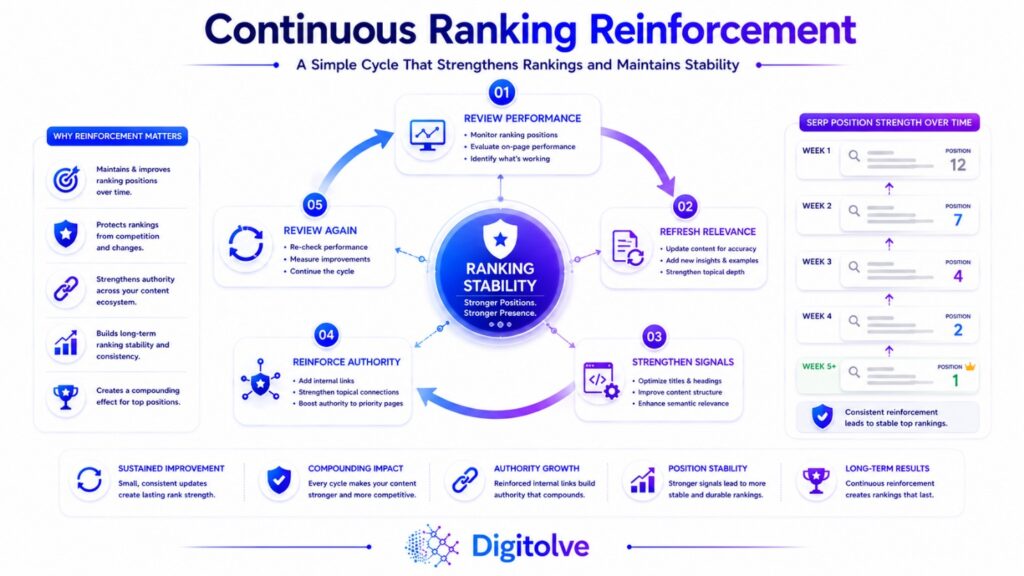
Ranking Improvement Is Not a One-Time Event
SEO optimization is sometimes treated as a completed task:
Optimize → Publish → Rank → Finished
A more sustainable ranking workflow recognizes that important pages exist within an evolving search environment.
The stronger model is:
Optimize → Evaluate → Reinforce → Review
This allows ranking improvement to become an ongoing process rather than a one-time intervention.
Search Competition Continues After You Rank
Achieving a strong position does not remove competition.
Other websites can publish more relevant resources, strengthen existing pages, improve their topical coverage, or develop stronger supporting content around the same search opportunity.
This means ranking assets should not be assumed to remain competitive indefinitely simply because they once performed well.
The goal is not constant editing. It is maintaining awareness of whether strategically important pages continue to serve their intended search purpose effectively.
Refresh Weakening Content Signals
Content should be updated when there is a meaningful reason for improvement.
That may include outdated information, changes in search expectations, missing contextual coverage, or sections that no longer support the page’s purpose as effectively as they once did.
Updates should reinforce the existing ranking architecture:
Search Intent → Content Relevance → On-Page Signals
Rather than changing successful pages unnecessarily, reinforcement should strengthen areas where relevance or clarity has genuinely weakened.
Reinforce Important Ranking Assets
Priority pages can also become stronger through the broader website ecosystem.
New supporting content may create relevant internal linking opportunities. Existing articles may be connected more strategically. Topic relationships may become clearer as the website expands.
This means reinforcement is not limited to editing the ranking page itself.
Sometimes the surrounding content architecture can provide the additional support an important page needs.
Review Performance Before Making Further Changes
One of the most important principles of ranking reinforcement is avoiding unnecessary optimization.
When rankings fluctuate, immediately changing titles, rewriting sections, adding keywords, and restructuring pages simultaneously can make it difficult to understand whether those changes actually improved the asset.
A stronger workflow is:
Review → Understand → Prioritize → Reinforce → Observe
Make deliberate improvements where appropriate, then allow enough time to evaluate their effect before introducing additional changes.
At the Mini level, this is the boundary of ranking reinforcement.
The SEO Ranking Blueprint establishes the foundational workflow for reviewing and strengthening ranking assets. Deeper monitoring, ongoing optimization management, and broader ranking-system operations belong within the future SEO Ranking System — Core.
Ranking stability is not created by constantly changing successful pages. It is strengthened by reinforcing the right signals when the ranking environment actually requires it.
Common Mistakes That Prevent Ranking Systems From Working
Even when businesses understand the individual elements of SEO, ranking improvement can remain inconsistent if those elements are executed without a connected structure. The problem is often not the absence of optimization, but the way individual activities are planned and applied.
A ranking system works best when search intent, content relevance, on-page signals, internal authority, and reinforcement all support the same ranking objective.
Optimizing Individual Pages Without a System
Page-level improvements can strengthen specific assets, but optimizing each page independently can create disconnected execution across the website.
One page may receive extensive content updates while another receives internal links. Another may have its headings rewritten without considering whether its search intent or content purpose is still aligned.
A structured ranking workflow keeps these decisions connected:
Intent → Relevance → Signals → Authority → Reinforcement
Each optimization should strengthen the broader ranking architecture rather than exist as an isolated SEO task.
Targeting Keywords Without Understanding Search Intent
Keyword selection provides direction, but keywords alone do not determine what a page should contain.
If the page format, depth, structure, or purpose does not align with what searchers expect from the query, adding more keyword references will not necessarily strengthen the asset.
Start with the search objective, define the page purpose, and then use the target keyword within that context.
This keeps keyword optimization connected to the Search Intent Alignment System.
Publishing Competing Pages for the Same Search Opportunity
Creating multiple pages around closely related topics can be useful when each page serves a distinct search purpose.
Problems arise when several pages target essentially the same query and satisfy the same intent.
Instead of reinforcing one clear priority asset, the website may create unnecessary competition between its own pages.
This is why every ranking workflow should establish:
Target Query → Search Intent → Page Purpose → Priority Asset
If multiple pages begin serving the same purpose, their roles within the content architecture should be clarified.
For a deeper explanation, read Why Keyword Cannibalization Is Killing Your Rankings (And Splitting Your SEO Authority Without You Realizing It).
Ignoring Internal Authority Distribution
Publishing strong content does not automatically give strategically important pages sufficient internal support.
If internal links are added randomly, low-priority pages may receive substantial attention while important ranking assets remain buried within the site architecture.
A structured system deliberately connects supporting content with priority pages where those relationships are contextually relevant.
The objective is not simply to increase the number of internal links.
It is to build meaningful internal authority around the pages that matter.
Treating Rankings as a One-Time Achievement
A page reaching a strong Google position can create the impression that optimization is complete.
But search environments continue evolving.
Content relevance can weaken, competitors can improve, and the surrounding content ecosystem can change. Important ranking assets therefore need periodic review and deliberate reinforcement when necessary.
The goal is not constant optimization.
It is ensuring that strong pages continue receiving the relevance and structural support required to remain competitive.
Changing Too Many SEO Signals at Once
When rankings fluctuate, businesses may respond by changing the title, rewriting content, restructuring headings, adding internal links, and adjusting keywords simultaneously.
This creates an execution problem: it becomes difficult to understand which change helped, which had little effect, and which may have introduced unnecessary disruption.
A more controlled ranking workflow is:
Review → Prioritize → Change → Observe → Reinforce
This keeps optimization deliberate rather than reactive.
The broader principle is simple:
A ranking system becomes stronger when SEO decisions are coordinated around a clear search objective rather than applied as disconnected reactions.
Avoiding these mistakes allows the five ranking systems to remain aligned while preserving a repeatable foundation for consistent ranking improvement.
From Ranking Strategy to Repeatable Execution
A ranking strategy provides direction, but direction alone does not create consistent execution.
Businesses may understand which keywords they want to target, which pages matter most, and which SEO improvements could strengthen their content. The challenge is turning those decisions into a repeatable process that can be applied across important ranking assets without returning to disconnected tactics every time.
This is where ranking strategy becomes a ranking system.
Strategy Creates Ranking Direction
A strong strategy establishes what the website wants to achieve in search.
It identifies priority topics, relevant search opportunities, important pages, and the broader direction of optimization. But strategy answers primarily what should be prioritized.
Execution answers a different question:
How will those priorities be implemented consistently?
Without a structured execution process, even a strong SEO strategy can become a collection of individual optimization activities.
A Framework Turns Strategy Into Repeatable Execution
A ranking framework creates a consistent sequence for translating strategy into action.
Instead of approaching every page differently, the same foundational logic can be applied:
Align Search Intent
↓
Strengthen Content Relevance
↓
Optimize On-Page Signals
↓
Build Internal Authority
↓
Reinforce Important Ranking Assets
Each stage has a defined role, making ranking improvement easier to organize and repeat across strategically important pages.
This systems-based approach also aligns with Google’s broader SEO guidance. Google’s official SEO Starter Guide emphasizes creating useful content, organizing a site logically, and helping search engines understand pages rather than relying on isolated ranking tricks.
Build a Consistent Ranking Improvement Workflow
A repeatable workflow prevents SEO execution from becoming reactive.
Rather than making random changes whenever rankings move, businesses can evaluate important pages through the same ranking architecture and determine which part of the execution process requires attention.
The workflow becomes:
Define Page Purpose → Align Intent → Build Relevance → Optimize Signals → Reinforce Authority → Review and Strengthen
This does not mean every page requires identical optimization.
It means every page is evaluated through the same strategic system while individual decisions remain appropriate to its search purpose.
The SEO Ranking Blueprint
The SEO Ranking Blueprint turns this architecture into a foundational execution process.
It is designed to connect the five systems explored throughout this guide:
Search Intent Alignment
Content Relevance
On-Page Signals
Internal Authority
Ranking Reinforcement
Rather than providing another collection of SEO tactics, the blueprint organizes these components into a repeatable ranking improvement workflow.
The SEO Ranking Blueprint is a structured execution blueprint for connecting search intent, content relevance, on-page signals, internal authority, and continuous reinforcement into a repeatable ranking improvement system.
The objective is straightforward:
Move from knowing which SEO activities matter to having a structured process for executing those activities as one connected ranking system.
This is the point where ranking strategy becomes repeatable execution—and where isolated optimization begins turning into a system.
From Diagnosis to Execution
Building an SEO ranking system works best when the business already understands what needs to be strengthened.
If rankings are underperforming but it is still unclear which signals are weak, missing, or misaligned, execution should not begin with assumptions. Making changes without first understanding the underlying ranking problem can lead to unnecessary optimization and disconnected SEO decisions.
This is where the roles of Smart Solve Lab and Digitolve remain intentionally separate.
Smart Solve Lab — Diagnose the Ranking Problem
Smart Solve Lab operates at the diagnostic stage.
The Ranking Failure Diagnostic Tool is designed to help identify where ranking performance may be breaking down before an execution framework is selected.
Its core tool, the Ranking Signal Checker, focuses on evaluating ranking signals and bringing clarity to the areas that require attention.
The objective is not implementation.
It is to answer:
What is preventing stronger ranking performance?
For businesses that are still trying to understand the problem, the diagnostic starting point is:
Why Your Blog Is Not Ranking on Google (Even After SEO Optimization)
Digitolve — Build the Ranking System
Once the ranking problem is understood, the role changes from diagnosis to execution.
Digitolve takes that clarity and turns it into a structured system for improvement.
The SEO Ranking Blueprint provides the execution architecture for connecting:
Search Intent → Content Relevance → On-Page Signals → Internal Authority → Ranking Reinforcement
Instead of continuing to investigate why ranking performance is weak, the focus becomes building the workflow required to strengthen it.
Diagnosis and Execution Serve Different Purposes
The relationship is intentionally simple:
Ranking Problem
↓
Smart Solve Lab — Diagnosis
↓
Ranking Signal Clarity
↓
Digitolve — SEO Ranking Blueprint
↓
Structured Execution
Smart Solve Lab identifies what needs attention and why.
Digitolve provides the framework for what to build next and how the execution should be structured.
This separation prevents businesses from jumping into random SEO changes before they understand the problem, while also preventing diagnosis from becoming a substitute for implementation.
Diagnose first. Gain clarity. Then build the ranking system designed to address the identified problem.
That creates a clean progression from uncertainty to structured ranking execution without overlapping the roles of the two brands.
Building Toward a Complete SEO Ranking System
The SEO Ranking Blueprint creates the foundational workflow for structured ranking improvement. But as a website grows, ranking management can become more complex.
More pages begin competing across larger topic areas. Important ranking assets require ongoing reinforcement. Search opportunities evolve, and ranking decisions need to be coordinated across a broader content ecosystem.
At that stage, businesses may need to move beyond a foundational blueprint toward a more comprehensive ranking system.
Start With the Foundational Ranking Workflow
The SEO Ranking Blueprint establishes the essential execution sequence:
Search Intent Alignment
↓
Content Relevance
↓
On-Page Signals
↓
Internal Authority
↓
Ranking Reinforcement
This gives businesses a repeatable foundation for approaching important ranking assets without relying on disconnected SEO tactics.
The purpose of the Mini Blueprint is therefore clear:
Build the foundational ranking workflow first.
Move From Individual Workflows to System-Level Execution
As the number of ranking assets increases, managing each page independently becomes less practical.
The next stage is connecting ranking processes across the broader website so that optimization, reinforcement, and strategic prioritization operate within a more coordinated structure.
The progression becomes:
SEO Ranking Blueprint — Mini
↓
Build the Foundational Ranking Workflow
↓
SEO Ranking System — Core
↓
Connect Broader Ranking Processes, Reinforcement, Monitoring and Optimization
↓
Future Advanced SEO Growth Systems
The Mini Blueprint establishes the execution foundation.
The future Core system expands that foundation into broader ongoing ranking management.
Build the Right Level of System for Your Current Stage
Not every website needs an advanced ranking system immediately.
A smaller content ecosystem may first need a clear and repeatable process for aligning intent, strengthening relevance, optimizing page signals, and building internal authority.
As ranking operations become more complex, the system can evolve with them.
This creates a natural progression from:
Individual SEO Activities → Repeatable Ranking Workflow → Complete Ranking System
The objective is not to introduce more complexity than the website currently needs.
It is to build a strong execution foundation that can eventually support a more sophisticated ranking architecture as the website grows.
Build the foundational workflow first. Expand into a complete ranking system when the complexity of your SEO execution requires it.
This keeps the SEO Ranking Blueprint focused on practical foundational execution while preserving advanced monitoring, optimization, reinforcement management, and system-level coordination for the future SEO Ranking System — Core.
Conclusion — Build a Ranking System, Not a Collection of SEO Tactics
Improving Google rankings consistently requires more than optimizing individual pages whenever performance changes.
Keywords, content updates, headings, internal links, and other SEO activities can all contribute to ranking performance. But their value becomes significantly stronger when they operate within one connected execution architecture.
A structured SEO ranking system brings those activities together around a clear search objective.
Search intent establishes what the page needs to accomplish. Content relevance builds the depth and context required to satisfy that intent. On-page signals communicate the page’s purpose more clearly. Internal authority connects priority pages with the broader content ecosystem. Ranking reinforcement helps important assets remain relevant and competitive over time.
Together, these systems create a repeatable ranking improvement process:
Align Intent
↓
Strengthen Relevance
↓
Optimize Signals
↓
Build Authority
↓
Reinforce Rankings
↓
Improve Continuously
The objective is not to chase every ranking fluctuation or continuously search for another SEO tactic.
It is to create a framework where every meaningful optimization strengthens the same ranking architecture.
As the website grows, that foundational workflow can eventually develop into a broader SEO Ranking System with deeper monitoring, optimization, reinforcement, and system-level management.
But the foundation remains the same:
Consistent Google rankings are not created by repeatedly applying isolated SEO tactics. They develop when search intent, content relevance, page-level signals, internal authority, and continuous reinforcement operate as one connected system.
Build that foundation first. Strengthen it systematically. Then expand the system as your ranking operations become more complex.
That is how SEO moves from a collection of optimization activities toward a repeatable ranking improvement system.
Build Your SEO Ranking System
Consistent ranking improvement becomes easier when SEO activities are connected through a repeatable execution process.
If you are still uncertain about what is preventing your pages from ranking, begin with diagnosis. If the ranking problem is already clear and you are ready to strengthen execution, move directly into the ranking blueprint.
Still Unclear What Is Preventing Your Rankings?
Start with the Ranking Failure Diagnostic Tool — Smart Solve Lab.
The diagnostic process is designed to help identify weak, missing, or misaligned ranking signals before you begin changing your SEO execution.
Best for:
Businesses that can see ranking underperformance but do not yet have enough clarity about what needs to be strengthened.
Your path:
Ranking Problem → Diagnose → Interpret Signals → Gain Clarity
Already Understand the Problem and Ready to Execute?
Move into the SEO Ranking Blueprint — Digitolve.
The blueprint helps turn ranking strategy into a structured execution workflow built around five connected systems:
Search Intent Alignment
↓
Content Relevance
↓
On-Page Signals
↓
Internal Authority
↓
Ranking Reinforcement
Instead of applying optimization tactics independently, you can use the blueprint to connect them around the same ranking objective.
Your path:
Clarity → Build the Framework → Execute Consistently → Reinforce Rankings
Choose the Right Starting Point
You do not need another collection of disconnected SEO tactics.
You need the next system that matches your current stage.
Need clarity? → Smart Solve Lab — Ranking Failure Diagnostic Tool
Ready to implement? → Digitolve — SEO Ranking Blueprint
The distinction is simple:
Diagnose what is preventing ranking performance. Then build the system that strengthens it.
This creates a cleaner progression from ranking uncertainty to structured execution—and eventually toward a complete SEO Ranking System as your ranking operations become more advanced.
Frequently Asked Questions
What Is an SEO Ranking System?
An SEO ranking system is a structured process that connects the elements supporting ranking performance, including search intent, content relevance, on-page signals, internal authority, and continuous reinforcement. Instead of treating each SEO activity separately, the system coordinates them around the same ranking objective.
How Can I Improve My Google Rankings Consistently?
Consistent ranking improvement requires more than repeatedly optimizing individual pages. Start by aligning each priority page with search intent, strengthening its topical relevance, clarifying on-page signals, building meaningful internal support, and reviewing important ranking assets over time.The objective is to create a repeatable process rather than depend on isolated SEO changes.
Why Doesn’t On-Page SEO Automatically Improve Rankings?
On-page optimization is only one component of ranking performance.A page can have optimized titles, headings, and structure while still lacking sufficient content relevance, search intent alignment, or internal authority. On-page signals become more valuable when they reinforce the broader purpose and relevance of the page.
How Does Search Intent Affect Google Rankings?
Search intent represents what users are trying to accomplish when they perform a search.Understanding that objective helps determine the appropriate page purpose, content format, depth, and supporting information. When the page closely aligns with the searcher’s needs, the rest of the ranking system can be structured around a clearer objective.
Does Internal Linking Help Pages Rank Higher?
Internal links can support ranking architecture by connecting related pages, clarifying content relationships, and directing relevant internal support toward strategically important content.However, internal linking works best when links are contextually useful and part of a logical website structure rather than added simply to increase link quantity.
Why Does Content Lose Rankings After Reaching Google?
Strong rankings are not necessarily permanent. Search competition changes, information can become outdated, user expectations may evolve, and competing pages can become stronger.Important ranking assets should therefore be reviewed periodically and reinforced when their relevance, clarity, or supporting architecture genuinely needs improvement.
How Can I Make SEO Rankings More Stable?
Ranking stability begins with maintaining the systems that supported ranking improvement in the first place.Keep search intent aligned, maintain content relevance, preserve clear on-page signals, reinforce important pages through meaningful internal relationships, and review priority ranking assets before making unnecessary changes.No system can guarantee fixed Google positions, but structured reinforcement can create a stronger foundation for sustainable ranking performance.
What Is the Difference Between an SEO Ranking Strategy and an SEO Ranking System?
An SEO ranking strategy defines the direction: which opportunities to pursue, which pages to prioritize, and what the website wants to achieve in search.An SEO ranking system turns that direction into repeatable execution.In simple terms:Ranking Strategy → What should we prioritize?Ranking System → How will we execute and reinforce it consistently?Combining strategic direction with repeatable execution allows ranking improvement to become a structured process rather than a collection of disconnected SEO activities
Recommended Reading
Continue strengthening your SEO ranking architecture with these three closely related guides.
Why Your Content Doesn’t Stay Ranked (Even After Reaching Top Positions)
Reaching a strong Google position is only part of the ranking journey. Explore why ranking performance can weaken over time and which broader signals influence ranking durability.
Why Your Internal Linking Is Not Helping Your SEO (And What Your Structure Is Missing)
Learn how internal linking, page relationships, and website structure influence the way important content receives support across your broader SEO architecture.
Why Keyword Cannibalization Is Killing Your Rankings
Understand how competing pages can divide ranking focus and why clearer page purposes and topic relationships matter when building a structured ranking system.
These three complete the supporting journey nicely:
Ranking Durability → Internal Authority → Ranking Focus
while the main blog remains firmly focused on building the SEO ranking execution system. 🔒