SEO strategy :
SEO can generate rankings without necessarily attracting the audience a business actually wants.
A website may target high-volume keywords, publish optimized content, improve individual pages, and even earn stronger search positions—yet still struggle to connect those efforts with meaningful business priorities. The problem is not always a lack of SEO activity. Often, the missing piece is a clear strategy that determines what should be targeted, why it matters, and which searchers the business actually wants to reach.
That is the role of an effective SEO strategy.
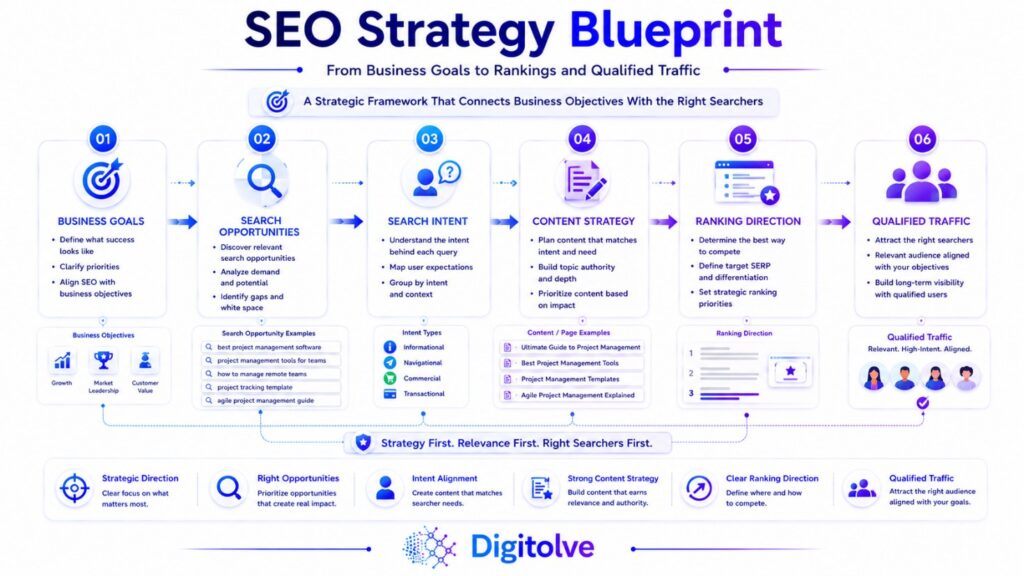
Instead of beginning with a list of keywords, a structured SEO strategy begins with business goals. Those goals provide direction for identifying relevant search opportunities, understanding the intent behind them, deciding which content should be created or prioritized, and defining where ranking efforts should be focused.
The strategic chain becomes:
Business Goals
↓
Search Opportunities
↓
Search Intent
↓
Content Strategy
↓
Ranking Direction
↓
Qualified Traffic
In this framework, qualified traffic does not simply mean more visitors. It means attracting relevant searchers whose needs and intent align with the purpose of the website and its business objectives.
This distinction matters because ranking for a keyword is not automatically valuable simply because the keyword has search volume. A strategically useful search opportunity should connect the right query with the right audience, the right content, and a meaningful business objective.
More rankings do not automatically mean a better SEO strategy.
A strong strategy creates priorities. It helps businesses decide which search opportunities deserve attention, which audiences they need to reach, what content should support those opportunities, and where ranking efforts should be directed.
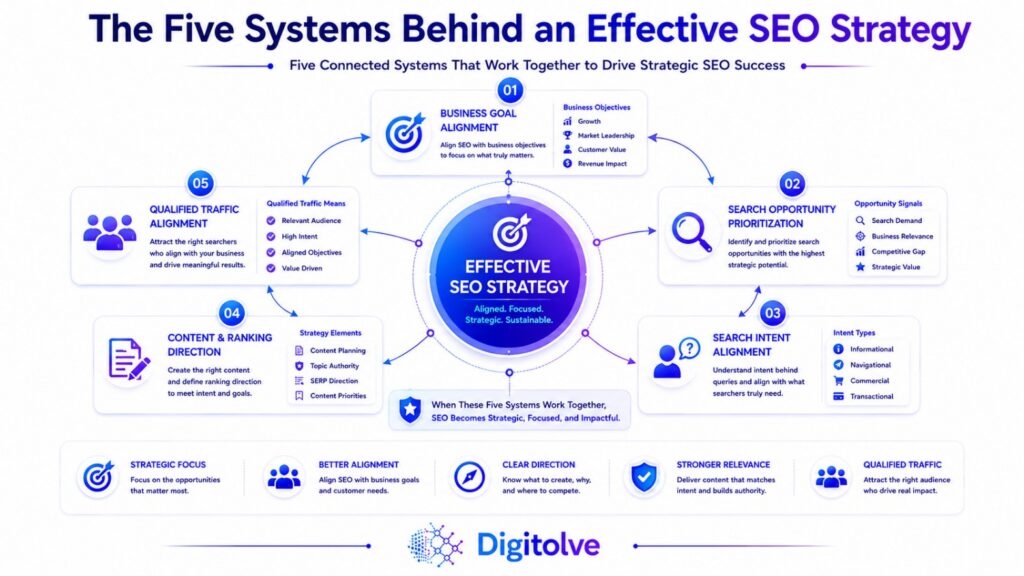
In this guide, we will build that strategic architecture around five connected systems:
Business Goal Alignment → Search Opportunity Prioritization → Search Intent Alignment → Content & Ranking Direction → Qualified Traffic Alignment
Together, these systems turn disconnected SEO activities into a clearer, repeatable strategic direction.
The objective is not visibility for its own sake.
It is to rank for the right opportunities, reach the right searchers, and build SEO around strategic value.
Table of Contents
What Is an SEO Strategy?
An SEO strategy is a structured plan for deciding which search opportunities a business should pursue, why those opportunities matter, and how they should connect with content, rankings, and the audience the business wants to reach.
This makes strategy different from simply performing SEO activities.
Keyword research, content creation, on-page optimization, internal linking, and ranking improvement can all support SEO. But without strategic direction, those activities may target opportunities that have little connection with the business, its audience, or its priorities.
A strong SEO strategy gives those activities a common direction.
SEO Strategy Is More Than a List of Keywords
Keywords are inputs into an SEO strategy—not the strategy itself.
A keyword may have attractive search volume and appear relevant at first glance, but that does not automatically make it strategically valuable.
Before prioritizing a search opportunity, businesses should consider questions such as:
Does this topic relate directly to what the business does?
Does the searcher represent an audience we actually want to reach?
What is the intent behind the query?
Do we have—or should we create—a page capable of serving that intent?
Would ranking for this opportunity support a meaningful SEO objective?
This shifts keyword research from finding search terms toward selecting strategically valuable opportunities.
The Difference Between SEO Tactics and SEO Strategy
SEO tactics are individual actions.
An SEO strategy determines why those actions should be performed and where they should be focused.
For example:
Tactic: Optimize a page for a keyword.
Strategy: Determine whether that search opportunity aligns with the business goal, audience, search intent, content direction, and ranking priorities before investing in the page.
Similarly, publishing content is an SEO activity.
A strategy determines which content deserves to be created, which search opportunity it should serve, and how that content contributes to the broader SEO direction.
The distinction can be summarized as:
SEO Tactics → What actions can we take?
SEO Strategy → Which opportunities should we pursue and why?
Why Rankings Need a Strategic Business Purpose
Ranking improvement can be valuable, but rankings should not become the objective in isolation.
A website could rank for dozens of queries that attract people with little relevance to its actual audience. Those rankings may increase visibility while contributing very little strategic value.
A stronger SEO approach asks:
Who do we want to reach?
↓
What are they searching for?
↓
Which of those searches align with our business objectives?
↓
Which opportunities deserve content and ranking focus?
This gives ranking efforts a clear strategic purpose.
The goal becomes not simply more rankings, but relevant rankings connected to valuable search opportunities.
How SEO Connects Search Demand With Business Goals
Search engines reveal existing demand through the questions, problems, comparisons, and information people actively search for.
SEO strategy creates the bridge between that demand and the business.
On one side are:
Business Goals + Audience Priorities
On the other are:
Search Demand + Search Intent
A structured SEO strategy identifies where these two sides intersect.
That intersection creates the strongest strategic opportunities—topics that people genuinely search for and that also make sense for the audience and objectives the business wants SEO to support.
The process becomes:
Business Goal → Relevant Audience → Search Demand → Strategic Opportunity → Content Direction
SEO therefore becomes more than competing for keywords. It becomes a method for connecting business priorities with existing search behavior.
What Qualified Organic Traffic Actually Means
Qualified organic traffic does not simply mean receiving more visitors from Google.
Within this strategy, it means attracting relevant searchers whose intent and needs align with the purpose of the page and the audience the business wants to reach.
For example, a lower-volume search opportunity that closely matches the target audience may be strategically more valuable than a much larger keyword attracting broad but poorly aligned visitors.
This is why traffic volume alone should not determine SEO priorities.
The strategic objective is:
Right Opportunity → Right Intent → Right Content → Right Searcher
That principle becomes the foundation for the rest of the SEO Strategy Blueprint.
Instead of asking:
“How can we rank for more keywords?”
the stronger strategic question becomes:
“Which search opportunities should we pursue to reach the audience that matters to our objectives?”
That is the difference between performing SEO activities and building an SEO strategy with clear strategic direction.
The Five Systems Behind an Effective SEO Strategy
An effective SEO strategy needs more than keyword research and a publishing calendar. It needs a structured way to decide what SEO should support, which opportunities deserve attention, who those opportunities should reach, and how they should translate into content and ranking direction.
The SEO Strategy Blueprint organizes those decisions into five connected systems.
1. Business Goal Alignment System
SEO direction should begin with what the business wants its search presence to support.
That might mean reaching a specific audience, becoming visible around strategically important topics, supporting particular services or solutions, or strengthening presence at an important stage of the customer journey.
The purpose at this stage is not to select keywords.
It is to establish a clear objective that later SEO decisions can be evaluated against.
This creates the first connection:
Business Objective → SEO Objective
Without that connection, SEO can generate activity without creating strategic direction.
2. Search Opportunity Prioritization System
Once the SEO objective is clear, the next step is identifying search opportunities worth pursuing.
Not every relevant keyword deserves equal investment.
Search opportunities should be evaluated according to factors such as:
Business Relevance → Audience Fit → Search Intent → Strategic Value
This prevents search volume from becoming the only reason a keyword enters the strategy.
The objective is to build a prioritized portfolio of search opportunities that support the direction established by the business goal.
3. Search Intent Alignment System
A strategically relevant keyword can still attract the wrong audience if its underlying intent is misunderstood.
Search Intent Alignment connects the opportunity with:
Who is searching
↓
What they are trying to accomplish
↓
What type of information or page they expect
↓
Whether that need aligns with the intended audience
This is where SEO begins moving from keyword targeting toward audience alignment.
Instead of simply asking whether a query can generate visibility, the strategy asks whether visibility for that query would place the business in front of a relevant searcher.
4. Content & Ranking Direction System
Once valuable opportunities and their intent are clear, they need to become actionable priorities.
The strategy determines which opportunities require new content, which may belong to existing pages, what purpose each page should serve, and which assets deserve ranking focus.
This creates the handoff:
Selected Opportunity → Search Intent → Content Priority → Page Purpose → Ranking Direction
Importantly, this system defines ranking direction rather than teaching the deeper mechanics of ranking improvement.
Those mechanics belong to the separate SEO Ranking Blueprint.
5. Qualified Traffic Alignment System
The final system ensures the strategy remains focused on relevance rather than traffic volume alone.
Qualified organic traffic, in this framework, means relevant visitors whose search needs align with the purpose of the page and the audience the business intends to reach.
That creates a final strategic check:
If this page ranks, are we likely to reach the right searcher?
A high-volume opportunity with weak audience alignment may deserve lower priority than a smaller opportunity closely connected to the intended audience.
How the Five Systems Work Together
The complete strategic architecture becomes:
Business Goal Alignment
↓
Search Opportunity Prioritization
↓
Search Intent Alignment
↓
Content & Ranking Direction
↓
Qualified Traffic Alignment
Each system narrows and strengthens the decisions made before it.
Business goals establish direction. Search opportunity prioritization determines where SEO should compete. Intent alignment identifies the searchers and needs behind those opportunities. Content and ranking direction turns them into actionable priorities. Qualified traffic alignment ensures the resulting visibility remains relevant to the intended audience.
A strong SEO strategy does not pursue every available search opportunity. It creates a structured process for deciding which opportunities are strategically worth pursuing and why.
This five-system architecture provides that decision framework without turning the strategy into a collection of disconnected SEO tactics.
Start SEO Strategy With Business Goals, Not Keywords
Keyword research is important, but it should not be the first decision that defines an SEO strategy.
When businesses begin with keywords alone, it is easy to prioritize opportunities because they have attractive search volume, appear easier to rank for, or seem broadly related to the industry. Those opportunities may generate visibility, but visibility has limited strategic value if it does not connect with the audience and objectives the business actually wants SEO to support.
A stronger process begins by defining the business direction first and allowing that direction to guide search opportunity selection.
Define What SEO Needs to Achieve
Before deciding what to target, establish what SEO is expected to contribute.
Different businesses may need search visibility to support different priorities. One may want to become discoverable around a particular solution category, while another may need to reach audiences researching a specific problem or strengthen visibility around strategically important topics.
The objective should therefore come before keyword selection.
A simple starting sequence is:
Business Priority
↓
SEO Objective
↓
Relevant Audience
↓
Search Opportunity Direction
This gives later keyword and content decisions a strategic reference point.
Connect Search Visibility With Business Priorities
Not every topic related to a business deserves the same SEO investment.
A search opportunity becomes more strategically useful when its visibility supports something the business genuinely wants to strengthen.
For every major SEO opportunity, ask:
What business priority does this visibility support?
If that connection is unclear, the opportunity may still generate impressions or rankings, but its strategic importance should be questioned before significant resources are committed to it.
This creates a useful distinction between:
Available Search Opportunity
and
Strategically Valuable Search Opportunity
SEO strategy is primarily concerned with the second.
Identify the Audience SEO Needs to Reach
Once the objective is clear, define who needs to be reached through search.
A business may have several potential audiences, but they will not necessarily search in the same way. Their problems, level of awareness, terminology, and search intent can differ significantly.
Understanding the intended audience helps narrow the search landscape.
Instead of asking:
“What keywords exist in our industry?”
the strategy asks:
“What does the audience relevant to this objective actually search for?”
That question creates a much stronger foundation for opportunity prioritization.
Separate Valuable Search Demand From Vanity Traffic
High search volume can be attractive because it suggests the potential for more visibility.
But more search demand does not automatically mean greater strategic value.
A broad keyword might attract a large audience with weak relevance to the business, while a more specific opportunity may attract fewer people whose needs align much more closely with the intended audience.
This does not mean search volume should be ignored.
It means volume should be considered alongside:
Business Relevance
Audience Fit
Search Intent
Strategic Value
The objective is not simply to find the largest available audience.
It is to identify search demand that is worth competing for.
Build Clear SEO Objectives Before Execution
Before moving into content planning or ranking execution, the strategy should be able to answer three basic questions:
What do we want SEO to support?
Who do we want search visibility to reach?
Which types of search opportunities align with both?
Once those answers are clear, keyword research becomes far more useful because opportunities can be evaluated against an established strategic direction.
The execution sequence becomes:
Business Goals → SEO Objectives → Audience → Search Opportunities → Content & Ranking Direction
Keywords should inform an SEO strategy, but business goals should determine its direction.
With that foundation established, the next step is to evaluate the search landscape and identify which opportunities are actually worth ranking for.
Identify Search Opportunities Worth Ranking For
Once business goals, SEO objectives, and the intended audience are clear, the next step is deciding which search opportunities deserve attention.
This is where SEO strategy becomes selective.
A business may discover hundreds or even thousands of relevant keywords, but treating every keyword as an equal opportunity creates scattered execution. A stronger strategy evaluates search opportunities according to their relevance, intent, audience fit, and strategic value before deciding where content and ranking efforts should be directed.
Search Volume Is Not the Only Opportunity Signal
Search volume can help estimate how frequently people search for a topic, but it should not determine SEO priorities by itself.
A high-volume keyword may attract a broad audience that has little connection with the business objective. A smaller search opportunity may represent a much more relevant audience with a clearly aligned need.
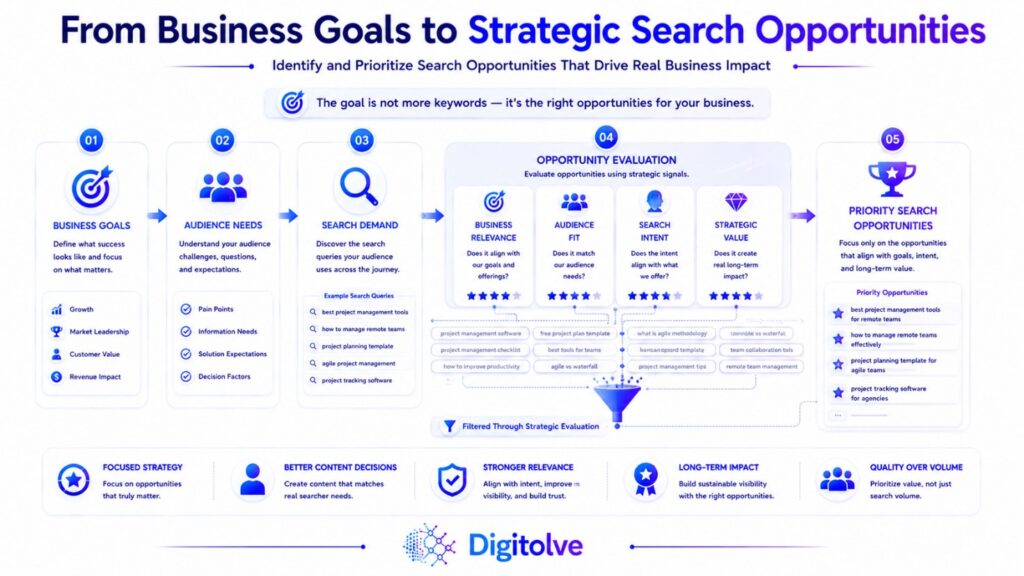
Search volume should therefore be considered alongside other strategic signals:
Search Demand
↓
Business Relevance
↓
Audience Fit
↓
Search Intent
↓
Strategic Value
This creates a more balanced view of what an SEO opportunity is actually worth.
Evaluate Relevance Before Ranking Potential
Before asking whether a website can rank for a search opportunity, first ask whether that opportunity is worth ranking for.
Consider:
Does the topic directly support an SEO objective?
Is it relevant to the audience the business wants to reach?
Does the search intent align with something the website can meaningfully address?
Would the resulting visibility strengthen the broader strategic direction?
This prevents ranking difficulty or keyword volume from becoming the only factors driving SEO decisions.
A technically achievable ranking can still be strategically weak if it attracts the wrong searchers.
Match Search Opportunities With Audience Needs
Strong search opportunities exist where business relevance and audience demand intersect.
The strategy should identify the problems, questions, needs, and objectives the intended audience expresses through search and determine which of those areas the business is strategically positioned to address.
The relationship becomes:
Audience Need → Search Behavior → Relevant Opportunity → Strategic SEO Direction
This helps prevent content planning from becoming disconnected from the people the strategy is supposed to reach.
Prioritize Opportunities by Strategic Value
Once potential opportunities have been identified, they should be prioritized rather than simply collected.
A simple strategic evaluation can consider four dimensions:
Business Relevance — How closely does the opportunity connect with the business objective?
Audience Fit — Does it attract the type of searcher the strategy wants to reach?
Intent Alignment — Can the business provide a page that genuinely satisfies the search need?
Strategic Value — Does pursuing the opportunity strengthen the broader SEO direction?
This is also why following SEO best practices does not automatically produce a coherent strategy. If the activities are not connected to the right opportunities and objectives, execution can remain strategically fragmented. For a deeper look at that problem, read Why Your SEO Strategy Fails (Even When You Follow Best Practices — And Still See No Results).
Build an Opportunity Portfolio Instead of Chasing Keywords
A strong SEO strategy does not need to depend on one high-volume keyword or a long list of unrelated targets.
Instead, businesses can build a portfolio of strategically connected search opportunities.
Some opportunities may address broad topics. Others may serve specific questions, problems, or stages of search intent. Together, they can create a clearer strategic direction for future content and ranking priorities.
The progression becomes:
Discover Opportunities → Evaluate Relevance → Understand Intent → Prioritize Strategic Value → Select SEO Targets
The objective is not to rank for every keyword you can find. It is to identify the search opportunities that are genuinely worth earning visibility for.
Once those opportunities have been selected, the next question becomes even more important:
Who is actually behind those searches—and does their intent align with the audience the business wants to attract?
Align Search Intent With Qualified Traffic
Selecting strategically valuable search opportunities is only part of building an effective SEO strategy. The next step is understanding who is behind those searches, what they are trying to accomplish, and whether that intent aligns with the audience the business actually wants to reach.
This is where search intent connects SEO visibility with qualified traffic.
Within this strategy, qualified traffic does not mean generating the largest possible number of visitors. It means attracting relevant searchers whose needs and intent align with the purpose of the page and the business objective behind it.
Understand Who the Searcher Is
The same broad topic can attract people with very different needs.
Some searchers may be learning about a problem for the first time. Others may already understand the problem and be comparing approaches. Some may be looking for a specific solution, while others may only want general information.
An SEO strategy should therefore look beyond the keyword itself and consider the type of searcher that opportunity is likely to attract.
The strategic question becomes:
“If we earn visibility for this search, who are we likely to reach?”
That helps determine whether the opportunity deserves a place in the strategy.
Identify What the Searcher Wants to Accomplish
Search intent represents the objective behind the query.
A searcher may want to:
Learn about a subject.
Understand or solve a problem.
Compare possible approaches.
Evaluate available options.
Find a particular resource or solution.
Understanding that objective helps determine whether the search opportunity aligns with what the business can meaningfully provide.
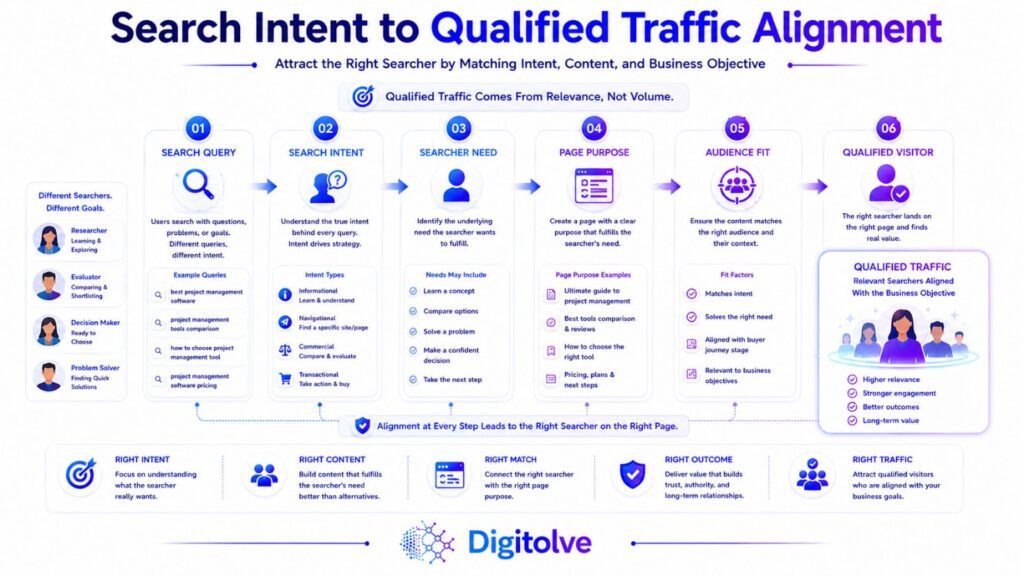
The process becomes:
Search Query → Search Intent → Searcher Need → Strategic Relevance
This prevents keywords from being evaluated only by their wording or search volume.
Match Search Intent With the Right Page Purpose
Once intent is understood, it should be connected with an appropriate page purpose.
An informational search may require an educational article. A comparison-oriented query may need content structured around evaluation. A more solution-aware search may require a page that directly addresses the relevant need.
The important principle is alignment:
Search Intent
↓
Searcher Expectation
↓
Page Purpose
↓
Relevant Content
When these elements support one another, the resulting visibility has a stronger chance of attracting visitors who genuinely wanted what the page was designed to provide.
Distinguish Relevant Traffic From Qualified Traffic
A visitor can be broadly relevant to a topic without being strategically aligned with the business objective.
For example, a searcher may be interested in SEO but looking for something completely outside the specific problem, audience, or solution area the business wants to support.
That creates an important distinction:
Relevant Traffic:
The visitor is interested in the general topic.
Qualified Traffic:
The visitor’s search need also aligns with the intended audience, page purpose, and strategic objective.
This is why an SEO strategy should not evaluate success only by how much organic traffic a keyword could potentially generate.
The better question is:
Would visibility for this search opportunity attract the kind of visitor this SEO objective is intended to reach?
Prioritize Intent That Supports Business Objectives
Search opportunities become stronger when three elements overlap:
Business Relevance
Audience Fit
Search Intent Alignment
When all three are present, the opportunity has clearer strategic value.
This does not guarantee that every visitor will take a particular action, nor does it guarantee rankings or business outcomes. It simply creates a stronger connection between what the business wants SEO to support and who its search visibility is designed to reach.
The strategic chain now becomes:
Business Goal → Search Opportunity → Search Intent → Page Purpose → Audience Fit → Qualified Traffic
The best SEO opportunity is not necessarily the keyword capable of generating the most traffic. It is the opportunity capable of attracting the right searcher for the right strategic objective.
Once that alignment is established, the next step is turning those selected search opportunities into a clear content strategy.
Turn Search Opportunities Into a Content Strategy
Once valuable search opportunities and their underlying intent are clear, the next step is turning those strategic decisions into content.
This is where SEO strategy moves from opportunity selection to content direction.
Instead of publishing because a topic appears relevant or because a keyword has search volume, every important content asset should have a defined role: which search opportunity it supports, which intent it serves, which audience it is designed for, and how it contributes to the broader SEO strategy.
Map Search Opportunities to Content Types
Different search opportunities require different types of content.
An educational query may need an in-depth guide. A problem-focused search may require content that explains the issue and possible approaches. A comparison-oriented query may need a page structured around alternatives or decision criteria.
The content type should therefore follow the search need.
A simple strategic flow is:
Search Opportunity → Search Intent → Searcher Need → Content Type → Page Purpose
This prevents businesses from forcing every keyword into the same article format.
The objective is to create the right content for the opportunity, rather than simply creating more content.
Give Every Page a Defined Search Purpose
Every SEO-focused page should have a clear reason to exist within the strategy.
Before creating or prioritizing a page, define:
Which search opportunity does it serve?
What intent does it satisfy?
Which audience is it intended to reach?
What role does it play within the broader content ecosystem?
When those answers are clear, content decisions become easier to prioritize.
This also helps prevent multiple pages from being created around essentially the same search purpose.
Build Supporting Content Around Priority Opportunities
Some strategically important topics cannot be covered effectively through one page alone.
Supporting content can address related questions, narrower problems, complementary concepts, or different stages of the search journey while remaining connected to a broader priority topic.
The architecture may look like:
Priority Search Opportunity
↓
Primary Content Asset
↓
Related Search Needs
↓
Supporting Content
↓
Connected Topic Coverage
The objective is not to publish large quantities of supporting articles.
It is to build content where additional coverage genuinely strengthens the strategic topic direction.
Connect Content Across the Search Journey
Searchers do not always arrive with the same level of understanding.
One person may be discovering a problem. Another may be researching possible approaches. A third may already understand the subject and be looking for a more specific solution.
A structured content strategy can account for these differences by connecting relevant search opportunities across the audience journey.
For example:
Problem Awareness → Topic Understanding → Approach Evaluation → Solution Direction
This gives individual pages a role within a larger content architecture instead of treating every article as an independent SEO asset.
Avoid Publishing Content Without Strategic Direction
Consistent publishing can expand a website’s content library, but publishing volume alone does not create strategic authority.
If new articles target disconnected opportunities, serve unclear intent, or have little relationship with priority topics, the website can accumulate content without strengthening its overall SEO direction.
This is why content planning should return to the original strategic chain:
Business Goal → Search Opportunity → Search Intent → Content Priority
A strong content strategy therefore does not answer only:
If a proposed content asset cannot be connected clearly to that chain, its priority should be reconsidered.
For a deeper look at the difference between publishing regularly and building meaningful authority, read Why Your Content Is Not Building Authority (Even After Publishing Regularly — And What Signals Are
“What should we publish next?”
It answers:
“Which content should we prioritize because it supports a strategically valuable search opportunity, serves the right intent, and reaches the audience our SEO strategy is designed to attract?”
Once those content priorities are established, the next stage is determining how they connect with ranking direction and ranking execution.
How Rankings Turn Into Qualified Organic Traffic
Achieving stronger rankings can increase search visibility, but visibility alone does not determine whether the resulting traffic is strategically valuable.
A page can rank well and attract visitors while still reaching people whose needs have little connection with the audience the business intended to serve. This is why an effective SEO strategy should connect ranking direction with search intent, page purpose, and audience relevance.
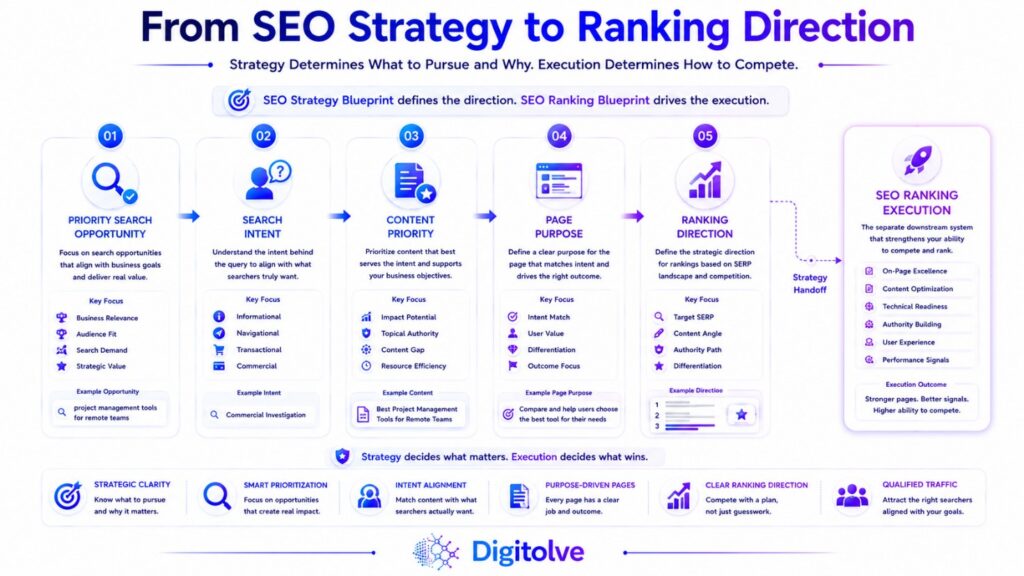
The objective is not simply to turn rankings into more traffic.
It is to turn strategically relevant rankings into opportunities to reach the right searchers.
Rankings Create Visibility, Not Automatically Value
A higher search position can make a page easier to discover.
But the strategic value of that visibility depends on the search opportunity behind the ranking.
Consider two different outcomes:
High Visibility → Broad Search Intent → Poor Audience Alignment
versus:
Relevant Visibility → Aligned Search Intent → Right Audience
The first may generate more visits.
The second may be more closely aligned with what the SEO strategy was designed to accomplish.
This is why ranking positions should be evaluated within their strategic context rather than treated as the final measure of SEO success.
Search Intent Determines Traffic Quality
Search intent helps explain what visitors are likely to want when they arrive.
If the query reflects a need that closely matches the page purpose and intended audience, the resulting visitor is more strategically relevant.
The relationship becomes:
Search Opportunity
↓
Search Intent
↓
Relevant Ranking
↓
Right Searcher
↓
Qualified Organic Traffic
This does not mean every visitor will take a desired action. It means the SEO strategy has created stronger alignment between the searcher’s need and the audience the business intended to reach.
Relevant Pages Attract More Relevant Visitors
Content plays an important role in maintaining this alignment.
A page designed around a clearly defined search opportunity should provide the information appropriate to that query rather than trying to appeal to every possible visitor.
This creates consistency between:
What the searcher asks
What the page promises
What the content provides
Who the business intends to reach
When those elements align, rankings become more strategically meaningful because the visibility is connected to relevant search demand.
Connect Search Visibility With the Right Audience
This is where the earlier stages of the SEO strategy come together.
Business goals establish direction.
Search opportunity prioritization determines where visibility is worth pursuing.
Search intent identifies the need behind the query.
Content strategy creates the appropriate page.
Ranking direction determines which assets deserve competitive focus.
Together, they create a path toward the intended audience:
Business Goals → Strategic Search Opportunities → Relevant Rankings → Right Searchers
Qualified traffic is therefore an alignment outcome, not a traffic-volume target.
Measure Strategic Outcomes Beyond Ranking Positions
Rankings remain useful SEO indicators, but they should not be viewed in isolation.
Businesses can also evaluate whether their SEO strategy is creating the intended type of visibility by considering questions such as:
Are priority pages gaining visibility for strategically relevant searches?
Do those searches reflect the intended audience and search intent?
Are the right content assets becoming discoverable?
Is organic visibility developing around the topics the strategy actually prioritizes?
Are SEO activities still aligned with the original business objective?
These questions keep performance evaluation connected to strategy.
Importantly, this does not turn the SEO Strategy Blueprint into a traffic-scaling system. Traffic growth, distribution, visibility expansion, and growth-plateau mechanics belong to separate execution systems.
The role here is narrower:
Rankings create visibility. Strategic alignment determines whether that visibility reaches the right searchers.
That is how an SEO strategy moves beyond pursuing rankings for their own sake and uses search visibility to attract qualified organic traffic aligned with the business objective.
Common SEO Strategy Mistakes to Avoid
Even when businesses invest consistently in SEO, strategic direction can become fragmented if individual decisions are made without considering how they connect to the broader objective.
The following mistakes do not necessarily mean that individual SEO activities are wrong. The problem occurs when those activities stop reinforcing the same strategic direction.
Choosing Keywords Without Business Context
A keyword can appear attractive because it has strong search demand or seems relevant to the industry.
But before it becomes an SEO priority, it should connect with a defined business objective and intended audience.
Otherwise, the strategy can gradually accumulate keywords that generate visibility without strengthening the areas the business actually wants search to support.
The stronger sequence is:
Business Goal → Audience → Search Opportunity → Keyword Priority
Keywords should support the strategy rather than determine it.
Prioritizing Search Volume Over Relevance
Large search volumes can make an opportunity look more valuable than it actually is.
A broad query may attract many searchers while only a small portion align with the intended audience. A more focused opportunity may have lower volume but much stronger strategic relevance.
Search demand therefore needs context.
Evaluate opportunities through:
Search Demand + Business Relevance + Audience Fit + Search Intent + Strategic Value
This keeps the strategy focused on meaningful visibility rather than traffic potential alone.
Creating Content Without Defined Search Intent
Content should not be created simply because a topic belongs to the industry.
Every SEO-focused asset needs a clear search purpose.
Before publishing, determine:
Which search opportunity does this page support?
What does the searcher want?
What role should the page perform?
Which audience is it intended to reach?
Without these decisions, content can become disconnected from both the search opportunity and the broader SEO strategy.
Pursuing Rankings That Attract the Wrong Audience
A ranking is not automatically strategically valuable.
If a page ranks for queries that consistently represent the wrong intent or audience, the resulting visibility may not support the objective that originally justified the SEO investment.
This is why ranking direction should remain connected to:
Opportunity → Intent → Page Purpose → Audience Fit
The goal is not simply to gain more ranking positions.
It is to earn visibility around opportunities that matter.
Treating Every SEO Opportunity as Equally Valuable
SEO strategies often contain far more possible opportunities than a business can realistically pursue at once.
Without prioritization, resources become distributed across too many keywords, pages, and topics.
Instead, opportunities should be grouped and prioritized according to strategic importance.
A useful decision structure is:
High Strategic Value → Prioritize
Relevant but Secondary → Schedule
Weak Alignment → Deprioritize
This creates focus without requiring every possible search opportunity to become an immediate SEO project.
Measuring SEO Success Only Through Ranking Positions
Rankings are important indicators, but they do not tell the entire strategic story.
A strategy should also consider whether visibility is developing around the intended topics, whether priority pages are reaching relevant searches, and whether those searches align with the audience the business wants to attract.
This changes the performance question from:
“How many keywords are ranking?”
to:
“Are we gaining visibility for the search opportunities our strategy actually prioritizes?”
That is a more useful measure of strategic alignment.
Changing Tactics Without a Strategic Framework
When SEO results fluctuate, it can be tempting to repeatedly change keywords, content plans, optimization tactics, or priorities.
But frequent tactical changes can make the overall strategy increasingly fragmented if each decision responds to a short-term signal rather than the original strategic objective.
A better sequence is:
Review Strategy → Evaluate Alignment → Identify Priority → Adjust Deliberately → Observe
If SEO activity continues but the results feel disconnected or unstable, Why Your SEO Results Are Inconsistent (And Why Nothing Feels Stable) explores that broader problem in more detail.
The central principle is simple:
An effective SEO strategy creates consistency in decision-making—not constant changes in response to every ranking or traffic movement.
Avoiding these mistakes keeps business goals, search opportunities, search intent, content priorities, ranking direction, and qualified traffic aligned around the same strategic objective.
From SEO Strategy to Repeatable Execution
A strong SEO strategy creates direction, but direction only becomes useful when it can be translated into consistent decisions and actions.
Businesses may understand their goals, identify promising search opportunities, and recognize the audience they want to reach. Without a repeatable framework, however, those decisions can still become scattered across keyword research, content planning, and ranking activities.
The next step is turning strategic thinking into a process that can be applied repeatedly.
Strategy Creates Direction
SEO strategy establishes the logic behind execution.
It clarifies:
What should SEO support?
Which audiences should search visibility reach?
Which search opportunities deserve priority?
What intent should those opportunities serve?
Which content assets should receive attention?
Where should ranking effort be directed?
These decisions create the strategic foundation.
Instead of asking “What SEO task should we do next?”, the business can ask:
“Which action best supports our current SEO priorities?”
That is a much stronger basis for execution.
Prioritization Turns Opportunities Into Decisions
Finding search opportunities is relatively easy compared with deciding which ones deserve investment.
A repeatable SEO strategy therefore needs a prioritization step that moves opportunities from a research list into an actionable plan.
The process can remain simple:
Identify Opportunities
↓
Evaluate Strategic Relevance
↓
Confirm Search Intent
↓
Prioritize Content Needs
↓
Define Ranking Direction
Not every opportunity needs to become a project.
Prioritization ensures that time and resources remain focused on the opportunities most closely connected to the SEO objective.
A Framework Turns Decisions Into Execution
Once priorities are established, a framework helps organize them into a consistent workflow.
Instead of starting from scratch every time a new keyword or content idea appears, each opportunity can move through the same strategic sequence:
Business Goal → Search Opportunity → Search Intent → Content Priority → Ranking Direction → Qualified Traffic Alignment
This creates consistency without requiring every SEO opportunity to be handled identically.
The framework provides the decision structure. The specific opportunity determines how that structure is applied.
This structured approach also aligns with Google’s guidance that SEO should focus on helping search engines understand content while creating useful, people-focused experiences rather than relying on isolated optimization tricks. For broader foundational guidance, see Google’s official SEO Starter Guide.
Build a Repeatable SEO Planning Workflow
A practical planning workflow should make it possible to move from strategic direction to immediate action.
For each priority opportunity, the business should be able to define:
SEO Objective — What does this opportunity support?
Search Opportunity — What should be targeted?
Search Intent — What does the searcher need?
Content Direction — What page or content asset should serve that need?
Ranking Direction — Which asset should receive ranking focus?
Audience Alignment — Is this likely to reach the intended searcher?
The result is not simply another keyword list.
It is a set of strategic SEO decisions ready for execution.
The SEO Strategy Blueprint
This is the role of the SEO Strategy Blueprint — Mini.
The blueprint is designed for businesses that already need to move from scattered SEO opportunities toward a clearer strategic direction.
The SEO Strategy Blueprint is a structured execution framework for connecting business goals, search opportunities, search intent, content priorities, ranking direction, and qualified traffic into one repeatable SEO strategy.
By the end of the process, the objective is for the business to be able to state clearly:
Our SEO goal is ___
We are targeting ___ opportunities because ___
Those opportunities match ___ search intent
We need ___ content or pages
Our ranking priorities are ___
The qualified audience we want to reach is ___
That is the difference between having SEO ideas and having an actionable SEO strategy.
The blueprint does not replace deeper ranking execution, traffic-growth systems, or broader visibility management. Its job is more focused:
Turn disconnected SEO opportunities into prioritized strategic direction and clear next actions.
Once that direction exists, execution can move forward with far greater clarity.
From Diagnosis to SEO Strategy
A structured SEO strategy becomes most useful when the business already understands the problem it needs to address.
If SEO activity is continuing but the business still does not know why performance is weak, which parts of the SEO system are breaking down, or where attention should be prioritized, immediately creating another strategy can lead to more assumptions rather than clearer execution.
In that situation, diagnosis should come before strategic direction.
Smart Solve Lab — Diagnose the SEO Problem
Smart Solve Lab operates at the diagnostic stage.
The SEO Breakdown Analyzer is designed to help businesses examine their SEO situation before deciding what should be built or changed.
Its core tool, the SEO Failure Scanner, supports that diagnostic process by helping surface areas where SEO signals, activities, or strategic connections may be breaking down.
The central question is:
“Why isn’t our SEO working?”
The purpose is not to create the new SEO strategy.
It is to provide enough clarity to understand what needs attention before execution begins.
For broader context around interconnected SEO problems, read Why Your SEO Is Not Working (And Why Every Problem Keeps Connecting Together).
Diagnosis Creates Clarity Before Strategic Decisions
Without diagnostic clarity, businesses can respond to weak SEO performance by changing keywords, creating more content, rewriting pages, or shifting priorities without knowing whether those actions address the actual problem.
Diagnosis creates a cleaner sequence:
SEO Problem
↓
SEO Breakdown Analyzer
↓
SEO Failure Scanner
↓
Diagnostic Clarity
Once the problem is clearer, the business can make more informed decisions about what its SEO strategy should prioritize.
Digitolve — Turn Clarity Into Strategic Direction
This is where the role moves from Smart Solve Lab to Digitolve.
Digitolve does not repeat the diagnosis.
The SEO Strategy Blueprint uses the resulting clarity as the starting point for building strategic direction around:
Business Goals
↓
Search Opportunities
↓
Search Intent
↓
Content Priorities
↓
Ranking Direction
↓
Qualified Traffic
The question has now changed from:
“Why isn’t our SEO working?”
to:
“What should our SEO strategy pursue, and why?”
Diagnosis and Strategy Have Different Jobs
The complete ecosystem handoff is:
SEO Problem
↓
Smart Solve Lab — Diagnosis
↓
Clarity
↓
Digitolve — SEO Strategy Blueprint
↓
Strategic Direction
↓
Execution
Smart Solve Lab identifies and interprets the problem.
Digitolve turns that clarity into a structured direction for what should be pursued next.
Diagnose the SEO problem first. Then use that clarity to build a strategy around the opportunities, audiences, and priorities that matter.
This keeps diagnosis and execution separate while creating a natural path from SEO uncertainty → clarity → strategy → action.
Building Toward a Complete SEO Visibility System
The SEO Strategy Blueprint provides the strategic foundation for deciding what SEO should pursue and why. But as a website grows, SEO execution often extends beyond strategic planning into a broader visibility environment.
More content assets need coordination. Ranking priorities expand. Search opportunities evolve. Different parts of the website need to work together around a consistent visibility direction.
At that stage, the business can move from a foundational strategy blueprint toward a more connected SEO visibility system.
Start With Clear Strategic Direction
The first priority is not building the most complex SEO system possible.
It is establishing clarity around:
Business Goals
↓
Search Opportunities
↓
Search Intent
↓
Content Priorities
↓
Ranking Direction
↓
Qualified Traffic
This is the role of the SEO Strategy Blueprint — Mini.
It gives the business a structured way to decide which opportunities deserve attention before deeper SEO execution begins.
Strengthen Ranking Execution Where It Matters
Once strategic priorities are established, selected pages need the ability to compete for those opportunities.
This creates the next layer:
SEO Strategy Blueprint — Mini
↓
Define What to Pursue and Why
↓
SEO Ranking Blueprint — Mini
↓
Strengthen Ranking Execution
The SEO Ranking Blueprint handles the deeper ranking workflow, while the SEO Strategy Blueprint remains focused on strategic direction.
Keeping these roles separate prevents strategy from becoming overloaded with ranking mechanics.
Expand Into a Broader SEO Visibility System
As SEO operations become more mature, individual strategic and ranking workflows may need to operate within a broader connected environment.
That creates the future progression:
SEO Strategy Blueprint — Mini
↓
Strategic SEO Direction
↓
SEO Ranking Blueprint — Mini
↓
Ranking Execution
↓
SEO Visibility System — Core
↓
Broader Connected SEO Visibility Execution
The future Core system can connect and manage wider visibility processes without requiring the Mini blueprint to contain those advanced mechanics.
Build the Right System for the Right Stage
Not every business needs a complete SEO visibility system immediately.
Some first need strategic clarity about which opportunities deserve investment. Others already have that direction but need stronger ranking execution. More mature SEO operations may eventually require broader system-level coordination.
The progression should therefore follow complexity rather than adding it prematurely:
Strategic Direction → Ranking Execution → Connected Visibility System
Build strategic direction first. Strengthen ranking execution second. Expand into broader visibility management when the SEO operation requires it.
This keeps the SEO Strategy Blueprint focused on its core promise: transforming disconnected SEO opportunities into a prioritized, repeatable strategic direction—while preserving the advanced execution territory of the future SEO Visibility System — Core.
Conclusion — Build an SEO Strategy Around Valuable Search Opportunities
Effective SEO is not about targeting every keyword, publishing as much content as possible, or pursuing rankings simply because an opportunity exists.
It is about making better strategic decisions about where SEO effort should be directed and why.
A structured SEO strategy begins with business goals and uses those goals to evaluate search opportunities. Search intent then clarifies what the audience actually needs, content strategy determines how those needs should be addressed, and ranking direction identifies where competitive effort should be focused.
The complete strategic chain is:
Business Goals
↓
Search Opportunities
↓
Search Intent
↓
Content Strategy
↓
Ranking Direction
↓
Qualified Traffic
Each stage protects the strategy from becoming disconnected.
Business goals prevent SEO from chasing visibility without purpose.
Search opportunity prioritization prevents every keyword from becoming equally important.
Search intent keeps the strategy connected to real audience needs.
Content priorities translate opportunities into meaningful assets.
Ranking direction determines where SEO effort should be concentrated.
And qualified traffic alignment keeps the final objective focused on reaching relevant searchers—not simply generating more visitors.
This is the fundamental difference between performing SEO activities and operating with a structured SEO strategy.
Successful SEO is not about ranking for as many keywords as possible. It is about identifying the search opportunities that matter, creating the right content for those opportunities, building the ranking direction to compete for them, and attracting visitors aligned with meaningful business objectives.
The final execution philosophy is simple:
Align Goals → Find Opportunities → Understand Intent → Build Content → Define Ranking Direction → Attract Qualified Traffic
When these decisions operate as one connected framework, SEO becomes easier to prioritize, execute, and repeat.
Rank for the right opportunities. Reach the right searchers. Build SEO around strategic value—not visibility for its own sake.
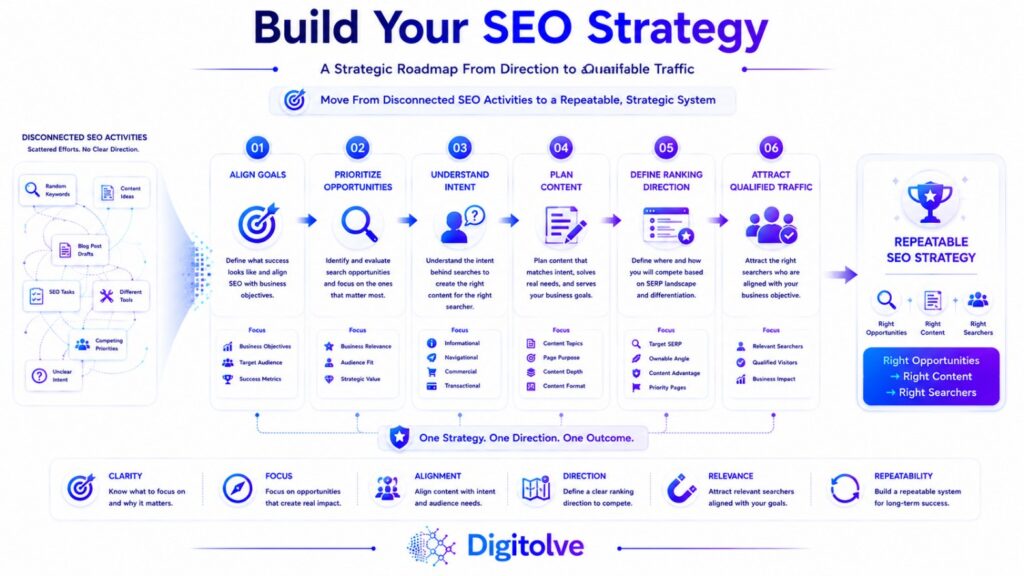
Build Your SEO Strategy — CTA
A strong SEO strategy creates more than a list of keywords or content ideas. It gives every search opportunity a clear strategic purpose and connects SEO decisions with the audience the business actually wants to reach.
The right starting point depends on whether you already understand what is happening inside your SEO system.
Still Unclear Why Your SEO Is Not Working?
Start with the SEO Breakdown Analyzer — Smart Solve Lab.
The diagnostic process is designed to help identify where SEO activities, signals, or strategic connections may be breaking down before you begin rebuilding your strategy.
Its core SEO Failure Scanner helps create clarity around the areas that require attention.
Your path becomes:
SEO Problem → Diagnose → Interpret → Gain Clarity
The objective at this stage is not to build another strategy based on assumptions.
It is to understand the problem first.
Already Understand the Problem and Ready to Build Your Strategy?
Move into the SEO Strategy Blueprint — Digitolve.
The blueprint turns strategic clarity into a structured execution direction connecting:
Business Goals
↓
Search Opportunities
↓
Search Intent
↓
Content Priorities
↓
Ranking Direction
↓
Qualified Traffic
The purpose is to help you decide what SEO should pursue, why those opportunities deserve attention, and how they should connect with content, rankings, and the right searchers.
Choose the Right Starting Point
If the problem is still unclear:
Smart Solve Lab → SEO Breakdown Analyzer → Diagnostic Clarity
If the problem is understood and strategic direction is needed:
Digitolve → SEO Strategy Blueprint → Repeatable SEO Strategy
The roles remain intentionally different:
Smart Solve Lab diagnoses what is breaking down.
Digitolve turns clarity into an execution system.
Diagnose the problem. Define the right opportunities. Build the strategy. Then execute with direction.
This creates a clean progression from SEO uncertainty → clarity → strategic direction → execution without mixing diagnosis with implementation.
Frequently Asked Questions
What Is an SEO Strategy?
An SEO strategy is a structured plan for deciding which search opportunities a business should pursue, why those opportunities matter, and how they should connect with search intent, content priorities, ranking direction, and the audience the business wants to reach.
Rather than treating SEO as a collection of individual tactics, a strategy gives those activities a shared direction.
How Do I Build an Effective SEO Strategy?
Start by defining what SEO needs to support before selecting keywords.
A practical strategic sequence is:
Business Goals → Search Opportunities → Search Intent → Content Strategy → Ranking Direction → Qualified Traffic
Each stage helps narrow SEO activity toward opportunities that are relevant to both the business objective and the intended audience.
What Is the Difference Between SEO Strategy and SEO Tactics?
SEO strategy determines what should be pursued and why.
SEO tactics are the individual actions used during execution, such as optimizing pages, creating content, improving internal links, or strengthening ranking signals.
In simple terms:
Strategy → Direction and priorities
Tactics → Actions used to execute those priorities
A strong SEO program needs both, but tactics should follow strategic direction rather than define it.
How Do I Choose the Right Keywords for an SEO Strategy?
Do not evaluate keywords by search volume alone.
Consider whether each opportunity aligns with the business objective, intended audience, search intent, content capabilities, and broader strategic direction.
A useful evaluation sequence is:
Search Demand + Business Relevance + Audience Fit + Search Intent + Strategic Value
The strongest opportunities are not necessarily the largest. They are the ones most closely aligned with what the SEO strategy needs to accomplish.
How Does Search Intent Affect SEO Strategy?
Search intent helps explain what someone wants to accomplish when performing a search.
Understanding that intent helps determine whether a search opportunity is strategically relevant, what type of page should serve it, what content the searcher expects, and whether that searcher aligns with the intended audience.
This connects keyword selection with real audience needs.
What Is Qualified Organic Traffic?
Qualified organic traffic refers to relevant visitors whose search needs and intent align with the purpose of the page and the audience the business intends to reach.
It does not simply mean generating more organic visitors.
Within an SEO strategy, the goal is to pursue search opportunities capable of attracting the right searchers, rather than maximizing traffic volume for its own sake.
How Do SEO Rankings Generate Qualified Traffic?
Rankings create search visibility, but qualified traffic depends on what the page ranks for.
When a strategically relevant search opportunity, appropriate search intent, useful content, and the intended audience are aligned, stronger rankings can make the page more discoverable to relevant searchers.
The relationship is:
Strategic Opportunity → Relevant Ranking → Right Searcher → Qualified Organic Traffic
Rankings create the visibility; strategic alignment determines the relevance of the audience reached.
What Is the Difference Between an SEO Strategy and an SEO Ranking System?
An SEO strategy determines which opportunities deserve ranking focus and why.
An SEO ranking system focuses on how priority pages can be strengthened to compete for those opportunities.
Therefore:
SEO Strategy Blueprint → What should we pursue and why?
SEO Ranking Blueprint → How do we strengthen our ability to rank?
Keeping these functions separate creates clearer strategic planning and execution.
How Often Should an SEO Strategy Be Reviewed?
An SEO strategy should be reviewed when meaningful changes occur in business priorities, audience needs, search behavior, content priorities, or the opportunities the website is pursuing.
The objective is not to repeatedly rebuild the strategy because individual rankings fluctuate.
Instead, review whether the fundamental alignment still holds:
Business Goals → Search Opportunities → Search Intent → Content Priorities → Ranking Direction → Qualified Traffic
If that strategic alignment remains valid, execution can continue without unnecessary changes.
Recommended Reading
Continue strengthening your SEO strategy with these three closely connected guides.
Why Your SEO Strategy Fails (Even When You Follow Best Practices — And Still See No Results)
Explore why following individual SEO best practices does not necessarily create a coherent strategy when search opportunities, priorities, and execution are not working toward the same objective.
How to Build an SEO Ranking System That Consistently Improves Google Rankings
Once your strategic direction is clear, learn how search intent, content relevance, on-page signals, internal authority, and ranking reinforcement can work together as a structured ranking execution system.
Why Your SEO Results Are Inconsistent (And Why Nothing Feels Stable)
Understand how disconnected SEO activities and unstable system relationships can contribute to inconsistent performance, even when SEO work is being performed regularly.
These three complete the supporting journey:
SEO Strategy Problem → Ranking Execution → SEO Consistency
while Blog 8 remains focused on its own core objective:
Business Goals → Search Opportunities → Search Intent → Content Strategy → Ranking Direction → Qualified Traffic 🔒