Finding keywords is easy. Deciding which keywords are actually worth targeting, which pages should target them, and which opportunities deserve priority is much harder.
Many businesses complete keyword research and end up with hundreds of potential search terms. They compare search volume, look at competition scores, select a few promising phrases, and begin creating content.
But a keyword list is not a keyword strategy.
Without a structured decision system, businesses can target keywords that do not match search intent, create multiple pages around overlapping opportunities, pursue highly competitive terms too early, or invest in content that has little strategic relevance.
The problem is not necessarily a lack of keywords.
It is a lack of keyword decision architecture.
Keyword Research Gives You Options. Strategy Creates Direction.
Keyword research helps uncover what people are searching for.
Keyword strategy determines what to do with those discoveries.
A structured strategy should answer questions such as:
Which keywords align with the searcher’s actual intent?
Which opportunities are relevant to the content and business?
Which keywords have realistic ranking potential?
Which terms belong together?
Which page should target each opportunity?
Which keywords should be targeted now, next, or later?
These decisions transform raw keyword data into an actionable direction for content.
The strategic process becomes:
Discover → Align → Evaluate → Map → Prioritize → Execute → Review
Each stage serves a different purpose.
Discovery creates the opportunity pool. Alignment connects keywords with search intent and content purpose. Evaluation determines whether an opportunity is worth pursuing. Mapping assigns keywords to appropriate pages. Prioritization determines the order of execution. Review keeps the strategy relevant as search results and opportunities evolve.
Search Volume Alone Cannot Build a Keyword Strategy
A high-volume keyword may look attractive, but volume does not tell you whether the search intent fits your content, whether the opportunity is realistic for your website, or whether targeting it supports a meaningful objective.
Likewise, choosing only low-competition keywords is not a complete strategy.
A useful keyword portfolio can contain different types of opportunities—some reachable now, some supporting larger topics, and others worth developing toward over time.
The goal is not to find the largest keyword list or simply the easiest keywords.
It is to build a structured portfolio of search opportunities that makes sense for your content, pages, audience, and current ability to compete.
From Keywords to Strategic Decisions
A strong keyword strategy ultimately creates clarity around three questions:
What should we target?
Where should we target it?
What should we prioritize first?
That is the focus of this guide.
We will move from keyword discovery through search intent alignment, opportunity evaluation, keyword portfolio development, page mapping, prioritization, execution, and ongoing refinement.
Research discovers keywords. Strategy determines which opportunities deserve action.
The objective is not to promise faster rankings simply by choosing different keywords. It is to create a more structured approach for identifying better-aligned, realistically competitive search opportunities and turning them into clear content and SEO decisions.
Table of Contents
Why Keyword Research Alone Does Not Create a Ranking Strategy
Keyword research is an important starting point, but discovering search terms does not automatically tell you which opportunities deserve investment or how those opportunities should be used.
A keyword research tool can reveal search demand, related queries, estimated competition, and variations around a topic. That information expands your options.
A keyword strategy performs a different job.
It turns those options into decisions.
Keyword Research Finds Opportunities
The purpose of keyword research is discovery.
It can help uncover:
What people search for
How they describe their problems or needs
Which related queries exist around a topic
How search demand varies between terms
Which new content opportunities may be available
At the end of research, however, you may still have dozens or hundreds of possible keywords.
That creates an opportunity pool—not an execution plan.
The strategic question remains:
Which of these keywords should actually be targeted?
Keyword Strategy Decides What to Do With Those Opportunities
A keyword strategy adds decision criteria to the research.
Instead of selecting a keyword simply because it appears attractive, each opportunity is evaluated within a broader context:
Search Intent — What does the searcher actually expect?
Relevance — Does the opportunity fit the topic, audience, and content purpose?
Ranking Potential — Is this a realistic opportunity for the website at its current stage?
Page Fit — Which existing or future page should target it?
Strategic Value — Is the opportunity worth pursuing?
Priority — Should it be targeted now, next, later, or not at all?
This changes the process from collecting keywords to making deliberate keyword decisions.
Why Volume-Based Keyword Lists Can Create Weak Direction
Search volume is useful information, but it represents only one part of an opportunity.
A high-volume keyword can still be a poor strategic target if its intent does not match the planned content or if the website is not realistically positioned to compete for it yet.
Likewise, a lower-volume keyword can sometimes provide a clearer opportunity because its intent is more specific and its relationship with the content is stronger.
The decision should therefore not be:
Highest Search Volume = Highest Priority
Instead, evaluate multiple signals together:
Relevance → Intent Fit → Ranking Potential → Business Value → Strategic Fit
Search volume can inform that decision, but it should not control it.
A Keyword List Does Not Define Page Direction
Another limitation of keyword research alone is that it does not necessarily establish where each keyword belongs.
For example, several related keywords may represent:
One shared search intent that belongs on a single page.
Different intents requiring separate pages.
A primary opportunity with several supporting terms.
An opportunity that is already covered by an existing page.
Without keyword-to-page decisions, businesses can create unnecessary content or target similar opportunities across multiple pages.
A keyword strategy therefore asks not only:
“Should we target this keyword?”
but also:
“Which page should own this search opportunity?”
That distinction becomes essential when the content library begins to grow.
Research Creates Data; Strategy Creates Priorities
The clearest difference can be summarized as:
Keyword Research
Discover → Collect → Compare
↓
Keyword Strategy
Align → Evaluate → Map → Prioritize → Execute
Research tells you what opportunities exist.
Strategy determines which opportunities should move forward.
A large keyword database does not create strategic advantage by itself. The value comes from knowing which opportunities fit your content, where they belong, and when they deserve attention.
That is why the next stage should not begin with competition scores or search volume alone.
It begins with the most fundamental alignment question:
What does the searcher actually want, and does this keyword belong with the content you intend to create?
Start With Search Intent and Keyword Alignment
A keyword can look promising based on search volume or competition data and still be the wrong opportunity for a particular page.
Before evaluating how difficult a keyword may be to rank for, the first strategic question should be:
Does this keyword represent the search intent our content is designed to satisfy?
This is the foundation of keyword alignment.
When the keyword, searcher need, content purpose, and target page point in the same direction, the opportunity becomes much clearer. When they do not, even a seemingly attractive keyword can create weak content direction.
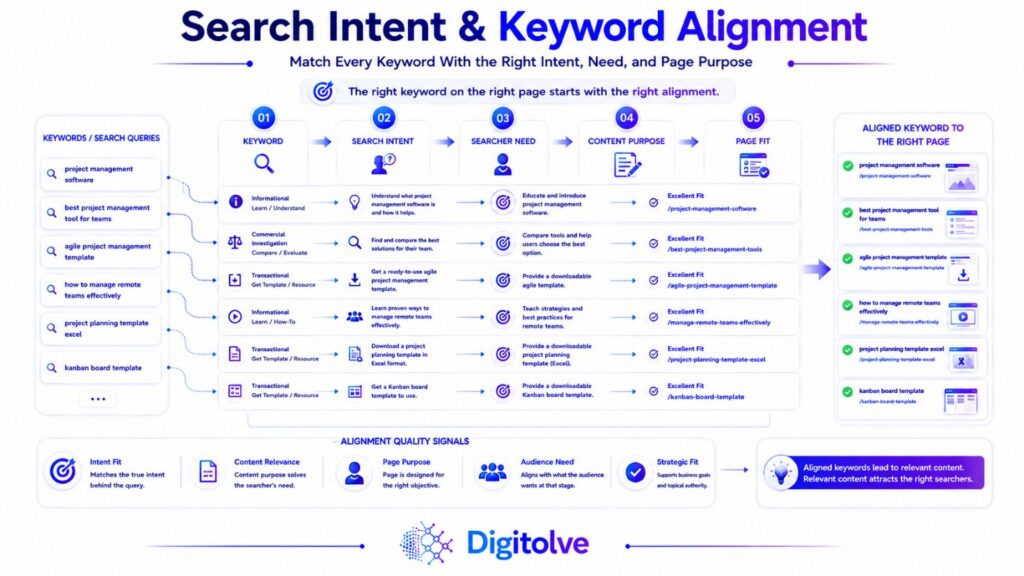
Identify the Search Intent Behind Each Keyword
Search intent describes what the searcher is actually trying to accomplish.
Two keywords can appear closely related while representing different expectations. One searcher may want an explanation, another may want a comparison, and another may be looking for a specific solution.
Instead of classifying intent only through broad labels, examine the practical expectation behind the query:
What does the searcher want to know or accomplish?
What type of content would reasonably satisfy that need?
What kind of page is currently being rewarded for that search?
Does that expectation match the content you intend to create?
This turns intent analysis into a strategic decision rather than a textbook classification exercise.
The alignment sequence becomes:
Keyword → Search Intent → Searcher Need → Content Purpose
If those elements do not connect naturally, the keyword may not belong with the planned content.
Match Keywords to the Right Content Purpose
Once the intent is understood, determine where the keyword should actually be used.
A keyword should not be assigned to a page simply because the phrase appears relevant to its topic.
The page itself needs a clear purpose that matches the searcher’s expectation.
For example, a keyword representing an educational question should generally connect with content designed to explain that question. A query reflecting comparison intent should connect with content capable of helping the searcher evaluate options.
The decision process becomes:
Keyword
↓
Searcher Need
↓
Content Purpose
↓
Appropriate Page
This creates a much stronger keyword-to-content relationship than inserting related keywords into whichever page appears convenient.
Evaluate Keyword Relevance at the Page Level
A keyword can be relevant to the overall website without being relevant to a particular page.
That distinction matters.
Suppose several keywords belong to the same broad topic. One may closely match the purpose of an existing page, while another represents a sufficiently different search need to require separate content.
The strategy should therefore evaluate relevance at two levels:
Topical Relevance — Does this keyword belong within the broader subject area?
Page Relevance — Does this specific page satisfy the intent behind the keyword?
Both should align before the keyword becomes a primary target.
Use SERP Context to Validate Intent
The wording of a keyword can sometimes be ambiguous.
Looking at the types of pages appearing in the search results can provide additional context about how the query is currently being interpreted.
If the results are dominated by guides, comparison pages, category pages, tools, or another consistent format, that pattern can help clarify what searchers are likely expecting.
This does not mean copying the existing results.
It means using the search landscape to validate whether your intended page purpose fits the opportunity.
When Keyword Alignment Breaks Down
Sometimes a business is already targeting a keyword, but the page is not developing the expected ranking performance.
In that situation, the problem may extend beyond keyword discovery. The keyword, search intent, page purpose, or content may not be aligned strongly enough.
For a deeper look at this specific problem, read Why Your Keywords Are Not Ranking (Even With Strong Content & SEO).
Alignment Comes Before Competition
It can be tempting to evaluate keywords primarily through search volume and difficulty scores.
But competition should come after alignment.
There is little strategic value in finding an easy keyword if its intent does not fit the page or the audience the content is intended to serve.
The stronger order is:
Intent Alignment → Content Fit → Opportunity Evaluation → Priority
Before asking whether you can rank for a keyword, establish whether it is the right keyword for the right content and the right page.
Once that alignment is clear, the next decision becomes much more useful: how competitive is the opportunity, and is it realistically worth pursuing at the website’s current stage?
Evaluate Keyword Competition and Realistic Ranking Potential
Once a keyword is aligned with the right search intent, content purpose, and page, the next question is whether the opportunity is realistically worth pursuing.
A strategically relevant keyword is not automatically an immediate target.
Some opportunities may be highly competitive relative to the website’s current position. Others may offer a more realistic path because the search intent is specific, the competitive environment is more accessible, or the website already has relevant topical support.
The objective is not to find only “easy” keywords.
It is to understand which opportunities make sense now and which should remain longer-term targets.
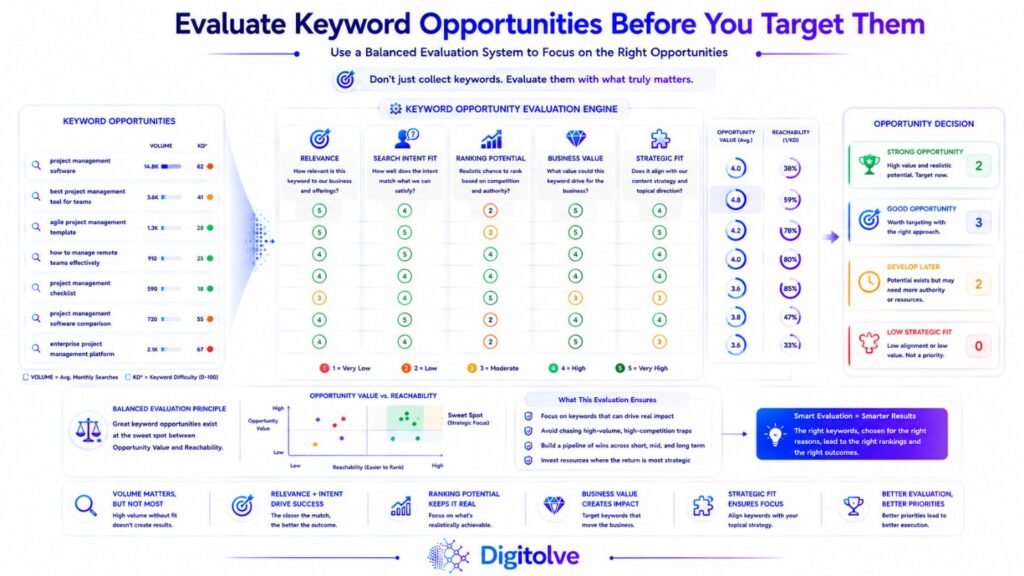
Search Volume Is Not the Same as Ranking Opportunity
Search volume measures demand. It does not measure strategic suitability.
A keyword with high search volume may also have strong competition, broad intent, established competitors, and a search landscape that does not fit the type of page you intend to create.
Meanwhile, a lower-volume opportunity may have clearer intent and stronger alignment with your content.
This creates an important distinction:
Search Demand = How much interest exists
Ranking Opportunity = Whether the keyword represents a worthwhile and realistic target
A keyword strategy should consider both.
Rather than asking:
“Which keyword has the highest volume?”
ask:
“Which opportunity provides the strongest combination of relevance, intent fit, strategic value, and realistic ranking potential?”
Compare Competition With Your Current Authority
Keyword competition should not be treated as an isolated score.
The same keyword can represent very different opportunities for different websites.
An established website with strong topical coverage and relevant authority may be positioned differently from a newer website entering the same search landscape.
That means competition should be considered relative to your current position.
Look at factors such as:
Who currently ranks for the query?
How closely do their pages satisfy the search intent?
How established are the competing websites within the topic?
Do you already have relevant supporting content?
Can your planned page genuinely compete in usefulness and relevance?
The goal is not to calculate a guaranteed probability of ranking.
It is to make a more informed strategic decision about whether the opportunity deserves resources now.
Look Beyond a Single Keyword Difficulty Score
Keyword difficulty metrics can be useful for comparison, but they should remain one input rather than the final decision.
Different SEO tools calculate difficulty differently, and a numerical score cannot fully represent search intent, content quality, topical context, or your website’s specific competitive position.
A stronger evaluation combines several signals:
Relevance
↓
Intent Fit
↓
Competition
↓
Current Position
↓
Strategic Value
↓
Ranking Potential
This produces a more useful decision than simply filtering a spreadsheet by difficulty score.
Look for Reachable Opportunities Before Expanding Upward
A balanced keyword strategy can include opportunities at different competitive levels.
For websites still developing search visibility, more specific and realistically reachable opportunities can provide useful starting points.
As content coverage and search presence strengthen, the strategy can gradually include more competitive targets.
The progression might look like:
Reachable Opportunities
↓
Supporting Topic Coverage
↓
Stronger Search Presence
↓
More Competitive Opportunities
This does not mean every low-competition keyword should be targeted.
Relevance and intent alignment still come first.
The principle is to avoid building an entire strategy around opportunities that are currently disconnected from the website’s realistic competitive position.
Recognize When an Opportunity Needs More Support
Sometimes a page may already be close to stronger search visibility but still struggle to move beyond its current position.
That situation is different from selecting a completely new keyword, but it demonstrates why competition and existing search position matter when deciding where future effort should go.
For related context, see Why Your Website Is Stuck on Page 2 of Google (And Why It Never Breaks Through).
Evaluate Opportunities Before Assigning Priority
At this stage, each keyword should begin moving beyond a simple research entry toward a strategic opportunity.
A useful evaluation logic is:
Is it relevant?
↓
Does the intent align?
↓
Do we have the right page or content direction?
↓
Is the competitive environment realistic?
↓
Is the opportunity strategically valuable?
If those signals align, the keyword becomes a stronger candidate for the strategy.
The best keyword opportunity is not automatically the largest or easiest. It is one that combines meaningful relevance with realistic competitive potential and clear strategic value.
The next step is therefore not choosing one type of keyword and ignoring everything else. It is building a balanced keyword portfolio that combines opportunities you can pursue now with those worth developing toward over time.
Build a Balanced Keyword Portfolio
A strong keyword strategy should not depend on one type of search opportunity.
Targeting only high-volume keywords can make the strategy unnecessarily competitive. Targeting only low-competition or long-tail keywords can also create limitations if those opportunities are not connected to broader strategic topics.
The stronger approach is to build a balanced keyword portfolio containing different types of opportunities, each with a specific role.
This allows the strategy to combine opportunities that are realistic today with search areas the website may want to strengthen over time.
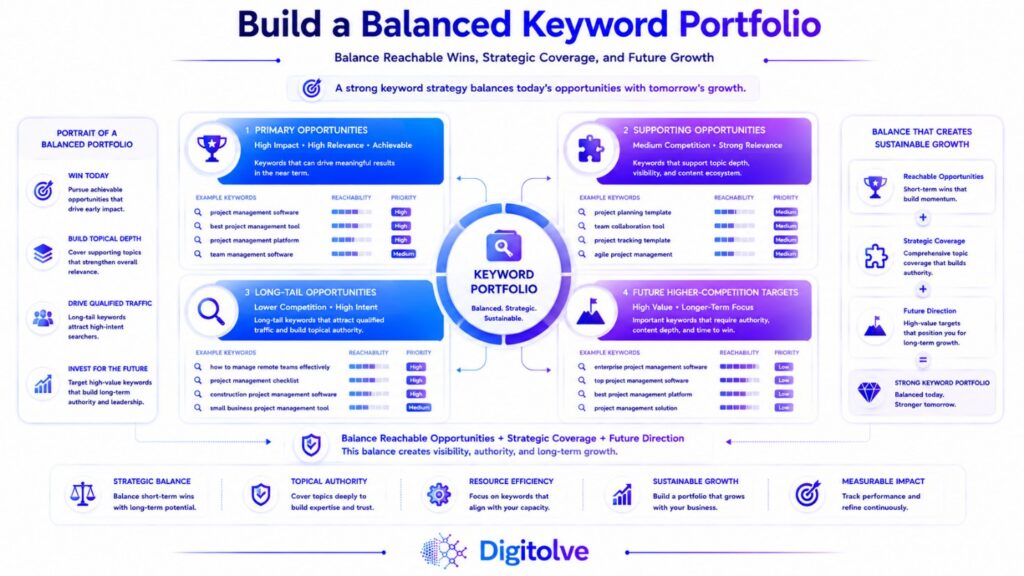
Build Around Primary Keyword Opportunities
Primary opportunities represent the main search directions that important pages or content assets are designed to pursue.
They should have strong alignment across:
Search Intent
Content Purpose
Page Relevance
Strategic Value
A primary keyword should not simply be the phrase with the largest search volume.
It should represent the clearest search opportunity around which the page can be structured.
The decision becomes:
What is the primary search purpose this page should serve?
↓
Which keyword best represents that purpose?
This gives each important content asset a clearer strategic direction.
Add Supporting Keyword Opportunities
A page may naturally be relevant to multiple closely related searches.
Supporting keywords help represent those related ways people search around the same underlying topic or intent.
The important distinction is that supporting keywords should reinforce the primary page purpose rather than create several competing purposes inside one page.
The relationship can look like:
Primary Opportunity
↓
Core Search Intent
↓
Closely Related Supporting Keywords
↓
One Coherent Page
This allows content to cover the subject naturally without creating a separate page for every keyword variation.
Use Long-Tail Opportunities Strategically
Long-tail keywords can be useful because they often express more specific search needs.
But “long-tail” should not automatically mean “easy,” nor should every low-volume phrase become a content target.
Evaluate long-tail opportunities using the same strategic criteria:
Is the intent clear?
Is it relevant to the audience and topic?
Does it belong within an existing page?
Does it justify separate content?
Does pursuing it strengthen the broader keyword portfolio?
When those conditions align, long-tail opportunities can add useful specificity and coverage to the strategy.
Keep Higher-Competition Opportunities in the Portfolio
A realistic keyword strategy does not require abandoning difficult opportunities completely.
Some highly relevant keywords may be strategically valuable but inappropriate as immediate priorities.
Instead of forcing them into current execution, place them within a longer-term opportunity group.
For example:
Target Now — Strong alignment and realistic current opportunity
Target Next — Valuable opportunities requiring additional preparation
Develop Later — Strategically important but currently more competitive
This creates direction without pretending every valuable keyword should be pursued immediately.
Balance Reachability With Strategic Direction
The portfolio should ultimately balance two considerations:
What can we realistically pursue now?
and
Where do we strategically want our search presence to develop?
Focusing only on immediate reachability can make the strategy too narrow.
Focusing only on ambitious future keywords can make execution unrealistic.
A balanced portfolio connects both:
Reachable Opportunities + Supporting Coverage + Long-Tail Opportunities + Future Targets
↓
Structured Keyword Direction
The objective is not to divide keywords mechanically into categories. The categories exist to help make better prioritization decisions.
Think in Portfolios, Not Isolated Keywords
Individual keywords make more sense when viewed as parts of a broader search opportunity structure.
A portfolio helps reveal:
Which keywords represent major opportunities.
Which terms support those opportunities.
Which specific searches deserve attention.
Which competitive areas should remain future targets.
This makes it easier to allocate content and SEO effort intentionally rather than reacting to individual keyword ideas as they appear.
A balanced keyword portfolio connects what is realistically achievable today with the search opportunities worth developing toward tomorrow.
Once the portfolio is structured, however, another critical decision remains:
Which page should actually target each keyword opportunity?
That is where keyword strategy moves from opportunity planning into keyword-to-page mapping.
Map Keywords to the Right Pages Before Creating Content
Finding the right keywords is only part of building a keyword strategy.
The next strategic decision is determining where each keyword belongs.
Without clear keyword-to-page mapping, websites can create unnecessary content, target the same search opportunity across multiple pages, or leave important topics without a dedicated page.
A structured keyword strategy ensures that every important search opportunity has a clear content destination before new content is created.
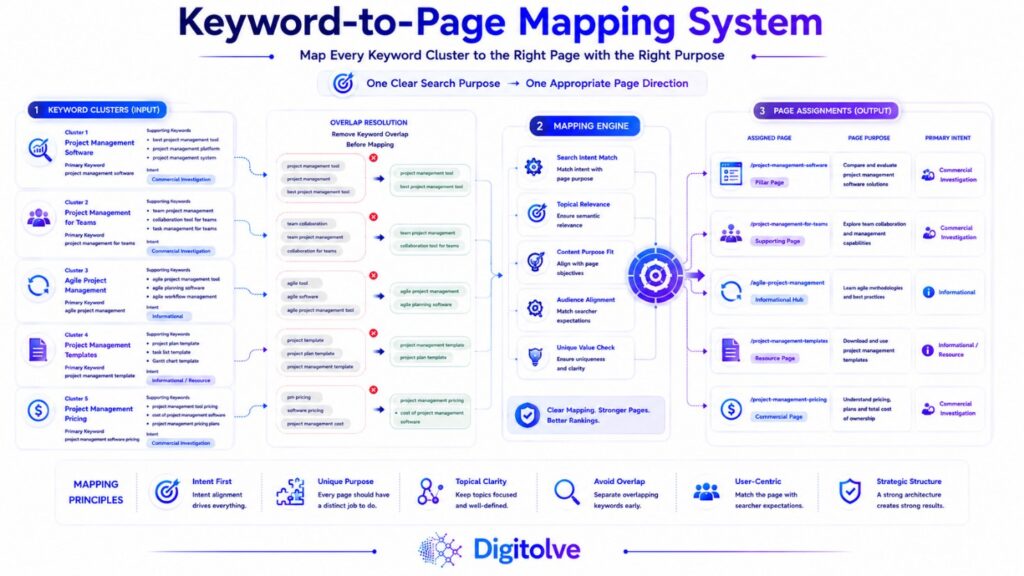
Assign One Clear Primary Keyword Direction
Every important page should have one primary search direction.
That does not mean the page can only rank for one keyword.
It means the page should have one central search opportunity that defines its purpose.
Ask:
What is the primary search opportunity this page is designed to satisfy?
↓
Which keyword best represents that opportunity?
↓
Does every major section of the page support that direction?
This creates a stronger relationship between search intent, content purpose, and page relevance.
Instead of trying to target multiple unrelated opportunities, the page develops around one clear strategic objective.
Group Closely Related Supporting Keywords
A page can naturally support several closely related keywords without trying to target completely different search intents.
Supporting keywords should strengthen the primary opportunity by expanding topical coverage and helping address related search needs.
The relationship becomes:
Primary Keyword
↓
Supporting Keywords
↓
Shared Search Intent
↓
One Structured Page
This approach allows content to cover a topic comprehensively while maintaining a consistent purpose.
The goal is not to include every variation.
The goal is to include the variations that genuinely support the same search opportunity.
Prevent Multiple Pages From Competing for the Same Intent
One of the most common keyword strategy mistakes is assigning the same search opportunity to multiple pages.
When several pages pursue the same intent without clear differentiation, it becomes difficult for each page to establish its own strategic role.
Before creating a new page, ask:
Is this a genuinely new search opportunity?
Does an existing page already satisfy this intent?
Can this keyword strengthen an existing page instead of creating another one?
These questions help reduce unnecessary overlap while keeping the content architecture organized.
For a deeper explanation of this issue, read Why Keyword Cannibalization Is Killing Your Rankings (And Splitting Your SEO Authority Without You Realizing It).
Build Your Content Around Search Opportunities
Keyword-to-page mapping changes the way content is planned.
Instead of asking:
“What article should we write next?”
The strategy asks:
“Which search opportunity needs a dedicated page, and which existing page can already satisfy it?”
This creates a much more intentional content architecture because every page exists for a defined strategic reason.
The planning sequence becomes:
Search Opportunity
↓
Primary Keyword
↓
Supporting Keywords
↓
Assigned Page
↓
Content Direction
Each page receives a clear responsibility within the broader keyword strategy.
Mapping Creates Clarity Before Execution
Keyword mapping is the bridge between planning and content creation.
Once every important keyword has an appropriate page assignment, content decisions become much easier.
Instead of constantly wondering where a keyword belongs, the strategy already provides the answer.
The result is:
Keywords
↓
Pages
↓
Content Priorities
↓
Clear Execution Direction
A strong keyword strategy does not simply collect opportunities. It assigns every important opportunity to the page best positioned to satisfy the searcher’s intent.
Once keyword opportunities are mapped correctly, the next challenge becomes deciding which opportunities deserve attention first. That is where prioritization transforms a keyword strategy into an actionable execution plan.
Prioritize Keywords Instead of Targeting Everything at Once
A well-structured keyword strategy usually identifies more opportunities than can be pursued immediately.
That is expected.
Not every keyword should become an immediate priority simply because it appears relevant. Effective keyword strategy requires deciding which opportunities deserve attention first and which should be scheduled for later.
Prioritization transforms a collection of keyword ideas into a practical execution roadmap.
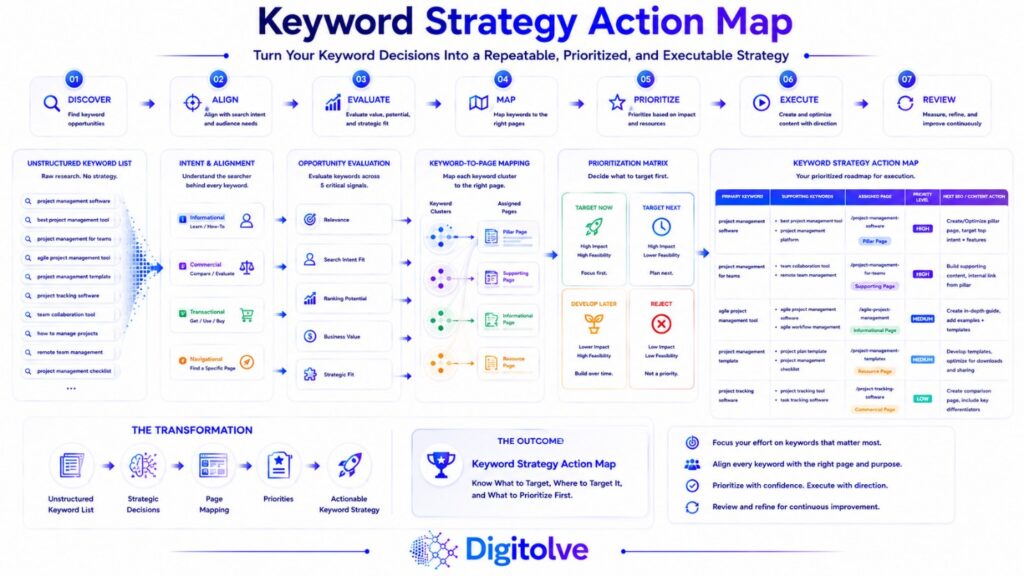
Prioritize Based on Strategic Value
The first priority should not automatically be the keyword with the highest search volume or the lowest competition.
Instead, evaluate each opportunity based on its overall strategic value.
Consider questions such as:
- Does this keyword closely align with our business objectives?
- Does it represent an important need for our target audience?
- Does it support a core topic we want to build authority around?
- Will it strengthen our existing content architecture?
The strongest priorities are usually those that create value across several of these areas rather than excelling in only one.
The evaluation sequence becomes:
Business Goals
↓
Audience Need
↓
Search Intent
↓
Strategic Value
↓
Priority Decision
This creates a more purposeful roadmap than simply sorting keywords by search metrics.
Balance Short-Term Wins With Long-Term Growth
A sustainable keyword strategy should contain both immediate opportunities and future objectives.
Some keywords may be realistic targets today because they fit the website’s current authority and content coverage.
Others may represent valuable long-term goals that require additional supporting content before becoming realistic priorities.
A balanced roadmap could look like:
Now
Keywords that are highly aligned and realistically achievable.
↓
Next
Opportunities that become stronger after expanding topical coverage.
↓
Future
High-value opportunities requiring greater authority and broader content support.
This staged approach allows the strategy to grow naturally instead of attempting everything at once.
Consider Your Existing Content Assets
Prioritization should also consider what already exists.
Sometimes improving or expanding an existing page provides greater value than creating an entirely new one.
Before planning new content, ask:
- Can an existing page satisfy this opportunity?
- Would updating current content strengthen our overall strategy?
- Is creating a new page genuinely necessary?
Looking at existing assets first helps prevent unnecessary duplication while making better use of previous work.
Turn Priorities Into an Execution Roadmap
Once priorities have been determined, they should be organised into a practical action plan.
Instead of maintaining a long spreadsheet of disconnected keywords, group them into a structured execution sequence.
The roadmap becomes:
High Priority
↓
Content Planning
↓
Content Creation
↓
Publication
↓
Performance Review
↓
Future Priorities
Each completed page creates a stronger foundation for future keyword opportunities.
Prioritization Is an Ongoing Decision
Keyword priorities should not remain fixed forever.
As new content is published, search visibility grows, business goals evolve, and audience interests change, the order of opportunities may also change.
Reviewing priorities regularly helps ensure the strategy continues to reflect current objectives rather than decisions made months earlier.
For a broader view of how keyword prioritization connects with an overall SEO strategy, read How to Build an SEO Strategy That Generates Rankings and Qualified Traffic.
Strategic Decisions Create Better Results Than More Keywords
Successful keyword strategies are rarely built by targeting the largest number of keywords.
They are built by making thoughtful decisions about which opportunities deserve attention first.
A smaller number of well-prioritized opportunities often creates more sustainable progress than attempting to pursue every keyword simultaneously.
The goal of keyword prioritization is not to do more. It is to focus effort on the opportunities that create the greatest strategic impact at the right time.
The final step is ensuring this process does not become a one-time exercise. A keyword strategy should be reviewed, refined, and improved as your website, content, and search visibility continue to evolve.
Turn Your Keyword Decisions Into a Repeatable Strategy
A successful keyword strategy is not built through isolated decisions.
It is built through a repeatable process that can be applied consistently whenever new content is planned or existing content is improved.
Without a structured workflow, keyword decisions often become inconsistent. Different pages may follow different standards, priorities may change without clear reasoning, and new opportunities can be overlooked.
A repeatable strategy replaces guesswork with a clear decision-making framework.
Build a Consistent Keyword Decision Workflow
Every keyword should pass through the same strategic evaluation process before becoming part of the content plan.
Instead of asking random questions for each keyword, use a consistent sequence of decisions.
The workflow becomes:
Keyword Discovery
↓
Search Intent Alignment
↓
Opportunity Evaluation
↓
Keyword Portfolio Assignment
↓
Keyword-to-Page Mapping
↓
Priority Decision
↓
Content Planning
↓
Execution
Following the same framework every time helps create consistency across the entire website.
Standardize Your Evaluation Criteria
Consistency comes from evaluating every opportunity using the same standards.
Rather than relying on instinct or personal preference, establish clear evaluation questions such as:
- Does this keyword align with the intended search intent?
- Does it support our business goals?
- Is there already a page that satisfies this opportunity?
- Is the ranking opportunity realistic for our current website?
- Where should this keyword fit within our overall portfolio?
Using consistent criteria reduces subjective decisions and creates a more reliable keyword strategy.
Document Your Keyword Decisions
A keyword strategy becomes significantly more valuable when important decisions are documented.
Instead of maintaining only a list of keywords, record why each opportunity was selected and how it fits into the broader strategy.
For every primary opportunity, document:
- Target keyword
- Search intent
- Assigned page
- Supporting keywords
- Priority level
- Current status
This creates a living keyword strategy that can be reviewed and improved over time rather than rebuilding the process from scratch.
Connect Keyword Strategy With Your Content Planning
Keyword strategy should guide content planning—not follow it.
Instead of creating content first and looking for keywords later, allow the keyword strategy to determine:
Which topics deserve dedicated pages.
Which opportunities strengthen existing content.
Which priorities should be published first.
Which opportunities should remain part of the future roadmap.
The planning sequence becomes:
Keyword Strategy
↓
Content Calendar
↓
Content Creation
↓
Publication
↓
Performance Review
This creates stronger alignment between SEO planning and content execution.
Learn From Previous Decisions
Every published page provides useful information for future keyword decisions.
Over time, patterns begin to emerge.
Some types of opportunities consistently perform well.
Some pages satisfy search intent more effectively than others.
Some keyword choices prove stronger than expected, while others may require refinement.
Reviewing these patterns helps improve future decision-making rather than treating every keyword as an entirely new challenge.
A Repeatable System Creates Long-Term Consistency
The real strength of a keyword strategy is not found in one successful page.
It comes from having a reliable system that continues producing thoughtful keyword decisions across dozens or even hundreds of content assets.
Instead of repeatedly asking:
“What keyword should we target next?”
the question becomes:
“What does our keyword strategy identify as the next logical opportunity?”
That shift creates consistency, scalability, and a stronger long-term SEO foundation.
A repeatable keyword strategy turns individual keyword decisions into a structured system that can support sustainable content growth for years to come.
Review and Refine Your Keyword Strategy Over Time
A keyword strategy should never be treated as a one-time project.
Search behavior evolves, business priorities change, new content is published, and your website gradually develops greater topical authority. As these factors change, your keyword strategy should evolve with them.
Regular review helps ensure that your keyword decisions continue supporting both your audience and your long-term SEO objectives.
Review Keyword Performance Regularly
Publishing content is not the final step.
After a page has had sufficient time to gain visibility, review how well it is performing against the original strategy.
Ask questions such as:
- Is the page attracting the type of audience it was intended to reach?
- Does the keyword still accurately represent the page’s purpose?
- Are supporting keywords aligning naturally with the content?
- Has search intent shifted since the page was published?
These reviews help identify opportunities for refinement without rebuilding the entire strategy.
The review process becomes:
Published Content
↓
Performance Review
↓
Opportunity Assessment
↓
Strategic Improvements
↓
Updated Keyword Strategy
Adapt to New Search Opportunities
New keyword opportunities appear continuously.
Customer questions evolve.
Industry terminology changes.
New products and services emerge.
Rather than creating an entirely new strategy each time, integrate new opportunities into the existing framework.
Evaluate every new keyword using the same decision process:
Search Intent
↓
Strategic Relevance
↓
Opportunity Evaluation
↓
Portfolio Placement
↓
Priority Decision
This keeps the strategy organised while allowing it to grow naturally over time.
Strengthen Existing Content Before Creating More
Growth does not always require publishing another page.
Sometimes the greatest improvement comes from strengthening existing content.
Updating information, improving topical coverage, expanding helpful sections, refining keyword alignment, or improving content structure can often provide more value than creating unnecessary new pages.
A mature keyword strategy balances:
Content Improvement
+
Strategic Expansion
rather than focusing only on continuous content creation.
Use Keyword Reviews to Improve Future Decisions
Every review provides insights that strengthen future planning.
Patterns begin to emerge.
You learn which types of opportunities align best with your audience, which content formats perform more effectively, and where additional topical coverage is needed.
Instead of treating each keyword as an isolated decision, use these lessons to improve the entire strategy.
Over time, the workflow becomes smarter because it is informed by previous experience rather than assumptions.
Diagnose Alignment Issues Before Changing Direction
Sometimes a page does not perform as expected even when the keyword appears appropriate.
Changing the keyword immediately may not solve the problem.
The underlying issue could involve search intent alignment, page focus, content structure, or keyword-to-page alignment.
Before making major strategic changes, it is helpful to diagnose the underlying alignment issue first.
🔵 SSL BRIDGE — URL ADD HERE
Recommended SSL Diagnostic:
Keyword Alignment Checker
This diagnostic complements the execution framework by helping identify whether a keyword, page, and search intent are properly aligned before making strategic adjustments.
Continuous Improvement Creates Sustainable Results
The strongest keyword strategies are never truly finished.
They are reviewed, refined, and improved as new information becomes available.
Instead of repeatedly starting from scratch, each review builds upon previous decisions, creating a stronger and more consistent SEO foundation over time.
The cycle becomes:
Review
↓
Refine
↓
Improve
↓
Execute
↓
Measure
↓
Review Again
This continuous process transforms keyword strategy from a static document into a long-term decision system that supports sustainable organic growth.
A keyword strategy delivers its greatest value when it evolves alongside your website, helping every new decision become more informed than the last.
Build a Keyword Strategy Around Alignment, Not Volume
Many keyword strategies begin with one question:
“Which keyword has the highest search volume?”
While your keyword strategy should always be guided by your own business goals and audience needs, it is also helpful to understand Google’s recommendations for creating helpful, people-first content. The Google SEO Starter Guide explains many of the fundamental principles that support long-term search visibility.
A keyword with impressive search volume may generate little value if it does not align with your audience, your content, or your business objectives.
Long-term SEO success is built on alignment rather than numbers alone.
Alignment Creates Stronger Strategic Decisions
Every keyword should support a clear purpose.
That purpose is created when several elements work together:
Business Goals
↓
Audience Needs
↓
Search Intent
↓
Content Purpose
↓
Page Relevance
↓
Keyword Selection
When these elements align, each page contributes to a stronger and more consistent search presence.
Without alignment, even well-researched keywords can lead to disconnected content and missed opportunities.
Volume Should Support Strategy—Not Define It
Search volume helps estimate demand.
It does not determine whether a keyword belongs in your strategy.
Before considering search volume, ask:
- Does this keyword solve a genuine audience need?
- Does it match the search intent we want to satisfy?
- Does it fit naturally within our content architecture?
- Does it support our long-term business objectives?
Only after answering these questions should search volume become part of the decision.
This keeps strategy focused on relevance before popularity.
Think in Systems Instead of Individual Keywords
Successful websites rarely grow because of one perfect keyword.
They grow because every page supports a structured search strategy.
Each keyword strengthens a topic.
Each topic strengthens a content cluster.
Each content cluster strengthens topical authority.
Together, these create sustainable organic visibility.
The progression becomes:
Individual Keywords
↓
Related Topics
↓
Content Clusters
↓
Topical Authority
↓
Sustainable Organic Growth
This systems approach creates far more long-term value than chasing isolated high-volume keywords.
Alignment Supports Sustainable SEO Growth
As your website expands, maintaining alignment becomes even more important.
Every new page should strengthen the existing strategy instead of competing with it.
When keyword selection, page purpose, and audience needs remain aligned, your content library becomes more organised, more useful, and easier for search engines to understand.
Rather than constantly searching for the next popular keyword, you build a structured ecosystem where every content asset has a clear role.
A Strong Keyword Strategy Is Built on Better Decisions
The real purpose of keyword strategy is not to collect more keywords.
It is to make better decisions.
When keyword discovery, intent alignment, opportunity evaluation, page mapping, prioritisation, and continuous refinement work together, keyword research becomes a repeatable strategic system instead of a collection of isolated ideas.
The strongest keyword strategies are not built around the biggest search volumes. They are built around the right opportunities, aligned with the right audience, on the right pages, at the right time.
Conclusion
Keyword research is only the starting point of an effective SEO strategy.
The real value comes from making informed decisions about which opportunities to pursue, why they matter, where they belong, and when they should become priorities.
Throughout this framework, we explored how to move beyond collecting keyword lists by following a structured process:
Keyword Discovery
↓
Search Intent Alignment
↓
Opportunity Evaluation
↓
Balanced Keyword Portfolio
↓
Keyword-to-Page Mapping
↓
Priority Decisions
↓
Execution
↓
Continuous Review
Each step contributes to a strategy that is organised, repeatable, and aligned with both audience needs and business objectives.
Rather than chasing the highest search volumes or targeting every possible keyword, focus on selecting opportunities that genuinely fit your content, support your website’s topical direction, and create long-term value.
As your website grows, this structured approach will help every new page strengthen the overall SEO strategy instead of becoming an isolated content asset.
A well-planned keyword strategy is not measured by the number of keywords you collect. It is measured by the quality of the decisions you make and the consistency with which those decisions are applied.
By building your keyword strategy around alignment, prioritisation, and continuous refinement, you create a sustainable foundation for stronger rankings, more relevant traffic, and long-term organic growth.
The most successful keyword strategies are not built by targeting more keywords—they are built by making better keyword decisions, consistently, over time.
Ready to Turn Keyword Research Into a Structured SEO Strategy?
Collecting keywords is easy.
Turning them into a clear, prioritised, and repeatable strategy is where sustainable SEO growth begins.
The Keyword Strategy Framework helps you move beyond spreadsheets and scattered keyword ideas by providing a practical system for evaluating opportunities, aligning search intent, mapping keywords to the right pages, and deciding what to target first.
Inside the framework, you’ll learn how to:
- Evaluate keyword opportunities using a structured decision process.
- Build a balanced keyword portfolio aligned with your business goals.
- Map every important keyword to the right page before creating content.
- Prioritise opportunities based on strategic value instead of search volume alone.
- Create a repeatable keyword strategy that supports long-term organic growth.
Whether you’re building a new content strategy or improving an existing one, this framework provides a practical roadmap for making better keyword decisions with greater confidence.
👉 Explore the Keyword Strategy Framework and start building a keyword strategy based on alignment, prioritisation, and long-term growth instead of guesswork.
Product: Keyword Strategy Framework
Level: Mini Framework
Perfect for: SEO professionals, content marketers, website owners, digital marketers, and businesses looking to build a structured keyword strategy.
Frequently Asked Questions (FAQs)
What is a keyword strategy?
A keyword strategy is a structured plan for selecting, evaluating, prioritising, and mapping keywords to the right pages based on search intent, business goals, and realistic ranking opportunities. Instead of collecting random keywords, it creates a clear roadmap for long-term SEO growth.
2. How is a keyword strategy different from keyword research?
Keyword research focuses on discovering search terms. A keyword strategy goes further by deciding which keywords to target, how they fit your content, where they belong on your website, and when they should become priorities.
3. Should I always target keywords with the highest search volume?
Not necessarily. High search volume does not always mean the best opportunity. The most valuable keywords are those that align with your audience, search intent, business objectives, and your website’s current ability to compete.
4. Why is search intent important in keyword strategy?
Search intent helps ensure your content matches what people are actually looking for. When your page satisfies the user’s intent, it is more likely to provide a better experience and become a stronger candidate for search visibility.
5. How do I choose which keywords to target first?
Prioritise keywords based on their strategic value rather than search volume alone. Consider relevance, search intent, realistic competition, business goals, and whether the keyword supports your overall content strategy.
6. What is keyword-to-page mapping?
Keyword-to-page mapping is the process of assigning each primary keyword to the most appropriate page on your website. This helps maintain a clear content structure and reduces unnecessary overlap between pages.
7. How often should I review my keyword strategy?
Review your keyword strategy regularly, especially after publishing new content, observing meaningful performance trends, or updating your business priorities. Regular refinement keeps your strategy aligned with changing search opportunities.
8. Can a small website build an effective keyword strategy?
Yes. A structured keyword strategy helps websites of all sizes focus on realistic opportunities, create purposeful content, and gradually build topical authority over time.
9. What are the biggest mistakes to avoid when creating a keyword strategy?
Common mistakes include targeting keywords based only on search volume, ignoring search intent, creating multiple pages for the same search opportunity, skipping keyword prioritisation, and failing to review the strategy as your website grows.
10. What is the first step in building a successful keyword strategy?
The first step is understanding the search intent behind your target keywords. Once intent is clear, you can evaluate opportunities, map keywords to the right pages, prioritise effectively, and build a repeatable strategy that supports sustainable organic growth.
Recommended Reading
Continue building your SEO knowledge with these related guides:
1. Why Your Keywords Are Not Ranking (Even With Strong Content & SEO)
Learn the most common reasons keywords fail to gain visibility and how to identify alignment issues before changing your SEO strategy.
2. Why Keyword Cannibalization Is Killing Your Rankings (And Splitting Your SEO Authority Without You Realizing It)
Understand how multiple pages competing for the same search intent can weaken your rankings and how proper keyword mapping prevents this problem.
3. How to Build an SEO Strategy That Generates Rankings and Qualified Traffic
Discover how keyword strategy fits into a complete SEO strategy by connecting business goals, search intent, content planning, and sustainable organic growth.