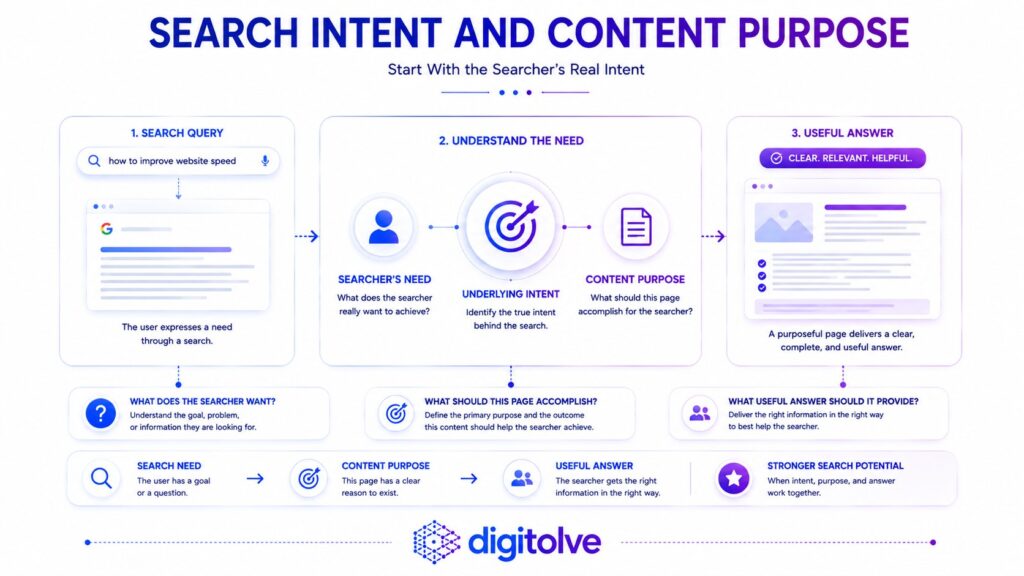
search relevance:
Creating high-quality content takes time. You can research the topic carefully, provide useful information, structure the article professionally, and still find that the page does not gain the search visibility you expected.
That can be frustrating—but content quality and search relevance are not exactly the same thing.
A page may be genuinely useful while still leaving important questions unanswered about its purpose, relevance, structure, context, or relationship to the searcher’s actual need.
The stronger question is not simply:
“Is this good content?”
It is:
“Does this content clearly satisfy the search need it is intended to serve?”
A stronger content approach therefore looks like:
Good Content → Search Alignment → Clear Understanding → Useful & Trustworthy Value → Stronger Search Potential
The goal is not to guarantee rankings by completing a checklist. It is to make the content’s purpose, relevance, usefulness, credibility, and context clearer to the people it is intended to serve—and easier for search systems to interpret.
If you are already creating valuable content but Google still appears to be overlooking it, the first step is to understand whether there is an underlying content relevance gap before making major changes.
If you need to investigate whether an existing content asset has a relevance problem before changing it, the Content Relevance Scanner provides the diagnostic layer.
Table of Contents
Why High-Quality Content Can Still Struggle to Rank
High-quality content and search relevance are closely connected, but they are not the same thing.
A page can be well-written, accurate, and genuinely useful while still failing to clearly satisfy the specific need represented by a search query. This is why simply improving writing quality does not always address a content visibility problem.
Content Quality Does Not Automatically Mean Search Alignment
Content quality focuses on whether the information is useful, accurate, clear, and valuable to the reader.
Search relevance asks a different question:
Does this content appropriately satisfy the need behind the search?
A page can succeed at one while being weaker at the other.
For example, an article may contain excellent information but focus on a broader topic than the searcher actually intended. Another may explain a subject thoroughly but fail to address the question that brought the visitor to the page.
The issue is therefore not necessarily that the content is “bad.”
It may simply be misaligned with the search need.
Search Systems Need Meaningful Context
For content to be useful in search, its purpose and subject should be reasonably clear.
The page should communicate:
- What topic it addresses
- What question or need it serves
- Who the information is intended to help
- How the different sections relate to the central subject
- What useful outcome the reader can gain from the content
This is not about creating content for a search engine instead of people.
It is about making the content’s meaning and usefulness clear.
The Difference Between Good Content and Relevant Content
A useful way to think about the distinction is:
Good Content
→ Clear, useful, accurate information
Relevant Content
→ Clear, useful, accurate information that also meaningfully satisfies the search need
The strongest content aims for both.
That means the goal should not be:
“How can I make this article better?”
in isolation.
It should also be:
“How can I make this article more useful for the specific person and search need it is intended to serve?”
This shift from content quality alone toward search relevance provides the foundation for everything that follows.
High-quality content is valuable, but stronger search potential comes from making that value clearly relevant to the searcher’s actual need.
Start With the Searcher’s Real Intent
Before creating or improving content, understand what the searcher is actually trying to accomplish.
A keyword can tell you what someone typed, but the underlying search need tells you what they expect to find.
The goal is to connect that need with a content purpose that provides a genuinely useful answer.
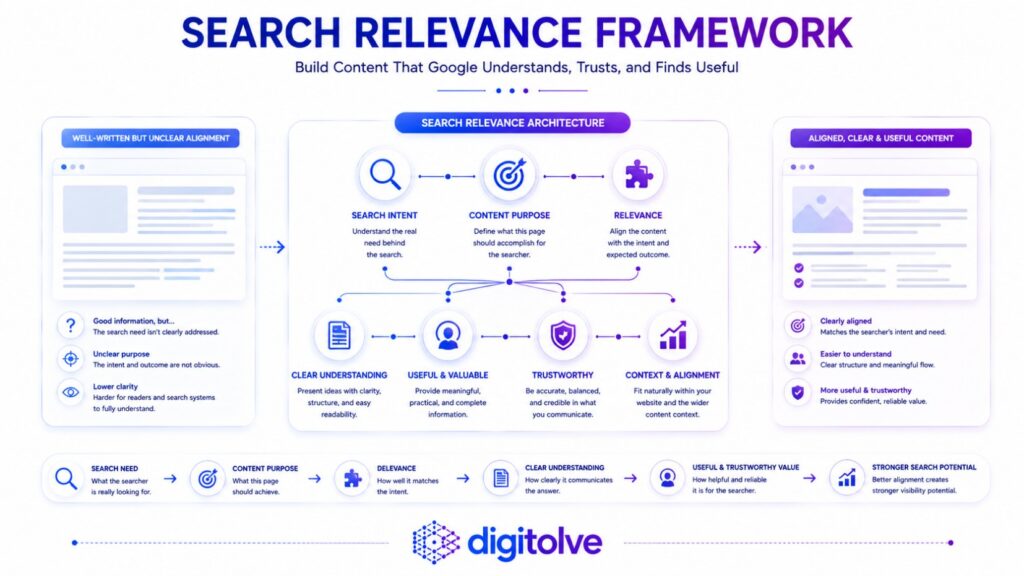
Understand What the Searcher Is Actually Trying to Accomplish
Look beyond the wording of the search query.
- What problem is the searcher trying to solve?
- What information are they looking for?
- What decision are they trying to make?
- What would make the page genuinely useful to them?
The same broad topic can represent very different needs depending on the context.
A strong content strategy therefore starts with the searcher’s need, not simply the keyword itself.
Match the Content Purpose to the Search Need
Once the underlying need is clearer, define what the page is actually supposed to accomplish.
The basic relationship is:
Search Need → Content Purpose → Useful Answer
For example, a searcher looking for an explanation needs a different content experience from someone comparing options or trying to complete a specific task.
The content should make that purpose clear from the beginning and maintain it throughout the page.
Avoid Writing for Keywords Instead of People
Keywords remain useful because they help identify how people describe their needs.
But the keyword should not become the purpose of the article.
Instead of asking:
“How many times should this keyword appear?”
ask:
“What does the person behind this search actually need?”
That shift helps prevent content from becoming repetitive, unnatural, or disconnected from the reader’s real objective.
Keep Keyword Strategy and Search Relevance Connected—but Distinct
Keyword selection can help identify opportunities, while search relevance determines whether the resulting content actually addresses those opportunities appropriately.
If you want to explore the keyword-decision layer separately, see How to Create a Keyword Strategy That Helps Your Content Rank Faster.
Make Your Content Easy to Understand
Once the searcher’s need is clear, the next challenge is making the content’s meaning and relationships clear.
Strong content should not force readers to work through an unclear structure before they can understand the main point. The page should communicate its central topic, organize the important ideas around it, and provide supporting details in a logical sequence.
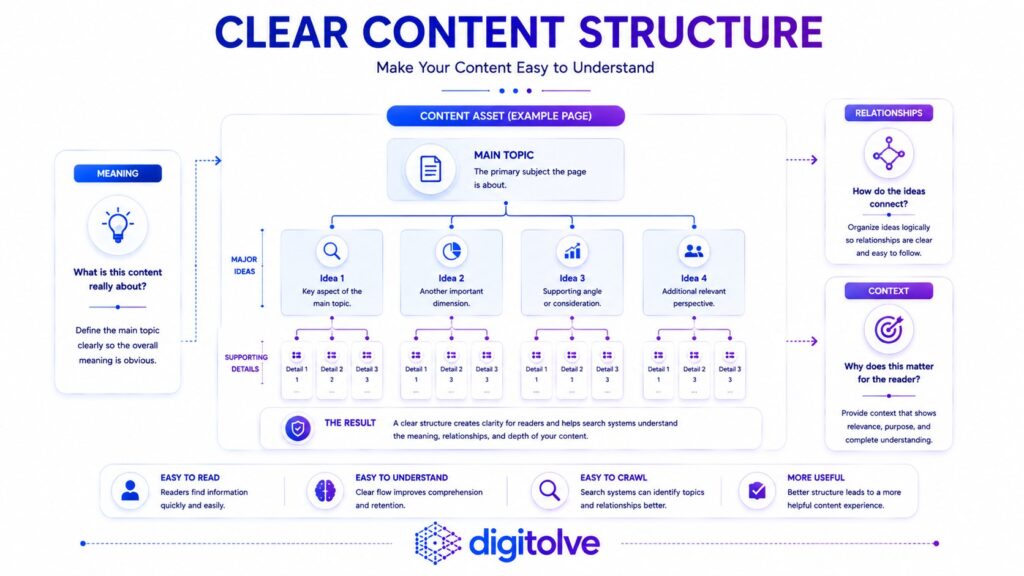
Give the Page a Clear Central Topic
Every content asset should have a recognizable central subject.
The reader should be able to understand:
- What the page is about
- What question it addresses
- Why the information matters
- What the major sections contribute to the overall answer
A clear central topic also helps prevent the page from drifting into unrelated subjects.
Organize Supporting Ideas Around the Main Topic
Supporting information should strengthen the primary subject rather than compete with it.
A useful conceptual structure is:
Main Topic → Major Ideas → Supporting Details
Each layer should contribute to the reader’s understanding of the layer above it.
This creates a more coherent information experience without requiring unnecessary complexity.
Make Relationships Between Ideas Clear
Individual sections should not feel like disconnected pieces.
Use logical transitions and contextual explanations to show how one idea relates to another.
For example:
Problem → Explanation → Context → Practical Understanding
This helps readers follow the reasoning and understand why each section belongs in the article.
Optimize for Meaning, Not Just Formatting
Clear headings and paragraphs are useful, but structure should serve meaning.
Do not add headings simply because an article needs more sections. Do not break content into smaller pieces merely to make it appear more optimized.
The better question is:
“Does this structure make the content’s meaning easier to understand?”
When the central topic, supporting ideas, and relationships between them are clear, the content becomes easier for people to navigate and easier for search systems to interpret.
Clear structure does not replace relevance. It helps make relevant information easier to understand.
Build Relevance Through Comprehensive Topic Coverage
Once the content has a clear purpose and structure, the next step is making sure it covers the important dimensions of the topic that genuinely contribute to the searcher’s need.
Comprehensive coverage does not mean making an article as long as possible. It means giving the reader enough relevant context to understand and act on the subject without introducing unnecessary material.
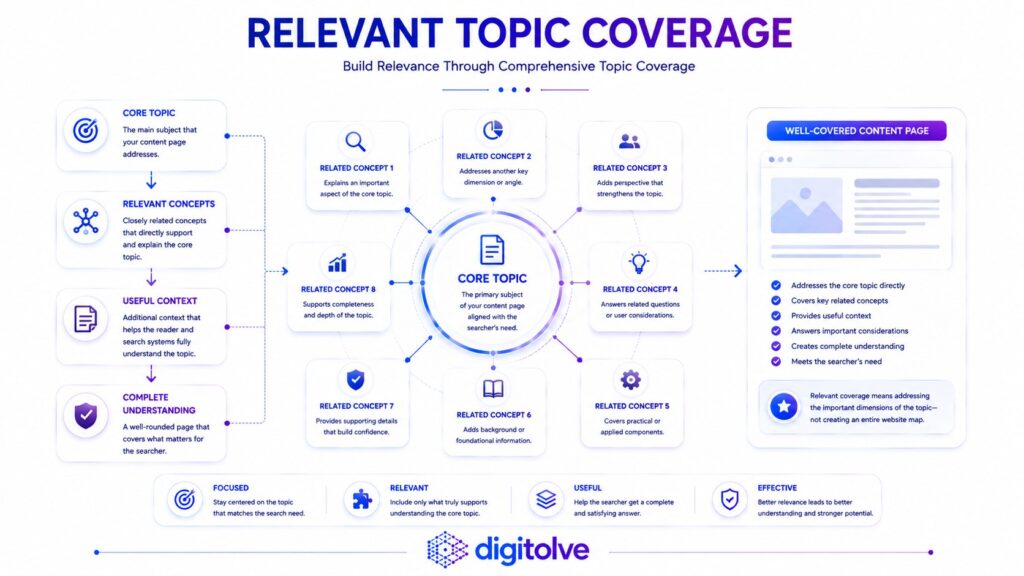
Cover the Important Dimensions of the Topic
Start with the central question the content is intended to answer.
Then consider which closely related ideas are genuinely necessary for a complete and useful response.
A useful principle is:
Core Topic → Relevant Concepts → Useful Context → Stronger Understanding
Each supporting idea should have a clear relationship with the main subject.
Fill Meaningful Information Gaps
More words do not automatically create better content.
Instead, look for information that the reader reasonably needs but the page does not currently provide.
- What important part of the question remains unanswered?
- What context would help the reader understand the subject?
- Is an important concept missing from the explanation?
- Would adding this information genuinely improve usefulness?
The objective is meaningful coverage, not content expansion for its own sake.
Keep Supporting Topics Connected
Supporting information should strengthen the main topic rather than turn the article into a collection of loosely related subjects.
A useful test is:
“Does this information help the reader understand or solve the primary problem this page addresses?”
If the answer is no, it may belong in another article instead.
This also helps maintain clear boundaries between related content across the wider Digitolve ecosystem.
Relevance at the Content-Asset Level
At this stage, the focus is one content asset and its ability to provide relevant coverage for its intended search need.
This is different from building a complete website-wide topical authority architecture.
The distinction matters:
Blog 12: Relevant coverage within the current content asset.
Search Relevance Framework: Systematically evaluate and strengthen that relevance.
Future Topical Authority System — Premium: Build broader website-wide topical authority architecture.
Keeping these boundaries clear allows the content to become more useful without turning this article into a complete topical-authority methodology.
Comprehensive content is not content that says everything. It is content that covers what matters to the searcher’s need without unnecessary expansion.
Strengthen Content Structure for Search and Readers
Once the topic and relevant coverage are clear, the next step is to organize that information so the reader can move through it naturally.
A strong structure does more than make an article look organized. It helps establish the relationship between the main subject, its major ideas, and the supporting information that explains them.
Create a Clear Information Hierarchy
Readers should be able to recognize the hierarchy of the page without having to decode its structure.
A useful model is:
Main Topic → Major Ideas → Supporting Details
The main topic establishes the purpose of the page.
Major ideas answer the most important parts of that purpose.
Supporting details provide the context, examples, or explanations needed to understand those ideas.
Use Headings to Clarify Meaning
Headings should tell the reader what each section contributes to the overall subject.
A good heading is not simply a place to insert a keyword.
It should make the section’s purpose clear before the reader begins reading it.
When headings follow a logical sequence, the article becomes easier to navigate and its central argument becomes easier to follow.
Connect Related Concepts Naturally
Sections should feel like parts of one connected explanation rather than separate articles placed together.
Use natural transitions, contextual references, examples, and relevant internal connections when they genuinely improve understanding.
The relationship should feel like:
Idea → Explanation → Related Context → Next Idea
rather than:
Topic → Random Tip → Keyword → Unrelated Topic
Keep Structure Focused on Meaning
Avoid adding sections simply to make the article longer or appear more comprehensive.
The purpose of structure is to make useful information easier to understand.
Ask:
“Does this organization make the relationship between the ideas clearer?”
If it does, the structure is serving its purpose.
If it only adds formatting without improving understanding, it may not be necessary.
A clear structure helps relevant information communicate its meaning more effectively; it does not replace the need for relevance itself.
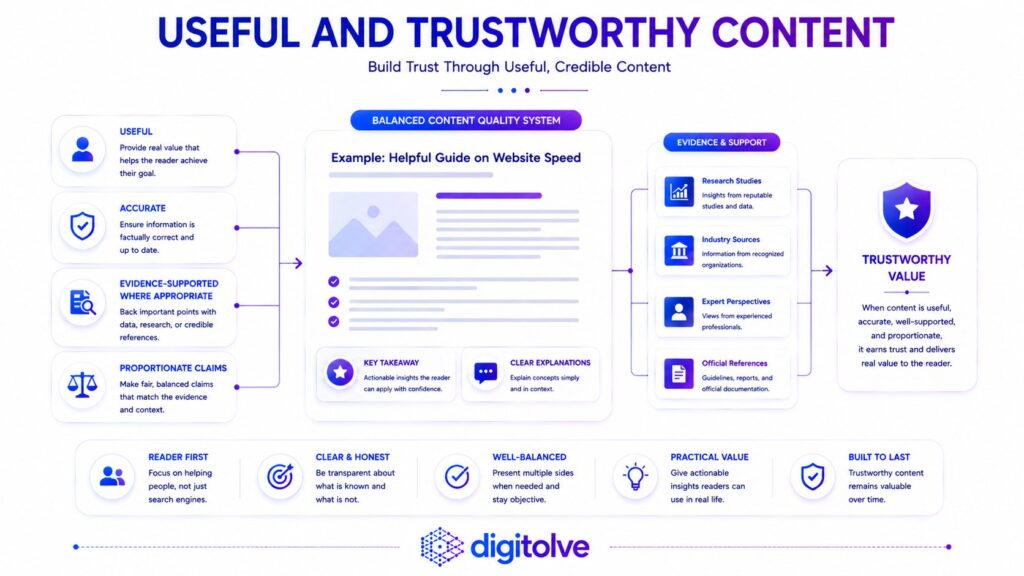
Build Trust Through Useful, Credible Content
Clear relevance and structure help content communicate its purpose, but usefulness also depends on whether the information deserves to be trusted.
Trust should not be treated as a decorative layer added to an article. It should emerge from the quality of the information, the accuracy of the explanation, the evidence supporting important claims where appropriate, and the honesty of the conclusions being presented.
Be Useful and Accurate
Start with information that genuinely helps the reader understand or solve the problem.
Avoid vague statements, unsupported assumptions, and advice that sounds authoritative without providing meaningful explanation.
Useful content should aim to be:
Clear → Accurate → Relevant → Actionable
Support Important Claims Where Appropriate
Not every sentence needs a citation.
However, claims involving research, statistics, official guidance, or other externally verifiable information may benefit from appropriate supporting evidence. For principles around creating useful, reliable, people-first content, see Google’s guidance on creating helpful, reliable, people-first content.
The goal is not:
Citation → Citation → Citation
The goal is:
Evidence → Credibility → Clarity
Evidence should strengthen understanding rather than become decoration.
Keep Claims Proportionate to the Evidence
Strong content should distinguish between what is known, what is reasonably supported, and what cannot be guaranteed.
For example, avoid presenting an SEO practice as something that will automatically produce a particular ranking outcome.
Instead, explain its potential role and the conditions that may influence the result.
This makes the content more credible and protects the reader from unrealistic expectations.
Make the Content Helpful Before Making It Promotional
Trust can weaken when every section is written primarily to push a product.
The article should first provide genuine understanding.
Then, when the reader reaches a point where structured implementation would genuinely help, the relevant framework can become the natural next step.
For this blog , that progression is:
Content Relevance Problem → Search Relevance Understanding → Search Relevance Framework
Trustworthy content does not need exaggerated claims to demonstrate value. Its usefulness, accuracy, evidence, and honesty should do that work.
Strengthen the Connection Between Content and Website Context
A strong content asset should not exist as an isolated page.
Its relevance becomes more meaningful when the page has a clear role within the website and connects naturally with other genuinely related resources.
Give the Page a Clear Role
Every article should contribute something specific to the broader content ecosystem.
- What does this page explain?
- Which problem does it address?
- What related questions might the reader have next?
- Which other pages provide useful context without duplicating this article?
This helps each page maintain its own intellectual territory while still contributing to a connected website.
Connect the Page to Relevant Supporting Content
Internal connections should exist because they improve the reader’s understanding—not simply because another URL is available.
A useful relationship might look like:
Current Problem → Related Content → Broader Context
For example, a reader learning about search relevance may naturally benefit from understanding keyword strategy or another closely related content problem.
The link should make sense within the sentence and provide a genuine next step.
Avoid Creating Isolated Content
A page that has no meaningful relationship with the rest of the website can become difficult for visitors to explore further.
Instead, think of the content ecosystem as connected resources where each article has a clear role.
That does not mean every page needs numerous internal links.
It means the links that do exist should be purposeful.
Prevent Topic Overlap
Website context also requires knowing when another topic should remain separate.
If two articles serve essentially the same search need, adding more links between them may not solve the underlying problem.
Instead, clarify what each page owns.
For Blog 12, the boundary is:
Content Relevance → Search Relevance
while broader website-wide topical relationships belong to a larger authority architecture.
A strong content asset should be useful on its own while also having a meaningful place within the wider website.
Review Whether Your Content Still Matches the Search Landscape
Content relevance is not necessarily permanent.
Search needs can evolve, competing pages can improve, and the information people expect from a query can change. A page that was useful previously may therefore need to be reassessed when there is meaningful evidence that its relevance has changed.
Compare Your Content With Current Search Expectations
When reviewing an existing page, consider the current search environment rather than assuming that the original content strategy is still appropriate.
Look at questions such as:
- What are searchers currently trying to understand?
- Has the expected content format changed?
- Are important aspects of the topic now missing?
- Does the page still address the central need clearly?
- Has the surrounding search landscape meaningfully changed?
The purpose is not to copy competing pages.
It is to understand whether the page still provides distinctive, useful value for the people it is intended to serve.
Improve Where the Evidence Shows a Gap
A meaningful change may justify reassessing the content.
But reassessment does not automatically mean rewriting everything.
A better principle is:
Meaningful Change → Reassess → Identify Genuine Gap → Improve Where Needed
If there is no meaningful evidence that the content has become less useful or relevant, unnecessary changes may create more work without solving a real problem.
Avoid Arbitrary Update Schedules
Content does not necessarily need to be changed simply because a certain number of months have passed.
Instead, consider whether there is a genuine reason to revisit it.
That reason might include:
- Important information becoming outdated
- A meaningful shift in search intent
- New information that materially improves the answer
- A clear relevance or usefulness gap
- Changes in the broader context that affect the reader
Preserve What Is Already Working
Reassessment should not become an excuse to constantly rewrite content.
If a section remains accurate, useful, and relevant, preserve it.
This follows a simple principle:
Correct → Preserve.
Only make changes where there is a genuine opportunity to improve the content’s usefulness or relevance.
The goal of reassessment is not to keep changing content. It is to recognize meaningful change and respond when the evidence shows that improvement is needed.
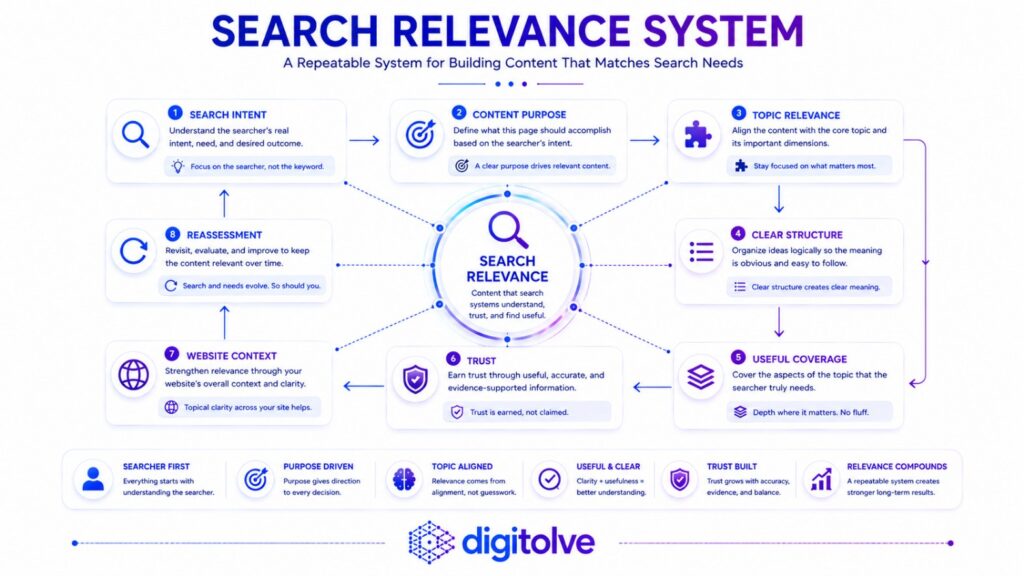
Build a Repeatable Search Relevance System
The previous sections have focused on the individual elements that make content more meaningfully aligned with a search need. The next step is to connect those elements into a repeatable way of thinking about content relevance.
The objective is not to create a rigid formula that guarantees rankings.
It is to develop a consistent perspective for creating and improving content so that its purpose, relevance, usefulness, credibility, and context remain connected.
Connect the Major Relevance Elements
At a high level, the system can be understood as:
Search Intent
↓
Content Purpose
↓
Topic Relevance
↓
Clear Structure
↓
Useful Coverage
↓
Trust
↓
Website Context
↓
Reassessment
Each element contributes something different.
Search intent establishes what the searcher needs.
Content purpose defines what the page is meant to accomplish.
Relevance and coverage determine how well the content addresses that need.
Structure helps communicate how the information fits together.
Trust supports the credibility and usefulness of the information.
Website context gives the content a meaningful place within the broader ecosystem.
Reassessment recognizes that search environments and information needs can change.
Move From Content Creation to Search Relevance Thinking
This changes the question from:
“Did we publish a good article?”
to:
“Does this content clearly satisfy the search need it is intended to serve?”
That shift is important because content production and search relevance are not the same activity.
Publishing more content does not automatically solve a relevance problem.
Likewise, rewriting an existing page does not automatically make it more relevant.
The improvement should come from understanding what the content is intended to accomplish and whether the important elements support that purpose.
Keep the System Conceptual
This article introduces the logic of the system.
It does not need to provide a complete audit methodology, scoring model, diagnostic matrix, worksheet, decision tree, or step-by-step evaluation process.
Those are implementation mechanisms rather than the strategic understanding this article is designed to provide.
The distinction is:
Blog 12 → Understand Search Relevance
Search Relevance Framework → Systematically Evaluate & Strengthen Relevance
Topical Authority System — Premium → Build Broader Website-Wide Authority Architecture
This protects the value of the Core product while giving the reader a clear understanding of why a structured framework can be useful.
Build a Repeatable Mindset
The real benefit of a relevance system is consistency.
Instead of treating every article as a completely separate SEO project, use the same high-level thinking whenever content is created, reviewed, or improved.
Ask:
What does the searcher need?
↓
What is this page meant to provide?
↓
Is the coverage genuinely relevant?
↓
Is the meaning clear?
↓
Is the information useful and trustworthy?
↓
Does the page have meaningful website context?
↓
Has anything meaningfully changed that requires reassessment?
These questions describe the direction of the system without revealing the detailed evaluation machinery of the Search Relevance Framework.
Search relevance becomes more sustainable when it is treated as a connected system of thinking rather than a collection of isolated content tactics.
Search Relevance Framework — The Next Execution Layer
At this point, a reader who understands the principles may naturally need a more structured way to apply them.
The Search Relevance Framework is the appropriate Core-level next step for systematically evaluating and strengthening content relevance.
It owns the implementation layer:
Understand → Evaluate → Prioritize → Strengthen → Improve
The future Topical Authority System — Premium sits one level above this, addressing broader website-wide topical relationships and authority architecture.
Conclusion
Building content that performs well in search is not simply about writing more, adding more keywords, or making every article longer.
The stronger approach is to make the content’s purpose, relevance, structure, usefulness, credibility, and context work together around a genuine search need.
The complete thinking process is:
Search Intent
↓
Content Purpose
↓
Relevant Coverage
↓
Clear Structure
↓
Useful & Trustworthy Value
↓
Website Context
↓
Search Landscape Reassessment
This does not create a guaranteed ranking formula. Search visibility depends on many factors outside the control of any individual content creator.
What this approach does provide is a stronger foundation for creating content that is genuinely useful, clearly positioned, and meaningfully aligned with the people it is intended to serve.
The key shift is:
Content Creation → Search Relevance Thinking
Strong search content is not simply content that is well written. It is content whose purpose, relevance, structure, usefulness, credibility, and context make its value clear to the people it is intended to serve.
Call to Action
If you understand that content quality alone is not enough, the next step is to turn search relevance into a structured improvement process.
The Search Relevance Framework is the Core-level implementation layer for businesses and creators who want to systematically evaluate and strengthen how their content aligns with search needs.
From Understanding to Execution
This article explains:
What search relevance means
↓
Why it matters
↓
What elements contribute to stronger relevance
The framework goes further:
Understand → Evaluate → Prioritize → Strengthen → Improve
It is designed to help turn the principles in this article into a more structured and repeatable content-relevance process.
Where It Fits in the Digitolve Product Ladder
Content Relevance Problem
↓
Search Relevance Understanding — Blog 12
↓
Search Relevance Framework — Core
↓
Topical Authority System — Premium
The Core framework focuses on the specific search-relevance system.
The future Premium system addresses the broader question of how multiple content assets and topics connect into a website-wide topical authority architecture.
If you need to move from understanding search relevance to systematically evaluating and strengthening your own content, the Search Relevance Framework provides the structured implementation layer.
Product Boundary
The blog provides the strategic understanding.
The Core product provides the structured execution system.
This keeps the article useful while protecting the deeper framework, tools, evaluation mechanisms, worksheets, and decision processes inside the product.
Frequently Asked Questions (FAQs)
Recommended Reading
Continue exploring the systems behind stronger search visibility and content performance:
How to Create a Keyword Strategy That Helps Your Content Rank Faster
Explore the keyword-strategy layer that helps connect search opportunities with a more intentional content approach.
Why Your SEO Rankings Are Not Improving (Hidden SEO Gaps Most Websites Miss)
Go one layer deeper into the structural gaps that can prevent otherwise useful SEO efforts from producing stronger ranking progress.
Why Your Content Is Not Building Authority (Even After Publishing Regularly — And What Signals Are Missing)
Explore the next layer beyond individual content relevance: why consistent publishing does not automatically create broader content authority.