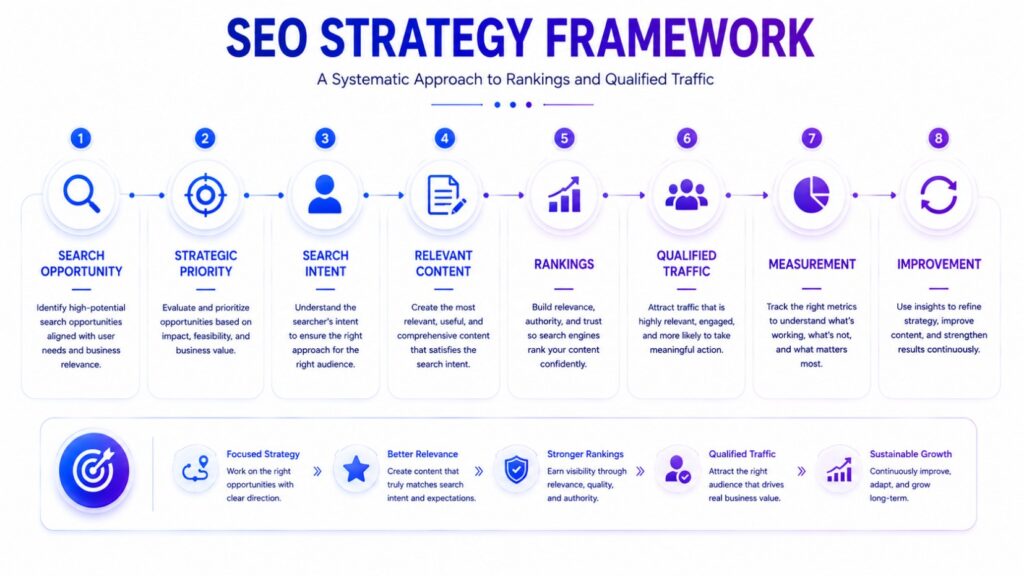
SEO strategy:
SEO often becomes a collection of separate activities:
Keywords → Content → Links → Technical Fixes → Updates
Each activity can have value, but activity alone does not create a strong SEO strategy.
A stronger approach connects the opportunities worth pursuing with the content, relevance, authority, and improvement decisions required to generate meaningful rankings and qualified traffic.
The important distinction is:
SEO Activity ≠ SEO Strategy
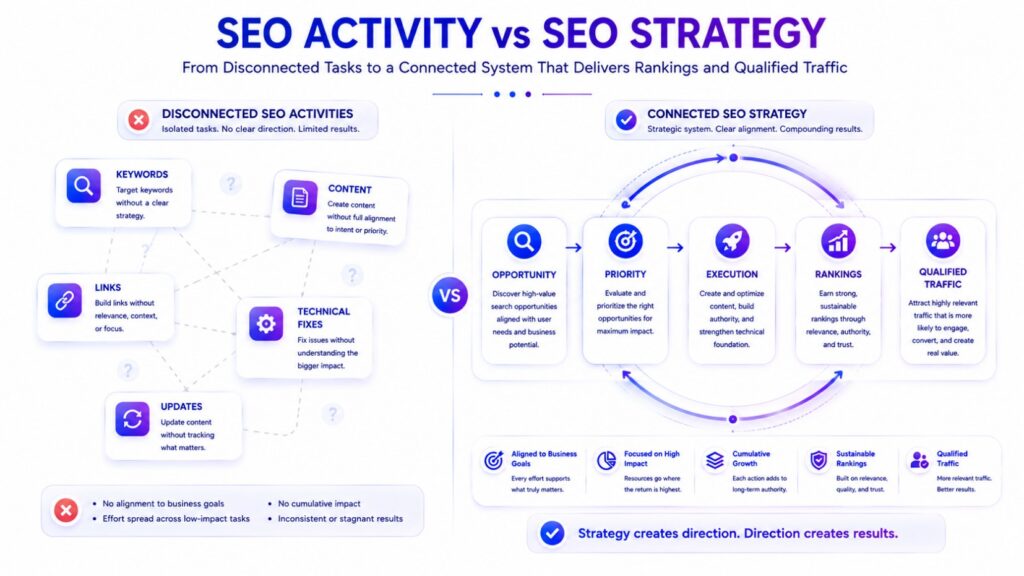
SEO strategy determines what deserves attention, why it matters, and how connected SEO decisions contribute to the desired outcome.
That means the goal is not simply to produce more content, build more links, or optimize more pages.
It is to create a deliberate direction:
Search Opportunity
↓
Strategic Priority
↓
Search Intent
↓
Relevant Content
↓
Ranking Development
↓
Qualified Traffic
↓
Measurement & Improvement
Rankings matter, but rankings alone are not the entire objective. The more meaningful question is whether the visibility being developed can attract people who are genuinely relevant to the business.
This article explores how those strategic connections work together—and how SEO can move from a collection of isolated activities toward a more deliberate system for generating rankings and qualified traffic.
Table of Contents
What an SEO Strategy Actually Means
An SEO strategy is more than a list of tasks to complete. It is the deliberate direction that connects search opportunities, priorities, content, relevance, authority, rankings, and qualified traffic.
Strategy vs. Tactics
SEO tactics are individual actions. An SEO strategy determines which actions deserve attention, why they matter, and how they contribute to a larger outcome.
For example, publishing an article is an activity. Choosing which topic deserves that article, what search need it should address, how it should support important ranking assets, and what outcome it is intended to contribute toward is strategic thinking.
Similarly, building links, improving technical elements, or updating content can all be useful activities—but none of them automatically becomes a strategy simply because they are being performed.
What a Strong SEO Strategy Connects
A connected SEO strategy can be understood at a high level as:
Search Opportunity
↓
Strategic Priority
↓
Search Intent
↓
Relevant Content
↓
Ranking Development
↓
Qualified Traffic
↓
Measurement & Improvement
Each stage answers a different strategic question. What opportunity matters? What should receive attention first? What does the searcher actually need? What content should support that need? How does visibility develop? Is the resulting traffic actually relevant? And what does the evidence tell us about the next improvement?
This is the key difference between doing SEO and directing SEO strategically.
Strategy determines what deserves attention, why it matters, and how connected SEO decisions contribute to the desired outcome.
Start With Search Opportunities That Matter
A strong SEO strategy does not begin by trying to target every possible keyword. It begins by identifying search opportunities that are genuinely relevant to the audience and the business.
Not every query has the same strategic value. Some may attract attention without bringing the right audience, while others may represent a much stronger connection between what people are searching for and what the business can meaningfully provide.
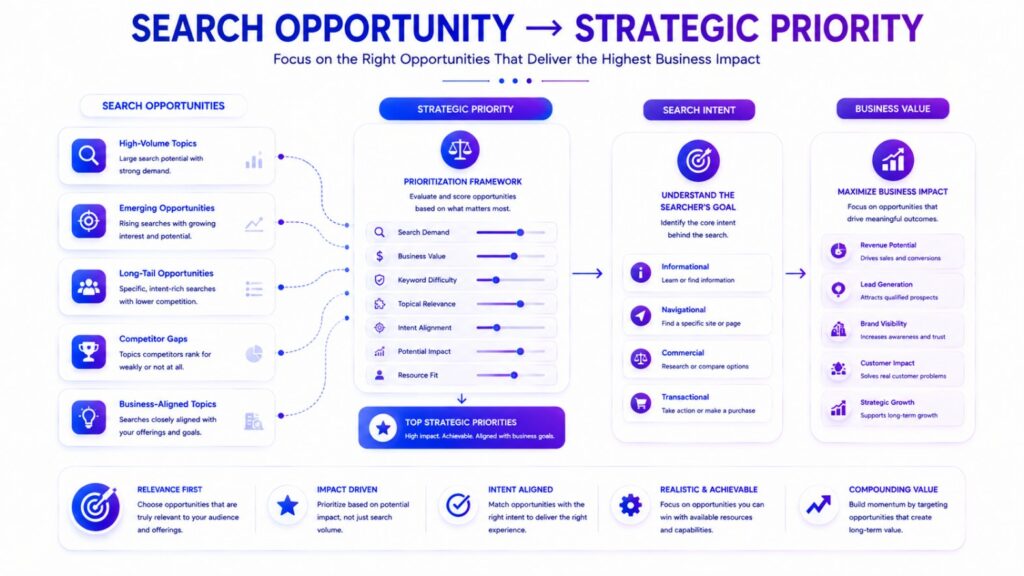
Identify Valuable Search Opportunities
Start by looking beyond search volume alone.
A useful opportunity should be considered in relation to:
- What people are actually searching for
- Whether the topic is relevant to the business
- Whether the business can provide genuinely useful content
- Whether the resulting visibility could attract a relevant audience
This creates a more strategic way to think about search opportunities rather than treating every keyword as an equally valuable target.
Connect Search Demand With Business Relevance
The strategic relationship can be understood as:
Search Demand → Relevance → Business Value
Search demand tells you that people are looking for something. Relevance helps determine whether that search need belongs within your content and business direction. Business value helps determine whether pursuing the opportunity makes strategic sense.
Prioritize Opportunities Strategically
The objective is not to create the largest possible list of keywords.
It is to identify the opportunities that deserve attention and connect them with the broader SEO strategy.
For a deeper look at the keyword-level planning layer, see:
How to Create a Keyword Strategy That Helps Your Content Rank Faster
The best SEO opportunity is not necessarily the query with the largest search volume. It is the opportunity that connects search demand with genuine relevance and meaningful business value.
Align SEO Strategy With Search Intent
Identifying a valuable search opportunity is only the beginning. A strong SEO strategy must also consider what the searcher actually needs when they make that search.
Search intent helps determine the direction content should take. Without understanding that need, a page can target a relevant-looking keyword while still providing the wrong type of answer.
Understand What Searchers Actually Need
Look beyond the wording of the query and consider the underlying purpose behind it.
Is the searcher trying to understand a problem, compare options, find a solution, complete an action, or explore a broader topic?
The answer influences what useful content should look like.
Match Content Direction With Search Intent
A strategic content direction should therefore connect:
Search Opportunity → Search Intent → Content Direction
This does not mean every page needs to follow a rigid formula. It means the content should have a clear relationship with the need represented by the search.
Avoid Building Strategy Around Keywords Alone
A keyword can identify an opportunity, but it does not fully explain what should satisfy that opportunity.
Search intent helps determine the answer, depth, perspective, and content direction that are appropriate for the searcher.
That distinction keeps SEO strategy focused on useful search experiences rather than simply increasing the number of keywords being targeted.
Build a Content Strategy That Supports Rankings
Once meaningful search opportunities have been identified and their underlying intent understood, the next strategic question is how content should support those opportunities.
A strong SEO strategy does not treat content production as a race to publish more pages. It connects content creation with meaningful search opportunities, genuine search needs, and important ranking assets.
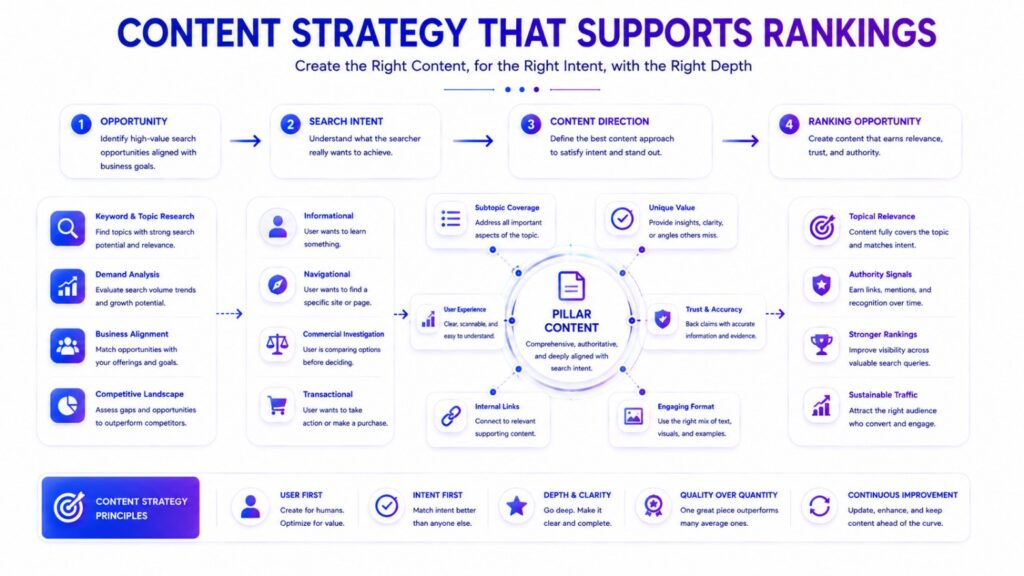
Create Content Around Meaningful Opportunities
Each important content asset should have a clear strategic reason for existing. It should address a search need that is relevant to the broader SEO direction rather than being created simply because a keyword appears attractive.
This helps prevent a common problem: a growing content library that contains many individual articles but lacks a clear relationship between what is being published and what the SEO strategy is trying to achieve.
Build Content That Serves Search Intent
Content direction should follow the need behind the search opportunity.
Opportunity → Intent → Content Direction → Ranking Opportunity
The objective is not to force every article into a predetermined format. It is to make sure the content has a meaningful purpose and provides an answer that is appropriate for the people searching.
Connect Supporting Content With Important Ranking Assets
A strategic content system can also connect supporting articles with the pages that matter most to the SEO strategy. Related content can reinforce useful topic relationships while giving visitors clearer paths to explore deeper information.
However, these relationships should be genuine. Internal connections should support understanding and navigation rather than being created simply to increase link counts.
Avoid Content Production Without Strategic Purpose
Publishing consistently can be valuable, but consistency alone does not make a content strategy effective.
The stronger question is:
What role does this content play in the SEO strategy, and what meaningful search opportunity is it intended to serve?
When content has a clear strategic role, publishing becomes part of a connected SEO direction rather than a separate activity operating alongside it.
Strengthen the Strategic Structure Around Important Pages
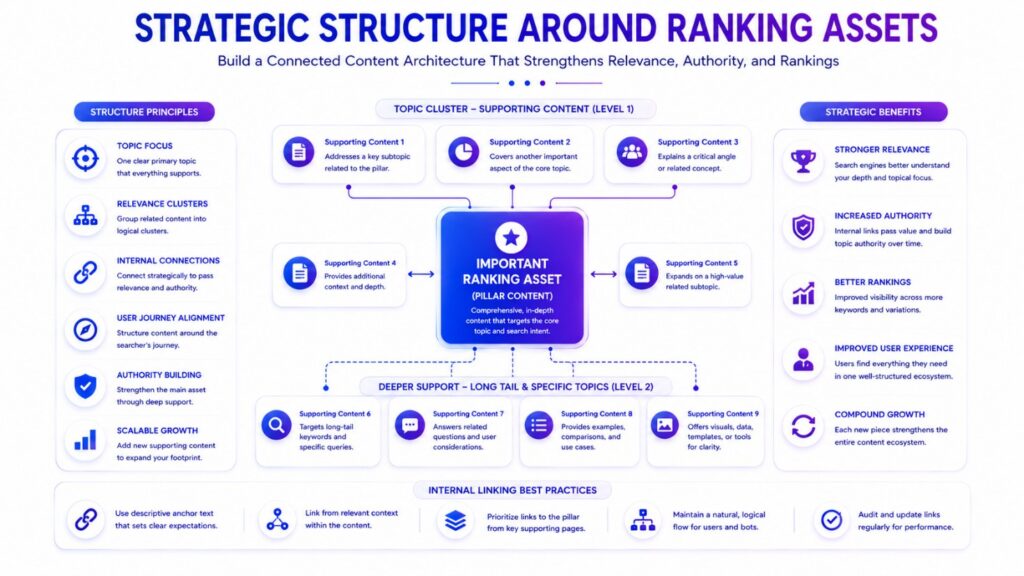
A strong SEO strategy does not treat every page as an isolated asset. Important ranking opportunities become more meaningful when the surrounding content and internal relationships support a clear strategic structure.
Identify Important Ranking Assets
Some pages have a more important role within the SEO strategy because they target valuable search opportunities, support important business goals, or represent topics the website wants to develop over time.
The objective is not to make every page equally important. It is to understand which content assets deserve stronger strategic support.
Connect Related Content Naturally
Relevant supporting content can help create meaningful relationships between pages. A visitor who begins with one topic should be able to move naturally toward related information that helps them understand the broader subject.
This creates a simple relationship:
Important Asset
↓
Supporting Content
↓
Internal Relationship
↓
Stronger Strategic Structure
Reduce Overlap and Structural Confusion
Strategic structure also means recognizing when multiple pages are addressing substantially similar search needs. Unnecessary overlap can make the site’s content relationships less clear and make it harder to maintain a deliberate ranking strategy.
Internal links should therefore be added because the relationship is genuinely useful—not simply because another page exists.
For a deeper look at this specific structural problem, see Why Your Internal Linking Is Not Helping Your SEO (And What Your Structure Is Missing).
Strong SEO structure is not about creating more links. It is about creating meaningful relationships between the pages that matter.
Build Authority Around Strategic Relevance
Authority can play an important role in an SEO strategy, but it should not be treated as a numbers game. The strategic objective is to strengthen the credibility and recognition of content in ways that are relevant to the topics and audiences the business is trying to reach.
Create Content Worth Referencing
Content has a stronger basis for earning recognition when it provides something genuinely useful, such as original insights, practical resources, credible research, useful data, or a distinctive perspective on an important problem.
The strategic question is not simply:
“How many links can we acquire?”
A better question is:
“Why would a relevant and credible source have a genuine reason to reference this content?”
Strengthen Relevant Authority Signals
Where evidence supports the need, an SEO strategy can evaluate whether important content assets have sufficient relevant recognition within their competitive search landscape.
This may involve strengthening the usefulness and distinctiveness of the content, developing resources that deserve attention, or building relationships that are genuinely relevant to the subject.
Prioritize Relevance and Credibility Over Link Volume
A large number of unrelated references does not automatically create a stronger SEO strategy. Relevance, credibility, context, and genuine value are more useful strategic considerations than simply pursuing higher link counts.
Authority should therefore remain one connected component of the wider system—not a replacement for search intent, useful content, relevance, structure, or strategic direction.
This section intentionally stays at the strategic level. It does not provide a backlink-building playbook or detailed authority-acquisition procedure.
Connect Technical SEO With Strategic SEO
Technical SEO can support a strong SEO strategy, but technical optimization should not become the strategy itself.
A technically healthy website still needs relevant content, clear search intent, useful information, meaningful structure, and a deliberate strategic direction.
Make Important Pages Accessible
Important content assets should be accessible to users and search systems so that the pages the strategy depends on can participate properly in the search journey.
This means technical considerations should be viewed in relation to the pages and opportunities that matter rather than treated as an endless list of isolated fixes.
Remove Technical Barriers
When a genuine technical barrier interferes with access, understanding, or search performance, resolving it can protect the effectiveness of the broader SEO strategy.
The strategic question is not whether every possible technical optimization has been completed. It is whether meaningful technical barriers are preventing important SEO assets from performing their intended role.
Protect Search Performance
Technical health should therefore work alongside the other parts of the SEO system:
Search Intent
+
Relevant Content
+
Strategic Structure
+
Technical Foundation
↓
Stronger SEO System
Technical health supports SEO strategy, but technical optimization cannot replace relevance, useful content, or strategic alignment.
Connect Rankings With Qualified Traffic
Ranking in search is an important part of SEO, but rankings alone are not the entire strategic goal. A page can gain visibility without necessarily attracting the people who are most relevant to the business.
This is why qualified traffic should become part of the SEO strategy itself. The objective is not simply to increase the number of visits, but to develop visibility around search opportunities that have genuine relevance to the audience and the business.
Rankings Alone Are Not the Entire Goal
A higher ranking can increase visibility, but its strategic value depends partly on what the ranking represents. If the underlying search opportunity is poorly aligned with the business, additional traffic may not create meaningful progress.
Not All Search Traffic Has Equal Value
Traffic becomes more strategically useful when it comes from people whose search need is meaningfully connected to what the business offers.
This creates an important distinction:
More Traffic ≠ Automatically More Qualified Traffic
Connect Visibility With Search Relevance
The strategic relationship can be viewed as:
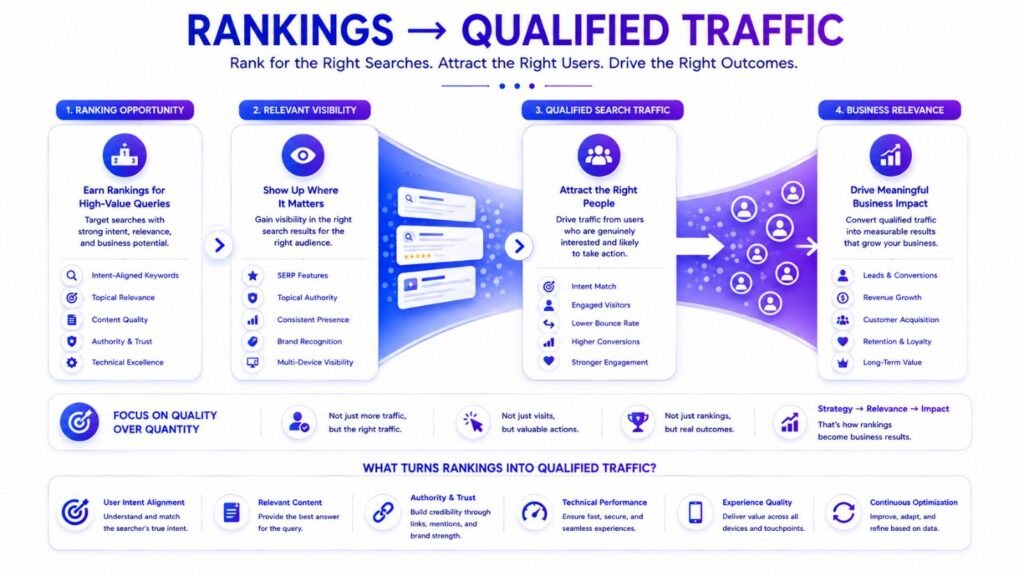
Ranking Opportunity
↓
Relevant Visibility
↓
Qualified Search Traffic
↓
Business Relevance
This does not mean that every ranking will produce a measurable business outcome. Rather, it means SEO strategy should deliberately consider whether the opportunities being pursued are capable of attracting a relevant audience.
Understand Qualified Traffic as a Strategic Outcome
When rankings, search intent, content direction, and business relevance are connected, traffic becomes more meaningful as an SEO outcome.
The strategic goal is therefore not simply:
“Get more pages to rank.”
It is to develop relevant search visibility that has a meaningful relationship with the audience and business objectives.
Measure SEO Strategy as a Connected System
A strategic SEO approach needs measurement, but measurement should help you understand what is happening—not encourage constant reactions to every ranking fluctuation.
Track Meaningful Ranking Movement
Monitor the ranking changes that matter to the SEO strategy, particularly around important search opportunities and ranking assets.
Individual position changes can provide useful information, but they should be interpreted in context rather than treated as isolated evidence that the entire strategy is succeeding or failing.
Evaluate Qualified Traffic
Rankings should also be considered alongside the traffic they generate. The strategic question is not simply whether organic visits increased, but whether the visibility is attracting a relevant audience.
This connects the measurement layer back to the central Pillar 2 objective:
Search Visibility → Qualified Traffic → Business Relevance
Look for Relationships Between SEO Signals
Instead of examining every metric separately, look for meaningful relationships between search opportunities, rankings, organic traffic, content changes, and other relevant SEO signals.
This creates a more useful learning process:
Measure → Understand → Improve
Avoid Reacting to Every Fluctuation
Search performance naturally changes over time. A temporary movement does not necessarily justify a major SEO intervention.
A stronger strategy gives meaningful patterns enough context before deciding whether something should be changed, strengthened, or simply monitored.
For official guidance on how Google describes Search performance data and its interpretation, see Google Search Central’s guidance on monitoring search traffic.
Measurement is most valuable when it turns SEO activity into evidence that can guide better strategic decisions.
Prioritize SEO Improvements Strategically
A connected SEO strategy does not require every possible improvement to happen at the same time. One of the most important strategic decisions is determining which opportunities deserve attention first.
Focus on the Opportunities That Matter Most
Prioritization helps separate meaningful opportunities from changes that may have little strategic value. Consider the evidence available, the potential impact, the relevance to the search opportunity, the effort involved, and the broader value to the SEO strategy.
A useful high-level principle is:
Evidence → Impact → Relevance → Feasibility → Strategic Value
This is not a rigid scoring formula. It is a way to think more deliberately about where limited SEO resources should be directed.
Separate Immediate Improvements From Strategic Development
Some opportunities may deserve attention because they address an important weakness or barrier. Others may require longer-term development, such as strengthening supporting content, improving strategic relationships, or developing broader authority.
Keeping these categories separate makes the strategy easier to manage without treating every improvement as equally urgent.
Avoid Random SEO Changes
Without clear priorities, SEO can become a cycle of changing whatever appears most visible at the moment.
A stronger approach asks:
What evidence suggests this deserves attention, and how does the improvement support the larger SEO objective?
The detailed prioritization mechanisms, decision rules, scoring methods, and execution tools belong in the SEO Strategy Core product. Here, the goal is simply to establish why strategic prioritization matters.
Build a Continuous SEO Strategy Improvement Cycle
SEO strategy should not be treated as a one-time plan that is created once and then left unchanged. Search opportunities, competitive conditions, content performance, and business priorities can evolve over time.
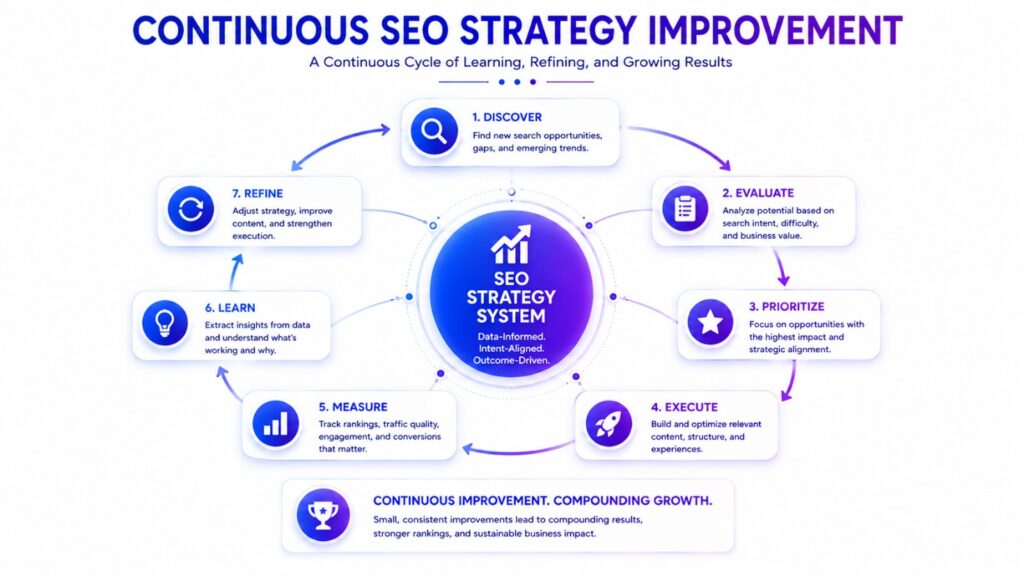
A stronger approach treats strategy as a continuous improvement process that learns from evidence and adjusts direction when meaningful changes justify it.
Move From One-Time SEO to Continuous Strategic Improvement
Instead of approaching SEO as:
Plan → Optimize → Finish
think of it as an ongoing cycle:
Discover
↓
Evaluate
↓
Prioritize
↓
Execute
↓
Measure
↓
Learn
↓
Refine
Let Evidence Guide the Next Decision
Continuous improvement does not mean constantly changing everything. It means using meaningful evidence to determine when a change is warranted and when an existing approach should simply be preserved.
This creates a healthier strategic rhythm:
Observe → Understand → Decide → Improve
Over time, this approach can help an SEO strategy become more deliberate, adaptable, and connected to the outcomes it is designed to support.
The detailed execution cycle, tracking mechanisms, refinement workflows, and decision tools belong inside the SEO Strategy Core product. The purpose here is to establish the strategic principle without giving away that implementation system.
How SEO Strategy Connects Rankings With Qualified Traffic
The strongest SEO strategies do not treat search opportunities, content, rankings, and traffic as separate objectives. They connect these elements through deliberate priorities and continuous improvement.
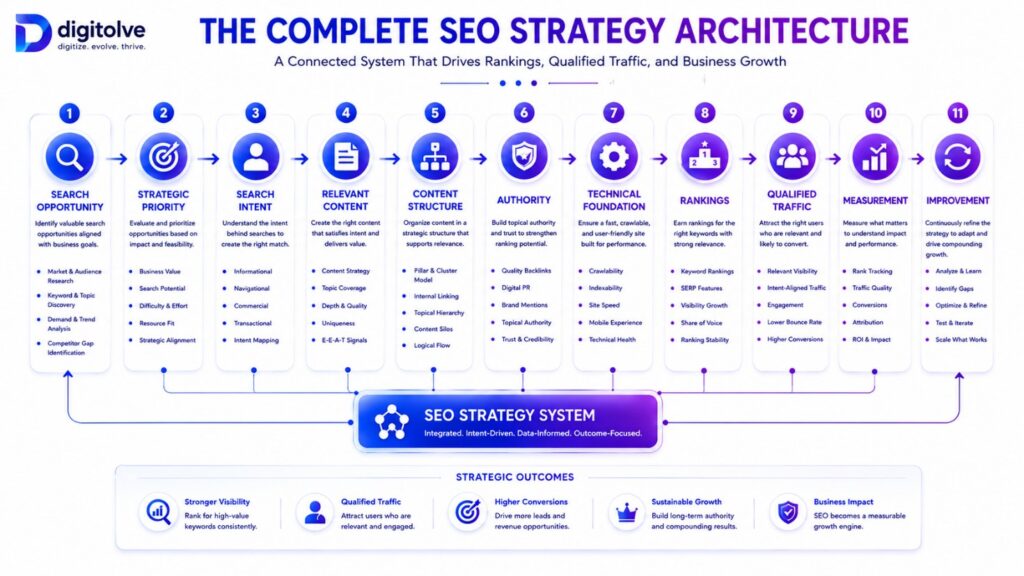
The complete strategic relationship can be understood at a high level as:
Search Opportunity
↓
Strategic Priority
↓
Search Intent
↓
Relevant Content
↓
Content Structure
↓
Authority
↓
Technical Foundation
↓
Rankings
↓
Qualified Traffic
↓
Measurement
↓
Improvement
Why the Connections Matter
Each part of the system contributes a different role. Search opportunities identify where attention may be worthwhile. Strategic priorities determine what deserves focus. Search intent and relevant content help align the page with the need behind the search. Structure, authority, and technical foundations support the broader SEO environment.
Rankings then become an important visibility outcome, while qualified traffic provides a more meaningful perspective on whether that visibility is reaching a relevant audience.
Measurement closes the loop by providing evidence that can inform future improvements.
SEO strategy is not simply about getting pages to rank. It is about strategically connecting the conditions that make relevant rankings and qualified traffic more meaningful and sustainable.
This is what separates strategic SEO from a collection of independent optimization activities. The value comes from understanding how the parts influence the direction of the whole system.
From SEO Tactics to Strategic SEO
The difference between tactical SEO and strategic SEO becomes clearer when we look at the individual activities businesses commonly perform.
Keywords Alone Are Not Strategy
Identifying search opportunities is important, but a keyword list does not explain which opportunities matter most, what needs they represent, or how they should contribute to the wider SEO direction.
Content Production Alone Is Not Strategy
Publishing more content can expand a website’s search footprint, but content becomes strategically valuable when it has a clear purpose and supports meaningful search opportunities.
Link Building Alone Is Not Strategy
Authority can matter, but pursuing links without considering relevance, credibility, content value, and the broader SEO objective can turn an important activity into an isolated tactic.
Technical Optimization Alone Is Not Strategy
Technical health can support search performance, but it cannot replace useful content, search relevance, strategic priorities, or a clear understanding of the audience.
Rankings Alone Are Not Strategy
Rankings are an important SEO outcome, but a ranking does not automatically mean that the resulting visibility is strategically valuable.
Traffic Alone Is Not Strategy
Traffic can be useful evidence, but the strategic question is whether that traffic is relevant to the audience and business objectives.
SEO strategy emerges when these activities are connected through deliberate priorities, relevance, execution, measurement, and continuous improvement.
Strategy is what connects individual SEO activities to a meaningful direction and desired outcome.
Conclusion — Build SEO Around Strategic Connections
A stronger SEO strategy is not created by simply adding more SEO activities. It comes from connecting the right opportunities, priorities, content, relevance, structure, authority, rankings, and traffic into a deliberate direction.
The complete strategic journey can be understood as:
Opportunity
→ Priority
→ Intent
→ Content
→ Structure
→ Authority
→ Technical Foundation
→ Rankings
→ Qualified Traffic
→ Measurement
→ Improvement
Each component has a role, but the real strategic value comes from how those components connect.
Search opportunities need strategic priorities. Content needs to reflect meaningful search intent. Important pages need a useful supporting structure. Authority should be relevant and credible. Technical foundations should support the system. Rankings should be considered alongside the quality and relevance of the traffic they generate.
Then measurement provides evidence that can guide the next improvement.
A stronger SEO strategy is not a larger list of SEO tasks. It is a connected approach that directs the right opportunities, assets, and improvements toward meaningful rankings and qualified traffic.
When SEO is approached this way, individual activities stop operating as disconnected tasks and begin contributing to a clearer strategic direction.
Turn SEO Strategy Into Structured Execution
This article has focused on the strategic layer: how search opportunities, priorities, content, relevance, authority, rankings, qualified traffic, measurement, and improvement connect.
The next step is moving from understanding the strategy to systematically executing it.
From Strategy to Execution
Understand the SEO Strategy
↓
Evaluate the Opportunities
↓
Prioritize What Matters
↓
Execute the Right Improvements
↓
Measure and Refine
The SEO Strategy Core product is designed as the structured implementation layer for turning this strategic thinking into a more deliberate and repeatable SEO process.
It goes beyond the conceptual direction covered in this article by providing the deeper framework, tools, worksheets, decision mechanisms, execution sequence, and tracking approach needed to work through the strategy systematically.
The goal is not to promise guaranteed rankings or traffic. The goal is to provide a clearer system for making better-informed SEO decisions and connecting those decisions to meaningful outcomes.
Where This Fits in the Digitolve Ladder
SEO Ranking System — Pillar 1
↓
SEO Strategy — Pillar 2
↓
Focused Ranking & Recovery Systems
↓
Broader Premium Architecture
Understand the system first. Then use the appropriate framework to execute it.
Frequently Asked Questions
Recommended Reading
Continue exploring the key systems that support stronger rankings, qualified traffic, and long-term SEO performance:
How to Create a Keyword Strategy That Helps Your Content Rank Faster
Explore the keyword strategy layer behind identifying and organizing search opportunities that can support a more focused SEO direction.
How to Move Your Website From Page 2 to Page 1 on Google
Learn how the broader SEO strategy connects with the focused challenge of improving pages that are already close to stronger search positions.
How to Recover Google Rankings With a Long-Term SEO Stability System
Explore the next layer of ranking strategy: recovering lost visibility and developing a more stable long-term SEO approach.