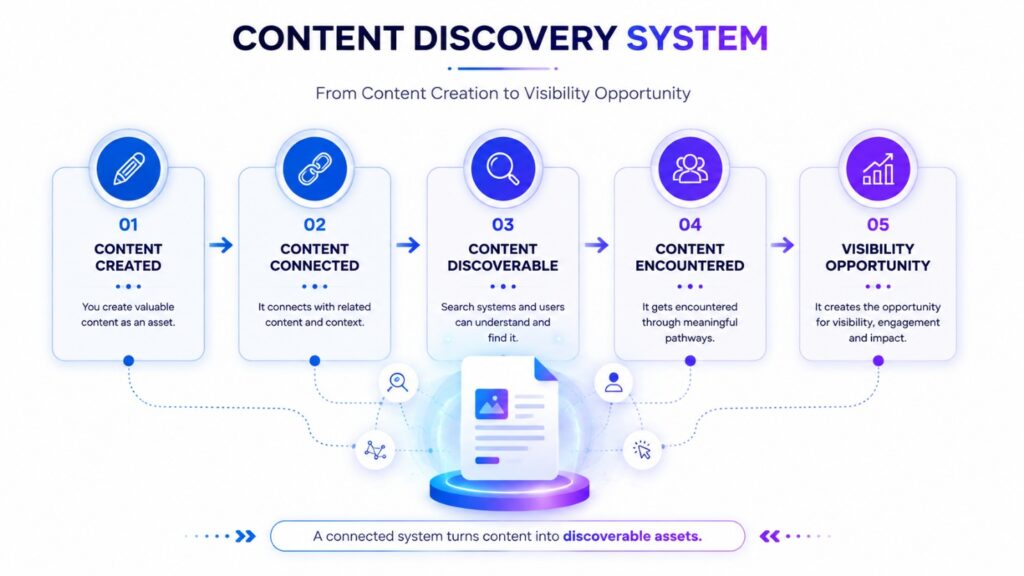
content discovery :
Publishing content consistently can feel like progress.
You research topics, create articles, publish them, and continue building your website. Over time, however, you may notice a frustrating pattern: the content exists, but some of it remains difficult to find.
This is where an important distinction becomes clear:
Publishing content is not the same as making content discoverable.
A published page is an asset, but publication alone does not create meaningful pathways through which search systems and audiences can encounter that asset. Content can remain isolated, weakly connected, or difficult to reach even when considerable effort has gone into creating it.
This broader visibility problem is also explored in Why My Blog Gets No Traffic: 5 Powerful Visibility System Fixes, but discovery deserves its own closer examination because a content asset must first have meaningful opportunities to be encountered before stronger visibility can develop.
The important shift is therefore not simply:
“How can I publish more content?”
but:
“Does the content I already have have a meaningful path to discovery?”
That question changes how you look at your content library. Instead of assuming that more publishing will solve a visibility problem, you begin examining how content is connected, how supporting relationships are formed, and whether important pages have clear pathways through the wider website.
This article explores that discovery problem from a system perspective. You will learn why publishing regularly does not automatically lead to discovery, what meaningful discovery pathways look like, why content relationships matter, and why existing content should be reviewed before simply producing more.
The goal is not to promise rankings or traffic. It is to understand the difference between content that exists and content that has a meaningful opportunity to be discovered.
Before creating another article, the first step may simply be understanding whether the content you already created has somewhere meaningful to be found.
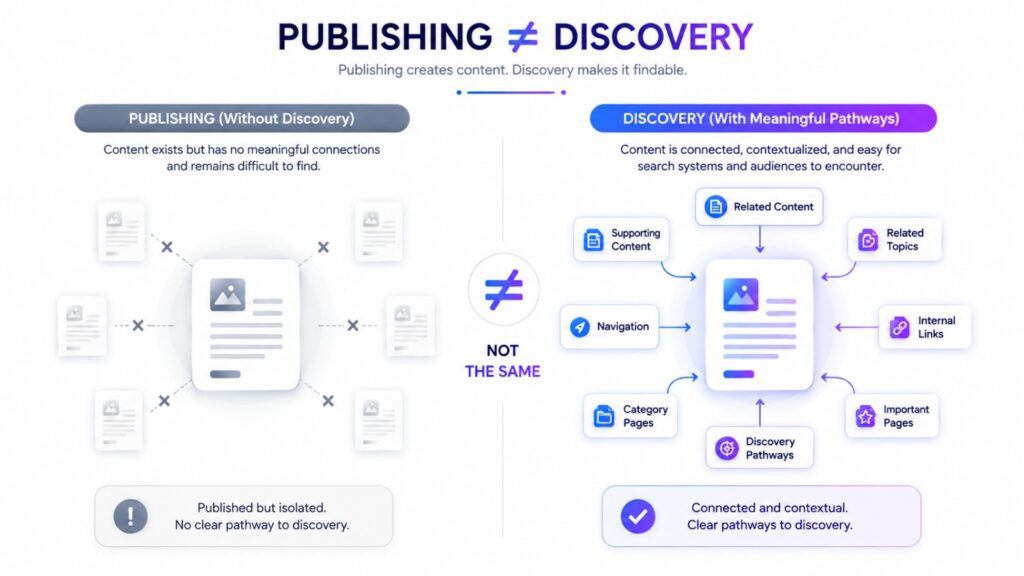
Table of Contents
What Content Discovery Actually Means
Discovery Is Not the Same as Ranking
Content discovery and search rankings are related, but they are not the same thing.
Discovery is about whether a content asset has meaningful opportunities to be encountered and understood within the search and website environment. Ranking is a later visibility outcome that depends on how a page performs against a particular search need and competitive context.
This distinction matters because a page can have a weak discovery path without the underlying problem being simply “low rankings.” If content is poorly connected, difficult to reach, or surrounded by limited contextual relationships, the first question should be whether the content has a meaningful opportunity to be encountered at all.
Discovery Is Not the Same as Traffic
Discovery should also be separated from traffic.
Traffic represents visits that actually reach a page. Discovery happens earlier in the journey: it creates an opportunity for a content asset to be encountered by search systems, website visitors, or people moving through related content.
A page may therefore exist within a website without generating meaningful traffic, while still having different possible discovery pathways available to it. Understanding those pathways helps separate the question of “Can this content be found?” from the later question of “How much traffic does it receive?”
How Search Systems and Audiences Encounter Content
Content can be encountered through more than one pathway.
Search systems may encounter a page through the broader structure and relationships of a website, while audiences may reach it through search results, internal links, navigation, related articles, categories, or other contextual pathways.
The important principle is not to treat every pathway as a separate tactic. Instead, look at whether the content has meaningful connections that make it easier to encounter within the wider digital environment.
Why a Published Page Can Still Have Weak Discoverability
Publishing gives a content asset a place on the website, but publication alone does not guarantee that the asset has a strong path to discovery.
A page can remain difficult to encounter when it exists in isolation, has limited relationships with relevant content, receives little contextual support, or does not have a clear place within the website’s broader subject direction.
This is why simply checking whether a page has been published is not enough. The more useful question is whether the page is meaningfully connected to the environment around it.
The Basic Discovery Path
A simple way to understand content discovery is:
Content Exists → Content Is Connected → Content Can Be Encountered → Visibility Opportunity
Each stage represents a different part of the journey.
First, the content must exist as a meaningful asset. Then it needs relevant relationships and pathways that connect it with the surrounding content environment. Those connections create opportunities for the content to be encountered. Only then does it make sense to consider the broader visibility opportunities that may develop from those encounters.
This does not mean that every connected page will rank or generate traffic. It means that meaningful discovery pathways create a stronger foundation for content to be encountered and understood.
That distinction is important because the goal of content discovery is not to promise rankings or traffic. The goal is to understand whether important content has a meaningful opportunity to be found within a connected content system.
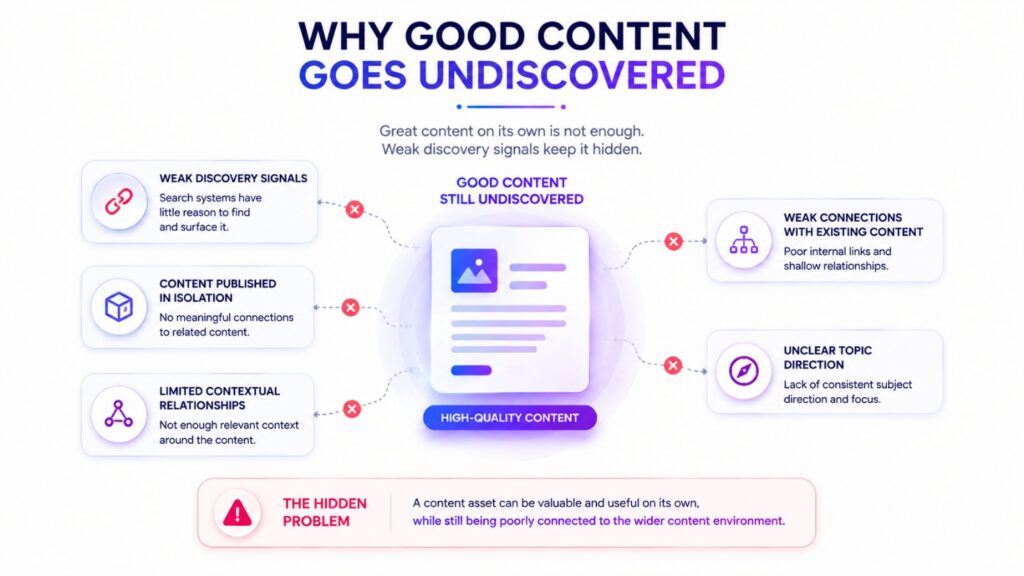
Why Good Content Can Still Go Undiscovered
Weak Discovery Signals
Good content does not automatically become easy to discover simply because it is well written or provides useful information.
Discovery depends partly on the meaningful signals and relationships surrounding the content. When those signals are limited, a valuable page may have fewer opportunities to be encountered within the wider content environment.
Content Published in Isolation
One common problem occurs when an article is published as an isolated asset.
The page may contain useful information, but if it has few meaningful relationships with other relevant pages, it becomes harder to understand where it belongs within the broader website context.
Publishing another isolated article does not necessarily solve this problem. The issue may be the lack of connection around the content that already exists.
Limited Contextual Relationships
Content becomes easier to understand within a wider environment when related pages provide meaningful context.
Without those relationships, an important article may have limited connections to supporting topics, related questions, or other relevant resources. This can leave the content standing alone instead of functioning as part of a connected content environment.
Weak Connections With Existing Content
A website can contain many useful articles while still having weak relationships between them.
When related content is not meaningfully connected, the value of one page may remain separated from the context provided by other pages. This is particularly important for older content that may have been published before the surrounding content library developed.
The goal is not to create as many connections as possible. The goal is to create meaningful relationships between relevant content assets.
Unclear Topic Direction
Discovery can also become difficult when content is published around disconnected subjects without a clear direction.
A website may publish consistently while moving between unrelated topics, leaving individual pages with limited relationships to the rest of the content library. In that situation, the problem is not necessarily the quality of each individual article. The wider content environment may simply provide insufficient context.
This creates an important distinction: a content asset can be useful on its own while still being poorly connected to the wider content environment.
Understanding that distinction helps shift the focus away from simply creating more content and toward examining whether existing content has meaningful relationships and pathways around it.
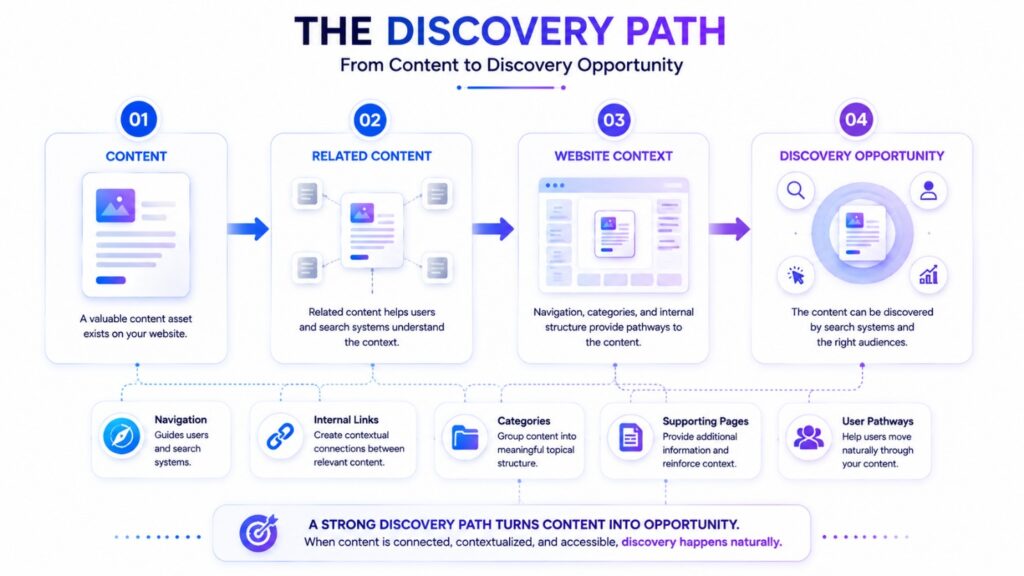
Does Your Content Have a Clear Discovery Path?
Search Discovery
Search is one of the ways people may encounter your content, but search discovery should not be reduced to the question of whether a page is already receiving rankings.
The more useful question is whether the content has a meaningful relationship with the subject it addresses and whether it exists within a website environment that provides relevant context.
This helps distinguish between simply having a published page and having content that is positioned within a broader path through which it can be encountered.
Google explains that Search begins with crawling, where automated crawlers discover pages and URLs across the web, and links from known pages can provide pathways for discovering new pages. You can explore Google Search Central’s guide to how Google Search works for a deeper explanation of how crawling, indexing, and serving search results fit together.
Internal Website Discovery
People can also discover content while moving through the website itself.
Navigation, contextual links, related articles, categories, and other relevant pathways can help visitors move from one useful resource to another. These connections give existing content more opportunities to be encountered without relying entirely on a single discovery source.
Supporting-Content Relationships
Important content often becomes easier to understand when related supporting content surrounds it.
A supporting article can provide context for another article, answer a related question, or create a natural pathway toward a more important resource. The purpose is not simply to connect pages together, but to establish relationships that make sense from the perspective of the content and the person encountering it.
Navigation and Context
Discovery is also influenced by how content fits into the wider structure of a website.
When important pages have clear contextual relationships with relevant sections, supporting resources, and other useful content, visitors have more natural ways to move through the website.
The same principle applies to search systems: meaningful relationships help place individual content assets within a broader context rather than leaving each page to exist independently.
Different Paths Can Lead to the Same Content Asset
An important content asset does not need to depend on one single discovery route.
It may be encountered through search, reached from another relevant article, found through navigation, surfaced through related content, or accessed through another meaningful website pathway.
A simple way to visualize this is:
Content → Related Content → Website Context → Discovery Opportunity
The stronger the meaningful relationships around an important asset, the more clearly that asset can exist within the wider content environment.
Before assuming that content needs to be rewritten, replaced, or published again, it is worth asking whether the content already has a clear path through which it can be discovered.
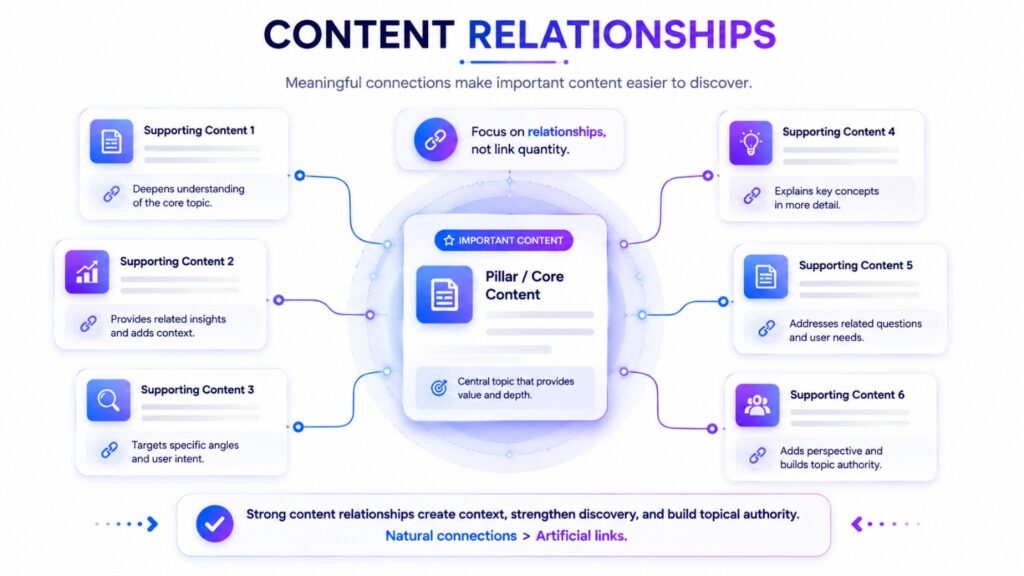
Strengthen the Connections Around Important Content
Connect Related Content Naturally
Important content becomes easier to discover when it is connected naturally with other relevant content across the website.
A related article can introduce a topic, answer a supporting question, provide additional context, or guide the reader toward a more important resource. These connections create meaningful pathways instead of leaving individual pages to function as isolated assets.
Build Meaningful Internal Relationships
Internal relationships should be based on genuine relevance.
When one page naturally helps the reader understand another page, an internal link can create a useful connection between the two. The purpose is not simply to move visitors from one URL to another, but to make the wider content environment easier to navigate and understand.
For a deeper look at the structural side of this issue, see Why Your Internal Linking Is Not Helping Your SEO (And What Your Structure Is Missing).
Avoid Isolated Pages
Content that exists without meaningful connections can become difficult to discover within the wider website.
This does not mean every page needs to be connected to many other pages. It means important content should have relevant pathways that place it within the context of the subjects and resources around it.
When an important page is isolated, the better question is not “How many links should I add?” but “Which existing content genuinely belongs in a relationship with this page?”
Avoid Artificial Link Volume
Adding links simply to increase the number of internal connections can create clutter without improving the underlying content relationships.
Excessive or irrelevant linking can make pages harder to read and can weaken the clarity of the relationships that actually matter. Discovery should therefore be approached through relevance and context rather than artificial link volume.
Think Relationships, Not Link Quantity
The strongest discovery pathways are based on meaningful relationships between content assets.
A useful relationship exists when the connected pages help explain, support, extend, or naturally continue the subject being discussed. This creates a clearer path for both people and the wider content environment.
The principle can be summarized simply:
Relevant Content → Meaningful Relationship → Clearer Context → Stronger Discovery Path
The objective is therefore not to maximize internal links. It is to make important content meaningfully connected to the content that surrounds it.
Build Content Around Discoverable Topic Relationships
Connect Related Topics
Content becomes easier to place within a wider discovery environment when related topics are connected through meaningful relationships.
Instead of treating every article as a separate publishing task, consider how one topic relates to the questions, subjects, and supporting ideas covered elsewhere on the website.
This creates a broader context around individual content assets without requiring every page to cover everything about a subject.
Develop Supporting Content
Supporting content can give important pages additional context and create natural pathways between related subjects.
A supporting article might explain a narrower question, explore a related problem, or provide information that naturally helps the reader continue their journey. These relationships can make the overall content environment more connected.
The purpose is not to create supporting content simply for the sake of producing more pages. Each supporting piece should have a meaningful reason to exist within the wider subject context.
Maintain Consistent Subject Direction
A connected content environment also benefits from a clear subject direction.
When content repeatedly moves between unrelated topics, individual pages may have fewer meaningful relationships with the rest of the website. Consistent subject direction helps create a clearer environment in which related content can support and contextualize one another.
This does not mean every article must discuss the same narrow subject. It means the content library should develop meaningful relationships around the areas that matter to the website and its audience.
Avoid Random Publishing
Publishing consistently is valuable only when the content being created contributes meaningfully to the wider content environment.
Randomly adding articles because a topic appears interesting or because more publishing feels productive can create a growing library without creating stronger relationships between its parts.
A better approach is to consider how each new content asset relates to existing content and whether it contributes useful context to an important subject area.
Help Content Exist Within a Wider Context
Discovery becomes stronger when content is connected through meaningful topic relationships rather than published as isolated assets.
The objective is not to build an artificial network of pages. It is to create a content environment where related information naturally supports other relevant information.
In simple terms:
Related Topics → Supporting Content → Meaningful Relationships → Wider Context → Discovery Opportunity
This shift changes content publishing from a collection of individual articles into a more connected body of useful information.
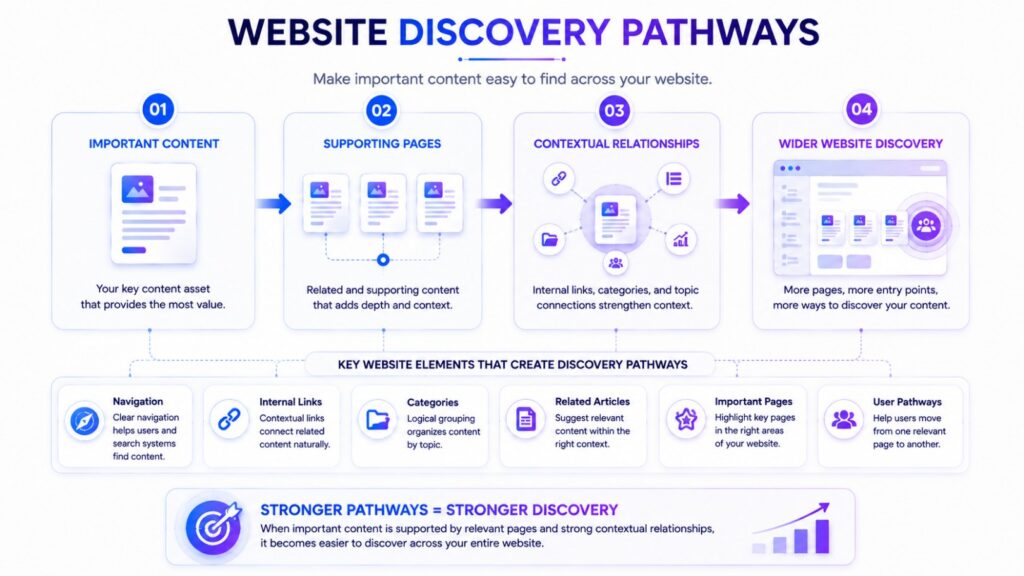
Make Important Content Easier to Discover Across the Website
Use Clear Website Navigation
Important content should have a logical place within the website rather than existing as a disconnected destination.
Navigation can help visitors understand where important resources belong and provide another natural pathway through which those resources can be encountered.
The objective is not to make every page equally prominent. It is to make important content accessible through a structure that makes sense for the website and its audience.
Create Useful Contextual Links
Contextual links can connect one piece of content with another when the relationship is genuinely useful.
A link placed within relevant content can help a visitor move from one question or subject to another without forcing an unrelated path. This creates a more natural journey through the website.
The value comes from the relationship between the pages, not simply from adding another internal link.
Connect Related Articles
Related articles can provide additional discovery pathways for both newer and existing content.
When articles address closely related questions or different aspects of the same broader subject, connecting them can help visitors discover information they may otherwise overlook.
This is particularly useful for older content that may have become less visible as the website’s content library has grown.
Give Important Pages a Clear Place
Some content deserves stronger contextual visibility because it provides important information, supports other content, or represents a significant subject area for the website.
These pages should not be hidden within an unstructured collection of articles. They need meaningful relationships with relevant supporting content and appropriate website pathways.
This does not mean giving every important page the same treatment. It means understanding which content matters and ensuring that its place within the wider website is clear.
Think in Terms of Content Pathways
A useful way to think about website discovery is to look at the path surrounding an important content asset.
Important Content → Supporting Pages → Contextual Relationships → Wider Website Discovery
Navigation, internal links, categories, related articles, and other relevant pathways can all contribute to this broader environment.
The goal is not to create a complicated structure. The goal is to make meaningful content easier to encounter through clear and relevant pathways across the website.
Review Why Existing Content May Be Overlooked
Newly Published Content vs. Older Content
Not every content asset has the same discovery history.
Newly published content may still be developing its relationships within the website, while older content may have become overlooked as the content library expanded around it.
Looking at both groups can help reveal whether the issue is limited to new publishing or whether existing content has also lost meaningful discovery pathways over time.
Identify Pages With Little Visibility
Some pages may receive limited visibility even though they contain useful information.
This does not automatically mean the content needs to be rewritten or replaced. Limited visibility can have different causes, and changing the content before understanding the underlying situation may simply move the problem from one place to another.
Look for Weak Internal Connections
One area worth examining is how the page connects with the rest of the website.
A page with few meaningful relationships to relevant content may have a weaker discovery path than an important page that is naturally supported by related resources.
The question is not how many links the page has. The question is whether the connections that do exist make sense and provide useful context.
Examine Limited Discovery Signals
When a page is repeatedly overlooked, consider whether it has meaningful signals that help place it within the wider content environment.
These signals can include relevant content relationships, contextual pathways, website structure, and other factors that influence how the content can be encountered.
The purpose of this review is not to assume a single cause. It is to identify where the discovery pathway may be weak before deciding what should change.
Do Not Change Everything Without Evidence
When content underperforms, the instinct may be to rewrite the article, publish another version, or make several changes at once.
That approach can make it difficult to understand what was actually wrong.
A better starting point is to examine the existing content and its surrounding relationships first. Before rewriting or replacing an underperforming page, understand whether the page has a meaningful path to discovery and where that path may be limited.
This diagnostic perspective helps separate “the content needs to change” from “the content needs a better discovery environment.”
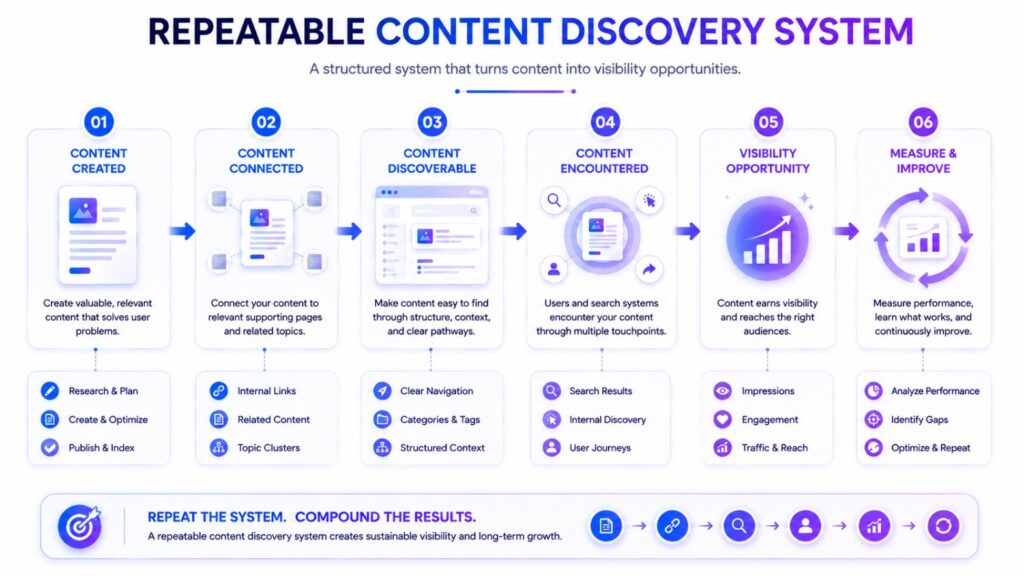
Build a Repeatable Content Discovery System
Move From Individual Pages to a Connected Process
Content discovery should not be treated as something that happens only after an article is published.
A stronger approach is to consider discovery as part of the wider content process, where newly created content is connected with relevant existing content and given meaningful context within the website.
Create Meaningful Connections
Every new content asset can be considered in relation to the content that already exists.
The objective is not to connect everything to everything else. It is to identify relationships that genuinely help place the new content within a relevant subject environment.
Make Content Easier to Encounter
Once meaningful relationships exist, content has more natural pathways through which it can be encountered.
These pathways can exist through related content, contextual links, navigation, and other relevant parts of the website. The emphasis remains on meaningful context rather than artificial visibility tactics.
Observe Visibility Opportunities
Discovery creates an opportunity for content to be encountered, but it does not guarantee rankings or traffic.
That distinction should remain clear. The purpose of a discovery system is to create and maintain meaningful pathways while allowing actual performance and visibility to be observed over time.
Use Observation to Guide Improvement
What you observe can help determine where further attention may be useful.
If important content remains difficult to discover, the next step is not automatically to publish more. The surrounding relationships, pathways, and contextual environment can be reviewed to understand
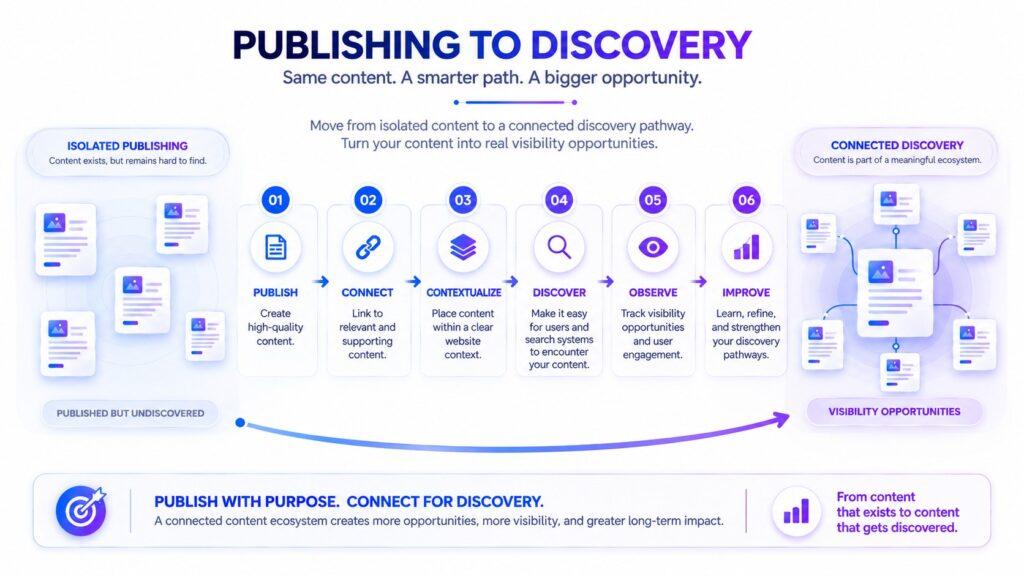
From Publishing Content to Building a Discovery System
Publishing Creates Content
Publishing is where the process begins.
Creating useful content gives a website a new asset that can answer questions, address problems, or provide information to its audience. But the act of publishing alone does not determine how easily that asset can be encountered.
Connection Creates Context
Once content exists, meaningful connections can place it within a wider environment.
Related articles, supporting resources, contextual links, and relevant website pathways can help show how one content asset relates to another.
Context Creates Discovery Pathways
When content has meaningful context around it, there are more natural ways for people to move toward that content.
The objective is not to create artificial pathways. It is to make relevant information easier to encounter through relationships that genuinely make sense.
Discovery Creates Visibility Opportunity
When content can be encountered through meaningful pathways, it has an opportunity to become part of a wider visibility process.
This opportunity should not be confused with a guarantee of rankings or traffic. Discovery is an important part of the journey, but actual visibility depends on many factors beyond simply publishing or connecting content.
Observation Creates Learning
A discovery system should also allow you to observe what happens after content is created and connected.
What remains overlooked, what becomes easier to encounter, and where meaningful pathways appear limited can provide useful information for future improvement.
Learning Guides Improvement
The final step is to use what you learn to improve the content environment rather than simply increasing publishing volume.
The strategic shift can therefore be summarized as:
Publish → Connect → Contextualize → Discover → Observe → Improve
This approach changes the role of content from a collection of individually published pages into a connected system where important information has meaningful opportunities to be encountered.
The goal is not simply to publish more content. It is to make important content easier to discover within a connected digital content system.
Conclusion — Content Must Be Discoverable, Not Merely Published
Publishing Creates the Asset, but Discovery Creates the Opportunity
Publishing content is an important starting point, but a published page is not automatically a discoverable page.
For content to have meaningful opportunities to be encountered, it needs relevant relationships, useful context, and clear pathways through the wider content environment.
Look Beyond Publishing Volume
When existing content is not being discovered, creating more content may not address the underlying problem.
Before increasing publishing volume, examine whether important content is isolated, weakly connected, difficult to reach, or missing meaningful relationships with relevant resources.
Build Discovery Into the Content System
A stronger approach is to treat discovery as part of the content system itself:
Content → Connection → Context → Discovery → Visibility Opportunity → Improvement
This does not guarantee rankings or traffic. Instead, it creates a more structured way to understand whether important content has meaningful opportunities to be encountered and how the wider content environment can be improved over time.
The goal is not simply to publish more content. The goal is to make important content easier to discover within a connected digital content system.
Content Discovery Diagnostic Toolkit
Understand Why Your Content May Be Going Undiscovered
Publishing regularly does not always mean that important content has a clear path to discovery.
If you want to move beyond general assumptions and understand where your content discovery environment may be weak, the Content Discovery Diagnostic Toolkit provides a structured diagnostic layer for examining the problem.
From Content Problem to Diagnostic Clarity
The toolkit is designed to help you investigate the discovery side of your content system, including the relationships, pathways, and signals that may influence how existing content can be encountered.
The purpose is not to promise rankings or traffic. It is to help you understand why content may be difficult to discover and which areas deserve closer attention.
A Focused Diagnostic Step Before Building More
Before simply producing more content, a clearer diagnostic view can help determine whether the opportunity lies in strengthening the discovery environment around content that already exists.
The Content Discovery Diagnostic Toolkit provides that focused diagnostic next step, while the future Content Discovery System can extend this into a broader system for building and managing content discovery across the website.
FAQs
What does content discovery mean?
Content discovery means the meaningful opportunities through which a content asset can be encountered by search systems and audiences. It goes beyond simply publishing a page and considers whether the content has relevant connections, context, and pathways through the wider website.
Why is my content not getting discovered?
Content may remain difficult to discover when it is isolated, weakly connected to relevant content, has limited contextual relationships, or does not have clear pathways through the wider website. The underlying issue should be understood before assuming that more publishing will solve it.
Does publishing more content improve discovery?
Publishing more content does not automatically improve discovery. New content can help when it contributes meaningful information and relationships, but simply increasing publishing volume may not solve a discovery problem affecting content that already exists.
What is the difference between content discovery and rankings?
Content discovery concerns whether a content asset has meaningful opportunities to be encountered and understood. Rankings are a separate visibility outcome associated with specific search queries. A page can therefore have a weak discovery path without the problem being reduced to rankings alone.
How do internal links help content discovery?
Relevant internal links can create meaningful pathways between related content. They can help visitors move through the website and provide additional context around important pages. The value comes from genuine relevance and useful relationships, not from increasing link quantity.
Can good content remain undiscovered?
Yes. Useful, well-written content can still have limited discoverability when it exists in isolation, has weak connections with relevant content, or lacks meaningful pathways through the wider website. Content quality and content discoverability are related but separate considerations.
How can I check whether my content has a clear discovery path?
Start by examining how the content connects with related articles, supporting resources, navigation, contextual links, and other relevant website pathways. The goal is to understand whether the page has meaningful opportunities to be encountered rather than simply checking whether it has been published.
Should I create more content when existing content is not getting discovered?
Not necessarily. Before creating more content, review whether existing important pages have meaningful relationships and clear discovery pathways. If the underlying issue is weak connection or context, publishing additional isolated content may not address the problem.
Recommended Reading
If you want to understand what may be happening beyond content discovery, these articles provide the next steps in the broader visibility journey:
-
Why My Blog Gets No Traffic: 5 Powerful Visibility System Fixes
Understand the broader visibility problems that can prevent a blog from generating meaningful results. -
Why Your Content Is Not Working
Explore how content direction and disconnected publishing can affect the results your content is intended to produce. -
Why Your Website Is Not Growing (And the Complete SEO Growth System Most Websites Never Build)
Move from individual content and visibility problems toward understanding the complete system behind sustainable website growth.