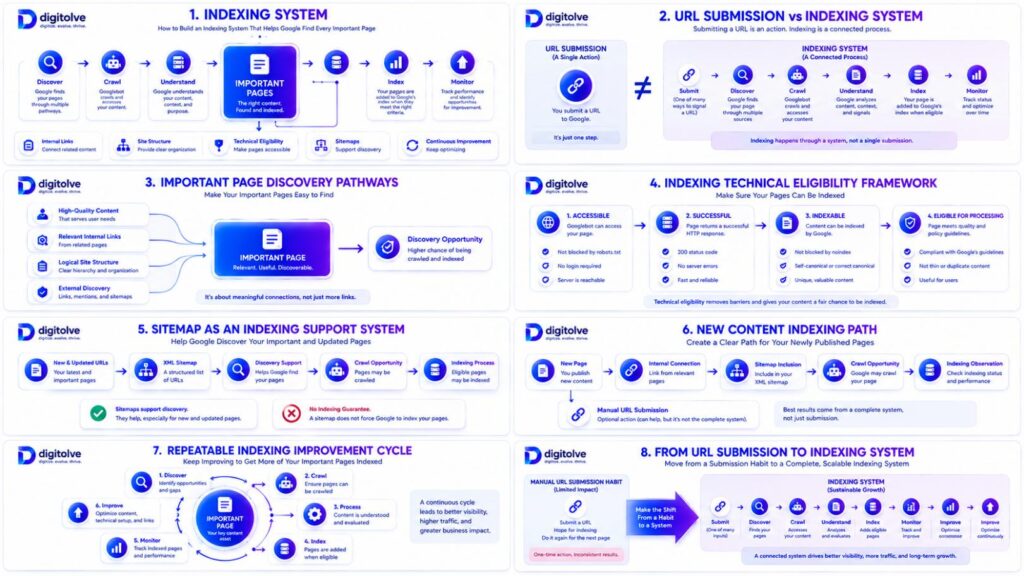
Why Some Important Pages Remain Unindexed
Publishing an important page is only the beginning of its journey through Google Search.
You may create a useful page, submit its URL, include it in your sitemap, and still find that the page does not appear in Google’s indexed pages as expected. This can be frustrating because the visible action has already been completed, yet the wider indexing process may still have several stages to pass through.
The important distinction is this:
Submitting a URL does not mean that the URL has been successfully discovered, crawled, processed, and indexed.
URL Submission vs. Sustainable Discovery
Manual URL submission can be useful when you want to draw attention to a specific page, but it should not become the foundation of your entire indexing approach.
A sustainable indexing system begins with making important content discoverable through meaningful website pathways, while also ensuring that search engines can access and process those pages properly.
This changes the question from “Did I submit the URL?” to “Does this important page have a clear path through the indexing process?”
Crawling, Indexing, and Ranking Are Different Processes
Indexing also becomes easier to understand when crawling, indexing, and ranking are treated as separate processes.
Crawling concerns Google’s ability to access and retrieve a page. Indexing concerns whether Google processes and stores information about that page for potential use in Search. Ranking happens later, when Google’s systems determine which indexed content may be relevant to a particular search.
These stages are connected, but one does not automatically guarantee the next.
Why Indexing Should Be Treated as a System
Important pages should not depend entirely on repeated manual submission.
A stronger approach connects discovery, crawlability, technical eligibility, indexing, and monitoring into a repeatable process. This creates a clearer environment around the pages that matter instead of treating every indexing problem as an isolated URL-level event.
The Strategic Shift
The shift can be summarized as:
Submit → Discover → Crawl → Understand → Index → Monitor
Submission can be one action within this process, but the larger goal is to build an environment where important pages are discoverable, technically accessible, eligible for processing, and continuously monitored.
This article explains how to build that indexing system without turning the process into a collection of disconnected technical fixes. The goal is to understand the architecture behind reliable indexing and create a repeatable direction for managing important pages.
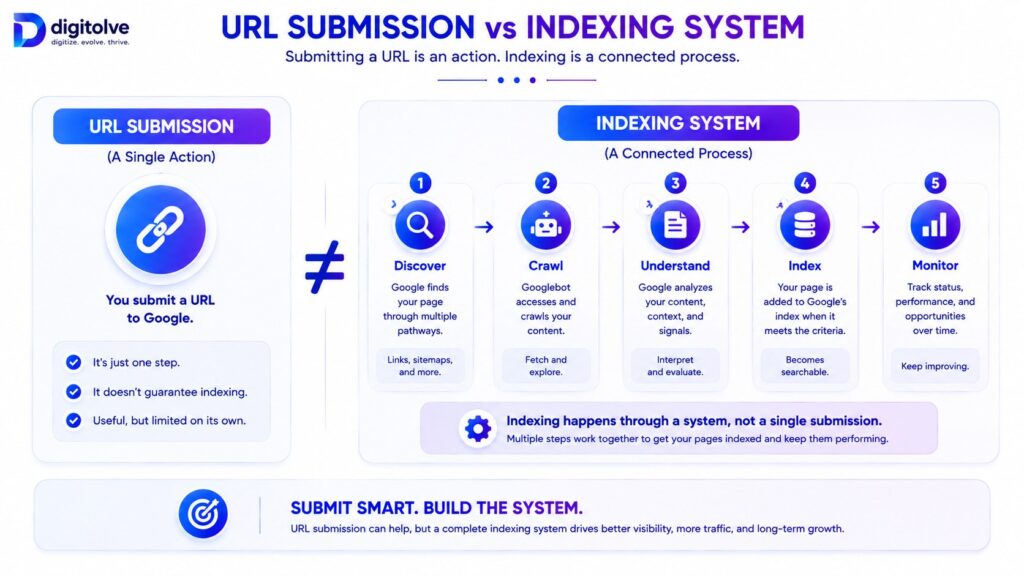
Table of Contents
What an Indexing System Actually Means
Discovery vs. Crawling vs. Indexing
These three stages are closely connected, but they describe different parts of how a page can move through Google’s search process.
Discovery is the point at which Google becomes aware of a URL. Crawling is the process of accessing and retrieving the page. Indexing involves processing the information Google finds and determining whether the page can be included in its search index.
Understanding these differences matters because a problem at one stage does not automatically mean the same problem exists at another.
Why Indexing Is Not Guaranteed
Getting a page discovered or crawled does not guarantee that it will ultimately be indexed.
Indexing depends on Google’s systems evaluating the page and the information available about it. This is why submitting a URL or placing it in a sitemap should be understood as part of the broader process rather than as a command that guarantees indexing.
The practical objective is therefore not to force every URL into the index, but to create a strong environment around the pages that are genuinely important.
How Important Pages Enter Google’s Indexing Process
An important page needs a meaningful path into the search process.
That path can begin when Google discovers the URL through relevant website connections or other available discovery mechanisms. Google can then attempt to crawl the page, process its content and signals, and determine whether the page should be included in its index.
This makes website structure, accessibility, and technical eligibility important supporting layers of the indexing system.
Published vs. Discoverable vs. Crawlable vs. Indexable
These terms should not be treated as interchangeable.
A page can be published because it exists on the website, while still having limited discovery pathways. A page can be discoverable while encountering problems during crawling. A page can be crawlable but still have issues that affect its eligibility for indexing.
The progression can therefore be understood as:
Published → Discoverable → Crawlable → Indexable → Potentially Indexed
Each stage represents a different condition that contributes to the wider indexing process.
The Basic Indexing Flow
A simple indexing model is:
Important Page → Discover → Crawl → Understand → Index → Monitor
This model does not mean that every page will necessarily reach the index. Instead, it provides a system-level way to understand the journey an important page needs to move through.
Publishing a URL does not automatically create a path for Google to discover, crawl, process, and potentially index it.
That is why an effective indexing approach needs to look beyond URL submission and consider the complete environment surrounding important pages.
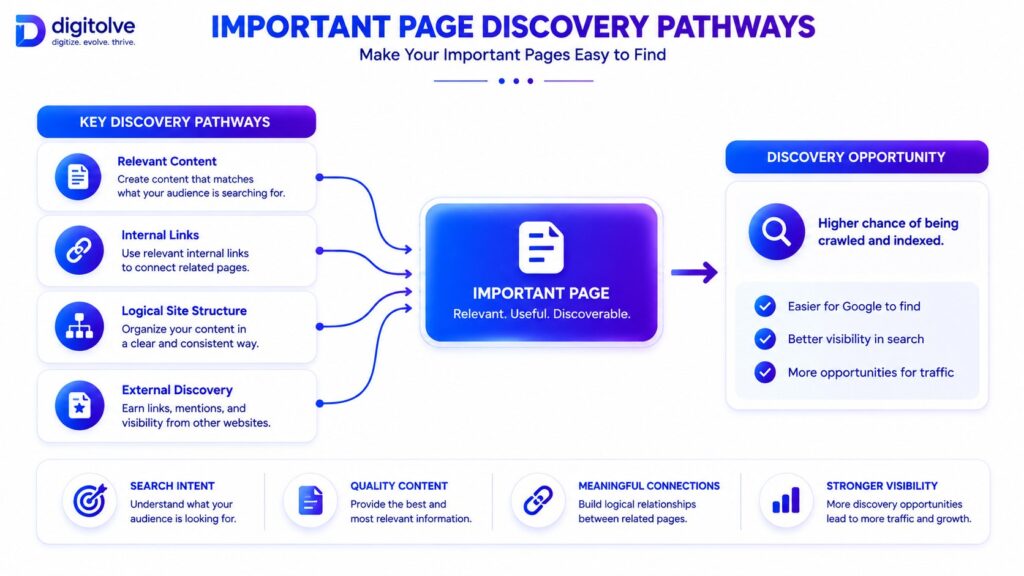
Make Every Important Page Discoverable
Build Clear Internal Pathways
An important page should not depend entirely on someone manually submitting its URL.
Clear internal pathways give important content meaningful connections with the rest of the website. When related pages naturally point toward one another, new and existing content can become easier to encounter within the wider site structure.
Connect New Pages With Relevant Existing Content
When a new page is published, consider where it belongs within the content that already exists.
Relevant existing articles can provide natural pathways toward the new page, while the new page can also strengthen the context of related content where appropriate. This creates a connected environment rather than a collection of individually published URLs.
Avoid Isolated Important Pages
An important page that has few meaningful connections with the rest of the website may have a weaker discovery path.
Isolation does not necessarily mean that a page can never be discovered. It means the website is providing fewer natural pathways through which that important page can be encountered.
The goal is therefore not to add links simply to increase link volume. It is to ensure that important pages have relevant relationships within the content structure.
Use a Logical Site Structure
A logical site structure helps organize important content into meaningful relationships.
Navigation, categories, contextual links, and related content can all contribute to a clearer structure when they genuinely reflect how the site’s information is organized.
This becomes particularly important as a website grows. Without meaningful structure, new pages can gradually become disconnected from the content that should provide context around them.
Support Discovery Beyond Manual URL Submission
Manual submission can be one action within an indexing process, but it should not replace a well-connected website structure.
A stronger system combines meaningful internal relationships with appropriate technical accessibility and other discovery support mechanisms. This gives important pages a more sustainable path toward being encountered rather than relying on repeated manual intervention.
For a deeper look at the structural layer behind internal discovery, see Why Your Internal Linking Is Not Helping Your SEO (And What Your Structure Is Missing).
Build a Crawlable Website Structure
Use Crawlable URLs
Discovery and crawlability are connected, but they are not the same thing.
Google first needs a meaningful way to encounter a URL, but once the URL is known, the page must also be accessible to Google’s crawlers. A crawlable website therefore starts with URLs that can be reached and retrieved without unnecessary barriers.
Use Standard HTML Links
Links provide important pathways between pages within a website.
Using standard, crawlable HTML links helps create clear relationships between relevant pages and gives important content additional pathways through which it can be discovered and accessed.
The purpose is not to connect every page with every other page. Links should reflect genuine relationships within the site’s content structure.
Build Navigation and Contextual Pathways
A crawlable structure should work at more than one level.
Website navigation can establish broader pathways between important areas, while contextual links can connect individual pages where the relationship is directly useful. Together, these structures can make important content easier to reach within the website.
This is why crawlability should be considered as part of the site’s overall information structure rather than as an isolated technical setting.
Avoid Blocking Important Content
Even when a page has been discovered, unnecessary technical restrictions can prevent Google from accessing it properly.
Important content should therefore be reviewed to ensure that the website is not unintentionally creating barriers that prevent search crawlers from reaching the pages that matter.
The objective is not to make every URL equally accessible. It is to ensure that the pages the website considers important are not unnecessarily blocked.
Make Important Pages Reachable Through the Site Structure
A useful indexing system connects discovery with accessibility.
If an important page can be discovered but cannot be successfully accessed, the indexing process cannot move forward as intended. This creates the key distinction:
Discovery gets Google to the URL; crawlability determines whether Google can successfully access the page.
Building a crawlable structure therefore means creating clear, meaningful pathways to important content while avoiding unnecessary barriers that interfere with access.
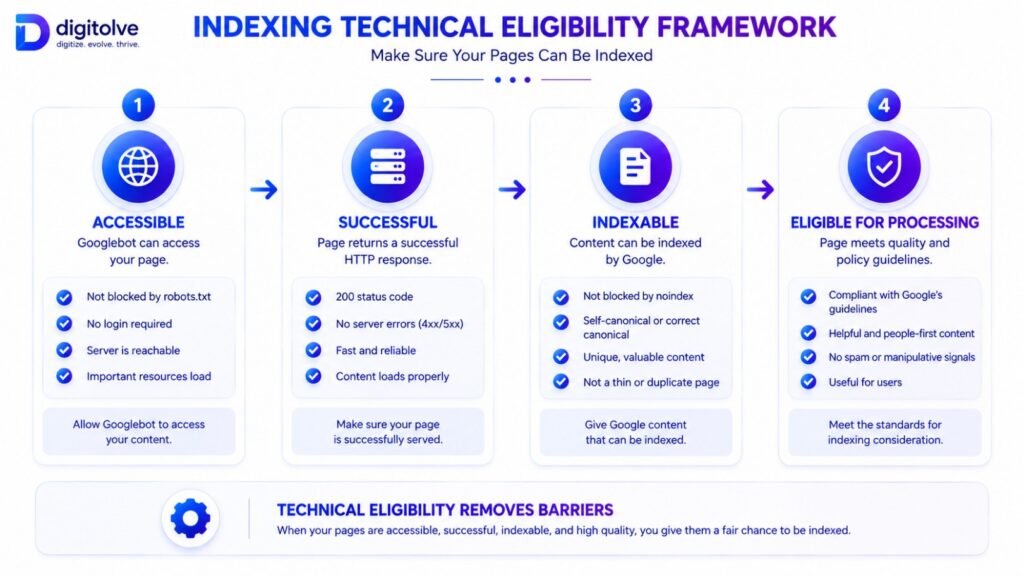
Make Pages Technically Eligible for Indexing
Googlebot Access
Before a page can move through the indexing process, Google needs to be able to access it.
Important pages should therefore not be unintentionally blocked from Google’s crawlers. Technical accessibility provides the foundation on which the rest of the indexing process can operate.
Successful HTTP Response
Accessibility alone is not enough. When Google attempts to retrieve an important page, the page also needs to respond successfully.
A page that cannot be successfully retrieved creates a barrier between discovery and further processing. This is why a reliable indexing system considers successful page access as an essential part of technical eligibility.
Indexable Content
A page also needs meaningful content that can be processed for indexing.
Being accessible and returning a successful response does not automatically mean that a page will be included in Google’s index. The content itself and the signals surrounding the page still matter to the broader indexing process.
Robots.txt vs. Noindex
Robots.txt and the noindex directive serve different purposes and should not be treated as interchangeable controls.
Robots.txt can affect whether crawlers are allowed to access particular URLs, while noindex is a directive used to indicate that a page should not be included in the search index.
Understanding this distinction helps prevent situations where a page is unintentionally restricted at the wrong stage of the indexing process.
Canonical Signals
Canonical signals help search engines understand which URL should be treated as the preferred version when similar or duplicate pages exist.
This becomes important when multiple URLs represent substantially similar content. A cleaner URL environment can make the indexing system easier to manage because important pages are less likely to compete with unnecessary duplicates or alternative versions.
Why Technical Eligibility Comes Before Indexing
Technical eligibility creates the foundation for a page to move through the indexing process.
The basic framework is:
Accessible → Successful → Indexable → Eligible for Processing
This framework should not be confused with a guarantee of indexing. It simply establishes the essential conditions that allow an important page to move forward through the wider process.
The goal is therefore to create a technically sound environment around important pages before expecting indexing to occur.
Use Sitemaps as an Indexing Support System
What Sitemaps Actually Do
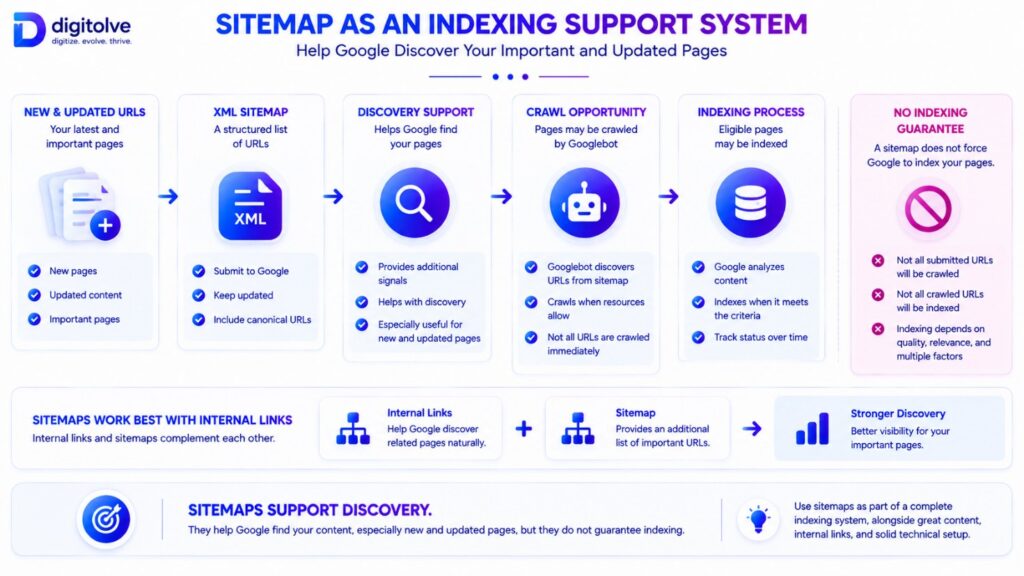
A sitemap provides search engines with a structured list of URLs that you consider important on your website. It can support the discovery of new or updated pages, especially when those URLs may not yet have strong internal pathways.
However, a sitemap should be understood as a discovery support system, not as a direct instruction that guarantees a page will be crawled or indexed. Google still evaluates whether a URL can be accessed, processed, and considered for indexing.
For a deeper explanation of how sitemaps support crawling and discovery, see Google Search Central’s guide to sitemaps.
New and Updated URLs
Sitemaps are particularly useful for communicating which URLs have been added or meaningfully updated. Keeping important URLs represented in an up-to-date sitemap gives search engines another structured pathway for discovering changes across the website.
This becomes more valuable as a website grows. Instead of relying entirely on manual URL submission whenever a new page is published, the sitemap can become part of the normal publishing and discovery process.
Sitemap vs. Internal Links
A sitemap and internal linking support discovery in different ways. A sitemap provides a structured list of URLs, while internal links create relationships and pathways between pages within the website.
For important content, these systems work better together than separately. Internal links provide contextual pathways through the site structure, while the sitemap provides an additional structured signal about the URLs that exist.
This means a sitemap should not be used as a replacement for a well-connected website. Important pages should still have meaningful relationships with relevant content and be reachable through the site’s structure.
Keep Sitemap URLs Clean and Useful
An effective sitemap should focus on URLs that are meaningful parts of the website’s search presence. Including unnecessary, duplicate, inaccessible, or otherwise unsuitable URLs can make the sitemap less useful as a representation of the site’s important content.
The goal is not to place every possible URL into a sitemap. The goal is to maintain a clean and useful set of URLs that supports the wider indexing process.
Why Submitting a Sitemap Does Not Guarantee Indexing
Submitting a sitemap creates a discovery opportunity, but it does not guarantee that Google will crawl every listed URL or include every page in its index.
A page can still encounter problems with accessibility, crawlability, indexability, canonicalization, duplication, content quality, or other signals that affect how Google processes it. This is why sitemap submission should be treated as one component of a broader indexing system rather than the entire indexing strategy.
The stronger approach is to connect sitemap support with internal discovery, crawlable site structure, technical eligibility, and ongoing monitoring. This turns sitemap management from a one-time submission activity into a repeatable part of the website’s indexing process.
Create an Indexing Path for New Content
New Page Creation
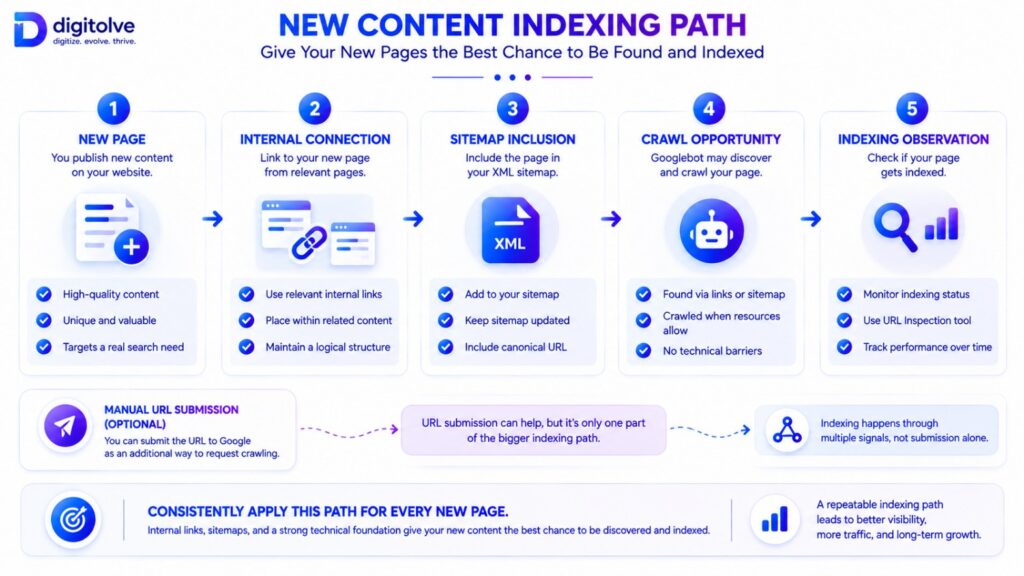
When a new page is published, indexing should not depend on a single manual action. The page should enter a repeatable process that gives it a clear opportunity to be discovered, crawled, processed, and potentially indexed.
This starts with publishing content that has a clear purpose and belongs logically within the website’s overall structure. The page should then become part of the pathways that connect related content across the site.
Internal Connection
New content should be connected to relevant existing pages through meaningful internal pathways. These connections help the new URL become part of the website rather than leaving it as an isolated destination.
The stronger the relationship between the new page and relevant existing content, the clearer its place can become within the site’s structure.
Sitemap Inclusion
Once a new page is published, its appropriate inclusion in the sitemap provides another structured discovery pathway. This complements internal links rather than replacing them.
The sitemap should remain aligned with the website’s important, useful URLs so that it continues to serve as a clean support layer for discovery.
Crawl Opportunity
After discovery pathways are established, Google needs an opportunity to access and process the page. A crawlable URL, accessible content, and a technically eligible page provide the foundation for this stage.
The important distinction is that creating a discovery path does not mean the page will automatically be indexed. It means the website is giving important content a structured opportunity to enter Google’s processing and indexing systems.
Indexing Observation
The process should continue after publication. Important pages should be observed to understand whether they are being processed as expected and whether recurring indexing patterns are developing across the website.
This creates a feedback loop: publish the page, connect it within the website, support its discovery, provide a crawl opportunity, and then observe what happens. Over time, this approach is more sustainable than repeatedly treating each new URL as an isolated submission task.
Why Manual Submission Should Not Become the Entire Process
Manual URL submission can be useful when appropriate, but it should not become the foundation of an indexing system. If every new page requires repeated manual intervention to create a discovery opportunity, the process becomes difficult to scale.
A stronger indexing approach builds the pathways into the website’s normal publishing process. New content should naturally move from creation to internal connection, sitemap support, crawl opportunity, and indexing observation.
The objective is not to eliminate every manual action. It is to make indexing support a repeatable system rather than a collection of one-off URL submissions.
Help Google Understand Which Pages Matter
Important Pages vs. Low-Value Pages
An indexing system is not simply about getting as many URLs as possible into Google’s indexing process. A strong system also creates a clearer environment around the pages that genuinely matter to the website.
Important pages should have a clear purpose within the site’s structure and should contribute meaningful value to the people the website serves. Other URLs may be less important, temporary, duplicate, or unnecessary for search visibility.
This distinction helps shift the focus from maximum URL inclusion toward meaningful indexing.
Content Hierarchy
A logical content hierarchy helps establish how pages relate to one another. Important pages can sit within clear topic and navigation structures, while supporting pages provide relevant context around them.
When this hierarchy is clear, the website becomes easier to understand as a connected system rather than a collection of unrelated URLs.
Canonical Consistency
Where multiple URLs represent the same or substantially similar content, consistent canonical signals can help establish which URL should be treated as the preferred version.
Without clear consistency, multiple URLs can create unnecessary complexity around the content the website intends to present as important.
Duplicate and Near-Duplicate URLs
Duplicate and near-duplicate URLs can make the indexing environment less clear. A website may contain URLs created by different parameters, variations, or overlapping content structures that do not all need independent search visibility.
The goal is not simply to increase the number of indexed URLs. It is to create a cleaner URL environment in which important pages have a clear role and meaningful place within the website.
Avoid Unnecessary URLs Competing for Crawl Attention
An effective indexing system should reduce unnecessary complexity around URLs that do not provide meaningful value. Important pages should not be surrounded by an uncontrolled collection of redundant or low-value URLs that make the overall environment harder to manage.
This does not mean every non-important URL is automatically harmful or should be removed. Instead, it means the indexing system should be designed with purpose, hierarchy, and clarity in mind.
An indexing system is therefore not only about helping Google discover more URLs. It is about creating a cleaner environment around the URLs that matter most.
Review Common Reasons Important Pages Remain Unindexed
Google Cannot Discover the URL
An important page may remain unindexed simply because Google has not found a clear pathway to it. Pages that are isolated from relevant internal content or difficult to reach through the website’s structure have fewer discovery pathways available to them.
This is why publishing a page and submitting its URL should not be treated as the complete indexing process.
Crawling Is Blocked
Even when Google becomes aware of a URL, the page still needs to be accessible for crawling. Blocking important content can prevent Google from successfully accessing and processing the page.
A reliable indexing system therefore needs to consider crawlability as a distinct layer after discovery.
The Page Is Marked Noindex
A page can also remain outside Google’s index when an intentional or accidental noindex directive tells search engines not to index it.
This is an important distinction because increasing discovery will not solve a page-level instruction that prevents indexing.
Technical Access Problems
Pages need to provide a successful response and accessible content before they can move through Google’s processing systems. Technical access problems can therefore interrupt the path between crawling and indexing.
This is why technical eligibility needs to be established as part of the wider indexing system rather than addressed only after indexing problems appear.
Duplicate or Canonical Issues
When multiple URLs represent the same or substantially similar content, Google may determine that another URL is the preferred version. In these situations, repeatedly submitting the URL does not necessarily change how Google processes the relationship between those pages.
A cleaner URL structure and consistent canonical signals can help create greater clarity around which page should represent the content.
Insufficient or Unclear Content and Value
Discovery and technical accessibility do not automatically make a page valuable enough to be included in the index. A page still needs to provide meaningful, useful content and have a clear purpose within the website.
This reinforces an important principle: indexing is not simply a technical submission problem. It is a process influenced by discovery, accessibility, page eligibility, content, and the wider context of the website.
The Site Is Too New
New websites and newly published pages may take time to move through discovery, crawling, processing, and indexing. The absence of immediate indexing does not automatically mean that the website’s indexing system is failing.
What matters is whether the website provides a clear and technically sound path for important content to be discovered, accessed, processed, and observed over time.
Why Repeatedly Submitting the URL May Not Solve the Underlying Issue
Manual submission can create another opportunity for Google to discover a URL, but repeating the same action does not necessarily address the reason a page remains unindexed.
If the underlying issue involves discovery, crawlability, technical eligibility, canonicalization, duplication, content value, or the wider site environment, submitting the same URL again does not replace the need for a stronger system.
The strategic shift is therefore from asking only “How do I submit this URL again?” to asking “Does this page have a clear, accessible, and sustainable path through the indexing process?”
Build an Indexing Monitoring System
Track Important URLs
A reliable indexing system does not stop once pages are published and submitted for discovery. Important URLs should be tracked over time so you can understand whether they are moving through the indexing process as expected.
The focus should remain on pages that matter to the website’s goals rather than treating every URL as equally important.
Monitor Indexed vs. Non-Indexed Pages
Comparing indexed and non-indexed pages can reveal broader patterns across the website. Instead of looking at one URL in isolation, monitoring helps identify whether certain types of pages, sections, or publishing patterns repeatedly experience indexing challenges.
This creates a more useful view of indexing because the goal is not simply to obtain a one-time status for a page, but to understand how the website’s indexing environment behaves over time.
Review Page Indexing Reports
Google Search Console provides Page Indexing reporting that can help website owners understand how Google’s systems are processing URLs across a property.
These reports can provide a broader perspective than checking individual URLs one at a time, making them useful for identifying patterns that may otherwise remain unnoticed.
Use URL Inspection When Needed
URL Inspection can be used when a specific important page needs closer observation. It provides a more focused way to examine an individual URL rather than relying only on the broader indexing picture.
The important principle is to use individual URL inspection as part of the monitoring process, not as a substitute for building a sustainable indexing system.
Watch for Significant Changes
Indexing status can change as websites publish new content, update existing pages, restructure internal pathways, or introduce technical changes. Monitoring allows these changes to be observed rather than discovered only after a significant problem develops.
A useful indexing system therefore includes an ongoing feedback layer that connects what is happening in search systems with how the website is being maintained.
Identify Recurring Indexing Patterns
Over time, monitoring can reveal recurring patterns. For example, certain sections may consistently contain more non-indexed URLs, newly published content may follow a particular indexing pattern, or structural changes may coincide with changes in indexing behavior.
These observations can inform future improvements to the website’s discovery, crawlability, indexability, and content structure.
The key shift is from checking indexing only when something appears wrong to using monitoring as a continuous feedback layer within the indexing system.
Connect Indexing With the Wider SEO System
Discovery Supports Crawling
Search visibility begins with the ability for important content to be discovered. Clear internal pathways, logical site structure, and sitemap support can create opportunities for Google to find important URLs.
Discovery, however, is only the beginning. Once a URL is discovered, Google still needs to be able to access and process it.
Crawling Enables Processing
Crawlability provides the next layer of the system. Important pages need to be reachable and accessible so that Google can request and process their content.
This is why discovery and crawling should not be treated as the same thing. A URL can be known to Google without necessarily being successfully crawled and processed.
Indexing Creates Search Eligibility
Indexing is the stage where a page may become part of Google’s searchable index. But being indexed should not be confused with receiving rankings or traffic.
The purpose of a strong indexing system is to create a technically sound and well-connected environment that gives important pages a clear path toward search eligibility.
Rankings Come Later
Ranking is a separate layer that comes after the processes involved in discovery, crawling, processing, and indexing. A page being indexed does not mean that it will automatically rank prominently for relevant searches.
This distinction prevents indexing from being treated as a direct ranking mechanism. Indexing creates an important foundation for search visibility, but ranking depends on broader SEO and search considerations.
Indexing Is One Layer of the Wider SEO System
Indexing works as one connected layer within the broader SEO environment. Discovery creates pathways, crawlability enables access, indexability supports processing, and indexing creates the possibility of appearing in Google’s search index.
The wider relationship can be understood as:
Discovery → Crawlability → Indexability → Indexing → Search Eligibility → Ranking
Each stage supports the next, but no single stage guarantees the outcome of the stages that follow it.
This is why an effective SEO system should not treat indexing as an isolated technical task. It should connect indexing with the website’s structure, content, discovery pathways, technical accessibility, and ongoing monitoring.
Build a Repeatable Indexing Improvement Cycle
Discover
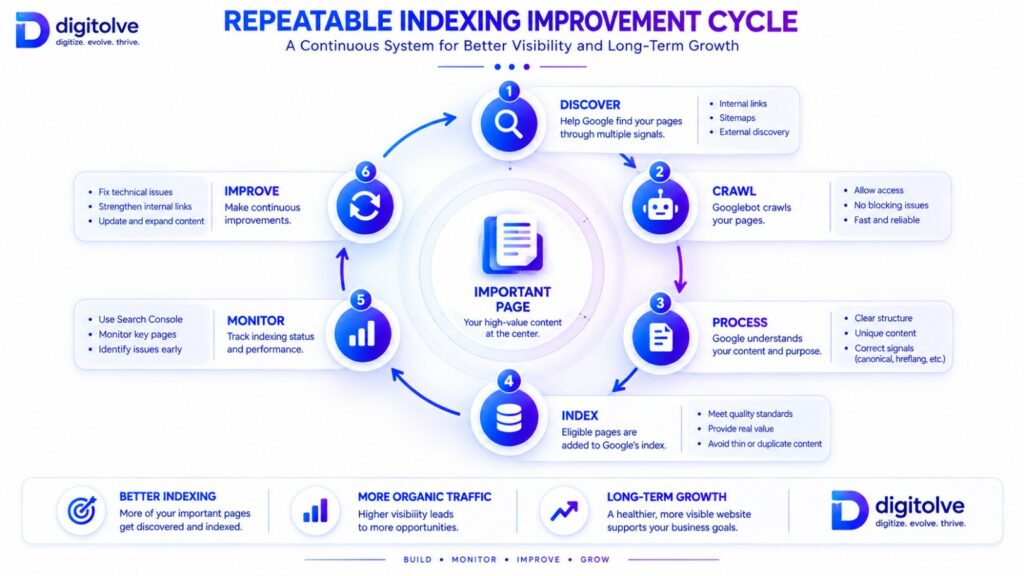
Begin by making important pages discoverable through clear internal pathways, logical site structure, and appropriate sitemap support. The objective is to give each important URL a meaningful path into Google’s discovery process.
Crawl
Once a page can be discovered, it needs to remain accessible for crawling. Crawlable URLs, reachable content, and an accessible website structure support the transition from discovery to processing.
Process
Google must be able to access and process the page before it can determine how that URL should be handled within its indexing systems. Technical accessibility and indexability therefore remain important parts of the process.
Index
Indexing is the stage where a page may become part of Google’s search index. It should not be treated as an automatic result of publishing, linking, or submitting a URL.
Monitor
After pages enter the indexing process, monitoring provides visibility into what is happening. Important URLs can be observed over time, while broader indexing patterns can help reveal whether the system is working as intended.
Improve
Monitoring creates the feedback needed to improve the system. If recurring patterns appear, the website can strengthen discovery pathways, crawlability, technical eligibility, content structure, or other relevant parts of the indexing environment.
The complete cycle can be understood as:
Discover → Crawl → Process → Index → Monitor → Improve
At the page level, the same system can be represented as:
Important Page → Discoverable → Crawlable → Indexable → Indexed → Monitored → Improved
The value of this cycle is that indexing becomes an ongoing system rather than a one-time submission activity. Each stage supports the next, while monitoring creates the feedback needed to make the system more reliable over time.
From URL Submission to an Indexing System
Submission Is an Action
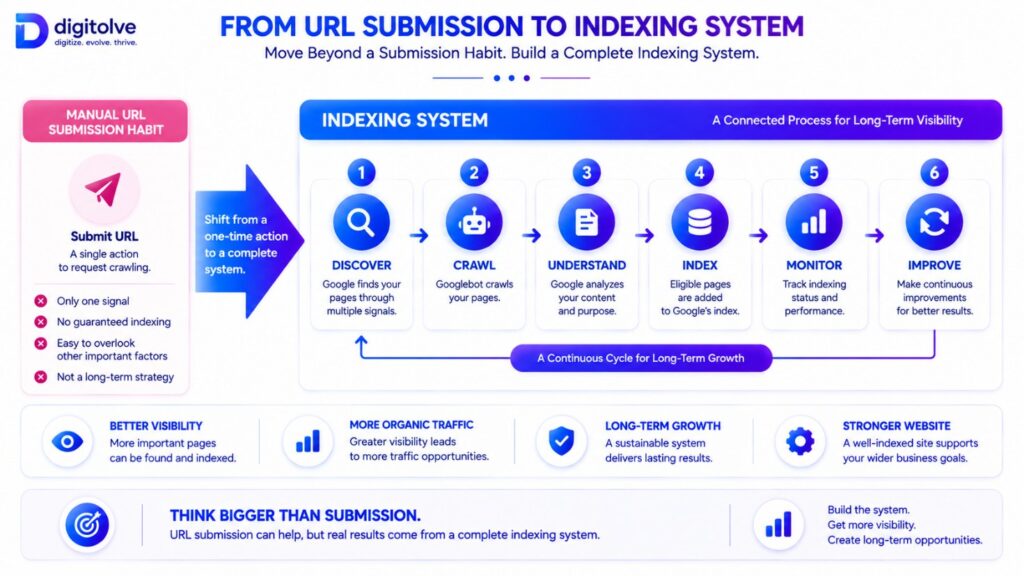
Submitting a URL can be a useful action when you need to communicate a specific URL to Google. But submission by itself does not create the complete environment required for sustainable indexing.
It should therefore be viewed as one activity within a broader process rather than as the definition of an indexing strategy.
Indexing Is a Process
Indexing involves multiple connected stages. A page needs to be discoverable, accessible for crawling, technically eligible for processing, and then observed as it moves through the indexing process.
This makes indexing fundamentally different from simply submitting a URL and waiting for a result.
Internal Structure Creates Sustainable Discovery
Internal pathways help important pages become part of the website’s connected structure. Relevant links and logical relationships create discovery opportunities that can continue working beyond a single manual submission.
This gives important content a more sustainable path through the discovery layer.
Technical Accessibility Supports Crawling
Once Google can discover a URL, the website needs to provide an accessible environment for crawling and processing. Crawlable URLs, successful responses, indexable content, and appropriate technical signals all contribute to this layer.
Technical accessibility therefore works together with discovery rather than replacing it.
Sitemaps Support Discovery
Sitemaps provide another structured way to communicate important URLs, particularly as new and existing content changes over time. They can strengthen the discovery layer but do not guarantee that every listed URL will be indexed.
The strongest approach combines sitemap support with meaningful internal pathways and a technically accessible website.
Monitoring Creates Feedback
An indexing system becomes more useful when it includes observation. Monitoring important URLs and broader indexing patterns provides feedback about how the system is performing over time.
This feedback can then inform improvements to discovery, crawlability, technical eligibility, and the wider website structure.
System Thinking Replaces Repeated Manual Submission
The strategic shift is simple: stop treating every indexing problem as a URL-submission task and start treating indexing as a connected system.
Discovery → Crawlability → Indexability → Indexing → Monitoring → Improvement
The objective is not to guarantee that every URL will be indexed. No indexing system can provide that guarantee. The objective is to create a technically eligible, discoverable, well-connected, and monitorable environment that gives important pages the strongest practical path through Google’s indexing process.
Conclusion — Build an Indexing System, Not a Submission Habit
Getting important pages indexed is not simply a matter of submitting URLs. A reliable approach connects discovery, crawlability, technical eligibility, indexing, and monitoring into one continuous process.
Internal pathways help important pages become discoverable. A crawlable website structure gives Google access to those pages. Technical eligibility supports processing, while sitemaps provide an additional discovery pathway. Monitoring then creates the feedback needed to understand and improve the system over time.
The strategic transformation is:
Manual Submission → Structured Indexing System
Instead of repeatedly asking Google to find individual URLs, build an environment in which important pages have clear, accessible, and sustainable pathways through the indexing process.
No indexing system can guarantee that every URL will be indexed. The goal is to create a website environment that gives important content the strongest practical path toward discovery, crawling, processing, and potential indexing.
When indexing is treated as a connected system rather than a submission habit, it becomes a repeatable part of the wider SEO process.
CTA — Indexing Optimization Blueprint
Understanding how indexing works is the first step. The next step is turning that understanding into a practical, repeatable process for your website.
The Indexing Optimization Blueprint is designed to help you build that process by translating the indexing system into a practical execution framework.
It helps you move from:
URL Submission → Structured Indexing Process
The blog explains how the indexing system works and how its major layers connect. The Blueprint provides the practical framework for applying that understanding to your website.
If you are trying to understand why an important page or website is not being indexed, that is a different problem. The Indexing Issue Fix Toolkit belongs to the diagnostic layer and is designed to help identify the underlying indexing issue.
The longer-term direction is a broader Search Indexing System, which can connect indexing with the wider architecture of search visibility. The Blueprint focuses specifically on the practical execution layer needed to build a more structured indexing process today.
One principle remains important throughout: no indexing system can guarantee that every URL will be indexed. The goal is to create a technically eligible, discoverable, well-connected, and monitorable environment that gives important pages the strongest practical path through Google’s indexing process.
Build the system—not just the submission habit.
FAQs
What is an indexing system?
An indexing system is a connected process that helps important website pages move from discovery through crawling, processing, indexing, and ongoing monitoring. It combines internal pathways, crawlability, technical eligibility, sitemap support, and feedback rather than relying only on manual URL submission.
Why is my website not indexed on Google?
A website or page may remain unindexed for different reasons, including limited discovery pathways, crawling restrictions, technical access problems, noindex directives, canonical or duplicate URL issues, unclear content value, or the website being relatively new. Repeatedly submitting the URL may not solve the underlying issue.
Does submitting a URL guarantee indexing?
No. Submitting a URL can support discovery, but it does not guarantee that Google will crawl, process, or index the page. Indexing depends on the wider environment surrounding the URL.
What is the difference between crawling and indexing?
Crawling is the process of accessing a URL and its content, while indexing is the process through which Google may include that content in its search index. A page can be discovered without necessarily being successfully crawled or indexed.
How do internal links help Google discover pages?
Internal links create pathways between related pages within a website. Meaningful internal connections can help important pages become part of the site’s discoverable structure rather than remaining isolated URLs.
Does a sitemap guarantee that pages will be indexed?
No. A sitemap provides a structured discovery pathway for URLs, but submitting a sitemap does not guarantee crawling or indexing. It works best as one support layer within a broader indexing system.
What should I check when an important page is not indexed?
Consider whether the page can be discovered, crawled, and technically processed. Also consider its indexability, robots.txt and noindex signals, canonical relationships, duplicate content, accessibility, and overall content purpose and value. The goal is to understand the page’s path through the indexing system rather than simply resubmit the URL.
How can I build a more reliable indexing process?
Build a repeatable process around important pages: make them discoverable through internal pathways, keep the site crawlable, maintain technical indexing eligibility, use clean sitemaps as discovery support, monitor important URLs, and improve the system based on recurring patterns.
Recommended Reading
- Why Your Internal Linking Is Not Helping Your SEO (And What Your Structure Is Missing)
- How to Build SEO Visibility for a New Website From Day One
- How to Build a Complete SEO Visibility System for Sustainable Organic Traffic Growth
These articles continue the journey from indexing to internal structure, then to new-website visibility, and finally to a complete SEO visibility system.