Introduction
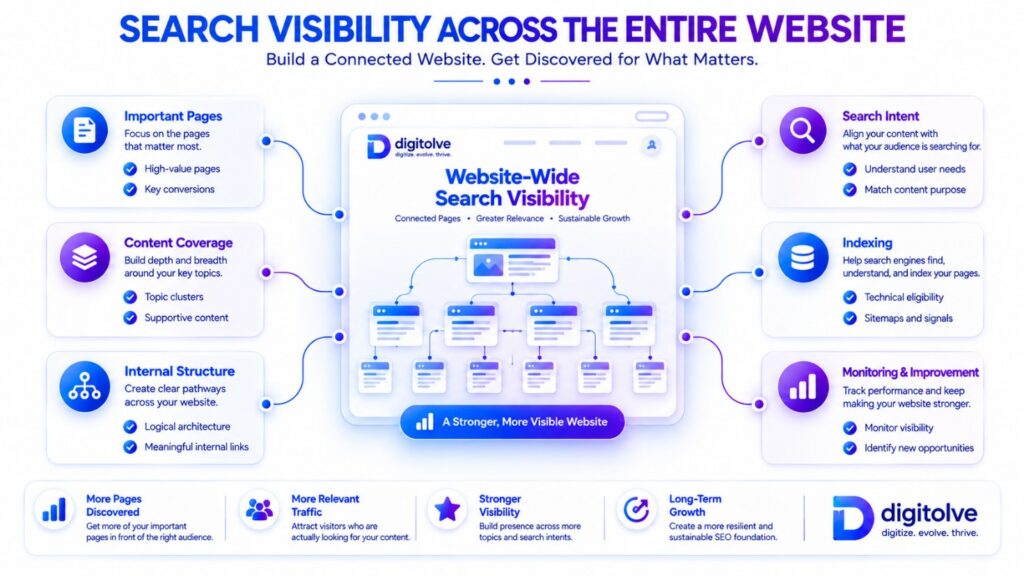
Why Search Visibility Must Be Built Across the Entire Website
Search visibility is often viewed through the performance of individual pages. One article ranks well, another page attracts traffic, and a few important keywords begin generating impressions. But a website can have successful pages without developing strong visibility across its broader content and structure.
This happens because search visibility is not created by one page or one SEO activity alone. A website may publish useful content, target relevant searches, build internal links, and make technical improvements, yet still have important sections that remain weak or disconnected.
Search Visibility Is More Than Ranking Individual Pages
A page ranking for a valuable search can be a positive result, but it does not automatically mean the rest of the website is visible. Other important pages may remain undiscovered, poorly connected, weakly aligned with search needs, or unable to contribute meaningfully to the website’s overall search presence.
Website-wide visibility therefore requires looking beyond individual rankings and understanding how important pages work together.
Why One Successful Page Does Not Create Website-Wide Visibility
A single high-performing page can generate visibility and traffic while other valuable pages receive very little search exposure. This creates an uneven visibility profile where a small number of pages carry most of the website’s search performance.
Over time, this dependence can become a limitation. A stronger approach is to develop visibility across multiple important pages so that the website has more than one source of meaningful search presence.
Isolated SEO Activity vs. Connected Visibility
SEO activities often happen separately. A website may publish an article, target a keyword, add an internal link, fix a technical issue, or review rankings as individual tasks.
These actions can be useful, but their value becomes stronger when they reinforce one another. Content can support important topics, internal structure can connect related pages, technical accessibility can support discovery and processing, and monitoring can provide feedback for future improvements.
Why Websites Develop Visibility Gaps Across Different Sections
Visibility gaps can develop when some parts of a website receive more attention than others. Important pages may lack supporting content, related pages may remain disconnected, search intent may not be clearly aligned with page purpose, or technical and structural improvements may not support the same priorities.
The result is a website where SEO activity exists, but visibility is fragmented across different sections.
The Strategic Shift
The stronger approach is to move from thinking about individual page visibility toward building connected website visibility.
Instead of asking only which page should rank next, consider which important pages, topics, content relationships, structural pathways, and visibility signals need to work together.
Individual Pages → Connected Website Visibility
This shift creates the foundation for a more repeatable search visibility process—one designed to strengthen the website as a whole rather than relying on isolated SEO wins.
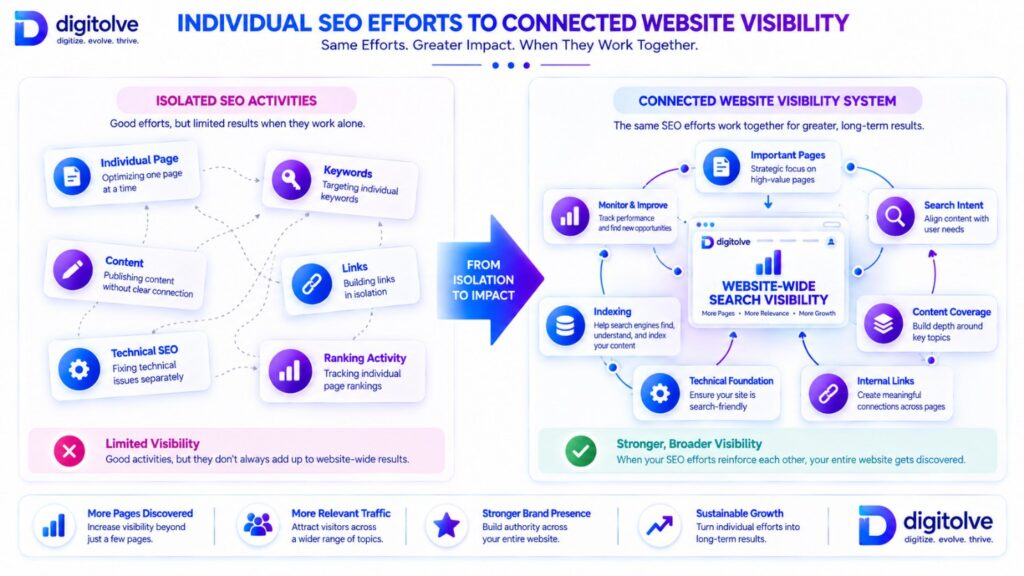
Table of Contents
What Search Visibility Actually Means
Search Visibility at the Website Level
Search visibility describes how effectively a website’s important content can become present and discoverable through relevant search experiences. At the website level, this means looking beyond one ranking or one keyword and considering how multiple important pages contribute to the site’s overall search presence.
A website with stronger search visibility has important content that can be discovered, understood, indexed, ranked where appropriate, and found through searches that match the needs those pages are designed to address.
Visibility vs. Rankings vs. Traffic
Search visibility, rankings, and traffic are related, but they are not the same thing.
Rankings describe where a page appears for particular searches. Traffic describes visits generated through those and other sources. Search visibility provides a broader view of how much of the website’s important content is gaining opportunities to appear for relevant searches.
A website can therefore have traffic without having broad visibility across its important pages. It can also have some rankings while still having significant visibility gaps elsewhere.
Why Different Pages Can Have Different Visibility Levels
Not every page on a website serves the same purpose or has the same search opportunity. Some pages may target important search needs, while others support those pages or serve audiences that generate less search demand.
This means website-wide visibility should not be interpreted as making every page equally visible. The objective is to build meaningful visibility around the pages and topics that matter most.
Why Visibility Depends on Multiple Connected Factors
Search visibility develops through multiple connected layers. Content needs to address meaningful search needs, pages need clear purposes, important content needs discoverable pathways, and the website needs an environment that supports crawling and indexing.
These elements work together rather than operating as completely separate SEO tasks. When they reinforce one another, individual improvements can contribute to a broader visibility system.
Published vs. Discoverable vs. Indexed vs. Ranked vs. Visible
Publishing a page is only the beginning of its potential search journey. A page can be published without being discovered, discovered without being indexed, indexed without achieving strong rankings, or ranked for searches without creating significant visibility across the wider website.
A useful conceptual progression is:
Published → Discovered → Understood → Indexed → Ranked → Found by Relevant Searches
Each stage represents a different part of the journey. Understanding these distinctions helps prevent search visibility from being reduced to a single ranking position or traffic number.
Search Visibility Is a Connected Website Outcome
Search visibility is not one metric or one SEO action. It is the combined ability of a website’s important content to become discoverable, understood, eligible, ranked, and found through relevant searches.
Google explains the broader processes involved in how Search discovers, understands, and organizes web content in Google Search Central’s guide to how Search works.
This gives us an important foundation: improving visibility across a website requires attention to the relationships between its important pages, content, structure, search needs, and search eligibility—not simply another isolated ranking tactic.
Start With the Pages That Matter Most
Identify Important Website Pages
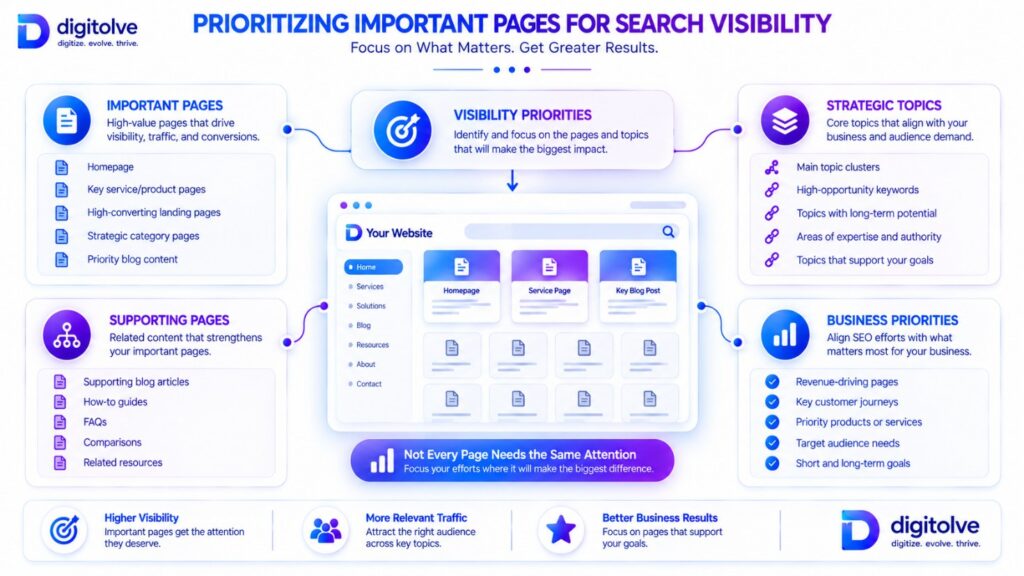
A website can contain dozens, hundreds, or even thousands of URLs, but not every page deserves the same level of visibility effort. The first step toward stronger website-wide visibility is identifying which pages are genuinely important to the website’s goals.
These may include core service pages, important resource pages, primary commercial pages, major educational content, or other pages that play a meaningful role in attracting and serving the right audience.
Connect Visibility With Business Priorities
Search visibility becomes more useful when it supports what the website is actually trying to achieve. A page may attract impressions or visits without being strategically important, while another page may have greater business value even if its current visibility is limited.
This means visibility priorities should be connected with the role each page plays in the wider website and its goals.
Distinguish Strategic Pages From Supporting Pages
Important pages and supporting pages can play different roles within the visibility system. A primary page may represent an important topic or business objective, while supporting pages can provide useful coverage, context, and pathways around it.
Recognizing these different roles makes it easier to build a website where content and structure reinforce important destinations rather than treating every page as an independent ranking target.
Avoid Optimizing Every URL Equally
Trying to give every URL the same optimization priority can spread effort too thin. Stronger visibility comes from understanding where attention can create the greatest strategic value.
This does not mean ignoring other pages. It means establishing a clear hierarchy so that the website’s most important assets receive appropriate attention first.
Build Visibility Around Meaningful Website Assets
Once important pages have been identified, the wider visibility process can be organized around them. Supporting content, internal pathways, search intent, technical eligibility, and monitoring can then be connected to the pages and topics that matter most.
This creates a more focused starting point for website-wide visibility.
Don’t optimize everything equally. Build visibility around what matters most.
The objective is not to make every URL equally visible. It is to create stronger search opportunities for the pages and topics that have the greatest strategic importance to the website.
Build Strong Search-Focused Content Coverage
Cover Problems Your Audience Actually Searches For
Website-wide search visibility becomes stronger when the content addresses the questions, problems, and needs that matter to the audience. Publishing content simply to increase the number of pages can create a larger website without creating broader meaningful visibility.
Instead, important topics should be supported by content that helps people find useful answers at different stages of their search journey.
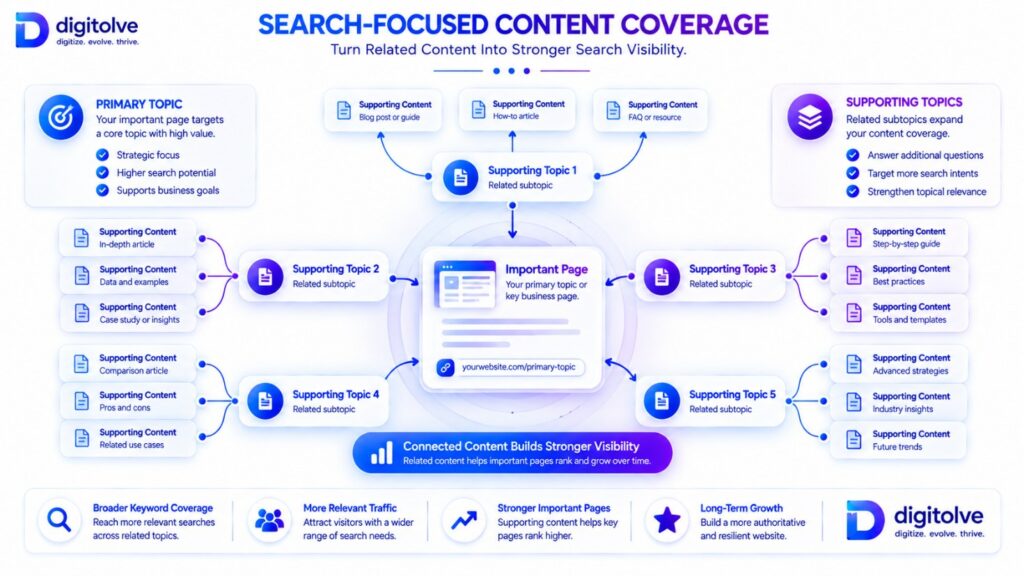
Build Connected Topic Coverage
A strong content environment does not depend on isolated articles. Related pages can work together to provide broader coverage around important subject areas and create clearer relationships between supporting content and more important pages.
This allows individual pieces of content to contribute to a larger visibility structure rather than functioning as independent search attempts.
Avoid Random Publishing
Publishing consistently can help a website grow its content library, but frequency alone does not create strong search visibility. Random topics can leave important subject areas underdeveloped while adding pages that have little connection to the website’s strategic priorities.
A more deliberate approach is to understand which topics matter, which pages should be supported, and where additional content can strengthen the website’s overall search presence.
Create Supporting Content Around Important Topics
Supporting content can expand coverage around important topics and provide additional opportunities for the website to address relevant searches. These pages can also contribute context and pathways toward more important website assets.
The goal is not simply to create more supporting articles. It is to create useful content relationships that strengthen the website’s broader visibility.
Let Related Content Work Together Instead of Independently
When related content is connected by a clear purpose, each page can contribute to a wider system. One page may address a specific question, another may explain a related problem, and another may support an important topic or destination page.
This creates a more connected content environment in which visibility can develop across multiple relevant pages rather than depending entirely on individual articles.
For a deeper look at why content can fail to produce the intended results, see Why Your Content Is Not Working.
The important shift is from publishing more content to building useful content coverage around the topics and pages that matter most.
Create Clear Internal Discovery Pathways
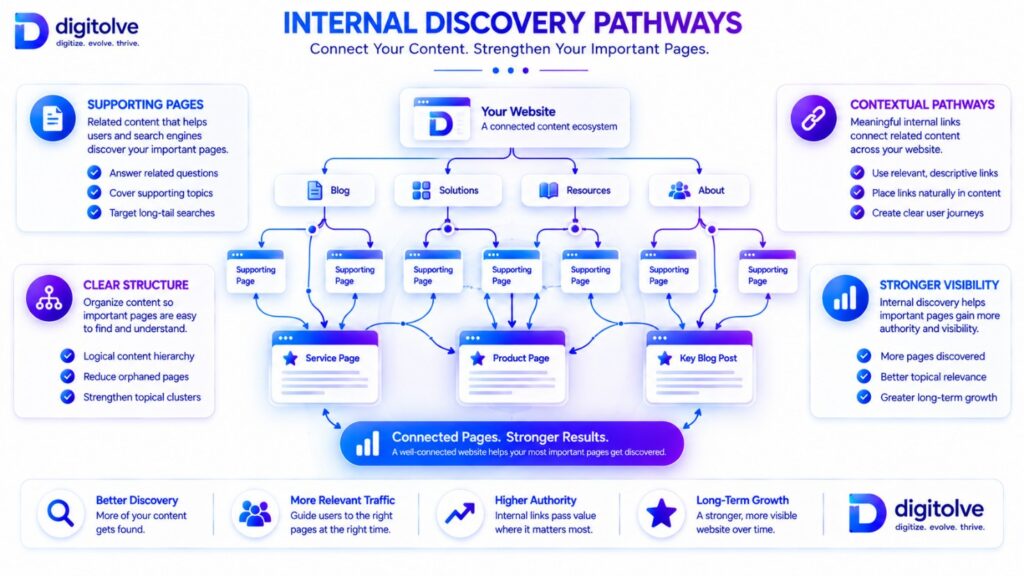
Connect Related Pages
Content coverage becomes more useful when related pages are connected through meaningful internal pathways. These relationships help search engines and visitors move between pages that address connected needs.
Instead of allowing each article or resource to exist independently, the website can use its internal structure to show how important pages and supporting content relate to one another.
Strengthen Important Page Pathways
Important pages should have clear pathways leading to and from relevant supporting content. These connections can help make important pages more integrated into the website’s overall structure.
The objective is not to add links simply because a page needs more links. Each connection should have a meaningful relationship with the content surrounding it.
Avoid Isolated Content
An important page can lose part of its potential value when it sits apart from the rest of the website. Similarly, useful supporting content may contribute less when there are no meaningful relationships connecting it with other relevant pages.
Reducing unnecessary isolation helps create a website where content works as a connected network rather than a collection of separate assets.
Use Contextual Internal Links
Context matters when connecting pages. Relevant internal links can help establish relationships between related subjects while giving visitors a natural path to continue exploring the website.
This makes internal linking part of the wider visibility system rather than treating it as a separate task focused only on increasing the number of links.
Build Relationships Between Supporting and Important Pages
Supporting pages can strengthen the visibility environment around important pages when their relationship is logical and useful. This creates a pathway through which content coverage and website structure reinforce one another.
The relationship can be understood simply as:
Supporting Content → Contextual Pathway → Important Page
For a deeper look at the structural problems that can weaken these connections, see Why Your Internal Linking Is Not Helping Your SEO (And What Your Structure Is Missing).
Strong internal discovery pathways therefore help transform separate pages into a more connected website visibility environment.
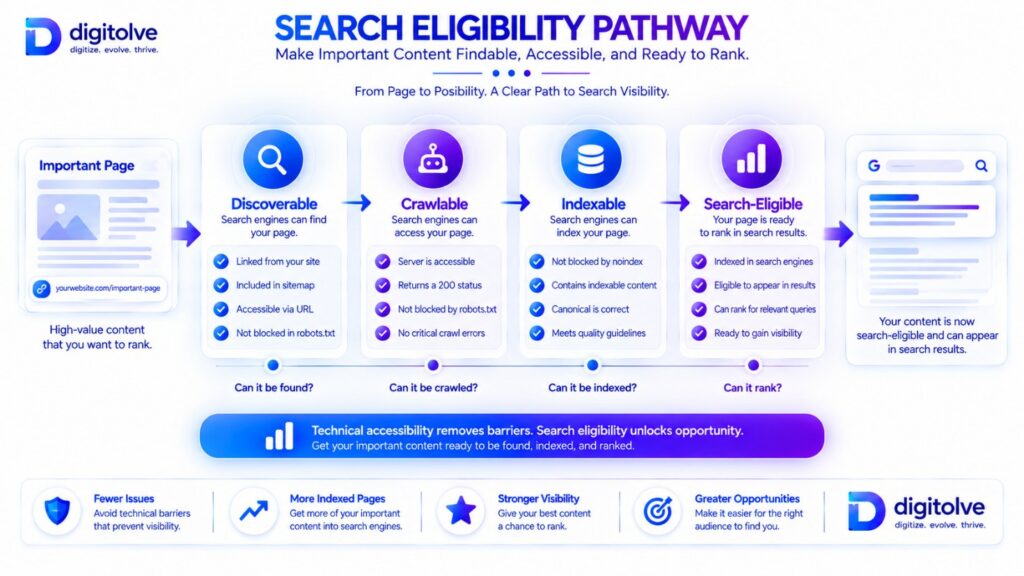
Make Important Content Search-Eligible
Ensure Important Pages Can Be Discovered
Important content needs a clear opportunity to enter the search process. Internal pathways, logical website structure, and other discovery signals can help important pages become reachable rather than leaving them isolated.
Discovery is therefore an important foundation for website-wide search visibility, but it is only one stage of the process.
Support Crawlability
After a page can be discovered, search engines need to be able to access it. A crawlable website structure helps provide that access and allows important content to move further through the search process.
This connects website structure with search visibility: important content should not only exist, but should also be reachable through a technically accessible environment.
Maintain Technical Indexability
Important pages also need to remain technically eligible for indexing. Accessibility, appropriate indexability signals, and a clear relationship between the intended page and its available URL all contribute to this foundation.
Technical eligibility does not guarantee rankings. It simply helps ensure that important content is not unnecessarily prevented from participating in the search process.
Prevent Important Content From Becoming Inaccessible to Search Systems
A website-wide visibility strategy should pay attention to whether important content can actually be reached and processed. If important pages are blocked, isolated, or otherwise inaccessible, other visibility efforts may have limited impact.
This is why technical accessibility should be considered alongside content and structure rather than treated as an unrelated SEO task.
Connect Technical Accessibility With Visibility
Technical eligibility is one layer within the larger visibility system. Content creates useful information, internal structure creates relationships, and technical accessibility supports the ability of search systems to discover and process important pages.
For a deeper explanation of how to build this indexing layer, see How to Build an Indexing System That Helps Google Find Every Important Page.
The key principle is simple: important content needs both meaningful visibility direction and a technically accessible path into the search process.
Align Pages With Search Intent
Understand What Users Are Actually Searching For
Search visibility becomes more meaningful when a page is aligned with the need behind the search. People search because they want to understand something, solve a problem, compare options, complete an action, or find a particular resource.
A website can therefore have useful content and still struggle to build visibility if its important pages do not clearly address the search needs they are intended to serve.
Match Pages With Appropriate Search Needs
Each important page should have a clear role in satisfying a relevant search need. The page’s subject, purpose, and content should make that relationship understandable rather than trying to make one page serve every possible search.
This creates stronger alignment between what people are looking for and what the website provides.
Avoid Multiple Pages Competing for the Same Purpose
Website-wide visibility can become fragmented when several pages attempt to satisfy essentially the same search purpose without a clear distinction between them.
A more deliberate structure gives each important page a meaningful role while allowing supporting pages to address related needs without unnecessarily duplicating the purpose of another page.
Make Page Purpose Clear
A page should make it reasonably clear what problem, question, or search need it is designed to address. Clear page purpose helps connect content with the audience it is intended to serve.
This also helps the wider website develop a clearer relationship between its important pages, supporting content, and the searches those pages are designed to address.
Build Visibility Around Relevance, Not Just Keywords
Keywords can help describe the language people use when searching, but website-wide visibility should not be reduced to inserting keywords into pages. The more important question is whether the page genuinely addresses the relevant search need.
This keeps the focus on relevance and usefulness rather than treating individual keywords as isolated ranking targets.
At this level, search intent is one component of the wider visibility system. The deeper process of discovering, evaluating, prioritizing, and mapping keywords belongs to a dedicated keyword strategy workflow rather than this broader visibility framework.
Strengthen Website-Wide Topic Relationships
Connect Related Topics
Search visibility can become stronger when related topics are organized into meaningful relationships across the website. Instead of publishing disconnected pages on unrelated subjects, build content relationships that help important topics develop greater depth and context.
This gives the website a clearer topical structure and allows individual pages to contribute to a broader subject area.
Build Depth Around Important Subject Areas
Important topics often require more than one page to address the different questions and needs surrounding them. Supporting content can expand coverage while giving the website additional opportunities to serve relevant searches.
The objective is not simply to increase the number of pages. It is to develop useful depth around the subject areas that matter most.
Support Primary Pages With Relevant Content
Supporting pages can strengthen the environment around important primary pages when they address related needs and connect logically with one another.
This creates a relationship in which supporting content contributes to the visibility of a broader topic rather than operating as a collection of unrelated articles.
Avoid Disconnected Topic Clusters
A website can have a large amount of content while still lacking clear topical relationships. When related pages are disconnected, the website may miss opportunities to create a coherent structure around its important subject areas.
Strengthening those relationships helps turn individual pieces of content into a more connected content environment.
Create Clearer Topical Direction Across the Website
Website-wide visibility benefits from clarity about which topics are important, how supporting content relates to them, and where important pages sit within the overall structure.
This creates a stronger foundation for a broader visibility system because content, structure, and search needs begin reinforcing one another.
The important distinction is that this section introduces the role of topic relationships in visibility. It does not attempt to provide the complete topical-authority architecture or the deeper operating system that belongs to the future SEO Visibility System — Core.
Expand Visibility Beyond a Few High-Performing Pages
Why One Ranking Page Is Not Enough
A website can generate meaningful search traffic from a small number of high-performing pages while many other important pages remain largely invisible. This can create the appearance of strong SEO performance without producing broad website-wide visibility.
Relying heavily on a few successful URLs also makes the website’s search presence more dependent on those individual pages.
Build Visibility Across Multiple Important Pages
A stronger approach is to develop search visibility across a wider set of important pages. Different pages can address different search needs, topics, and stages of the audience journey while contributing to the same broader website objective.
This creates multiple sources of search visibility rather than expecting one page to carry the entire website.
Strengthen Supporting Content
Supporting content can play an important role in expanding visibility when it addresses relevant searches and connects naturally with important pages. It can help the website participate in a broader range of searches while strengthening the surrounding topic environment.
The purpose is not to create supporting pages for their own sake. Each page should have a useful role within the wider visibility structure.
Reduce Dependence on a Small Number of Traffic-Producing URLs
When most search traffic comes from only a handful of pages, there may be significant untapped visibility across the rest of the website. Reviewing which important pages are contributing little search exposure can reveal opportunities to strengthen the broader system.
The answer is not necessarily to make every page a traffic producer. Instead, identify the important pages that should have a stronger role and build the surrounding conditions that can support their visibility.
Create Broader Website-Level Search Presence
Website-wide visibility develops when multiple important pages can contribute to relevant searches. Content coverage, internal relationships, search intent alignment, technical eligibility, and monitoring can work together to support this broader presence.
The goal is not simply to make one page visible. It is to build a website where multiple important pages can contribute to search visibility.
That is the difference between an SEO strategy built around isolated wins and a visibility approach designed to strengthen the website as a connected whole.
Connect Content, Structure, and Search Signals
Content Creates Relevance
Useful content gives a website something meaningful to be found for. It addresses the questions, problems, and needs that matter to the audience and creates the foundation for relevant search visibility.
But content works more effectively when it is connected to the rest of the website rather than operating as an isolated asset.
Internal Structure Creates Relationships
Internal structure helps show how pages relate to one another. Meaningful connections between supporting content and important pages can create clearer pathways through the website and strengthen the relationships between related subject areas.
This allows content coverage and website structure to reinforce one another.
Technical Accessibility Supports Discovery and Processing
Important content also needs an accessible technical environment. Pages need appropriate pathways for discovery and the ability to be accessed and processed by search systems.
Technical accessibility does not create relevance by itself, but it supports the conditions through which useful content can participate in the search process.
Search Intent Creates Alignment
Search intent connects what people are looking for with the purpose of a page. When content, page purpose, and search needs are aligned, the website has a clearer basis for developing relevant visibility.
This keeps the focus on satisfying meaningful search needs rather than treating keywords or rankings as isolated objectives.
Important Pages Create Strategic Focus
Not every page needs to play the same role. Important pages provide strategic destinations around which content coverage, internal relationships, and visibility efforts can be organized.
This creates a hierarchy within the website instead of spreading attention equally across every URL.
Monitoring Creates Feedback
Visibility also needs feedback. Monitoring important pages and observing changes over time can help reveal which parts of the website are strengthening, which remain weak, and where future attention may be useful.
That feedback can then inform the next cycle of prioritization and improvement.
Connect the Signals Into One System
When these elements are viewed together, the website becomes more than a collection of individual SEO activities. Content, structure, accessibility, relevance, and monitoring begin working as connected parts of the same visibility process.
A useful conceptual model is:
Content → Structure → Accessibility → Relevance → Visibility → Feedback
The purpose of this model is not to suggest that search visibility follows a perfectly linear sequence. Instead, it shows how different website elements can reinforce one another when they are designed as part of a connected system.
Why Isolated SEO Improvements Often Fail to Scale
Fixing One Page at a Time
Improving individual pages can produce useful results, but a page-by-page approach can become fragmented when each improvement is treated as a separate project.
If important pages, supporting content, internal relationships, and search priorities are not connected, individual improvements may never develop into broader website-wide visibility.
Publishing Without Connecting Content
Publishing another article can expand a website’s content library, but a new page does not automatically strengthen the rest of the website. Without meaningful relationships to relevant topics and important pages, the new content may remain another isolated asset.
Content becomes more valuable within the visibility system when it has a clear purpose and relationship with the surrounding website.
Targeting Individual Keywords Without Website Direction
Individual keyword targets can provide useful direction for specific pages, but targeting keywords independently can create a collection of pages without a coherent website-level purpose.
Stronger visibility comes from understanding how individual search needs fit into the topics, pages, and priorities that matter to the website as a whole.
Improving Technical Elements Without Content Alignment
Technical improvements can support accessibility, discovery, and processing, but technical changes alone do not create meaningful content relevance. A technically accessible page still needs a clear purpose and useful content that addresses an appropriate search need.
This is why technical accessibility should work alongside content and search-intent alignment rather than operating as a completely separate visibility strategy.
Building Content Without Structural Relationships
A website can accumulate a large amount of useful content while still having weak relationships between its pages. When supporting content, important pages, and related topics remain disconnected, the website’s visibility potential can become fragmented.
Structure gives content relationships a place to work together.
Why Isolated Improvements Create Fragmented Visibility
The underlying problem is not necessarily that individual SEO activities are wrong. The problem is that they can produce limited results when they are not connected to a wider system.
One page improves. Another article is published. A technical issue is fixed. A keyword begins ranking. But if these improvements do not reinforce one another, the website may continue to experience uneven visibility.
The strategic shift is therefore from asking “What SEO task should I do next?” to asking “Which improvement will strengthen the wider visibility system?”
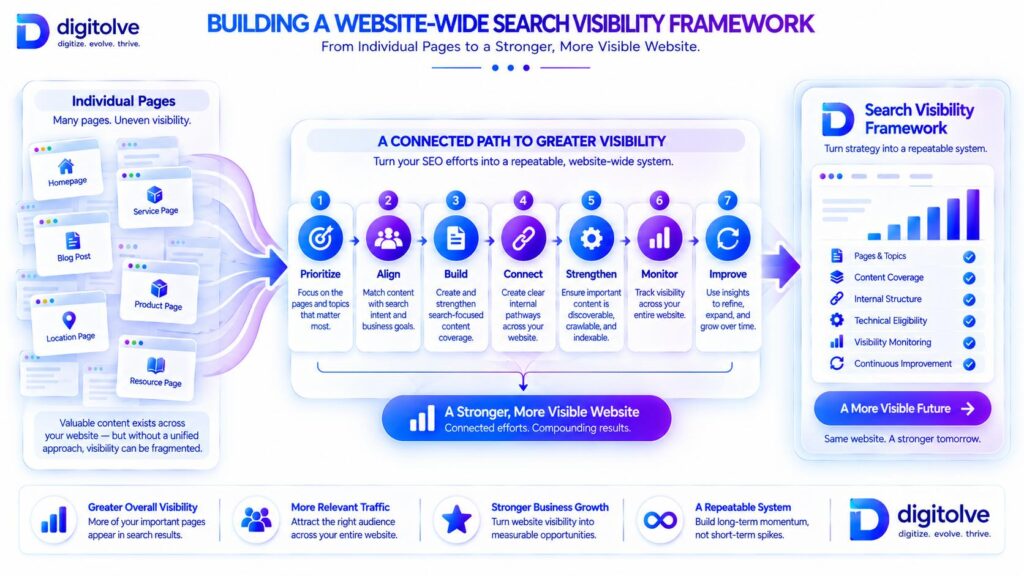
At this point, the individual pieces should begin to feel less like separate tasks and more like parts of a connected framework. The next step is to organize those pieces into a repeatable process that helps determine what to prioritize, align, build, connect, strengthen, monitor, and improve.
Build a Repeatable Search Visibility Framework
Once the major visibility layers are connected, the next step is to turn them into a repeatable process. Instead of approaching every SEO activity independently, the website can move through a consistent sequence that keeps priorities, alignment, content, structure, strengthening, monitoring, and improvement connected.
Prioritize
Start by identifying which pages and topics deserve visibility attention first. Consider their strategic importance, role within the website, and relationship to the audience and business goals.
Question: What deserves visibility first?
Align
Next, consider whether important pages are aligned with the search needs they are intended to address. Page purpose, audience needs, content relevance, and search intent should point in the same direction.
Question: Is each important page aligned with the search need it is trying to satisfy?
Build
Develop useful search-focused content around the topics and pages that matter. Supporting content should contribute to meaningful coverage rather than simply increasing the number of published URLs.
Question: Does the website have enough useful content around the topics that matter?
Connect
Strengthen relationships between pages through meaningful internal pathways and contextual connections. Important pages and supporting content should work together within the website’s structure.
Question: Do the website’s important pages actually work together?
Strengthen
Review the wider visibility environment to identify areas that remain fragmented or weak. Consider website-wide coverage, content relationships, search eligibility, and dependence on a small number of high-performing pages.
Question: Where is visibility still fragmented or weak?
Monitor
Observe how visibility develops across important pages and topics. Monitoring creates the feedback needed to understand what is improving, what is stagnating, and where attention may be needed next.
Question: What is improving, stagnating, or weakening?
Improve
Use what you learn to determine the next improvements. Reprioritize important areas, strengthen weak relationships, improve useful content coverage, and continue the cycle.
Question: What should be improved next?
The Repeatable Visibility Framework
The complete conceptual framework is:
Prioritize → Align → Build → Connect → Strengthen → Monitor → Improve
This framework provides a consistent way to think about website-wide search visibility without requiring every page or SEO activity to receive equal attention.
The framework gives you the direction and structure of the process. A practical implementation system can then turn that direction into specific planning and execution decisions for your website.
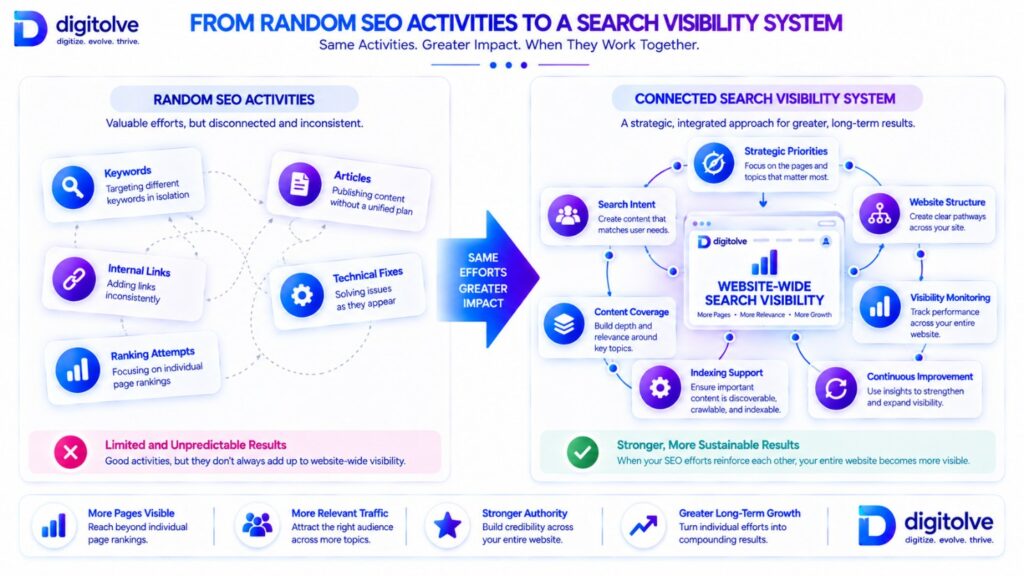
Turn Individual SEO Efforts Into a Website-Wide Visibility System
Start With the Fragmented Approach
Without a connected framework, SEO can easily become a collection of separate activities. A website may target keywords, publish articles, add internal links, make technical improvements, and review rankings, but each activity can still operate independently.
This creates a familiar pattern:
Keywords → Articles → Internal Links → Technical Fixes → Ranking Attempts
Each activity may have value on its own, but the larger question is whether those activities are reinforcing the same website-wide visibility goals.
Connect the Strategic Priorities
A stronger visibility system begins with clear priorities. Important pages and topics should provide direction for the content, structure, and improvement efforts that follow.
Instead of asking what SEO task should be completed next, the system asks which areas deserve attention and how each improvement can contribute to broader visibility.
Align Search Intent With Content Coverage
Search intent helps connect audience needs with page purpose, while content coverage provides the information needed to address those needs across the website.
When these elements work together, content can serve a clearer role within the wider visibility structure instead of becoming a series of disconnected search targets.
Connect Content With Website Structure
Content coverage becomes more useful when relevant pages are connected through the website’s internal structure. Supporting content can lead naturally toward important pages, while related pages can reinforce broader topic relationships.
This allows the website’s content and structure to work together rather than developing as separate SEO projects.
Support Visibility With Indexing and Monitoring
Important content also needs a path through the technical search process. Discovery, crawlability, and indexing support help create the conditions for important pages to participate in search, while monitoring provides feedback about how visibility develops over time.
These layers do not operate independently. They support the wider system by helping important content move from creation and connection toward measurable search visibility.
Move From Activities to a Connected System
The transformation can be represented as:
Random SEO Activities
Keywords
→ Articles
→ Internal Links
→ Technical Fixes
→ Ranking Attempts
becomes:
Connected Search Visibility System
Strategic Priorities
→ Search Intent
→ Content Coverage
→ Website Structure
→ Indexing Support
→ Visibility Monitoring
→ Continuous Improvement
The difference is not that the individual SEO activities disappear. The difference is that they become connected to a shared visibility direction.
SEO activities become more valuable when they reinforce one another instead of operating as isolated tasks. That is what turns individual improvements into a website-wide search visibility system.
From Search Visibility to Sustainable SEO Growth
Visibility Creates the Foundation
Broader search visibility gives a website a stronger foundation for sustainable organic growth because multiple important pages can contribute to relevant searches rather than relying on a small number of isolated ranking successes.
Website-Wide Visibility Is Stronger Than Isolated Rankings
Individual rankings still matter, but a website becomes more resilient when its important content develops visibility across multiple topics, pages, and search needs.
This creates a broader search presence instead of making the website dependent on a few high-performing URLs.
Connected Systems Can Reinforce One Another
When content, internal structure, search intent, technical accessibility, indexing support, and monitoring work together, improvements in one area can contribute to the effectiveness of other areas.
This connected approach creates a stronger foundation than treating each SEO activity as an independent task.
Visibility Requires Continuous Improvement
Search visibility is not a one-time project. Important pages, search needs, content relationships, and website structures change over time, which means the visibility process needs ongoing observation and improvement.
The goal is to create a repeatable cycle rather than reach a fixed point and stop.
From Search Visibility Framework to SEO Visibility System
The Search Visibility Framework provides a practical foundation for organizing and improving website-wide visibility.
As a website grows, that foundation can eventually develop into a broader SEO Visibility System that coordinates a deeper range of SEO visibility processes and workflows.
The progression is:
Search Visibility Framework → SEO Visibility System
Mini → Core
The important point is that sustainable SEO growth begins with a connected visibility foundation—not with an endless collection of disconnected SEO tasks.
Conclusion — Build Visibility Across the Website, Not Just Individual Pages
Search visibility becomes more meaningful when it is built across the website rather than concentrated in a small number of individual pages.
Important pages need clear priorities. Content needs meaningful search-focused coverage. Internal structure needs to connect related pages. Technical accessibility needs to support the search process, while monitoring provides feedback for continuous improvement.
These elements become more valuable when they reinforce one another through a connected framework.
The transformation is:
Individual SEO Efforts → Connected Website-Wide Search Visibility
You do not necessarily need more random SEO activity. You need a connected visibility framework that helps your important pages, content, structure, and search efforts work together.
When the website is treated as one connected visibility system, SEO becomes less about chasing isolated wins and more about steadily strengthening the search presence of the website as a whole.
CTA — Search Visibility Framework
Understanding website-wide search visibility is the first step. The next step is turning that understanding into a practical process you can actually use to organize, strengthen, and improve your website’s visibility.
From Understanding to Practical Visibility Improvement
This article gives you the strategic direction: search visibility becomes stronger when important pages, search intent, content coverage, website structure, technical accessibility, and ongoing improvement work together.
The Search Visibility Framework takes that direction one step further by giving you a practical structure for organizing those improvements.
What the Search Visibility Framework Helps You Do
The framework helps you move from fragmented SEO activity toward a more connected process for improving website-wide visibility. Instead of repeatedly asking what SEO task to perform next, you can work through a structured visibility process that helps you prioritize important areas, align pages with search needs, strengthen content coverage, connect your website, review visibility gaps, and plan the next improvements.
Prioritize → Align → Build → Connect → Strengthen → Monitor → Improve
Choose the Right Level for Your Website
If you are trying to understand why your search visibility is weak, the Search Visibility Checker from Smart Solve Lab provides the diagnostic direction.
If you already understand the problem and want to organize how to build and improve website-wide visibility, the Search Visibility Framework provides the practical framework and execution direction.
And as your needs become more advanced, the future SEO Visibility System will provide a broader operating system for managing website-wide search visibility.
Turn Fragmented SEO Into a Visibility Process
Your website does not need another disconnected SEO task. It needs a clearer way to decide what matters, connect the right improvements, and keep strengthening visibility over time.
Search Visibility Framework — Mini
Turn fragmented SEO activity into a repeatable website-wide search visibility process.
Blog → Understanding + System Direction
Search Visibility Framework → Practical Structure + Execution Direction
Search Visibility Checker → Diagnosis
SEO Visibility System → Complete Visibility Architecture
FAQs
What is search visibility?
Search visibility is the combined ability of a website’s important content to be discovered, understood, indexed, ranked, and found through relevant searches. It is broader than the ranking position of one individual page.
How can I increase search visibility across my website?
Start by prioritizing important pages and topics, aligning pages with search intent, strengthening relevant content coverage, creating clear internal discovery pathways, supporting technical accessibility, and continuously monitoring and improving weak areas.
What is the difference between search visibility and rankings?
Rankings describe where a particular page appears for a particular search. Search visibility is a broader website-level concept that considers how effectively multiple important pages can be discovered and found across relevant searches.
Why does my website have traffic but weak search visibility?
A website can receive traffic from a small number of successful pages while many other important pages remain weak or undiscovered. Strong performance from a few URLs does not necessarily mean the entire website has broad search visibility.
How do internal links improve search visibility?
Relevant internal links create pathways between related pages and help connect supporting content with important pages. A stronger internal structure can make the relationships between different parts of a website clearer and reduce isolated content.
Does publishing more content increase search visibility?
Publishing more content does not automatically create stronger visibility. Content is more useful when it addresses meaningful search needs, contributes to relevant topic coverage, and connects with the wider structure of the website.
How do I improve visibility across multiple website pages?
Identify the pages that matter most, prioritize their visibility needs, align them with appropriate search intent, strengthen supporting content, create useful internal pathways, maintain search eligibility, and establish a repeatable monitoring and improvement process.
What is a search visibility framework?
A search visibility framework is a structured process for organizing the factors that contribute to website-wide search visibility. The Search Visibility Framework uses the sequence Prioritize → Align → Build → Connect → Strengthen → Monitor → Improve.
Recommended Reading
If you want to strengthen the individual systems that contribute to website-wide search visibility, these related guides provide the next logical steps:
Why Your Internal Linking Is Not Helping Your SEO (And What Your Structure Is Missing)
Learn how internal relationships and contextual pathways can strengthen the structure connecting important pages across your website.
How to Build SEO Visibility for a New Website From Day One
Explore how visibility can be built deliberately when establishing a new website rather than relying on isolated SEO activities.
How to Build a Complete SEO Visibility System for Sustainable Organic Traffic Growth
Go deeper into the broader visibility system that connects website-level SEO efforts into a more sustainable organic traffic growth process.
Recommended Journey:
Website-Wide Visibility → Internal Structure → New-Site Visibility → Complete Visibility System