Introduction — Why Search Impressions Matter
Getting your content published is only the beginning of becoming visible in search. A website can have useful articles, optimized pages, and an active SEO process, yet still receive fewer search impressions than expected.
This is because search visibility and search exposure are not created simply by publishing more content or optimizing individual pages. A page needs an opportunity to appear in relevant searches, a clear purpose, useful content, appropriate search-intent alignment, and meaningful relationships with the rest of the website.
Search impressions provide an important signal because they show that your website or content is being exposed to users through search results. But the goal should not be to chase impressions from every possible search. What matters is building relevant search exposure — appearing in searches that actually relate to your audience, topics, website, and business priorities.
This creates an important distinction between being SEO optimized and being meaningfully exposed in search.
You can optimize a page’s title, headings, content, and other elements, but optimization alone does not guarantee that the page will participate in a wide range of relevant searches. Similarly, publishing more articles does not automatically create broader search exposure if those articles are not connected to meaningful search opportunities or to the wider website.
That is why impression growth should be approached as a structured process rather than as a collection of random SEO tasks.
Instead of simply asking:
“What else can I optimize?”
a stronger question is:
“Where can this website earn more relevant search exposure, and what needs to improve to support that exposure?”
That shift changes how you think about search impressions.
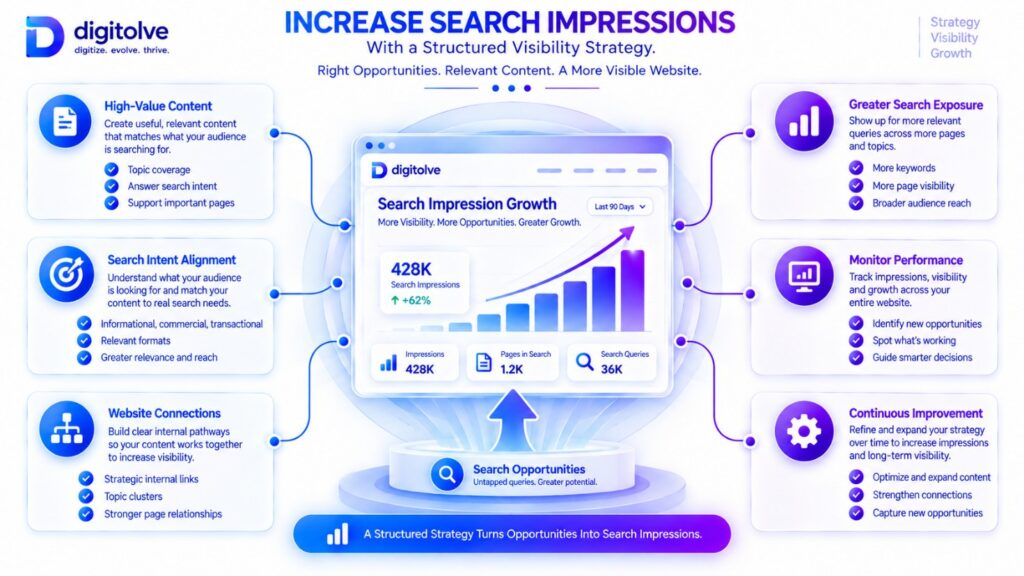
Instead of treating impressions as a number to increase at any cost, you begin looking at the relationship between search opportunities, search intent, content, website connections, exposure, monitoring, and continuous improvement.
In this article, we will build that perspective step by step and introduce a structured process for turning fragmented SEO activity into a more deliberate approach to search impression growth.
The objective is not simply to generate more impressions.
The objective is to expand relevant search exposure across the important content that your website has the potential to make visible.
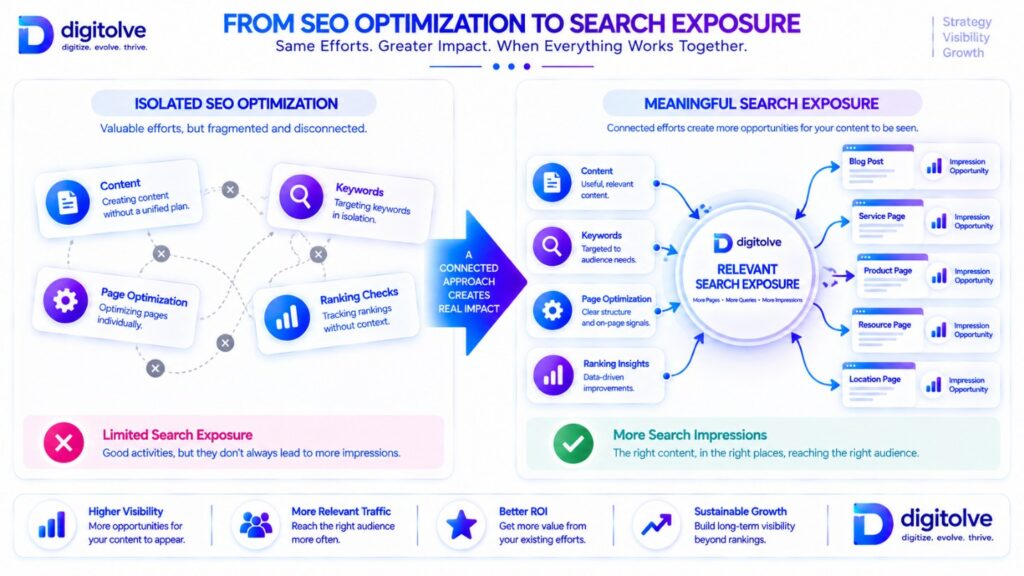
Table of Contents
What Search Impressions Actually Mean
Before trying to increase search impressions, it is important to understand what an impression actually represents.
A search impression is an indication that a page from your website was shown in search results for a user’s search. It represents search exposure, not necessarily a visit, a click, or a strong ranking position.
This distinction matters because impressions, clicks, CTR, and rankings describe different parts of the search journey.
Impressions tell you that your content received exposure in search.
Clicks tell you that users actually selected your result.
CTR (click-through rate) helps you understand how frequently users clicked after seeing your result.
Rankings describe where your page appeared for particular searches, but a page can receive impressions across many searches and positions rather than having one single ranking.
For example, a page might begin appearing for a wider range of relevant searches before those impressions produce a significant increase in clicks. In that situation, impression growth can provide an early indication that the page is gaining broader search exposure.
However, more impressions do not automatically mean better SEO.
A website could receive thousands of impressions from searches that are poorly aligned with its audience or business. Those impressions may add volume without creating meaningful value.
That is why impression growth should always be considered in terms of relevance and opportunity.
A useful way to think about the search journey is:
Search Opportunity → Search Appearance → Impression → Click
Each stage represents a different point in the path from a user’s search need to website engagement.
For website owners, this means the objective is not simply to make the impression number larger. The more useful objective is to create opportunities for important content to appear in searches that are genuinely relevant to the people the website is trying to reach.
You can use Google Search Console’s Performance Report to examine search performance data such as impressions, clicks, CTR, and related search information. The tool can help you observe what is happening, but the strategic question remains: where should your website expand its relevant search exposure?
That question takes us beyond simply measuring impressions and toward identifying the search opportunities that actually matter.
Start With the Search Opportunities That Matter
If the goal is to increase search impressions, the first instinct may be to look for as many additional searches as possible.
But increasing exposure indiscriminately is not a strong strategy.
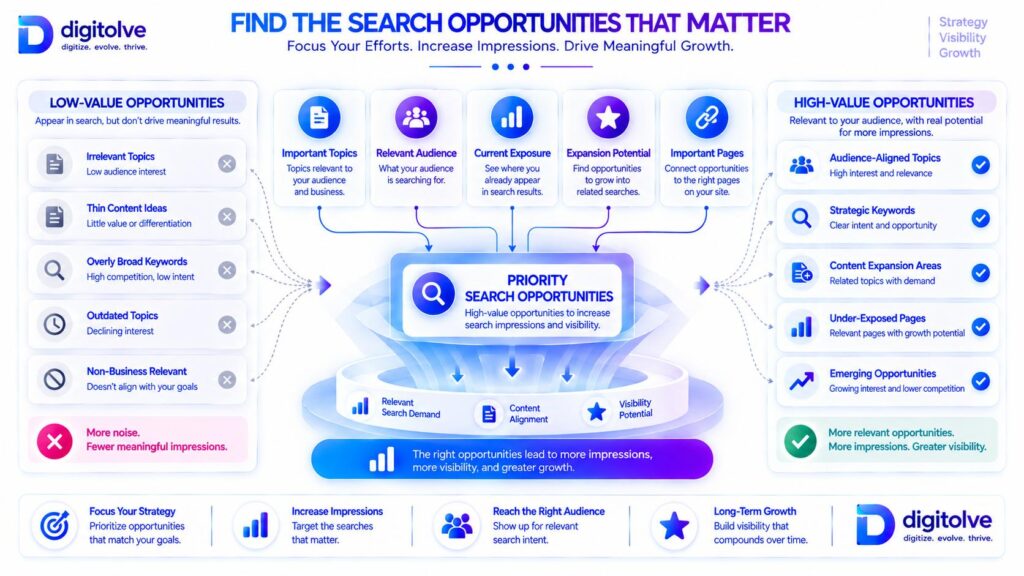
A website can appear for thousands of searches and still generate little meaningful business value if those searches are unrelated to its audience, products, services, or core topics.
Effective impression growth therefore begins with relevant search opportunities.
Start by considering which topics, pages, and areas of the website deserve greater search exposure. These may include important commercial pages, valuable informational content, supporting articles, or topic areas that are closely connected to the audience’s needs.
The goal is to understand where additional exposure could actually strengthen the website rather than simply increase a reporting number.
One useful distinction is between visibility volume and valuable visibility.
Visibility volume asks:
“How many searches is the website appearing in?”
Valuable visibility asks:
“How many relevant searches is the website positioned to participate in?”
The second question is much more useful for building a sustainable search-exposure strategy.
This also means that not every page should receive the same level of attention. Some pages may be strategically important, while others simply support the wider website. Some topics may have strong relevance to the audience, while others may have limited potential.
By identifying these differences, you can begin directing effort toward opportunities where additional search exposure is more meaningful.
The principle is simple:
More impressions are useful only when they come from searches relevant to your website and audience.
Once those opportunities are clear, the next question becomes whether your existing content is capable of earning exposure for them.
Build Content That Can Earn Search Exposure
Identifying a relevant search opportunity is only the beginning. Your website also needs useful content that gives searchers a meaningful reason to encounter your pages.
This does not mean publishing more articles simply to increase the number of URLs on the website.
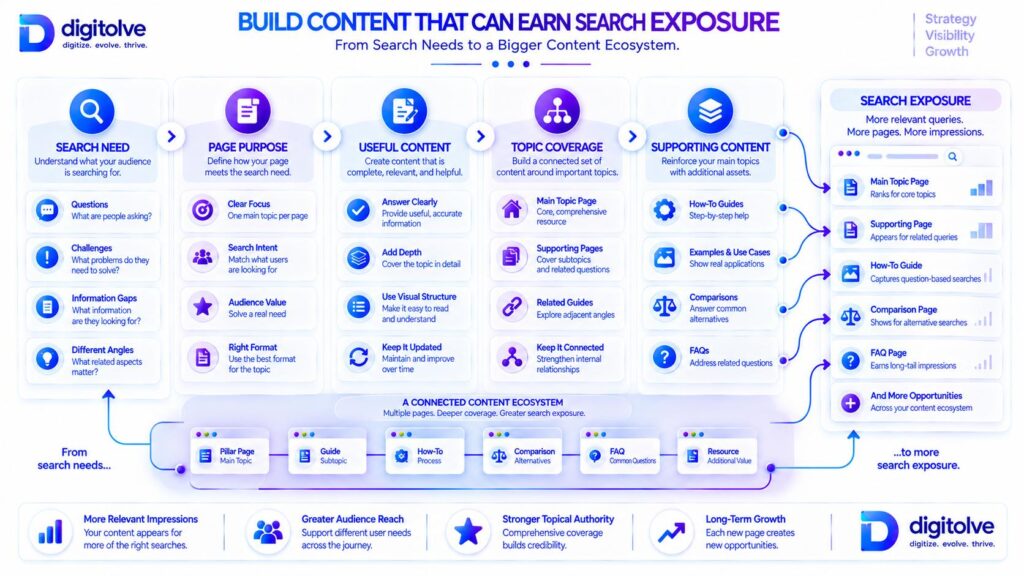
Content should be built around real search needs and a clear understanding of what each page is intended to provide.
A strong page has a recognizable purpose. It should address a meaningful need, provide useful information, and fit naturally within the broader subject area of the website.
This becomes especially important when trying to expand search exposure. A website may already have content covering a topic, but additional opportunities can remain if important areas of that topic are weakly covered or if supporting content is missing.
Instead of asking only:
“What keyword should I add?”
consider asking:
“What useful search need does this page help satisfy, and what related needs should the website cover?”
This shifts content development from isolated keyword targeting toward broader search-focused coverage.
Supporting content can also play an important role. Related pages can address connected questions, problems, and subtopics while contributing to a stronger overall content environment around an important subject.
If your existing content is not producing the results you expect, it can also help to step back and examine whether the content itself is serving a clear purpose. Our article Why Your Content Is Not Working explores that broader content problem from another angle.
The important point here is that content is one part of impression growth. It creates the substance that allows a website to participate in relevant searches, but its potential becomes stronger when it is aligned with search intent and connected to the wider website.
That leads to the next layer of the process: making sure the content is aligned with what the searcher actually needs.
Align Content With Search Intent
Having content around a relevant topic does not automatically mean that the content is positioned to earn meaningful search exposure.
The page also needs to align with the search intent behind the opportunity it is trying to serve.
Understand the Need Behind the Search
People search because they have a need, question, problem, comparison, or goal they want to address. A page has a stronger opportunity to earn relevant exposure when its purpose matches that underlying need.
This means looking beyond the words used in a search and considering what the person is actually trying to accomplish.
For example, someone looking for an explanation may need educational content, while someone comparing solutions may need a different type of page. A page designed for one purpose may therefore be poorly suited to another search need, even when the topic appears closely related.
Make the Page Purpose Clear
Every important page should have a recognizable purpose.
When the purpose of a page is unclear, the content may cover a topic without providing a strong answer to the specific search need. Clear purpose helps keep the content focused and makes its role within the website easier to understand.
A useful question to ask is:
“What specific search need is this page designed to satisfy?”
If that question cannot be answered clearly, the page may need a stronger connection between its topic, purpose, and intended audience.
Avoid Multiple Pages Serving the Same Purpose
Search exposure can also become less focused when several pages are created around essentially the same purpose without a clear distinction between them.
Instead of continually creating similar pages, consider whether an existing page should be strengthened, expanded, or supported by genuinely different content.
This helps the website develop clearer relationships between its pages rather than creating a collection of overlapping assets.
Relevance Comes Before Impression Volume
The objective is not to make a page appear for every possible variation of a search.
The objective is to build content that is genuinely relevant to the searches the website is trying to serve.
When search intent, page purpose, audience need, and content relevance work together, the website has a stronger foundation for expanding meaningful search exposure.
Search intent is therefore not a separate task that sits outside impression growth. It is one of the factors that helps determine whether additional impressions are actually valuable.
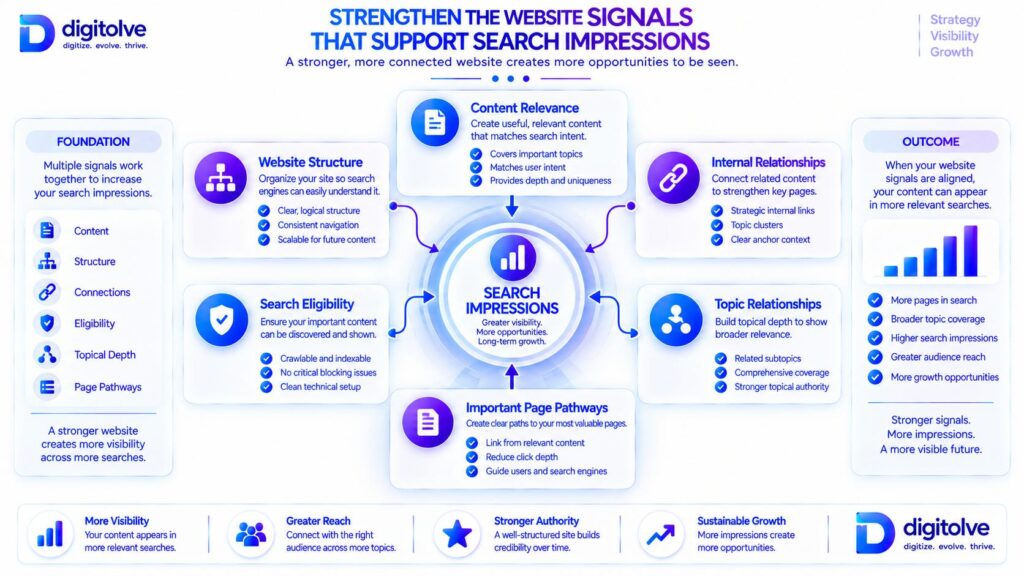
Strengthen the Website Signals That Support Impressions
Search impressions do not come from content in isolation. A website’s ability to gain search exposure is influenced by how its important content fits into the wider website.
This means impression growth should not be treated as an isolated page-level activity.
Connect Content Relevance With Website Structure
Useful content provides relevance, while website structure helps establish relationships between pages.
When related pages are connected in meaningful ways, the website can present a clearer relationship between important topics, supporting content, and the pages that matter most.
Strengthen Internal Relationships
Important pages should not exist as isolated assets.
Contextually relevant internal relationships can connect supporting content with important pages and help create clearer pathways throughout the website.
This is one reason a broader approach to website-wide search visibility matters. Search exposure is stronger when individual SEO efforts contribute to a connected website rather than operating independently.
Support Search Eligibility
Content also needs to remain accessible to search systems. If important content cannot be properly discovered, processed, or considered for search, the opportunity for exposure can be limited.
Technical accessibility therefore supports the wider impression-growth process, even though technical SEO is not the entire strategy.
Build Relationships Around Important Topics
Topic relationships also matter. Supporting pages can contribute to a stronger content environment around important subjects, while important pages can provide clear destinations within those relationships.
The objective is not to create connections simply for the sake of adding more links or more pages.
The objective is to make the website’s important content work together in a meaningful structure.
Think of these elements as connected rather than separate:
Content Relevance → Website Structure → Internal Relationships → Search Eligibility → Topic Relationships → Search Exposure
When these elements reinforce one another, the website has a stronger foundation from which relevant search impressions can develop.
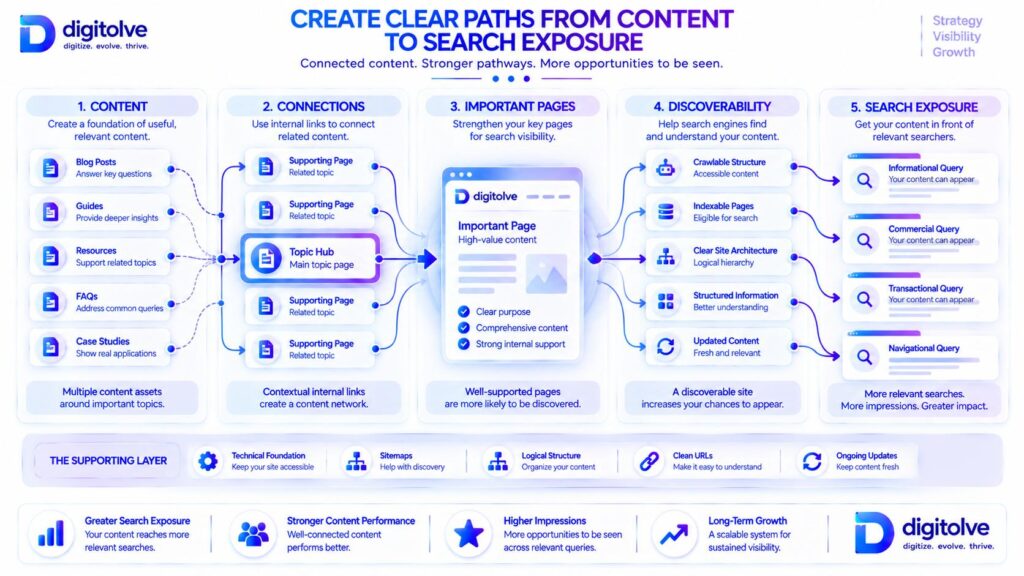
Create Clear Paths From Content to Search Exposure
Creating useful content is important, but important content should also have a clear place within the website.
When valuable pages are isolated, their relationship with the rest of the website can remain weak. A more connected structure can create clearer pathways between supporting content and important pages.
Make Important Content Discoverable
Start by making sure important content has meaningful pathways leading toward it.
Supporting articles, related pages, and other relevant website assets can create contextual relationships that make important content easier to encounter within the wider website.
Connect Supporting Content With Important Pages
Supporting content should have a reason to exist within the larger structure.
When a supporting page naturally relates to an important page, a contextual connection can help establish that relationship.
This is different from adding internal links simply to increase the number of links on a page. The connection should make sense to the visitor and contribute to the website’s overall topic structure.
Avoid Isolated Content
Publishing an article and leaving it disconnected from related content creates a fragmented content environment.
Instead, consider how each important piece of content fits into the surrounding topic relationships.
Ask:
“What related content should connect with this page, and which important page does this content ultimately support?”
Think Beyond a Single Page
Search exposure can become broader when multiple relevant pages contribute to the same overall subject area.
This does not mean every page should be connected to every other page. It means the connections that do exist should be purposeful, contextual, and useful.
These pathways also depend on the website’s ability to make important content available for discovery and processing. For a deeper look at that particular layer, see How to Build an Indexing System That Helps Google Find Every Important Page.
The broader principle is simple:
Content should not merely exist on the website. Important content should have meaningful relationships and pathways within the website.
Those relationships can help create a stronger foundation for expanding relevant search exposure beyond individual isolated pages.
Expand Search Exposure Beyond a Few Pages
A common pattern on content-driven websites is that a small number of pages generate most of the site’s search impressions while many other potentially valuable pages receive little exposure.
This can create the appearance of search visibility without creating a genuinely broad search presence.
Why One Successful Page Is Not Enough
A page that consistently earns impressions can be a valuable asset, but relying too heavily on a few high-performing URLs creates a narrow visibility base.
If most of the website’s search exposure comes from only a handful of pages, there may be an opportunity to develop additional relevant pages and topics that can contribute to search visibility.
Expand Exposure Across Important Pages
Instead of asking only how to increase impressions on an already successful page, look across the website for other important content that could reasonably participate in relevant searches.
This may include supporting articles, important informational pages, service-related content, or other assets that address meaningful needs within the website’s subject areas.
Build Supporting Content Around Meaningful Topics
Broader exposure does not necessarily require publishing content on unrelated subjects.
A stronger approach is to expand around topics that are already relevant to the website and its audience. Supporting content can address related needs while contributing to a broader search presence around important subject areas.
Reduce Dependence on Individual URLs
A healthier search-exposure structure allows multiple important pages to contribute rather than depending on one or two pages to carry most of the website’s organic exposure.
This does not mean every page needs to generate significant impressions. The goal is to identify where additional exposure would be meaningful and then strengthen those opportunities systematically.
The objective is not simply to increase impressions on one page. It is to expand relevant search exposure across the website’s important content.
Understand Why Impressions May Stay Low
When a website receives fewer search impressions than expected, it is tempting to assume that one specific SEO element must be responsible.
In reality, limited search exposure can be connected to several different areas of the website and its content.
Limited Search Opportunities
Some pages may simply have limited opportunities to appear in the searches that matter to the website. If the surrounding topic coverage is narrow, the page may have fewer relevant opportunities for exposure.
Weak Content Coverage
A website may have useful content but still leave important parts of a subject insufficiently covered. This can limit the number of relevant search situations in which the website can participate.
Misaligned Search Intent
Content can also struggle to gain meaningful exposure when the page does not closely match the underlying need behind relevant searches.
A page may discuss the right general topic while serving a different purpose from what the searcher actually needs.
Unclear Page Purpose
When the purpose of a page is unclear, it can become harder to build a strong connection between the content, its audience, and the search opportunities it is intended to serve.
Weak Website Relationships
Important content can also remain relatively isolated when its relationships with supporting content and other important pages are weak.
These factors do not mean that every low-impression page has the same underlying problem. They simply show why impression growth should be approached as a connected process rather than through a single optimization action.
If you need to understand why your website’s search exposure is weaker than expected, the Impression Gap Analyzer provides the diagnostic layer designed specifically for that question.
The role of this article is different: it focuses on what a structured impression-growth process can look like once you understand the need to improve relevant search exposure.
Build a Structured Impression Growth Process
Once you stop treating impressions as a number to increase through random SEO changes, the next step is to organize the work into a repeatable process.
A structured impression-growth process can be built around seven connected stages:
Identify → Align → Build → Connect → Expand → Monitor → Improve
Identify — Find Meaningful Opportunities
Begin by identifying relevant search opportunities, important topics, important pages, and areas where additional exposure could be valuable.
The question is:
“Where could this website earn more relevant search exposure?”
Align — Match Content With Search Needs
Next, consider whether the relevant pages are aligned with search intent, audience needs, and their intended purpose.
The question is:
“Is the page actually aligned with the search opportunity?”
Build — Strengthen Useful Coverage
Where meaningful opportunities exist, strengthen the content needed to address them. This may involve improving existing content or developing useful supporting coverage around important topics.
The question is:
“Does the website have enough useful content to participate in these searches?”
Connect — Strengthen Website Relationships
Connect relevant content through purposeful internal pathways and meaningful relationships between supporting content and important pages.
The question is:
“Are the website’s relevant pages working together?”
Expand — Develop Additional Exposure
Look beyond the website’s current sources of impressions and identify additional relevant opportunities where search exposure could be expanded.
The question is:
“Where can relevant search exposure be expanded beyond the current few pages?”
Monitor — Observe Exposure Changes
Track changes in impressions, important pages, emerging search opportunities, and areas where exposure is increasing or weakening.
The purpose is not simply to collect numbers. Monitoring provides feedback about where the process is producing movement and where further attention may be needed.
Improve — Turn Observations Into the Next Action
Finally, use what you observe to decide what should receive attention next.
A simple improvement flow is:
Finding → Priority → Action → Review
After review, the process begins again. This creates a continuous cycle rather than a one-time SEO project.
The important point is that these stages work together. Identifying an opportunity without alignment may produce weak results. Building content without connections may leave it isolated. Monitoring without a clear improvement process simply produces data without direction.
A structured process gives each SEO activity a role in expanding relevant search exposure.
Why Random SEO Optimization Does Not Always Increase Impressions
SEO optimization can improve individual pages, but optimization becomes less effective when every action is treated as a separate task without a clear connection to search exposure.
Optimizing Individual Pages Without Expanding Opportunities
A page can be carefully optimized while still having limited opportunities to appear in relevant searches.
Improving an existing page is useful, but if the website is not also identifying additional meaningful search opportunities, impression growth can remain limited.
Publishing Without a Clear Search Direction
Publishing more content can increase the size of a website without necessarily increasing its relevant search exposure.
When new content is created without a clear relationship to meaningful search needs, the website may gain more pages without gaining a stronger presence in the searches that matter.
Improving On-Page Elements Without Sufficient Coverage
Titles, headings, content improvements, and other on-page changes can strengthen a page, but they cannot replace useful topic coverage.
If important search opportunities are not adequately addressed, optimizing individual elements may not create the broader exposure a website is looking for.
Targeting Searches Without Understanding Intent
A page can be associated with a relevant topic while still failing to match the underlying need behind a search.
When search intent and page purpose are misaligned, simply adding more optimization does not necessarily create more meaningful impressions.
Building Content Without Website Relationships
Content that exists independently from the rest of the website can miss opportunities to contribute to a broader search-exposure structure.
Important pages, supporting content, and related topics should have meaningful relationships rather than functioning as disconnected assets.
Measuring Rankings While Ignoring Exposure
Rankings can provide useful information, but they represent only one part of the search journey.
If the objective is broader search exposure, impression movement can provide another important perspective on whether the website is appearing across a wider range of relevant searches.
The bigger problem with random optimization is that each task may be reasonable on its own while the overall process remains fragmented.
That leads to a more useful question:
“What SEO task should I optimize next?”
Instead, ask:
“Which improvement can expand relevant search exposure?”
That shift turns SEO activity into a more deliberate search-impression growth process.
Turn Search Impressions Into a Repeatable Visibility Strategy
Once search exposure becomes the objective, SEO activities can be organized around a clearer sequence instead of being performed independently.
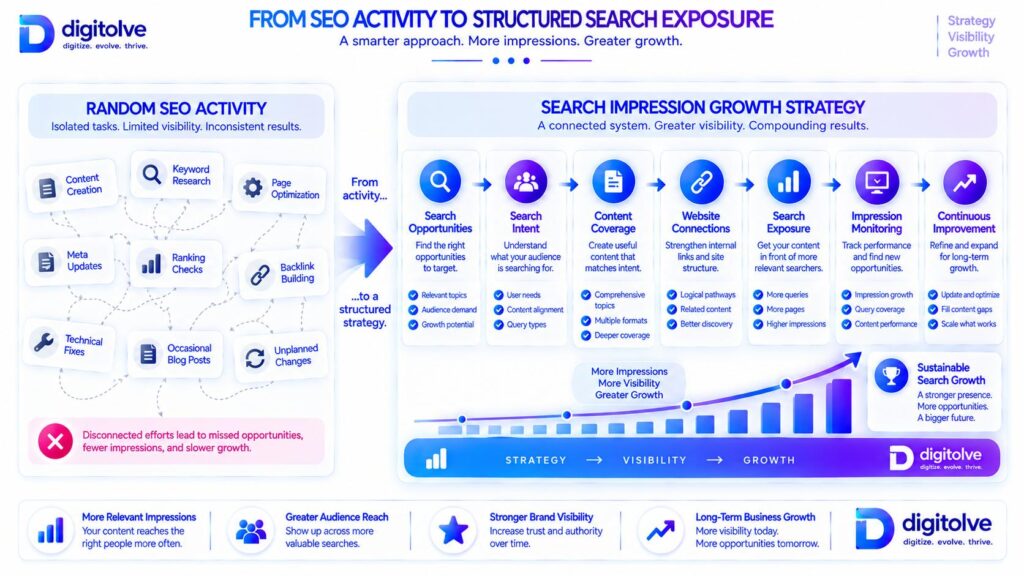
The Random SEO Activity Model
A fragmented approach often looks like this:
Keywords → Content → Optimization → Ranking Checks → Repeat
Each activity may have value, but the sequence does not necessarily answer an important question: how does each activity contribute to expanding relevant search exposure?
The Structured Visibility Strategy
A more connected approach begins with search opportunities and then builds the supporting layers needed to expand exposure:
Search Opportunities → Search Intent → Content Coverage → Website Connections → Search Exposure → Impression Monitoring → Continuous Improvement
This sequence creates a stronger relationship between the work being performed and the exposure the website is trying to develop.
Connect Each Activity to the Next
Search opportunities help establish direction.
Search intent helps clarify what the content needs to satisfy.
Content coverage provides useful resources around those opportunities.
Website connections help related content and important pages work together.
Search exposure becomes the outcome being observed.
Impression monitoring provides feedback.
Continuous improvement turns that feedback into the next round of action.
Why the Connection Matters
The strength of this approach is not any single step. It is the relationship between the steps.
For example, identifying an opportunity without creating appropriate content leaves the opportunity underdeveloped. Creating content without aligning it with search intent can weaken relevance. Building content without connecting it to the wider website can leave it isolated.
When the activities reinforce one another, impression growth becomes part of a repeatable process rather than a series of unrelated SEO experiments.
Search impression growth becomes more sustainable when SEO activities are organized around expanding relevant search exposure rather than optimizing isolated pages.
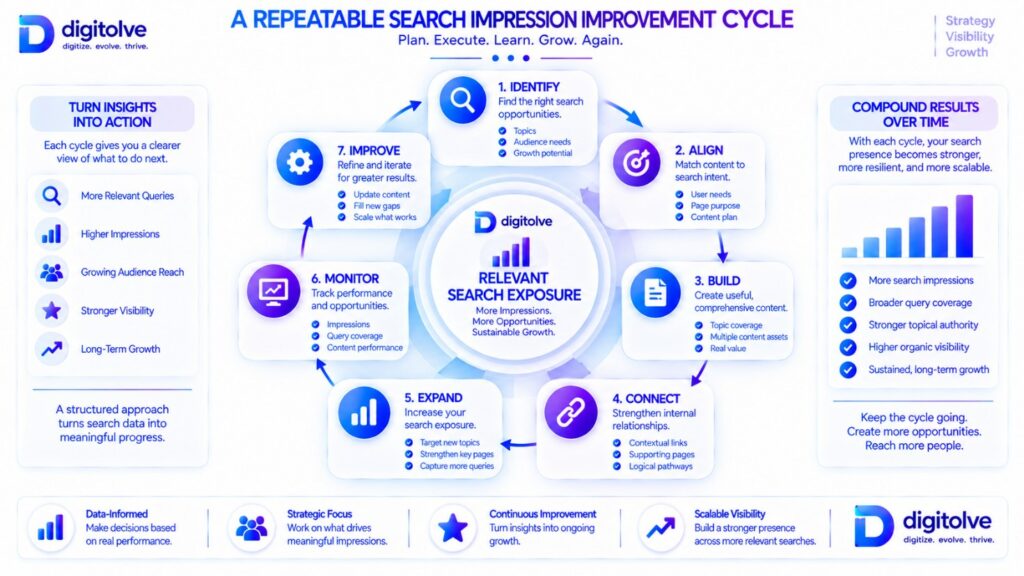
Build a Repeatable Search Impression Improvement Cycle
Search impression growth should not be treated as a project that ends after one round of optimization.
Search opportunities change, content develops, website priorities evolve, and exposure can move over time. A repeatable improvement cycle makes it possible to respond to those changes continuously.
Identify
Begin by finding meaningful opportunities for additional search exposure.
Look at important topics, pages, and areas where the website may have room to participate in more relevant searches.
Align
Evaluate whether the relevant content and page purpose match the search needs behind those opportunities.
The goal is to strengthen the relationship between what people are searching for and what the page is designed to provide.
Build
Strengthen the content coverage required to serve important opportunities.
This may involve improving existing content or developing useful supporting content where meaningful gaps exist.
Connect
Build purposeful relationships between supporting content, related topics, and important pages.
This helps the website operate as a connected content environment rather than a collection of isolated pages.
Expand
Look beyond the website’s current sources of impressions and identify additional relevant opportunities for search exposure.
The objective is to gradually broaden the number of important content assets capable of contributing to meaningful search visibility.
Monitor
Observe changes in impressions, important pages, emerging opportunities, and areas where exposure appears to be changing.
Monitoring provides feedback about where the process is moving and where further attention may be useful.
Improve
Turn observations into the next improvement decision.
A simple cycle is:
Finding → Priority → Action → Review
After the review, return to the beginning and identify the next meaningful opportunity.
Make Improvement Continuous
The value of the cycle comes from repetition.
Instead of optimizing once and moving on, the website continuously identifies opportunities, strengthens relevant content and relationships, observes exposure, and uses what it learns to determine the next improvement.
This creates a more deliberate operating rhythm for search impression growth.
Identify → Align → Build → Connect → Expand → Monitor → Improve ↺
The framework itself is simple. The real advantage comes from applying it consistently to the opportunities that matter most.
From Impressions to Broader Search Visibility
Search impressions are an important part of search exposure, but they are not the complete definition of search visibility.
Impressions Represent Search Exposure
An impression tells you that your content was exposed through search. It provides a useful view of how often your website is appearing in relevant search situations.
But exposure is only one layer of a broader visibility picture.
Relevant Exposure Can Broaden Search Presence
When important pages begin participating in more relevant searches, the website can develop a broader presence across its subject areas.
This is why impression growth should not be separated from the wider visibility strategy. The objective is to expand meaningful exposure across content that matters, rather than simply increase a single metric.
Visibility Requires Continuous Improvement
Search visibility is not something that can be permanently completed through one round of optimization.
New content is created, search opportunities evolve, website priorities change, and some pages may gain or lose exposure over time. A repeatable improvement process therefore becomes important for maintaining and expanding visibility.
Impressions can provide valuable feedback within that process.
They help you observe where search exposure is developing and where additional opportunities may deserve attention.
Impressions as Part of a Wider Strategy
The broader perspective is:
Search Opportunities → Relevant Exposure → Impressions → Wider Search Visibility → Continuous Improvement
Managing impressions effectively therefore means understanding how they contribute to the larger search-visibility picture without treating them as the only measure of SEO success.
For a broader website-wide approach to search visibility, the next level is the Search Visibility Growth System — Core, which is intended to provide a wider architecture beyond the focused impression-growth process covered here.
Conclusion — Increase Relevant Search Exposure, Not Just SEO Activity
Search impression growth does not come simply from doing more SEO.
Publishing additional content, optimizing individual pages, adding keywords, checking rankings, and making isolated improvements can all have a role, but they become more meaningful when they contribute to a connected search-exposure process.
Move From Activity to Strategy
The stronger approach is to move from:
Random SEO Optimization → Structured Visibility Strategy → Broader Relevant Search Exposure
This means starting with meaningful search opportunities, aligning content with search intent, building useful coverage, strengthening website relationships, expanding exposure, monitoring changes, and continuously improving the areas that matter.
Focus on Relevant Exposure
More impressions are not automatically better.
The real objective is to help important website content become visible across more searches that are relevant to the audience and meaningful to the website.
When content, intent, structure, and visibility efforts reinforce one another, impression growth becomes part of a repeatable process rather than a collection of disconnected SEO activities.
Build a Process You Can Improve
The most useful shift is therefore from asking how to increase a number to asking how to systematically expand meaningful search exposure.
Your website does not necessarily need more SEO activity. It needs a structured visibility strategy that helps more of its important content become relevant to more meaningful searches.
Build a Structured Search Impression Growth Process
Understanding why impressions matter is the first step. The next step is building a practical process for identifying opportunities, prioritizing where to focus, strengthening relevant content and connections, expanding search exposure, and monitoring what changes over time.
Need to Understand the Impression Gap?
If your first question is:
“Why is my website getting fewer impressions than it should?”
Start with the Impression Gap Analyzer from Smart Solve Lab. It provides the diagnostic layer for understanding where impression visibility may be weaker than expected.
Ready to Build the Process?
If your question is:
“How do I systematically increase relevant search impressions?”
The Search Impression Blueprint provides the practical execution framework for turning search opportunities into a structured impression-growth process.
It is designed to help you move through:
Identify → Align → Build → Connect → Expand → Monitor → Improve
Looking Beyond Impression Growth?
For websites that need a broader architecture for managing connected search-visibility growth across multiple layers, the future Search Visibility Growth System — Core represents the next level beyond this focused Mini framework.
The progression is simple:
Diagnosis → Focused Execution → Broader Visibility Architecture
If your website already has content but is not gaining the relevant search exposure you expect, the goal is not simply to do more SEO.
The goal is to build a repeatable process that helps the right content reach more meaningful searches.
FAQs About Search Impressions
1. What are search impressions?
Search impressions indicate that a page from your website was shown in search results for a user’s search. They represent search exposure, but they do not necessarily mean that someone clicked the result or visited your website.
2. How can I increase search impressions?
Start by identifying relevant search opportunities, aligning content with search intent, strengthening useful content coverage, connecting related pages, expanding exposure across important content, and monitoring changes over time. A structured process is more useful than relying on isolated SEO actions.
3. Why is my website getting low search impressions?
Low impressions can be associated with limited search opportunities, weak content coverage, search-intent misalignment, unclear page purpose, weak website relationships, or limited exposure across important pages. Understanding the specific reason requires looking at the website and its search data rather than assuming one universal cause.
4. What is the difference between impressions, clicks, and CTR?
Impressions represent search exposure, while clicks represent visits generated when users select a search result. CTR, or click-through rate, describes the relationship between clicks and impressions. These metrics provide different perspectives on the search journey.
5. Can SEO optimization increase search impressions?
SEO optimization can support search exposure, but optimization alone does not guarantee increased impressions. Impression growth can depend on relevant search opportunities, content quality and coverage, search intent, website relationships, and other connected factors.
6. Why do some pages get impressions while others do not?
Pages can have different levels of search exposure because they may address different search opportunities, have different levels of content coverage, serve different search intents, or have different relationships within the website. Not every page has the same search-exposure potential.
7. How does search intent affect search impressions?
Search intent helps determine whether a page is aligned with what users are actually trying to find. When page purpose and search intent are better aligned, the content has a stronger foundation for participating in relevant searches.
8. What is a search impression strategy?
A search impression strategy is a structured approach to expanding relevant search exposure. It can involve identifying search opportunities, aligning content with intent, building useful coverage, connecting website content, expanding exposure, monitoring impressions, and continuously improving the process.
Recommended Reading
If you want to understand the wider system behind search impressions, these three articles provide useful context around website visibility, indexing, and broader SEO visibility.
-
How to Increase Search Visibility Across Your Entire Website
Understand how important pages, content, structure, search intent, and connected website signals contribute to broader search visibility.
-
How to Build an Indexing System That Helps Google Find Every Important Page
Explore the indexing layer that supports the discovery and processing of important website content.
-
How to Build a Complete SEO Visibility System for Sustainable Organic Traffic Growth
Move from focused search-exposure improvement toward a broader SEO visibility system designed for sustainable organic growth.
Together, these resources create a useful progression:
Indexing → Search Visibility → Search Impressions → Complete SEO Visibility