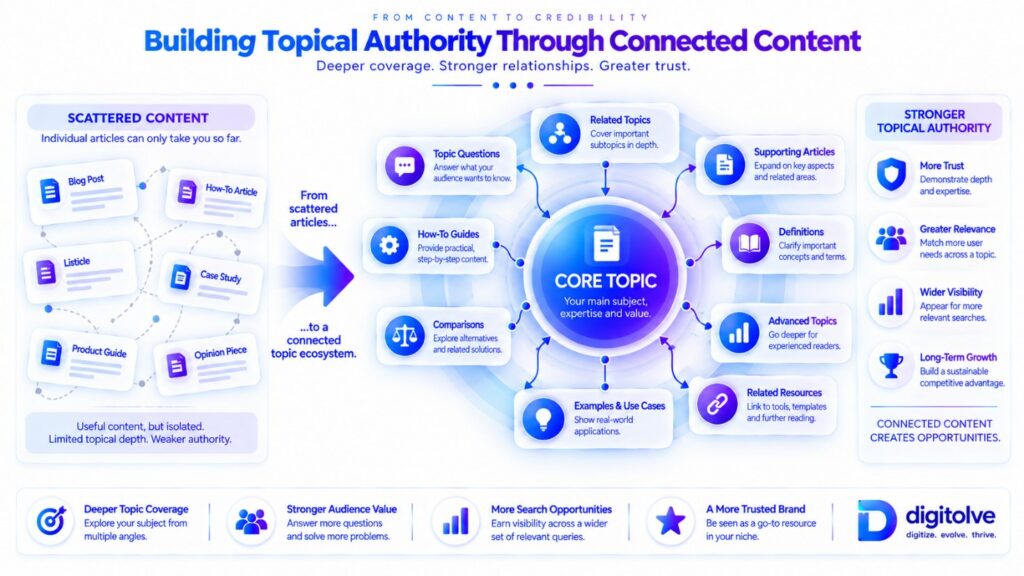
Publishing more content does not automatically create topical authority. A website can have dozens—or even hundreds—of articles and still lack a clear, connected body of coverage around the subjects that matter most to its audience and business.
The difference is not simply how much content a website publishes. It is how that content works together.
Strong topical authority develops when a website focuses on meaningful subject areas, builds useful depth around those subjects, connects related content, and continues strengthening those relationships over time. Instead of treating every article as an isolated asset, the website begins to develop a connected topic ecosystem.
This creates an important shift in how content should be approached:
Individual Content → Connected Topic Coverage → Stronger Topical Authority Foundation
In this guide, we will look at what topical authority actually means, how to choose the topics your website should focus on, how to build meaningful depth, how related content can work together, and how to develop a repeatable framework for strengthening your topical ecosystem over time.
The goal is not to publish content simply to increase volume. The goal is to deliberately build useful, relevant, and connected coverage around the topics your website should be known for.
Table of Contents
What Is Topical Authority?
Topical authority is the depth, relevance, and connectedness of a website’s coverage around the subjects that matter to its audience and purpose.
It is not simply a measure of how many articles a website has published. A website may publish consistently while still having scattered topics, shallow coverage, or weak relationships between its pages.
A stronger topical foundation develops when multiple useful pieces of content contribute to a broader subject area and work together as part of a meaningful ecosystem.
Topical Authority Is More Than Publishing More Content
Publishing regularly can help a website develop its content library, but publishing frequency alone does not create meaningful topical depth.
If every new article focuses on a different subject without a clear relationship to the website’s core areas, the result can become a large collection of individual pages rather than a coherent body of knowledge.
The more important question is not simply, “How much content have we published?” It is:
“How well does our content collectively cover the topics we want our website to be known for?”
Topic Depth vs. Content Volume
Content volume describes how much content exists. Topic depth describes how meaningfully a subject is covered.
Consider a website that has ten unrelated articles compared with another website that has ten useful articles covering different questions, subtopics, and supporting areas within one important subject.
The second structure creates a clearer topical direction because the content contributes to a shared subject area rather than existing as disconnected pieces.
How Related Content Builds Stronger Topic Coverage
Related content can contribute different perspectives, questions, and supporting information around the same broader subject.
When these pieces are connected meaningfully, the website begins to form a topic ecosystem instead of a collection of isolated articles.
Why One Strong Article Does Not Create Topical Authority
A single excellent article can be useful and valuable on its own. But topical authority operates at a broader level.
It develops through a body of useful content that covers a subject from multiple meaningful angles while maintaining clear relationships between those pieces.
Topical Authority vs. Individual Page Rankings
Topical authority should not be confused with the ranking performance of an individual page.
A page can perform well for a particular search while the wider website has limited coverage around the subject. Likewise, a website can develop broad and useful topical coverage without every individual page performing equally.
The strategic focus is therefore broader:
Individual Page → Related Content → Topic Coverage → Connected Topic Ecosystem
Topical authority develops when a website consistently demonstrates useful, relevant, and connected coverage around subjects that matter to its audience.
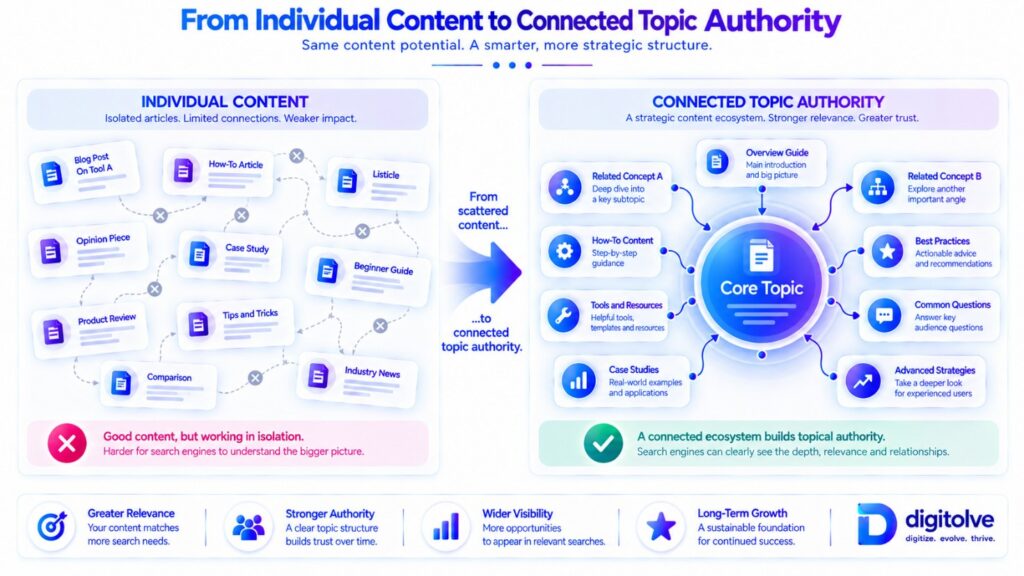
Choose the Topics Your Website Should Be Known For
Topical authority starts with focus. Before expanding content coverage, a website needs to understand which subject areas deserve sustained attention.
Trying to build authority around everything can weaken the overall direction of the content ecosystem. A stronger approach is to identify the subjects that are genuinely important to the website, relevant to its audience, and capable of supporting its broader purpose.
Start With Core Subject Areas
Begin by identifying the major subjects that sit closest to what your website actually provides.
These core subject areas become the foundation from which supporting topics, questions, and related content can develop.
The objective is not to create a long list of possible topics. It is to establish a focused set of subject areas around which meaningful coverage can be developed over time.
Connect Topics With Audience Needs
A topic should matter not only because it is related to your business, but because it connects with something your audience genuinely needs to understand, solve, compare, or accomplish.
This helps prevent a common content problem: creating articles because a topic appears interesting or popular without considering whether it belongs within the website’s larger purpose.
Prioritize Topics That Support the Website’s Purpose
Your most important topics should have a clear relationship with the role your website is trying to play.
Ask questions such as:
- Which subjects are central to what our website offers?
- Which subjects matter most to our audience?
- Which areas deserve deeper coverage over time?
- Which topics naturally support our broader website purpose?
These questions help turn topic selection into a strategic decision rather than a simple content-generation exercise.
Avoid Building Authority Around Random Topics
Random topic expansion can make a website’s content ecosystem increasingly difficult to understand.
One article may be valuable by itself, but if it has little meaningful relationship with the website’s important subject areas, it may contribute very little to the broader topical direction.
Topical authority is therefore not about claiming expertise in every possible subject. It is about developing meaningful coverage where the website has a legitimate reason to provide useful information.
Create a Clear Topical Direction
Once the core subject areas are identified, the next step is to create a clear direction for future coverage.
This gives every future content decision a larger context. Instead of asking only, “What should we publish next?” the website can ask:
“Does this topic strengthen an important subject area within our ecosystem?”
You cannot build meaningful topical authority everywhere. Start with the subjects that matter most to your audience and your website’s purpose.
Build Depth Around Your Core Topics
Once your core topics are clear, the next challenge is building enough useful coverage to make those subject areas meaningful.
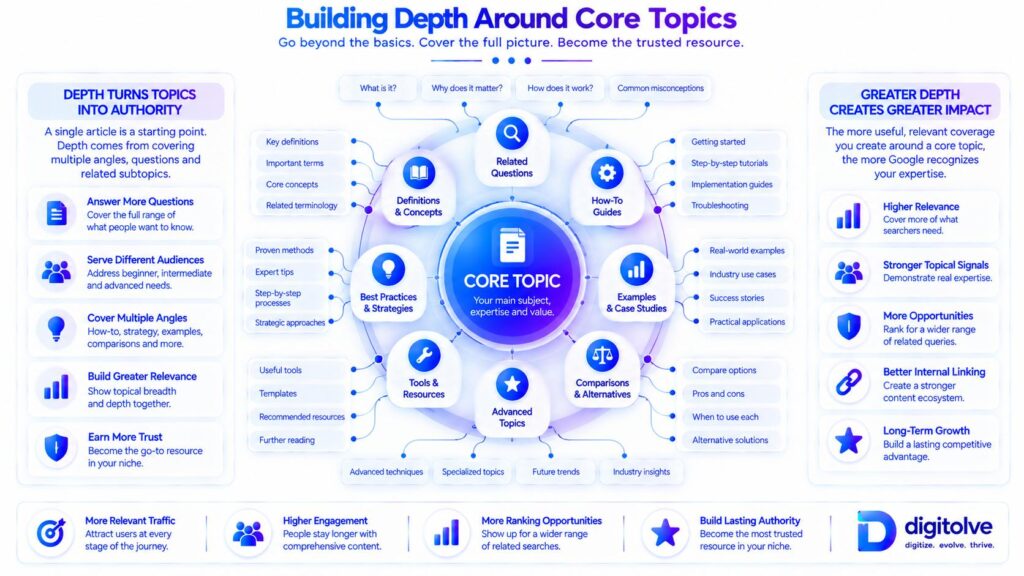
Depth does not mean producing as many articles as possible. It means exploring the important questions, perspectives, supporting subjects, and search needs that naturally belong within the topic.
Cover the Main Topic From Multiple Useful Angles
A core topic rarely consists of one question or one type of information.
Different people may approach the same subject from different perspectives. They may need definitions, comparisons, practical guidance, explanations, examples, solutions, or answers to related questions.
Useful topical depth comes from recognizing these meaningful angles and building coverage where it genuinely adds value.
Create Supporting Content Around Core Subjects
Supporting content can explore narrower areas that contribute to a broader core topic.
This creates a structure in which individual pages have their own purpose while still contributing to the larger subject area.
Instead of:
Core Topic → One Article
the ecosystem can develop toward:
Core Topic → Related Questions → Supporting Content → Deeper Coverage
Cover Different Questions and Search Needs
People rarely interact with a topic through one identical search need.
Some may be looking for a basic explanation, while others may need a practical solution or a deeper understanding of a specific part of the subject.
Building useful coverage means recognizing these meaningful differences rather than repeatedly creating pages that answer essentially the same question.
Move Beyond One Article Per Topic
One article can introduce a subject, but broader authority requires the subject to be developed thoughtfully.
Supporting content should add genuinely different value, explore relevant areas, and help create a more complete understanding of the topic.
This is where topical depth begins to differ from simple content volume.
Build Depth Without Creating Unnecessary Content
More pages are not automatically better.
Creating multiple articles that repeat the same information can increase volume while adding very little useful coverage. It can also make the relationship between pages less clear.
The goal is therefore selective depth: identify meaningful gaps in the subject area and strengthen them with genuinely useful coverage.
A strong topical ecosystem grows by answering more meaningful questions—not by creating more pages simply to make the content library larger.
Connect Related Content Into a Topic Ecosystem
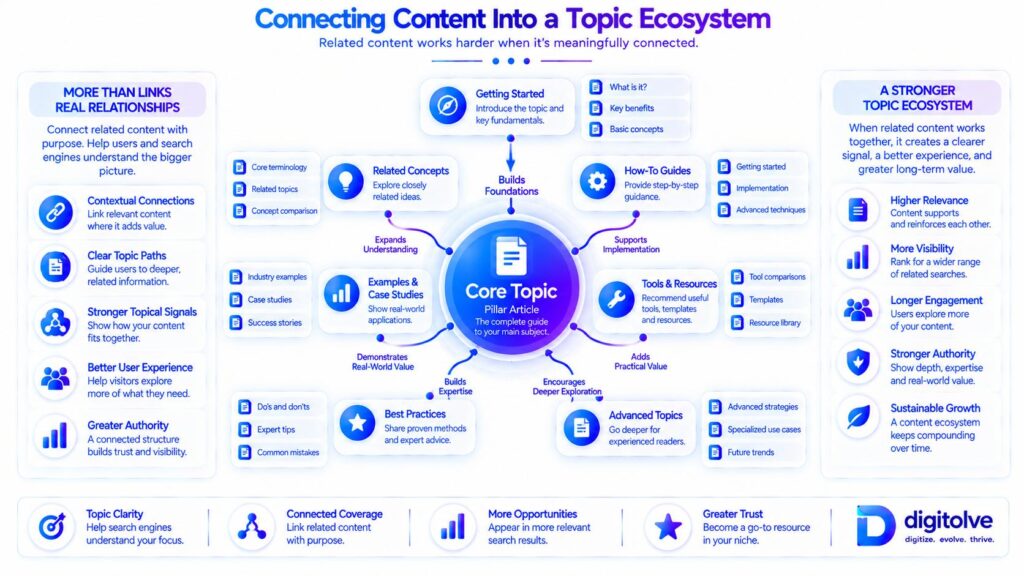
Building topical depth is only one part of the process. The next step is helping related content work together as a connected ecosystem.
When important articles exist without meaningful relationships, the website can still feel like a collection of individual pages. Connecting related content gives the broader topic structure more coherence.
Why Related Articles Should Work Together
Each article should have its own clear purpose, but it should also have a meaningful place within the wider topic ecosystem.
A supporting article can contribute context to a broader topic, while a core article can bring together related areas. This creates relationships between pieces of content rather than leaving them to operate independently.
Connect Supporting Content With Core Content
Supporting content should have a logical relationship with the core subject it contributes to.
This does not mean every page needs to link to every other page. Instead, connections should exist where they help users move between genuinely related information and understand how different parts of the subject fit together.
Build Meaningful Content Relationships
Content relationships should reflect actual subject relationships.
For example, a detailed supporting article may naturally connect to a broader guide, while a broader guide may direct readers toward more specific areas of the same subject. These relationships help transform separate pages into a more coherent topic ecosystem.
This is also where contextual internal linking can support the broader structure of related content.
Use Contextual Internal Links
Internal links are most useful when they connect pages for a meaningful reason.
Instead of adding links simply to increase the number of internal links on a page, consider whether the linked content genuinely extends, supports, clarifies, or complements the current subject.
The goal is not to create a complicated web of links. It is to create useful pathways between related pieces of content.
Avoid Isolated Topic Coverage
Important content should not remain isolated when other relevant content already exists around the same subject.
Look at the relationships between your core content and supporting content. Where a meaningful connection exists, strengthen it. Where several pages cover closely related areas, consider how they can contribute to a clearer topic ecosystem.
The principle is simple:
Useful Content + Meaningful Relationships → Connected Topic Ecosystem
Topical authority becomes stronger as content stops functioning as isolated articles and begins working together around meaningful subject areas.
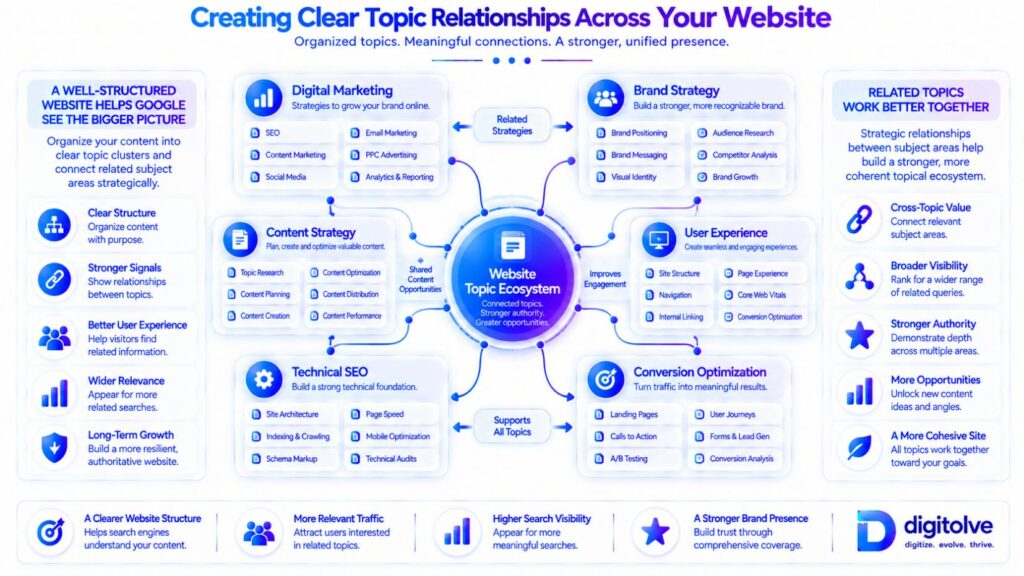
Create Clear Topic Relationships Across Your Website
As a website grows, topical relationships can become increasingly complex. Multiple subject areas may contain their own core and supporting content, while some topics may naturally connect with one another.
A clear topical structure helps keep these relationships meaningful instead of allowing the content ecosystem to become scattered.
Organize Content Around Meaningful Subject Areas
Start by looking at your website as a collection of important subject areas rather than simply a list of URLs.
Each major subject should have a clear place within the broader content ecosystem. Supporting topics can then be organized around the subject areas they genuinely belong to.
Connect Closely Related Topics
Some topics naturally support one another. When the relationship is meaningful, connecting them can create a more complete topical picture.
The objective is not to connect everything. It is to identify the relationships that make sense from the perspective of the subject, the audience, and the website’s purpose.
Separate Supporting Topics From Unrelated Topics
Not every topic that appears interesting belongs inside the same topical ecosystem.
Keeping unrelated subjects separate helps preserve a clear direction. A website should be able to distinguish between content that strengthens an important topic and content that simply happens to exist on the same domain.
Create Logical Topic Hierarchies
A useful topical structure can move from broad subjects toward narrower supporting areas:
Core Subject → Major Topic → Supporting Topic → Specific Question
This does not require every website to follow one rigid hierarchy. The important principle is that the relationships should reflect the actual meaning and purpose of the content.
Make Your Website’s Topical Direction Easier to Understand
When important topics, supporting areas, and related content have clear relationships, the overall content ecosystem becomes more coherent.
This also creates a stronger foundation for continued content development because future topics can be evaluated according to where they belong within the existing ecosystem.
Instead of continually asking what content should be created next, the website can begin asking:
“Where does this topic belong, and how does it strengthen the subject areas we have chosen to develop?”
Strengthen Content Relevance Within Each Topic
Topical authority depends on more than having related pages. The content within those topic areas should also be genuinely useful and relevant to the needs it is intended to address.
A connected ecosystem made up of repetitive, unclear, or low-value pages does not create meaningful topical depth. Each supporting piece should contribute something useful to the broader subject.
Give Every Page a Clear Purpose
Every important page should have a reason for existing within the topic ecosystem.
Before expanding a topic, consider what the page is intended to help the audience understand or accomplish and how that purpose differs from the pages that already exist.
Match Content With the Search Need
Useful topical coverage requires attention to the underlying need behind the content.
If several pages are created for essentially the same purpose, the website may increase content volume without meaningfully increasing topic depth.
The objective is to cover genuinely different needs and perspectives that belong within the subject.
Provide Useful Context Around the Main Topic
Supporting information should help the reader understand the subject more completely.
Context can come from related concepts, supporting explanations, examples, questions, or other information that naturally belongs within the topic.
Avoid Thin or Repetitive Topic Coverage
Topic depth is weakened when multiple pages provide substantially overlapping information without a clear reason for being separate.
Before adding another page, consider whether it introduces a genuinely useful angle or simply repeats coverage that already exists.
Make Supporting Content Genuinely Useful
Supporting content should contribute real value to the topic ecosystem rather than existing only to create the appearance of greater topical coverage.
This distinction matters because topical authority is not created by assembling the largest possible collection of pages. It is developed through useful, relevant, and connected coverage that becomes stronger over time.
At the individual-page level, relevance and usefulness still matter. At the website level, those pages should contribute meaningfully to the broader topic relationships being developed.
Build Authority Through Consistent Topic Coverage
Topical authority is not built through a single publishing campaign. It develops as a website continues to strengthen meaningful coverage around the subject areas it has chosen to focus on.
This means consistency should not be understood simply as publishing on a fixed schedule. The more important form of consistency is continuing to develop the same important topic areas with useful, relevant, and connected content.
Consistency Is More Than Publishing Frequency
Publishing frequently can increase the amount of content on a website, but frequency by itself does not determine whether the website is developing meaningful topical depth.
A more useful approach is to maintain consistent attention on the subject areas that matter most, while allowing new content to contribute something genuinely useful to those areas.
Keep Expanding Important Topic Areas
As your understanding of an important subject develops, there may be additional questions, supporting areas, and useful perspectives worth covering.
Expansion should therefore follow the natural development of the topic rather than a requirement to produce a certain number of articles.
Strengthen Existing Topic Relationships
Topical growth does not always require creating something new. Existing content relationships can also become stronger when related pages are reviewed and connected more meaningfully.
This creates an ongoing process in which new coverage and existing coverage support one another.
Build Supporting Content Over Time
A topic ecosystem can become deeper gradually. Supporting content can be added as new meaningful areas emerge, while existing content continues to contribute to the broader subject.
This makes topical authority a cumulative process rather than a one-time content project.
Let Your Topic Ecosystem Grow Naturally
Not every possible subtopic needs to be covered. Growth should remain connected to the website’s purpose and the needs of its audience.
Consistency means strengthening meaningful topic coverage over time—not simply publishing frequently.
Avoid Common Topical Authority Mistakes
Building topical authority can become less effective when content decisions are driven by volume, randomness, or short-term opportunities rather than a clear topical direction.
Recognizing these patterns helps keep the content ecosystem focused and meaningful.
Publishing Random Topics
Publishing on unrelated subjects can make it difficult to develop meaningful depth around the topics that matter most.
A growing content library should have a clear relationship with the website’s important subject areas.
Confusing Content Quantity With Authority
A larger number of articles does not automatically mean stronger topical authority.
Useful depth, meaningful coverage, and relationships between content matter more than simply increasing the number of published pages.
Creating Multiple Pages With the Same Purpose
Creating several pages that address essentially the same need can increase repetition without adding meaningful topical coverage.
Before creating another page, consider whether it contributes a genuinely different and useful angle.
Building Topic Clusters Without Real Relationships
Grouping pages together does not automatically create a meaningful topic ecosystem.
The pages should have genuine subject relationships and should contribute to a coherent understanding of the broader topic.
Creating Content Only for Keywords
Keywords can help describe what people search for, but topical authority should not be reduced to producing one page for every keyword.
The broader question is whether the content contributes useful coverage to an important subject area.
Ignoring Existing Content
Topical growth is not only about creating new pages. Existing content may contain useful relationships or opportunities for stronger coverage that should not be overlooked.
Expanding Into Topics That Do Not Support the Website
Not every related-looking topic deserves a place in the ecosystem.
Expansion should remain connected to the website’s purpose, audience, and important subject areas.
The objective is not to create the largest possible content library. It is to build a meaningful body of connected coverage around the topics that matter.
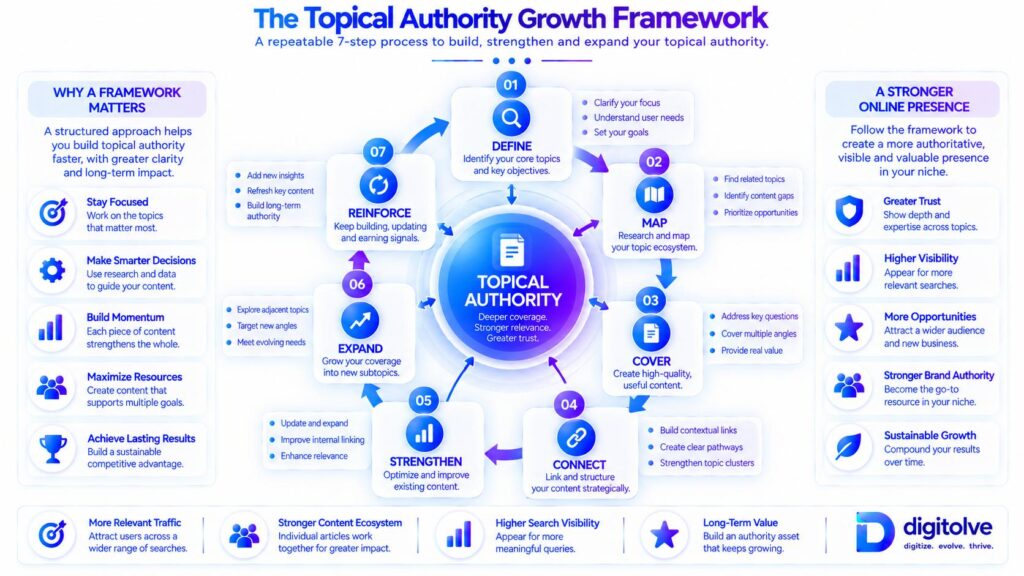
Build a Repeatable Topical Authority Framework
Topical authority becomes easier to develop when topic decisions follow a repeatable process rather than being made independently for every new article.
A simple framework can organize the major stages of building and strengthening a topical ecosystem:
DEFINE → MAP → COVER → CONNECT → STRENGTHEN → EXPAND → REINFORCE
Define
Identify the subject areas that are most important to the website, its audience, and its overall purpose.
Map
Understand the main topics, supporting areas, related questions, and meaningful relationships within each subject area.
Cover
Develop useful content across meaningful angles and search needs instead of repeatedly covering the same narrow perspective.
Connect
Create meaningful relationships between related content so that individual pages contribute to a larger topic ecosystem.
Strengthen
Improve topic depth, useful coverage, relevance, and relationships where the ecosystem has room to become stronger.
Expand
Identify additional topic areas that naturally belong within the ecosystem and can provide genuine value to the audience.
Reinforce
Continue strengthening the ecosystem as new content, questions, and knowledge develop over time.
The important principle is that topical authority is not a one-time publishing task. It is a continuous process of focused coverage, meaningful relationships, strengthening, and thoughtful expansion.
The framework provides the strategic direction. The Topical Authority Blueprint turns that direction into practical planning tools, workflows, and implementation assets.
Why Random Content Publishing Does Not Build Strong Authority
Publishing content consistently can become ineffective when every article is treated as a separate opportunity rather than as part of a broader topical direction.
A website may continue adding new posts while its most important subject areas remain shallow, disconnected, or unevenly developed.
Publishing Without Topical Direction
When content decisions are made without a clear understanding of the subjects the website should focus on, the content library can gradually become scattered.
Individual articles may still provide value, but they may not contribute meaningfully to the website’s most important topic areas.
Creating Disconnected Articles
Related content becomes more useful when the relationships between those pieces are clear.
If articles are created independently without considering how they contribute to a broader subject, opportunities to develop deeper and more connected coverage can be missed.
Chasing Every Available Keyword
Keyword opportunities can be tempting, particularly when they appear to offer another topic to publish about. But pursuing every available keyword can pull a website away from the subject areas it is actually trying to develop.
The better question is whether a search opportunity belongs within an important topic ecosystem and adds meaningful coverage.
Focusing on Volume Instead of Depth
Increasing the number of articles can create the appearance of progress while leaving important areas insufficiently covered.
Topical depth requires deliberate attention to meaningful questions, supporting subjects, relationships, and useful coverage—not simply a larger publishing queue.
Ignoring Relationships Between Pages
Even strong individual articles can remain disconnected when the relationships between related pages are not considered.
Topic authority becomes more coherent when content contributes to a broader structure rather than functioning entirely on its own.
Creating Content Without Strengthening the Wider Topic Ecosystem
Every new article should be considered in relation to the topic ecosystem around it.
Does it deepen an important subject? Does it address a meaningful supporting area? Does it strengthen the overall coverage? Does it create a useful relationship with existing content?
These questions shift the focus away from publishing for the sake of publishing.
More Content → Better Topic Coverage → Connected Authority
The goal is not to stop publishing. It is to make publishing contribute to a deliberate and increasingly connected topical ecosystem.
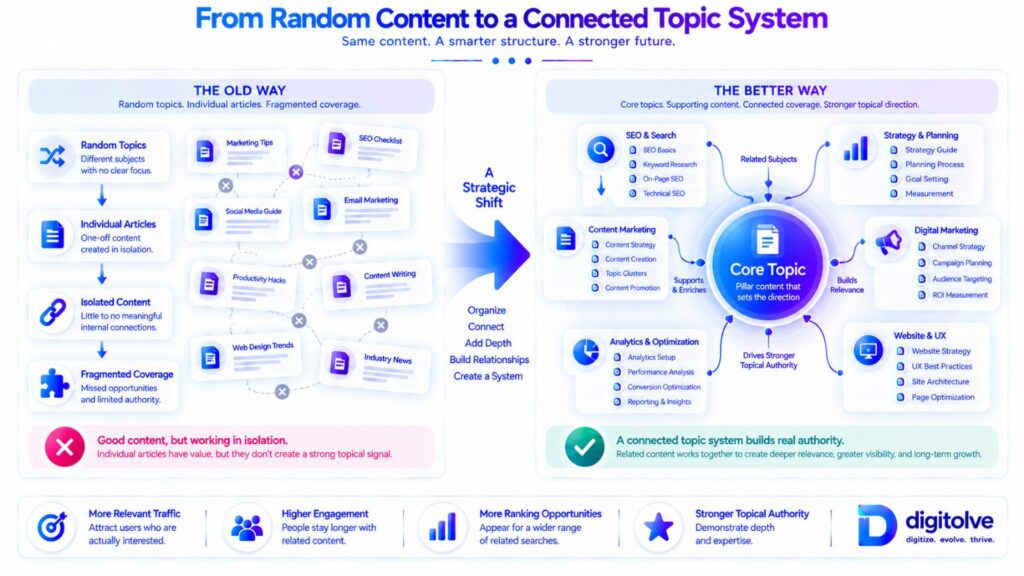
Turn Individual Articles Into a Connected Topic System
The biggest shift in topical authority happens when a website stops viewing its articles as isolated assets and starts viewing them as components of a larger topic system.
This does not mean every article needs to connect to every other article. It means each important piece of content should have a meaningful place within the subject areas the website is deliberately developing.
From Fragmented Coverage
A disconnected content approach can look like this:
Random Topics → Individual Articles → Isolated Rankings → Fragmented Coverage
In this model, content decisions are primarily made one article at a time. The website may continue growing, but the relationships between its important subject areas remain unclear.
To Connected Coverage
A more deliberate approach develops around a broader structure:
Core Topics → Supporting Content → Topic Relationships → Connected Coverage → Stronger Topical Direction
Here, individual articles still have their own purposes, but they also contribute to a larger subject area.
Make Each Article Part of Something Larger
Before creating or expanding content, consider where the article belongs within the existing topic ecosystem.
A useful supporting article should strengthen a meaningful subject area. A broader article can bring related areas together. Existing content can provide context for new content, while new content can strengthen the coverage around established topics.
Build Relationships Instead of Collections
A collection is simply a group of pages. A topic system is a group of pages whose purposes and relationships make sense together.
That distinction is important because topical authority depends on meaningful coverage rather than the size of the content library alone.
Your website becomes strategically stronger when its content works together to demonstrate meaningful coverage around the topics that matter.
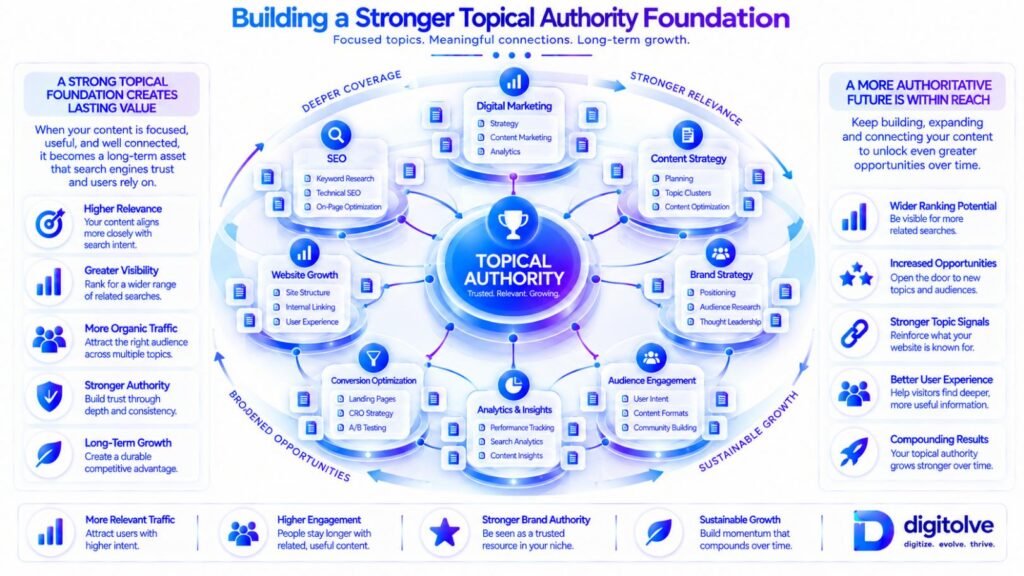
Build a Repeatable Topical Authority Growth Cycle
Topical authority should not be treated as a project that ends once a certain number of articles has been published. A stronger approach is to create a cycle that allows the topic ecosystem to develop continuously.
The same framework can guide this ongoing process:
DEFINE → MAP → COVER → CONNECT → STRENGTHEN → EXPAND → REINFORCE ↺
Define
Continue identifying the subject areas that deserve attention based on the website’s purpose and audience needs.
Map
Review how core topics, supporting areas, questions, and content relationships fit together.
Cover
Develop useful coverage where meaningful areas remain unexplored or insufficiently developed.
Connect
Strengthen meaningful relationships between related content so the ecosystem becomes more coherent.
Strengthen
Improve depth, relevance, supporting coverage, and relationships within important topic areas.
Expand
Develop additional areas when they naturally belong within the ecosystem and provide genuine value.
Reinforce
Continue strengthening the ecosystem as new content, questions, and knowledge develop over time.
This creates a continuous cycle:
Priority → Coverage → Relationship → Depth → Reinforcement → Continued Improvement
The purpose is not endless expansion. It is deliberate development of the topic areas that matter most.
From Topical Authority to Broader SEO Growth
Topical authority is not an isolated SEO objective. A well-developed topical ecosystem can provide a stronger foundation for broader search visibility and long-term content growth.
When a website develops meaningful coverage around important subjects, its content can address a wider range of relevant questions and create stronger relationships between related areas.
Topical Authority Strengthens the Foundation for Broader Visibility
Focused topic coverage gives a website more opportunities to provide useful information around subjects that matter to its audience.
The objective is not to create visibility for unrelated searches. It is to develop meaningful exposure around the subject areas the website has deliberately chosen to build.
Connected Content Creates Stronger Website-Level Relationships
As related content becomes connected, individual pages contribute to a broader website-level topic structure.
This helps turn content development into a cumulative process rather than a series of disconnected publishing decisions.
Deeper Coverage Creates More Opportunities to Serve Relevant Searches
A subject can contain many meaningful questions and supporting areas. Thoughtful coverage allows a website to address these different needs without abandoning its central topical direction.
Authority Development Is Long-Term
Topical authority is developed through continued attention to useful coverage, meaningful relationships, depth, and reinforcement.
It should therefore be viewed as an ongoing process rather than a short-term campaign with a fixed endpoint.
Topical Authority Blueprint → Topical Authority System
The Mini provides a focused framework for deliberately building and strengthening a topical ecosystem. A future Core system can extend this approach into broader and more advanced topical authority management across larger websites.
Conclusion — Build Authority Around Topics, Not Just Articles
Publishing more articles does not automatically create topical authority.
A website develops a stronger topical foundation when its content is deliberately organized around important subject areas, built with meaningful depth, connected through genuine relationships, and strengthened over time.
The transformation is straightforward:
Random Content → Connected Topic Coverage → Stronger Topical Authority
The goal is not to publish on every possible subject or create the largest possible content library. It is to build useful and connected coverage around the topics that matter most to your audience and your website’s purpose.
When individual articles become part of a deliberate topic ecosystem, content development becomes more strategic. New content can strengthen existing subject areas, supporting pages can contribute additional depth, and meaningful relationships can help the ecosystem continue developing over time.
Your website does not necessarily need more articles. It needs meaningful, connected coverage around the topics that matter most to your audience and business.
Build Your Topical Authority Systematically
Understanding topical authority is the first step. The next step is turning that understanding into a deliberate planning and execution process.
If your existing content is not building the authority foundation you expected, start with the diagnostic layer:
Why Your Content Doesn’t Build Authority (Even After Publishing Many Posts)
For the practical execution layer, the Topical Authority Blueprint helps you move from scattered content toward deliberate topic focus, coverage, relationships, strengthening, expansion, and reinforcement.
DEFINE → MAP → COVER → CONNECT → STRENGTHEN → EXPAND → REINFORCE
The future Topical Authority System — Core can extend this foundation into broader topical authority management for larger and more complex websites.
Diagnosis → Understanding → Execution → Advanced System
Build around the topics that matter. Connect the content that belongs together. Strengthen the ecosystem over time.
FAQs — Topical Authority
What is topical authority?
Topical authority is the depth, relevance, and connectedness of a website’s content coverage around important subject areas. It develops when useful content works together to provide meaningful coverage rather than existing as isolated articles.
How do you build topical authority?
Start by defining the important topics your website should focus on, map their relationships, build useful coverage, connect related content, strengthen topic depth, expand naturally, and reinforce the ecosystem over time.
Does publishing more content increase topical authority?
Publishing more content alone does not guarantee stronger topical authority. Content should contribute meaningful coverage to important subject areas and have genuine relationships with related content.
What is the difference between topical authority and domain authority?
Topical authority concerns how meaningfully a website covers and connects a particular subject area. Domain Authority is a third-party SEO metric used by some tools to estimate the relative strength of a domain. They are not the same concept.
How does internal linking support topical authority?
Meaningful internal links can connect related content and help create clearer relationships between pages within a topic ecosystem. The links should be contextual and useful rather than added simply to increase link volume.
How many articles do you need to build topical authority?
There is no universal number of articles required. The appropriate amount depends on the subject
Continue building your SEO knowledge through these related Digitolve resources: Explore the content relevance foundation behind useful, clear, and search-aligned content. Learn how connected website-wide visibility extends beyond individual content and topic areas. Move from individual SEO execution layers toward a broader connected visibility system.Recommended Reading