content strategy for organic traffic:
Publishing content consistently can feel like progress. You have a content calendar, you are producing articles, and new pages are being added to your website regularly. Yet organic traffic may still remain inconsistent, slow, or far below what you expected.
The problem is not always how often you publish. It can be where your content is going, why each piece exists, and how your overall content efforts fit together.
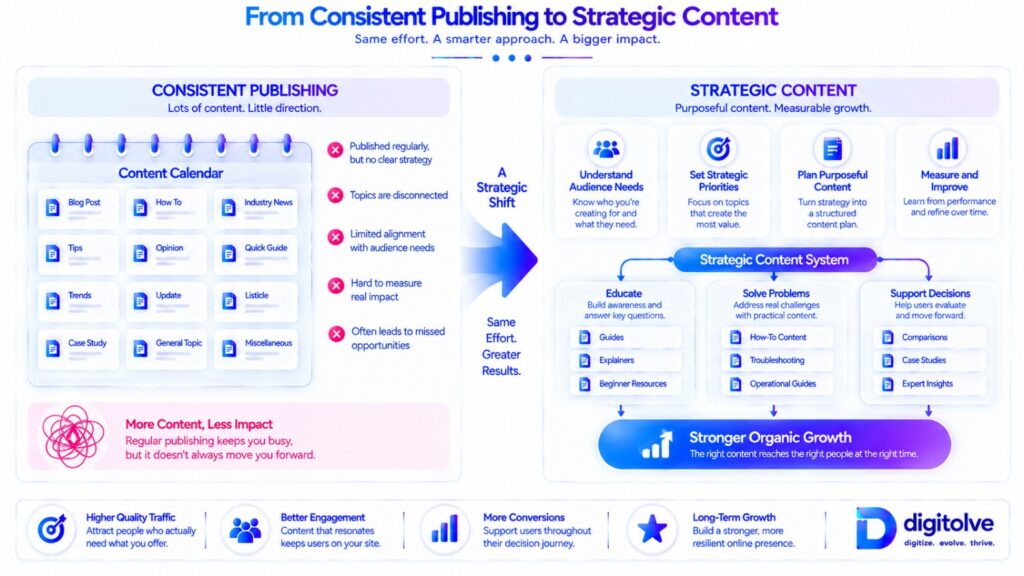
A publishing calendar tells you when to publish. A content strategy determines what you should create, why it matters, who it should serve, what should be prioritized, and how your direction should evolve over time.
Without that strategic direction, content can easily become a collection of individual articles rather than a connected system. One article may target one audience need, another may address an unrelated topic, and a third may be created simply because there was an available publishing slot.
This creates activity without necessarily creating meaningful strategic coverage.
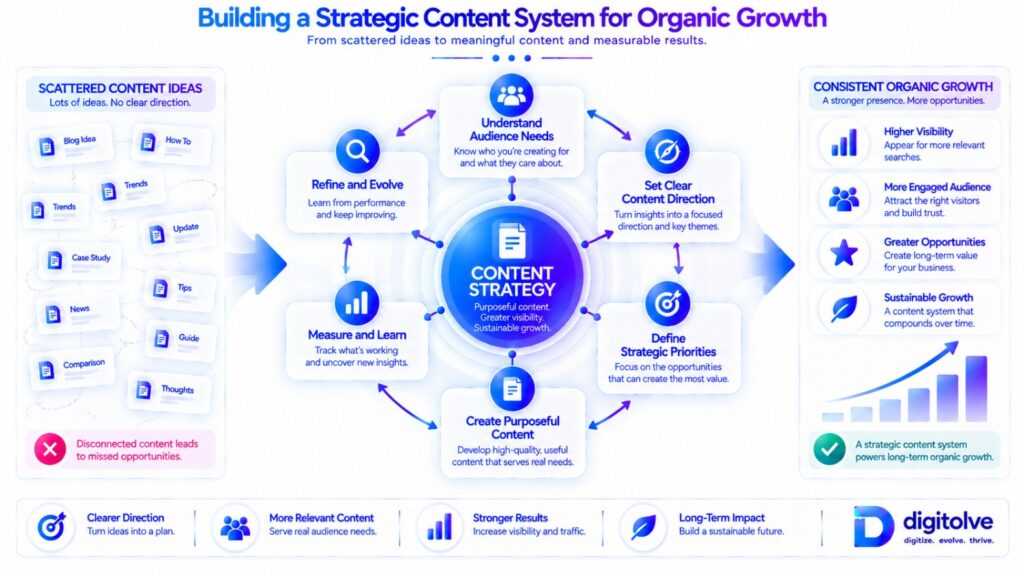
A strong content strategy starts with a different sequence:
Audience Needs → Clear Content Direction → Strategic Priorities → Purposeful Content → Connected Content Strategy → Performance Learning → Refined Strategy → More Consistent Organic Growth
The goal is not to publish as much content as possible. The goal is to make better decisions about which content deserves to exist, how it supports your website’s broader purpose, and how future content decisions should improve based on what you learn.
In this guide, we will break down how to build that strategic direction and turn content planning from a simple publishing schedule into a repeatable system for organic growth.
Table of Contents
Why Content Publishing Alone Does Not Create Organic Traffic
Just Keep Publishing Is Not a Strategy
“Just keep publishing” sounds practical because consistency does matter. But publishing frequency alone does not answer the strategic questions that determine whether your content efforts are moving in the right direction.
You can publish one article every week and still create a disconnected collection of pages if there is no clear reason behind the topics, priorities, or direction.
Consistency becomes valuable when it supports a meaningful strategy.
Consistency Without Direction Can Waste Resources
Every article requires resources. Someone has to research the subject, plan the content, write it, edit it, publish it, maintain it, and eventually evaluate its performance.
If content is produced without clear priorities, those resources can gradually become spread across too many unrelated subjects.
The website becomes busy, but the overall content direction remains unclear.
A stronger approach is to decide which content areas deserve attention before deciding how frequently to publish.
Disconnected Articles Create Fragmented Coverage
Imagine a website publishing articles on ten different subjects simply because each topic appeared to be interesting or potentially valuable.
Individually, some of those articles may be useful. But if they have little relationship with the website’s broader purpose or with one another, they may not create a strong strategic content foundation.
Content works more effectively when individual articles contribute to recognizable areas of value and support the needs of the audience the website is trying to serve.
Every Article Should Have a Reason to Exist
Before creating a new article, the strategy should be able to explain why that article deserves attention.
That reason could relate to an important audience problem, a strategic content area, a business objective, an information gap, or an opportunity to strengthen existing coverage.
The exact reason will vary by website, but the principle remains the same: content should be intentional rather than simply available.
Content Volume Is Not the Same as Strategic Content Coverage
Publishing fifty unrelated articles does not necessarily create a stronger content strategy than publishing twenty carefully selected articles that address meaningful audience needs and contribute to clear strategic areas.
The important question is not only:
“How much content have we published?”
It is also:
“What meaningful coverage have we built through that content?”
If you want to examine why content can fail to produce meaningful results even when you are creating it consistently, see Why My Content Is Not Working for a broader look at the problem.
Start With a Clear Content Purpose
A strong content strategy begins before topic selection and before the publishing calendar.
It begins with purpose.
When you know what your content is supposed to accomplish, it becomes easier to decide which opportunities deserve attention and which ideas should be left aside.
Define What Your Content Should Accomplish
Content can serve different purposes depending on the website.
It may help people understand a problem, answer an important question, explore a solution, compare approaches, or move closer to making an informed decision.
The important point is to define that purpose deliberately rather than allowing every article to follow a different direction.
A clear purpose gives content a strategic role within the wider website.
Connect Content With Website Objectives
Content strategy should not exist separately from the purpose of the website itself.
If the website has specific business objectives, the content strategy should consider how its content can support those objectives while still providing genuine value to the intended audience.
This does not mean turning every article into a sales message. It means understanding how useful information contributes to the larger direction of the website.
Start With Audience Needs
The next question is the audience.
What problems are they trying to solve? What information do they need? What questions are they asking? What situations are they trying to understand?
These questions help move content planning away from “What can we publish?” toward a more useful question:
“What does our audience genuinely need from us?”
Identify the Problems Your Content Should Solve
Useful content begins with a meaningful problem, need, or question.
When the purpose is clear, the content strategy can focus on solving the right problems instead of simply filling publishing slots.
This also supports a people-first approach to content. Google’s guidance on creating helpful, reliable, people-first content emphasizes creating useful content primarily for people rather than producing content simply to manipulate search visibility.
Turn Purpose Into Clear Content Direction
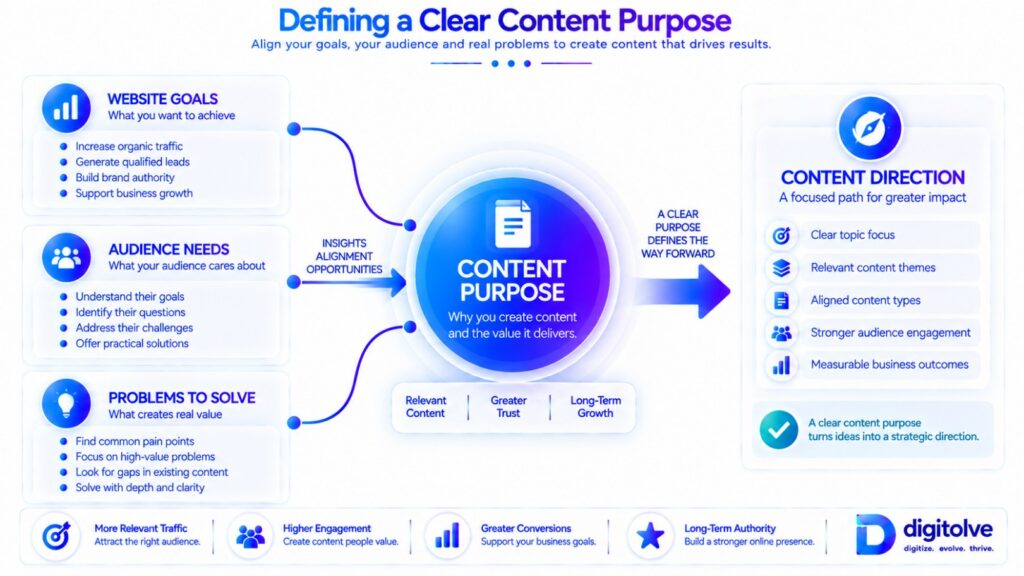
Once website objectives and audience needs are understood, they can be translated into a clearer content direction.
That direction becomes the foundation for discovering opportunities, setting priorities, planning content, and deciding what should receive attention first.
Instead of beginning with a blank publishing calendar, you begin with a reason.
Purpose → Audience Needs → Content Direction → Strategic Priorities
This creates a much stronger starting point for the rest of the content strategy.
Identify the Right Content Opportunities
Once your content has a clear purpose, the next challenge is deciding what to create.
This is where many content strategies become reactive. A new idea appears, a competitor publishes something interesting, or a topic starts receiving attention, and the website immediately adds it to the publishing plan.
A strategic content process works differently.
Instead of treating every possible topic as an opportunity, you evaluate whether the opportunity actually supports your audience, website purpose, and broader content direction.
Start With Audience Problems
One of the most useful sources of content opportunities is the problems your audience repeatedly encounters.
These problems can reveal areas where useful content could provide genuine value.
Ask:
- What problems does our audience need help understanding?
- What questions repeatedly appear around our subject?
- Where might people need clearer explanations?
- What information would help them make better decisions?
The answers can reveal content opportunities that are connected to real audience needs rather than simply being interesting topics.
Look for Important Questions and Needs
Not every audience question deserves an article.
The purpose of content strategy is to identify the questions and needs that are important enough to support the website’s direction.
An opportunity becomes more meaningful when it connects a genuine audience need with a subject area the website has a reason to cover.
Connect Opportunities With Website Purpose
A useful content opportunity should make sense within the larger purpose of the website.
For example, a topic may be popular but still be a poor strategic fit if it has little connection with the audience you serve or the problems your website is designed to address.
Strategic content planning therefore asks more than whether a topic could attract attention.
It asks whether that topic contributes to the direction the website is intentionally building.
Think Beyond the Next Article
A good opportunity can also create room for meaningful future coverage.
Instead of asking only whether one article is worth publishing, consider whether the subject connects naturally with other important questions, needs, or content areas.
This helps prevent every article from becoming an isolated project.
Avoid Chasing Every Idea
A website can always find more topics to publish. The challenge is deciding which ones deserve resources.
Following every possible idea can dilute the strategy and make the content ecosystem increasingly difficult to manage.
A stronger approach is to maintain a deliberate opportunity set and evaluate new ideas against the website’s existing direction.
The goal is not to discover more ideas. It is to discover the right opportunities for the strategy you are building.
Build a Strategic Content Direction
Identifying content opportunities gives you possibilities. Strategic content direction determines where those possibilities should lead.
Without a clear direction, even useful content ideas can become scattered across the website. The strategy needs a way to organize those opportunities around a smaller number of meaningful priorities.
Define Core Content Areas
Start by identifying the major areas your website should consistently cover.
These areas should reflect the intersection between audience needs, website purpose, and the subjects where your content can provide meaningful value.
Core content areas give your strategy boundaries. They help answer whether a new idea belongs within the direction you are building or whether it would pull the website into an unrelated area.
Set Content Priorities
Not every content area deserves equal attention at every stage.
Some areas may be more important because they address a significant audience need, support an important business objective, or provide a foundation for future content development.
Strategic priorities allow you to decide where limited time and resources should be directed first.
This changes the planning question from:
“What should we publish next?”
to:
“Which content direction deserves our attention next?”
Identify Topics That Deserve Continued Coverage
Some subjects cannot be meaningfully covered through a single article.
They may involve different audience questions, different stages of understanding, or multiple related problems that deserve separate pieces of useful content.
A strategic direction recognizes these areas and allows them to develop over time without turning content production into random expansion.
Set Direction Before Building the Calendar
A publishing calendar should be the result of strategic decisions, not the thing that makes those decisions for you.
First determine the areas that matter. Then decide which opportunities deserve priority. Only after that should those priorities be translated into a practical publishing schedule.
This creates a more logical sequence:
Content Purpose → Content Opportunities → Strategic Priorities → Content Direction → Publishing Plan
Turn Content Ideas Into Strategic Paths
An individual idea becomes more valuable when you understand where it fits within the larger direction.
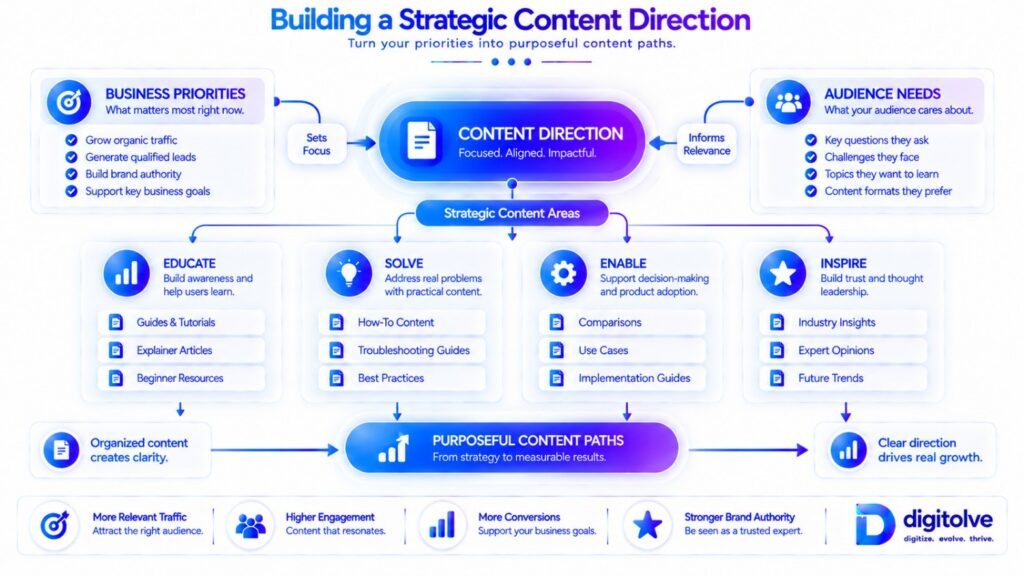
Instead of viewing content as a list of unrelated titles, organize ideas into strategic paths that support specific audience needs and content priorities.
This gives the publishing process a clear destination.
You are no longer simply collecting ideas. You are building a structured path from audience needs to purposeful content coverage.
Connect Content With the Customer Journey
People do not arrive at a website with identical needs.
One person may be trying to understand a problem for the first time. Another may already understand the problem and be comparing possible approaches. Someone else may be looking for information that helps them make a decision.
A content strategy should account for these different needs.
Recognize Different Content Needs
Content can support people at different points in their journey.
Some content helps establish understanding. Some explores problems and possible approaches. Other content helps people evaluate options or move toward a decision.
The purpose is not to force every article into a rigid funnel. It is to recognize that audiences require different types of useful information.
Support Problem Awareness
People often begin with a problem rather than a solution.
Content at this stage can help them understand what is happening, why the problem matters, and what questions they should consider.
Support Education and Consideration
Once people understand a problem, they may need deeper information to evaluate possible approaches.
Educational content can help clarify concepts, explain alternatives, and provide context that supports informed decision-making.
Support Decision-Oriented Needs
Some audiences already understand what they need and are looking for more specific information before taking the next step.
Content can support these needs by providing clear, relevant information without turning every page into an aggressive sales message.
Build a Balanced Content Strategy
A sustainable content strategy should not focus exclusively on one type of audience need.
Instead, it should create a useful balance across the questions and situations that matter to the people the website serves.
The result is a content strategy that supports people through different information needs while keeping the website’s broader direction intact.
Audience Need → Useful Information → Deeper Understanding → Evaluation → Informed Next Step
Build Content Around Meaningful Topic Areas
A clear content strategy should not only decide which individual articles to publish. It should also establish the broader areas of knowledge and value that the website intends to develop.
This creates consistency across content without requiring every article to follow the exact same format or purpose.
Develop Coherent Content Areas
Meaningful content areas give your strategy a recognizable direction.
Instead of publishing whatever topic appears next, organize content around areas that matter to your audience and support the purpose of your website.
These areas become the foundation from which individual content opportunities can be selected and prioritized.
Avoid Random Expansion
As a website grows, it becomes increasingly tempting to expand into every related subject.
But expansion without a clear reason can gradually weaken the strategic focus of the content.
Before adding a new area, ask whether it genuinely supports the audience, purpose, and direction you have already established.
Connect Related Content Naturally
Content within the same strategic area should not exist as completely separate pieces.
When articles address related audience needs, they can naturally contribute to a broader understanding of the subject.
This creates opportunities for useful relationships between pieces of content while keeping each article focused on its own purpose.
Build Enough Coverage to Support the Direction
A strategic content area may require more than one article to become useful.
Different questions, problems, perspectives, and levels of understanding may need to be addressed before the website has meaningful coverage of that area.
The objective is not to produce content simply to increase volume. It is to develop enough useful coverage to support the direction the strategy has chosen.
Know When a Content Area Deserves Expansion
Not every subject needs to keep expanding indefinitely.
Once an area has meaningful coverage, the strategy should be able to evaluate whether additional content is genuinely useful or whether resources would be better directed toward another priority.
This keeps content development intentional.
Choose meaningful areas → Build useful coverage → Connect related needs → Review the direction → Expand where it adds value.
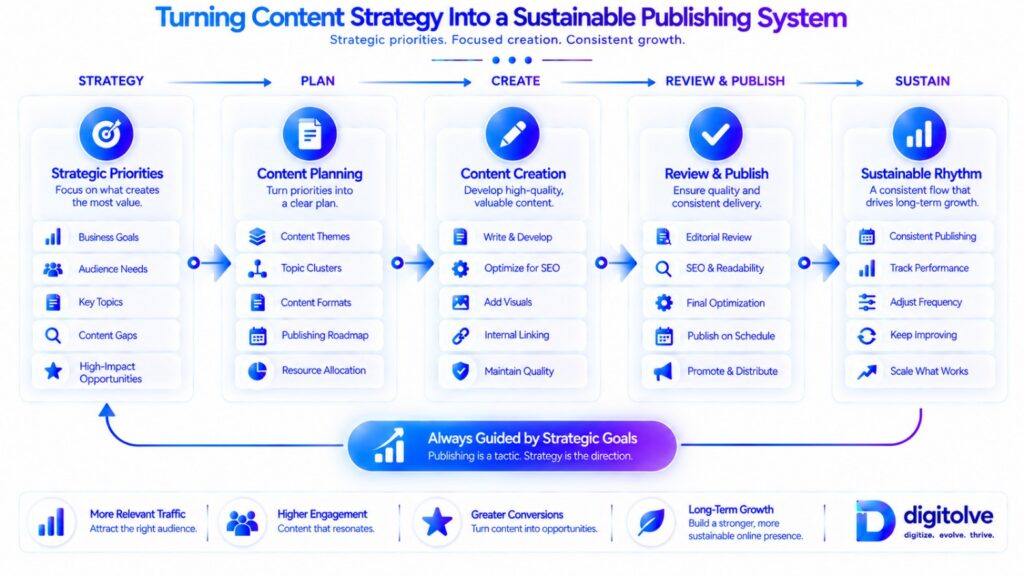
Turn Content Strategy Into a Sustainable Publishing System
Once content direction and priorities are clear, they need to become practical publishing decisions.
This is where strategy connects with consistency.
The purpose of a publishing system is not simply to keep the calendar full. It is to make sure publishing activity continues to reflect the strategic direction of the website.
Prioritize Before You Schedule
A common mistake is to create a calendar first and then try to decide which topics belong inside it.
A stronger process works in the opposite direction.
First establish the strategic priorities. Then select the content opportunities that support those priorities. Finally, organize them into a realistic publishing schedule.
This keeps the calendar accountable to the strategy.
Balance New Content With Existing Content
A sustainable content strategy should not assume that growth always requires creating something new.
Existing content may need improvement, expansion, clarification, consolidation, or a stronger strategic role.
Balancing new content with existing content can help prevent the website from continuously adding pages while overlooking the assets it has already created.
Choose a Realistic Publishing Rhythm
The best publishing rhythm is one that can be maintained without sacrificing strategic quality.
Publishing frequency should therefore reflect available resources, content complexity, audience needs, and the priorities of the strategy.
A slower but deliberate process can be more useful than an aggressive schedule that produces disconnected or low-value content.
Review Strategic Goals Regularly
A publishing system should remain connected to the goals that shaped it.
Regular reviews can help determine whether the content being produced still reflects the website’s priorities or whether the direction needs adjustment.
Adjust as Audience Needs Change
Content strategy should not remain frozen after the initial plan is created.
Audience needs can change. New questions can emerge. Existing priorities can become less important, while other opportunities become more relevant.
A sustainable publishing system leaves room for these changes without abandoning strategic direction.
The result is a healthier relationship between strategy and publishing:
Strategic Priorities → Content Selection → Publishing Rhythm → Review → Adjustment → Continued Publishing
Measure Whether Your Content Strategy Is Working
A content strategy cannot improve if every publishing decision ends with publication.
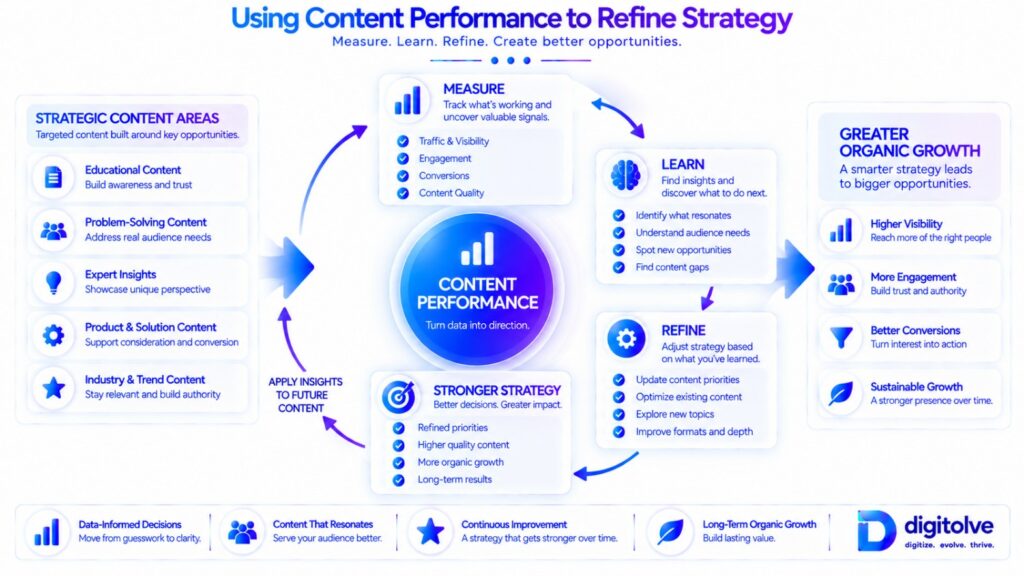
Once content is live, performance can provide information about which strategic directions are gaining traction, which areas may need improvement, and where future priorities should be reconsidered.
Look Beyond Publishing Frequency
Publishing consistently is an activity. It is not, by itself, evidence that the strategy is working.
Instead of measuring success primarily through the number of articles published, consider what those articles are contributing to the broader content direction.
Watch Organic Traffic Trends
Organic traffic trends can provide useful context about how content performance is developing over time.
The purpose is not to expect every article to produce immediate traffic growth. Content can take time to develop, and individual results can vary.
Instead, look for meaningful patterns across the strategic areas you are building.
Review Performance Across Strategic Areas
Performance should be considered at more than the individual-page level.
When multiple pieces of content belong to a broader strategic area, reviewing their performance together can provide a clearer picture of where the strategy is creating useful traction and where it may need adjustment.
Identify Strong and Weak Content Directions
Some strategic areas may consistently show stronger engagement or organic performance than others.
That does not automatically mean weaker areas should be abandoned. It means they deserve closer examination.
You may discover that an area needs better coverage, clearer content purpose, stronger prioritization, or simply more time to develop.
Use Performance Signals to Refine Future Priorities
The most useful role of measurement is not to create a permanent score for your content strategy. It is to improve future decisions.
Performance becomes valuable when it feeds back into planning.
Content Performance → Learning → Strategy Refinement → Better Future Priorities
This turns measurement from a reporting exercise into part of the content strategy itself.
Common Content Strategy Mistakes
A content strategy can look organized on the surface while still lacking a clear strategic direction underneath.
Recognizing common mistakes makes it easier to identify where the strategy is becoming disconnected from its purpose.
No Clear Content Purpose
When content is created without a defined purpose, individual articles can become difficult to prioritize and evaluate.
Before adding another article to the plan, ask what role it is supposed to play and which audience need it is intended to address.
Chasing Every New Topic
New topics appear constantly. Following all of them can gradually pull the website away from its intended direction.
A strong strategy needs boundaries so that new ideas can be evaluated instead of automatically accepted.
Confusing Consistency With Strategy
Publishing regularly is useful only when the publishing activity supports meaningful priorities.
A full calendar can create the appearance of progress while the underlying content direction remains unclear.
Building Content Only Around Keywords
Search opportunities can inform content decisions, but a content strategy should not reduce every decision to selecting keywords.
The strategy must also consider audience needs, website purpose, content priorities, and the role each piece of content should play.
Ignoring Existing Content
A strategy focused entirely on new publishing can overlook valuable opportunities within the content already available on the website.
Existing content may need improvement, expansion, clarification, or a stronger relationship with the broader strategic direction.
Expanding Into Too Many Unrelated Areas
More subjects do not automatically create a stronger content ecosystem.
When unrelated areas continue to accumulate, resources become fragmented and the website’s overall direction can become harder to maintain.
Never Reviewing Performance
A strategy that never learns from its results eventually becomes disconnected from reality.
Performance signals should be used to understand what deserves further attention and where strategic priorities may need adjustment.
Treating Every Opportunity as Equally Important
Not every content opportunity has the same strategic value.
Prioritization is what allows a website to focus its limited resources on the areas that matter most.
The goal is not to eliminate every mistake. It is to create a strategy that can recognize these problems early and continuously improve.
Build a Repeatable Content Strategy Framework
A content strategy becomes more useful when its major decisions can be repeated rather than recreated from scratch every time new content is planned.
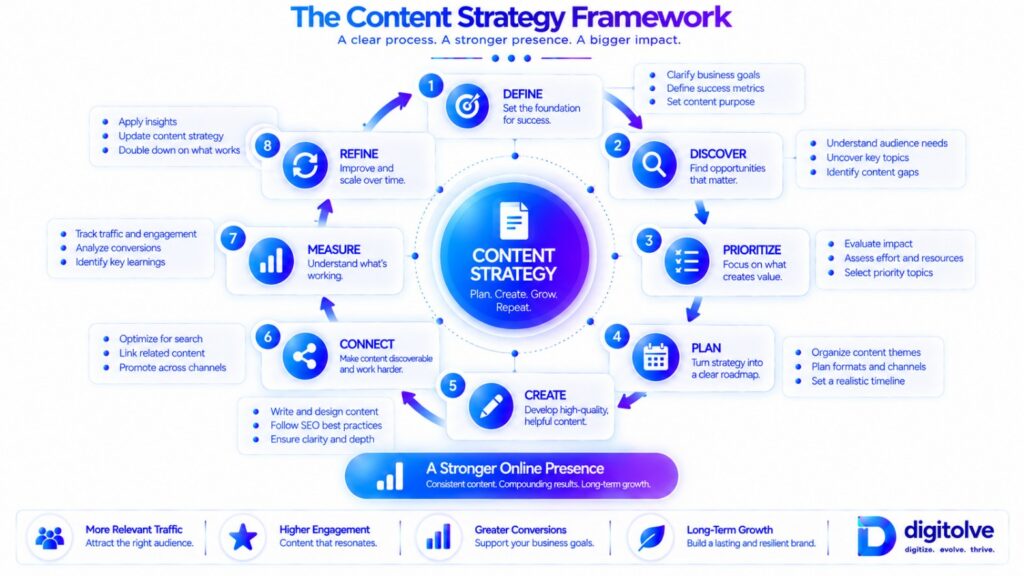
The following framework creates a practical sequence for moving from audience needs to continuous strategy improvement:
DEFINE → DISCOVER → PRIORITIZE → PLAN → CREATE → CONNECT → MEASURE → REFINE
1. Define
Start by defining the purpose of the content strategy.
Clarify who the website serves, what it is trying to accomplish, which audience needs matter, and what role content should play in the wider direction.
2. Discover
Identify meaningful content opportunities based on audience problems, questions, needs, and strategically relevant subject areas.
The goal is to create an opportunity set rather than immediately turn every idea into a publishing commitment.
3. Prioritize
Evaluate the opportunities and determine which ones deserve attention first.
Prioritization helps prevent limited resources from being spread across too many directions at once.
4. Plan
Turn the selected priorities into a strategic content plan.
Determine how the chosen content areas should develop, which pieces should come first, and how the planned content supports the broader direction.
5. Create
Produce content according to the strategic priorities rather than creating content simply to maintain publishing activity.
Each piece should have a clear reason to exist and a defined relationship with the strategy.
6. Connect
Connect related content naturally so that individual articles contribute to a broader content experience.
This helps prevent the website from becoming a collection of isolated pages.
7. Measure
Review meaningful performance signals to understand how the strategy is developing across its different content areas.
The purpose is to learn, not simply to collect numbers.
8. Refine
Use what you learn to adjust future priorities, content opportunities, and strategic direction.
This creates a continuous process rather than a one-time content plan.
Define the direction. Discover the opportunities. Prioritize what matters. Plan the strategy. Create purposeful content. Connect related content. Measure performance. Refine the direction.
That is what turns content strategy from a document into a repeatable operating process.
Why More Content Does Not Always Mean More Organic Traffic
It is easy to assume that increasing content production will eventually produce increasing organic traffic.
But content growth and organic growth are not the same thing.
A website can increase the number of published articles while leaving its underlying content direction unchanged.
More Publishing Does Not Automatically Create Strategy
Publishing more frequently can increase activity, but activity alone does not determine whether the right content is being created.
Without clear priorities, additional publishing can simply produce more disconnected pages.
More Topics Do Not Automatically Create Better Direction
Expanding into additional subjects may increase the size of the content library, but it can also dilute strategic focus when those subjects do not meaningfully support the website’s purpose.
More Keywords Do Not Automatically Create Better Planning
Keywords can help identify search opportunities, but content strategy involves broader decisions about audience needs, content purpose, priorities, relationships, and future direction.
A longer keyword list does not automatically create a better content plan.
More Articles Do Not Automatically Create Useful Coverage
Useful coverage depends on whether content meaningfully addresses the needs and questions that matter to the intended audience.
Ten disconnected articles may contribute less strategically than a smaller group of purposeful articles that work together around important content areas.
More Activity Does Not Automatically Create Meaningful Growth
The central shift is therefore from measuring content activity to building strategic content direction.
More Content → Clearer Direction → Better Priorities → More Meaningful Coverage → Stronger Organic Growth Foundation
The objective is not to stop publishing. It is to make publishing serve a strategy that can improve over time.
Build a Content Strategy Growth Cycle
A content strategy should not end once the initial plan has been created.
Audience needs change, content performance develops, priorities shift, and new opportunities appear. A sustainable strategy therefore needs a repeatable cycle that allows the direction to evolve without becoming completely disconnected from its original purpose.
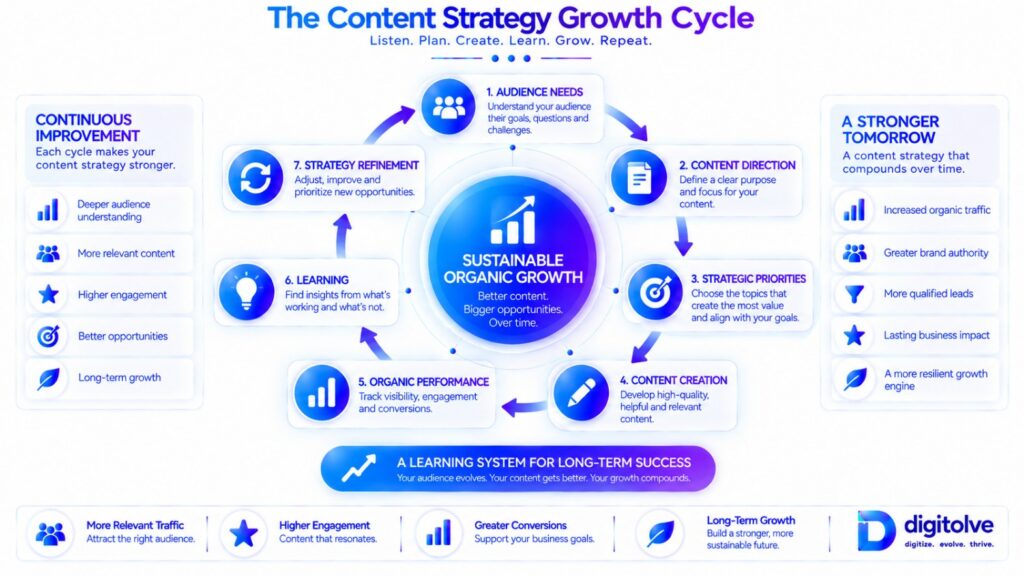
The growth cycle can be represented as:
Audience Needs → Content Direction → Strategic Priorities → Content Creation → Organic Performance → Learning → Strategy Refinement ↺
Start With Audience Needs
The cycle begins by understanding what the audience needs now.
This keeps the strategy grounded in the problems, questions, and information needs the website is trying to serve.
Translate Needs Into Content Direction
Audience needs should then inform the areas of content the website intends to develop.
This creates a clear connection between what people need and what the website chooses to build.
Turn Direction Into Strategic Priorities
Not every opportunity can receive equal attention at the same time.
Priorities determine which content areas and opportunities should receive resources first.
Create According to the Priorities
Content production then follows the strategic decisions that have already been made.
This prevents the publishing process from becoming the primary driver of strategy.
Learn From Organic Performance
Once content has been published and has had time to develop, its performance can provide useful signals.
These signals can reveal where the strategy appears to be gaining traction and where additional attention or reconsideration may be needed.
Refine the Strategy
The final stage is refinement.
What you learn should influence future content priorities, opportunities, and direction.
The cycle then returns to audience needs with a better-informed strategy.
This creates a continuous process:
Understand → Decide → Create → Learn → Improve → Repeat.
The strength of a content strategy comes not only from the quality of its initial plan, but from its ability to keep learning and becoming more deliberate over time.
From Content Strategy to Sustainable Organic Growth
A content strategy does not create organic growth through a single action. Its value comes from connecting many content decisions into a coherent direction that can improve over time.
When audience needs inform content direction, content direction informs priorities, and priorities guide creation, the website is no longer publishing simply for the sake of maintaining activity.
Each stage supports the next.
Strategy Creates Direction Before Production
Without strategy, content production can easily become the starting point for every decision.
With strategy, production becomes the execution of decisions that have already been made about purpose, audience, opportunities, and priorities.
Direction Creates More Meaningful Coverage
Clear direction helps a website decide which areas deserve continued attention and which ideas do not belong within the current strategy.
This allows content development to become more intentional instead of continuously expanding in unrelated directions.
Performance Creates Learning
Once content is published, performance provides information that can influence future decisions.
This means the strategy is not permanently fixed. It can respond to what the website learns from its existing content and audience.
Learning Creates Better Future Decisions
The long-term opportunity is to use each cycle of planning, publishing, and evaluation to make the next cycle more informed.
Over time, this creates a stronger strategic foundation:
Clear Direction → Better Priorities → Purposeful Content → Performance Learning → Strategy Refinement → Stronger Future Decisions
Sustainable organic growth therefore begins with more than a publishing schedule. It begins with a content strategy that knows where the website is going, why each major content decision matters, and how the strategy will evolve as new information becomes available.
Conclusion — Build a Content Strategy, Not Just a Content Calendar
Consistent publishing can help a website maintain momentum, but consistency alone does not create a content strategy.
A stronger approach begins with understanding audience needs, defining content purpose, discovering meaningful opportunities, setting strategic priorities, organizing content direction, and creating a publishing system that can learn from performance.
The complete process can be summarized as:
DEFINE → DISCOVER → PRIORITIZE → PLAN → CREATE → CONNECT → MEASURE → REFINE
This shifts the focus from simply producing more articles to making better content decisions.
The goal is not to create an endless publishing calendar. It is to build a strategic content system in which every important piece of content has a reason to exist, contributes to meaningful coverage, and helps inform future decisions.
When content strategy becomes a continuous cycle rather than a one-time plan, your website can move from random ideas and disconnected publishing toward clear direction, purposeful content, strategic priorities, and continuous improvement.
That is the foundation on which a more consistent organic growth strategy can be built.
Content Strategy Blueprint
Understanding content strategy is the first step. The next step is turning that understanding into a practical system you can use to make better content decisions.
Content Strategy Blueprint is designed for website owners who know they need a clearer content direction but want a practical framework for deciding what to create, what to prioritize, and how their strategy should evolve.
What the Blueprint Helps You Build
- A clear Content Direction Map
- A structured list of meaningful content opportunities
- A prioritized Content Roadmap
- A practical Strategic Content Plan
- A repeatable Content Strategy Growth Cycle
- A clear process for reviewing and refining future content decisions
The framework follows a simple progression:
DEFINE → DISCOVER → PRIORITIZE → PLAN → CREATE → CONNECT → MEASURE → REFINE
If you are still trying to understand why your content strategy is not bringing traffic even when you publish consistently, start with the diagnostic side of the system through Smart Solve Lab:
Why Your Content Strategy Doesn’t Bring Traffic (Even With Consistency)
Once the problem is understood, the Content Strategy Blueprint provides the practical framework for turning that clarity into a structured content strategy.
From random content ideas to clear direction. From publishing activity to strategic priorities. From a content calendar to a repeatable content strategy.
I don’t know what content direction my website needs.
→ Start with the Content Direction Planner.
I know my direction but need a practical strategy for what to create and prioritize.
→ Use the Content Strategy Blueprint.
I need a larger, more advanced content growth system.
→ The future Content Growth System — Core is designed for broader strategic operation.
FAQs
What is a content strategy?
A content strategy is a structured approach to deciding what content a website should create, why it should create it, who that content should serve, what should be prioritized, and how the strategy should improve over time. It connects audience needs with content direction, strategic priorities, planning, creation, measurement, and refinement.
Why isn’t publishing consistently enough to generate organic traffic?
Publishing consistently creates activity, but consistency alone does not guarantee meaningful organic traffic. If content is created without clear purpose, audience alignment, strategic priorities, or connected direction, a website can publish frequently while still building fragmented content coverage.
How do I create a content strategy for organic traffic?
Start by defining your content purpose and understanding your audience’s needs. Then identify meaningful content opportunities, prioritize them, create a strategic content plan, publish purposefully, connect related content, review performance, and refine future priorities based on what you learn.
How do I choose the right content topics?
Choose topics based on meaningful audience problems, questions, and needs while considering how well each opportunity supports your website’s purpose and broader content direction. The goal is not to pursue every possible topic, but to prioritize the opportunities that fit the strategy.
What is the difference between a content strategy and a content calendar?
A content strategy determines the direction behind your content decisions: what you should create, why it matters, who it serves, and what should be prioritized. A content calendar organizes selected content into a publishing schedule. The calendar should follow the strategy rather than replace it.
How often should I publish content?
There is no single publishing frequency that works for every website. Your publishing rhythm should reflect your available resources, content complexity, audience needs, and strategic priorities. A realistic and sustainable rhythm is generally more useful than publishing frequently without clear direction.
How do I know whether my content strategy is working?
Look beyond the number of articles published. Review organic traffic trends and performance across your strategic content areas, then use those signals to identify stronger and weaker directions. The purpose of measurement is to learn what can improve future content decisions.
Can a small website build an effective content strategy?
Yes. A small website can begin with a focused strategy built around its most important audience needs and a limited number of meaningful content areas. A smaller content library does not prevent strategic planning; it can make prioritization even more important.