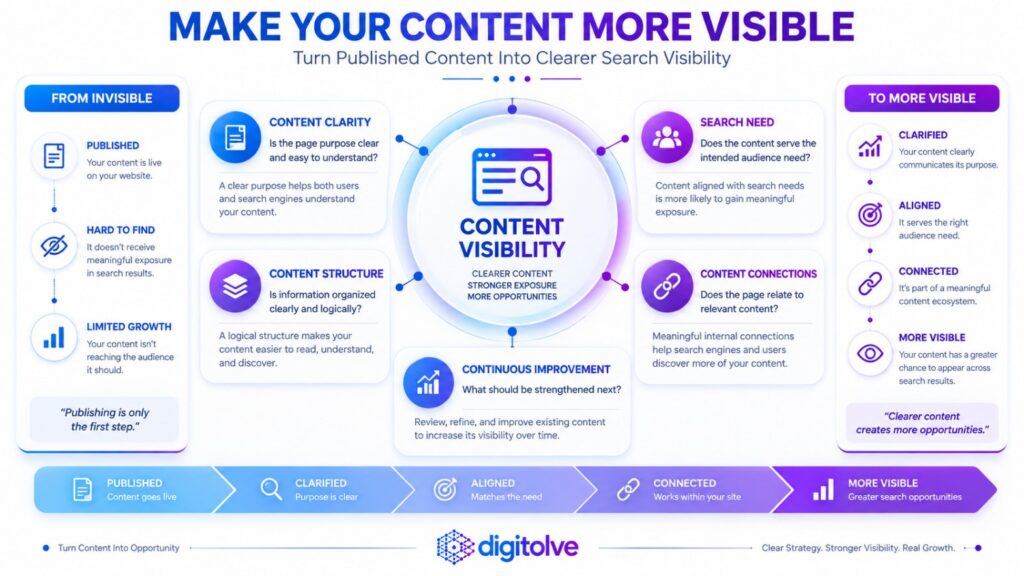
Introduction — Why Published Content Can Still Feel Invisible
Publishing a page is only the beginning of its journey.
You may have spent hours researching a topic, writing a detailed article, optimizing the page, adding images, and finally publishing it on your website. Yet after weeks or even months, the page may still receive very little search exposure.
That can be confusing.
The content exists. The page is published. The information may genuinely be useful.
So why does it still feel invisible?
One common mistake is to assume that publishing more content will automatically solve the problem. If one article is not getting visibility, the instinct may be to publish five more. But increasing the number of pages does not necessarily improve how clearly those pages communicate their purpose, relevance, or value.
This is where content visibility becomes important.
Published Content Is Not the Same as Visible Content
A published page simply means that the content exists on your website.
Visibility is different.
For content to have an opportunity to appear across relevant search results, its purpose needs to be clear, its subject needs to be understandable, and the information needs to serve a meaningful need. The page also needs to make sense within the wider content environment of the website.
This does not mean every visibility problem has one simple cause. Search exposure can be influenced by many factors, and no framework can guarantee rankings or traffic.
But one useful starting point is to examine whether the content itself is sending clear and consistent signals.
Why More Publishing Is Not Always the Answer
When existing content struggles to gain visibility, creating more content can sometimes add another layer of complexity.
- More pages competing for attention
- Overlapping topics
- Unclear page purposes
- Disconnected articles
- Valuable existing content that remains underdeveloped
Instead of asking only:
“What should I publish next?”
it can be more useful to ask:
“Is my existing content clear enough, focused enough, and connected enough to support visibility?”
That change in perspective can help shift attention from content quantity toward content quality, clarity, and structure.
Clarity Comes Before Visibility
A page should make its purpose understandable.
Readers should be able to recognize what the page is about, what problem it addresses, and what value it provides. Related information should support the main purpose rather than make the page harder to understand.
The same principle can be applied across a website.
When individual pages have clear purposes and meaningful relationships with related content, the website becomes easier to navigate and the content becomes easier to understand as part of a larger system.
This does not guarantee search visibility. Instead, it creates a stronger foundation from which visibility can be improved and evaluated.
The Shift: Published Content → Clear Content → Search Visibility → Organic Growth
The goal is not simply to publish more pages.
The goal is to build content that has a clear purpose, serves a meaningful need, communicates its value, and continues to improve over time.
That creates a more useful progression:
Published Content → Clear Content → Search Visibility → Organic Growth
In this guide, we will examine the practical foundations behind that progression — from content clarity and search-need alignment to structure, relationships between related pages, and continuous improvement.
The objective is simple:
Make your content clearer, more purposeful, and better positioned to earn meaningful search visibility — rather than assuming that publishing more will automatically solve the problem.
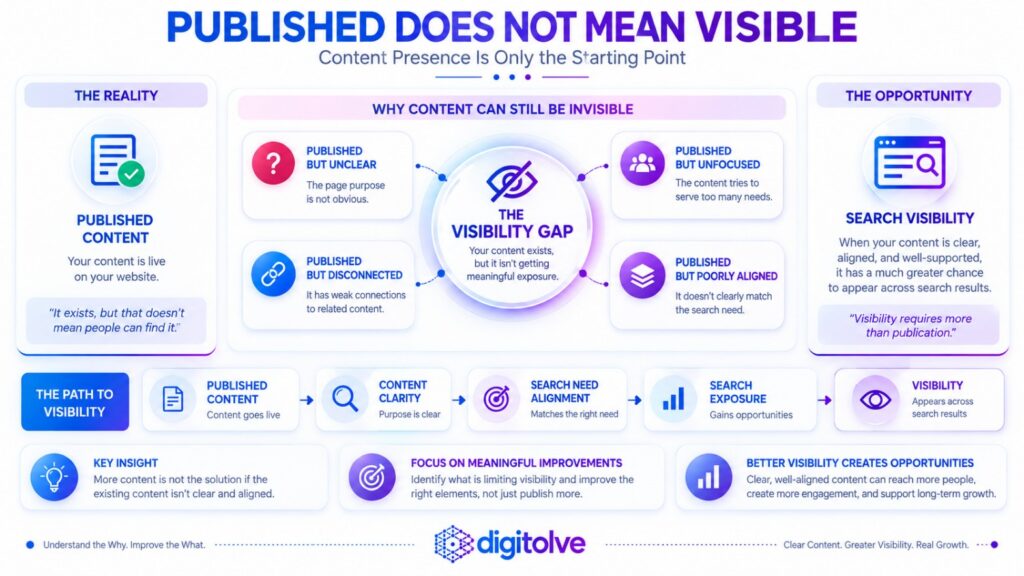
Table of Contents
Why Published Content Does Not Automatically Become Visible
Publishing content makes a page available on your website, but it does not automatically mean that the page will receive meaningful search exposure.
A page can be live for months and still receive very few impressions or visits from search. In many cases, the problem is not simply that the page needs more content. The page may need clearer signals about what it is, who it serves, and how it relates to the rest of the website.
Published Does Not Mean Discoverable
A published page becomes part of your website, but search visibility depends on more than simply having a URL online.
Search engines need to discover, understand, and evaluate pages within the wider context of the web. That means a page can exist without gaining meaningful exposure for the searches it was created to address.
This is why the question should not stop at:
“Is the page published?”
A more useful question is:
“Is the page clear enough for its intended purpose, and is there a meaningful reason for it to become visible?”
Why Content Can Exist Without Meaningful Search Exposure
Several content-level problems can make visibility more difficult.
- The page has an unclear or overly broad purpose.
- The main topic is difficult to identify.
- The content tries to address several unrelated needs at once.
- The page provides information without making its central value clear.
- Related content exists, but the relationship between the pages is weak or unclear.
None of these factors automatically means that a page cannot rank. They are simply useful areas to examine when published content is receiving little search exposure.
Content Presence vs Search Visibility
It helps to separate two ideas that are often treated as the same.
Content presence means the information exists on your website.
Search visibility concerns whether that content is receiving exposure in relevant search results.
A website can have hundreds of published pages while only a smaller portion receives meaningful search visibility. Adding more pages without understanding why existing pages are struggling can therefore create more content without addressing the underlying visibility problem.
Why More Publishing Does Not Automatically Solve Visibility
When a website has weak search exposure, publishing more articles can feel like the obvious solution.
But if the existing problem involves unclear page purpose, weak content focus, poor alignment with the intended need, or disconnected content relationships, simply increasing publishing volume does not necessarily resolve it.
In some cases, improving an existing valuable page may be more useful than immediately creating another one.
Why Visibility Problems Often Begin With Unclear Content Signals
Before trying to increase visibility, it is worth examining what the content is actually communicating.
Can a visitor quickly understand the page’s purpose?
Is the main topic clear?
Does the content stay focused on its intended need?
Does the structure make the important information easy to understand?
Does the page have meaningful relationships with closely related content?
These questions create the foundation for the next stage of the process: understanding what content visibility actually means and which signals are worth examining.
Understand What Content Visibility Actually Means
Content visibility is often reduced to one simple question: “Is my page ranking?”
But visibility is broader than a single ranking position.
A page can receive some search exposure without generating significant traffic. Another page may appear for several relevant searches but perform differently depending on the search intent, position, competition, and how well the result communicates its value.
Understanding this distinction helps you diagnose visibility problems more accurately instead of treating every weak-performance situation as a ranking problem.
Visibility Is More Than Rankings
A ranking position is one way to observe search performance, but it does not describe the entire visibility picture.
A page can appear in search results for relevant queries while still having limited overall exposure. Likewise, visibility can change across different queries, pages, locations, devices, and time periods.
This means that asking only “What position is my page in?” can provide an incomplete view of how visible the content actually is.
Visibility Is More Than Traffic
Traffic tells you that people reached your website. Visibility concerns the exposure that creates opportunities for those visits to happen.
A page may have limited traffic because it receives limited search exposure. But low traffic can also result from other factors, such as the type of searches it appears for or how often people choose the result.
For this reason, traffic and visibility should be examined as related but distinct signals.
Search Exposure in the Bigger Picture
Search visibility exists within a larger journey:
Content → Search Exposure → Search Result Interaction → Website Visit
Each stage represents a different part of the journey.
If the content receives little exposure, there may be a visibility issue to investigate. If it receives exposure but very few people interact with the result, a different problem may need attention.
This distinction prevents you from changing the wrong part of the system.
Why Different Pages Can Receive Different Exposure
Not every page on a website has the same visibility potential.
Different pages address different subjects, needs, audiences, and levels of demand. Some may naturally receive more search exposure than others, while some valuable pages may need clearer positioning or improvement before they gain meaningful visibility.
Therefore, comparing every page against the same traffic or visibility expectation can lead to misleading conclusions.
The Difference Between Visibility and Performance
Visibility creates opportunities for content to be seen in search. Performance describes what happens after those opportunities exist.
A useful distinction is:
Visibility asks: “Is the content receiving search exposure?”
Performance asks: “What happens as a result of that exposure?”
Keeping these concepts separate makes diagnosis more useful. Instead of immediately changing the content whenever traffic is low, you can first determine whether the underlying issue is limited exposure, weak engagement, or another part of the search journey.
Once visibility is understood more clearly, the next step is to examine the signals that the content itself communicates.
Build Clear Content Signals
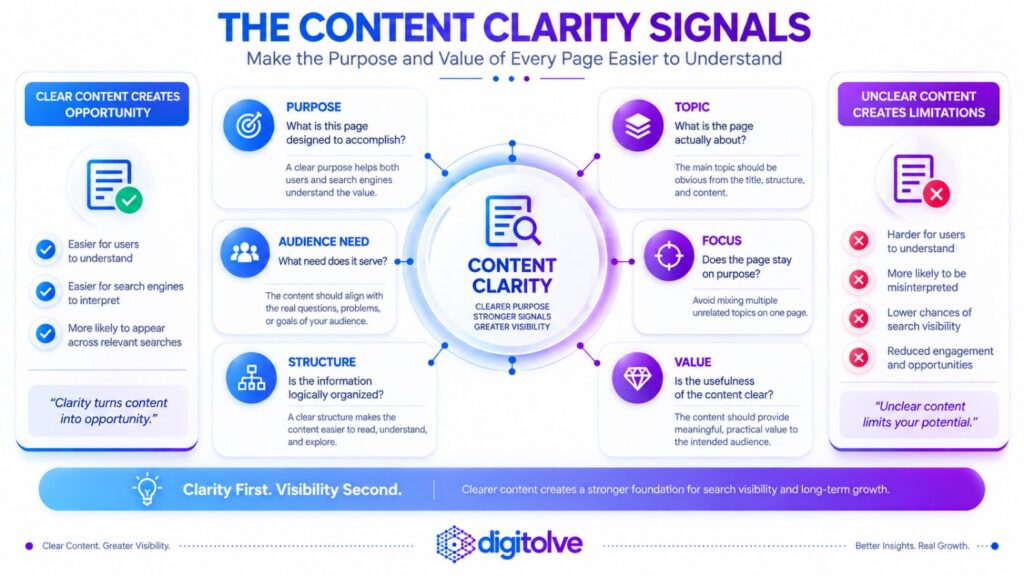
Before trying to increase search visibility, make sure the content communicates a clear purpose.
A visitor should be able to understand what the page is about, what need it addresses, and why the information is useful. When these signals become unclear, the value of the page can become harder to understand.
Content clarity does not mean making every page shorter or simpler. It means making the main purpose easier to recognize.
Give Every Page a Clear Purpose
Every important page should have a reason for existing.
It might answer a specific question, explain a problem, provide guidance, compare options, or help the reader take a meaningful next step.
When a page tries to perform too many unrelated roles, its central purpose can become difficult to identify.
Make the Main Topic Easy to Understand
The primary subject of the page should be apparent from the beginning.
Readers should not have to work through several paragraphs before discovering what the page is actually about.
A clear topic gives the rest of the content a stronger direction and helps supporting information remain connected to the main subject.
Keep Content Focused on the Intended Need
A page becomes easier to understand when its information consistently supports the need it was designed to serve.
This does not mean removing every related idea. Supporting information can add value when it strengthens the main purpose. The problem begins when unrelated information starts competing with that purpose.
These principles also align with Google’s guidance to create helpful, reliable, people-first content, where the focus is on creating useful content for people rather than producing content primarily to manipulate search rankings. You can review the guidance directly in Google Search Central’s guidance on creating helpful, reliable, people-first content.
Remove Confusing or Competing Messages
Content can become difficult to interpret when several different messages compete for attention.
Review the page for sections that introduce unrelated subjects, repeat different versions of the same idea, or distract from the main answer.
Strengthening the central message can often make an existing page clearer without requiring a complete rewrite.
Make Page Value Clear
A useful page should make its value understandable.
The reader should be able to see what problem the content addresses and what they can gain from reading it.
The core principle is simple:
Before trying to increase visibility, make sure the content communicates clear purpose and value.
Align Content With the Need It Is Designed to Serve
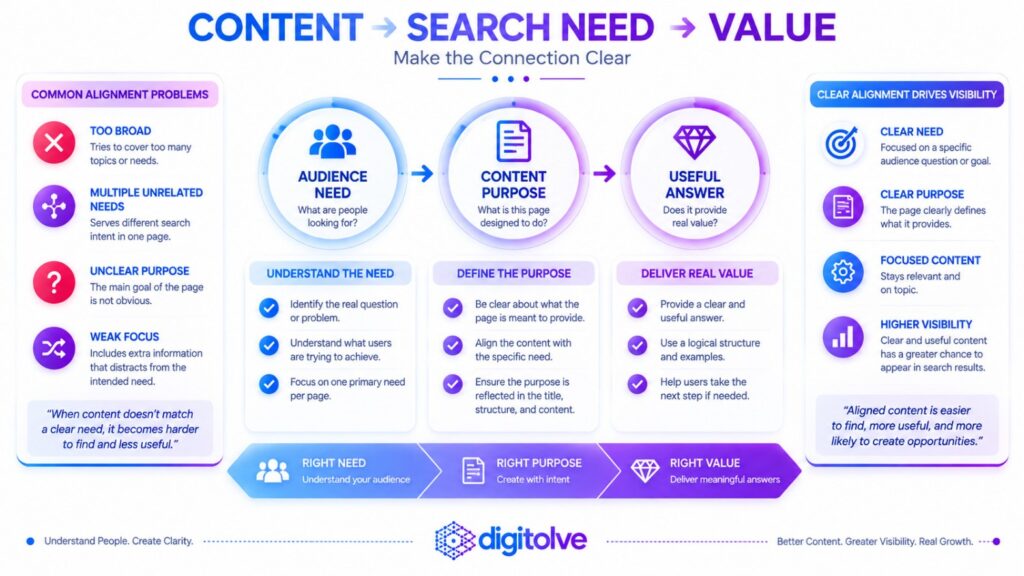
Clear content also needs a clear relationship with the need it is intended to address.
A page may contain useful information and still struggle to communicate a focused purpose if it tries to serve several unrelated needs at once.
The goal is not to make every page extremely narrow. The goal is to make sure the information on the page supports a coherent purpose.
Understand the Intended Audience Need
Start by identifying what the reader is actually trying to accomplish.
Are they trying to understand a problem? Find an explanation? Learn how to approach something? Compare possible solutions? Decide what to do next?
Understanding this need gives the content a clearer direction.
Keep the Page Focused on One Meaningful Purpose
A page can answer several related questions, but those questions should support the same overall purpose.
If the content begins addressing completely different problems, the page can become less focused and harder to understand.
Avoid Mixing Unrelated Search Needs
Related information can strengthen a page, while unrelated information can dilute its purpose.
Review each major section and ask whether it helps the reader accomplish the main purpose of the page.
If a section does not contribute meaningfully, it may belong on another page instead.
Make Content Match Its Intended Role
Different pages serve different roles within a website.
An educational article should provide understanding. A comparison page may help readers evaluate alternatives. A product page should communicate the product’s value and next step.
When the content matches the role of the page, the overall experience becomes more coherent.
Strengthen the Connection Between Need and Content
The closer the relationship between the intended need and the information provided, the easier it becomes to understand what the page is trying to accomplish.
This is why content visibility should not be examined only through rankings or traffic. The underlying relationship between the audience need, the page purpose, and the information provided also deserves attention.
The objective is not to make content relevant to everything. It is to make the content clearly useful for the need it was designed to serve.
Strengthen Content Structure and Clarity
Even useful information can become difficult to understand when it is poorly organized.
Content structure helps readers identify the main idea, understand supporting information, and move through the page without unnecessary confusion.
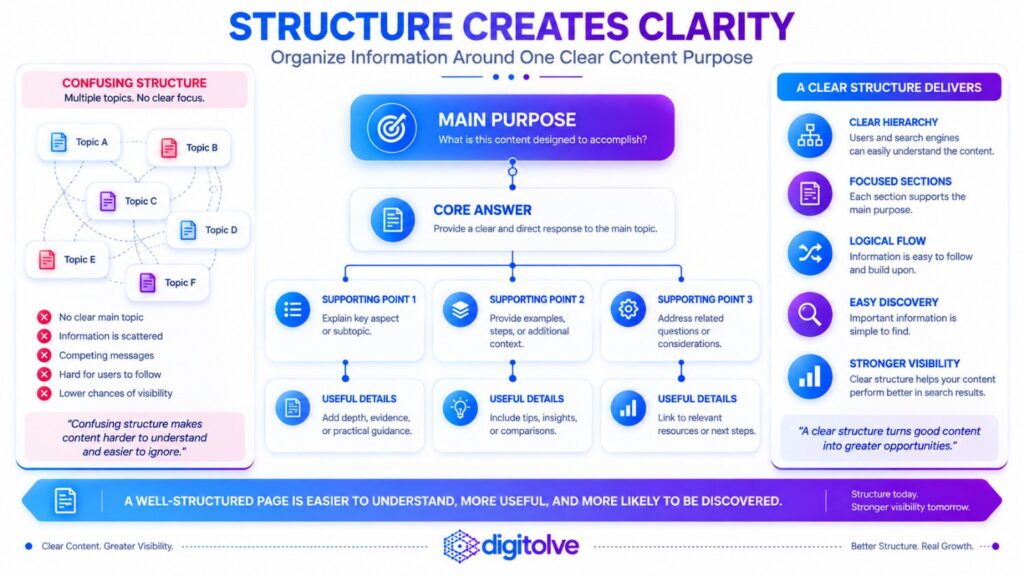
Create a Clear Information Hierarchy
Organize the page around a clear main purpose and supporting ideas.
Headings should help readers understand how each section relates to the overall subject rather than simply dividing a large block of text.
Make Important Information Easy to Find
Readers should not have to search through unrelated details to find the main answer.
Important explanations should appear where they make sense within the flow of the page, while supporting information should remain secondary to the central purpose.
Keep Supporting Information Around the Main Purpose
Supporting examples, explanations, definitions, and additional details can strengthen content when they clearly support the main subject.
They become less useful when they pull the reader away from the page’s primary purpose.
Remove Structural Confusion
Review the page for repeated ideas, unnecessary sections, abrupt topic changes, or information that would make more sense in another location.
The objective is not to remove useful detail simply to make a page shorter. It is to organize that detail so the main message remains clear.
Make Content Easier to Understand
A strong structure allows readers to understand the page progressively:
Main Purpose → Core Answer → Supporting Information → Useful Details
This creates a clearer path through the content and helps the page communicate its value without unnecessary friction.
Content structure is therefore part of content clarity. But it should not be confused with the broader technical architecture of an entire website. Here, the focus is the clarity and organization of the individual content itself.
Help Individual Content Pieces Work Within the Website
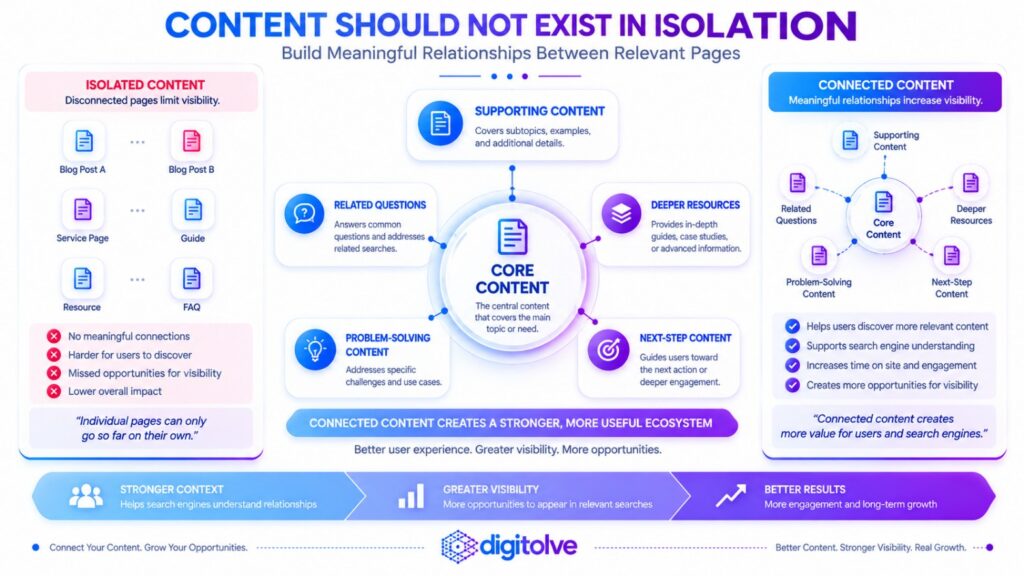
Even when individual pages are clear and useful, they do not have to operate as isolated pieces of content.
A website becomes easier to navigate when related pages have meaningful relationships with one another. These connections can help readers move from one useful resource to another while giving important content a clearer place within the wider website.
Why Content Should Not Exist in Isolation
A single article may answer one question, while another page explains a related problem, provides deeper information, or helps the reader take the next step.
When these pages remain completely disconnected, readers may never discover the information that would naturally help them continue their journey.
Connect Closely Related Content Naturally
Internal links should connect pages because the relationship between them is genuinely useful.
For example, a page discussing content visibility may naturally lead to a deeper resource about internal linking when the reader needs to understand how related pages can support one another.
For a practical look at this specific issue, see Why Your Internal Linking Is Not Helping Your SEO.
Give Important Content Appropriate Context
Not every page needs the same number of internal links.
The important question is whether the connection makes sense for the reader. A link should provide useful context, answer a related question, or help the reader move naturally toward the next relevant resource.
Help Users Discover Related Information
Related content can extend the value of the original page.
A visitor who begins with a general explanation may later need a deeper guide, a related problem explanation, or a practical next step. Meaningful content relationships make those resources easier to discover.
Strengthen the Relationship Between Related Pages
The goal is not to create links simply because more internal links exist.
The goal is to build useful relationships between content that belongs together.
This creates a more connected content environment where individual pages can support the reader’s journey rather than functioning as isolated articles.
Useful content relationships should make the website easier to understand and the next relevant resource easier to find.
Improve Existing Content Before Simply Creating More
When a website has content that is receiving little search visibility, the first response does not always need to be creating another page.
Some existing pages may already contain useful information but need clearer purpose, stronger focus, better organization, or more meaningful connections with related content.
Reviewing existing content can help you identify opportunities that may otherwise be overlooked.
Find Content With Weak Visibility
Start by identifying pages that are already published but receive limited search exposure compared with their intended purpose.
These pages can become useful candidates for a closer content review.
Review Clarity Before Replacement
A page with weak visibility is not automatically a failed page.
Before replacing it, examine whether the existing content has a clear purpose, focused topic, useful information, and understandable structure.
In some cases, targeted improvements may be more appropriate than starting from zero.
Strengthen Weak Content Signals
Look for specific areas that may be making the page harder to understand.
For example, the main purpose may be unclear, supporting information may overwhelm the central answer, or the page may attempt to address several different needs.
Identifying the specific weakness makes improvement more focused.
Improve Valuable Existing Pages
Existing content may already have useful information, accumulated context, or a relationship with other pages on the website.
Improving that content can preserve what is already valuable while strengthening the areas that need attention.
Avoid Duplicate or Unnecessary Content
Creating another page for every visibility problem can sometimes produce overlapping content.
Before publishing something new, ask whether an existing page could be improved or whether the new topic genuinely deserves its own page.
More content is not always the next step. Sometimes the better opportunity is to make valuable existing content clearer and more useful.
Identify the Signals That May Be Limiting Visibility
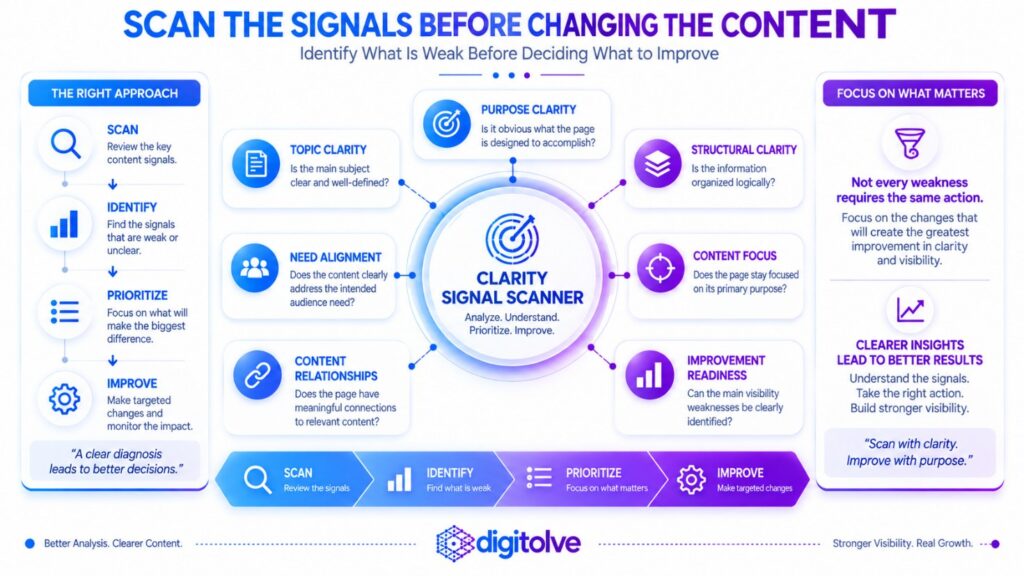
Once content has been published, its visibility can be examined by looking at the signals the page communicates.
The purpose of this review is not to assume that one weak signal automatically explains poor search performance. Instead, it helps identify areas that may deserve closer attention.
Unclear Content Purpose
If it is difficult to explain what a page is designed to accomplish, its purpose may need clarification.
A clear purpose gives the page a stronger foundation and helps keep supporting information focused.
Weak Topic Clarity
The main subject should be understandable without requiring the reader to interpret several competing ideas.
If the topic becomes difficult to identify, review the page structure and remove information that distracts from its central subject.
Poor Alignment With the Intended Need
Content should provide information that meaningfully supports the need it was designed to address.
If the page attempts to answer unrelated questions or moves away from its intended purpose, the content may need to be refocused.
Confusing Content Structure
Even useful information can become difficult to follow when the hierarchy is unclear.
Review whether the main answer, supporting explanations, and additional details appear in a logical order.
Weak Relationships With Relevant Content
A page does not need to link to everything on the website. However, closely related resources should be connected when doing so genuinely helps the reader.
Meaningful relationships can give individual pages better context within the wider content environment.
Content Not Clearly Communicating Value
A visitor should be able to understand why the information matters and what problem it helps solve.
If the value is difficult to recognize, the page may need clearer explanations, stronger organization, or a more focused purpose.
These signals can be reviewed individually, but they become more useful when examined together rather than treated as isolated problems.
This is where a structured Clarity Signal Scanner can help organize the review by examining the major content-visibility signals systematically.
Common Content Visibility Mistakes
Content visibility problems often become harder to solve when the wrong problem is being addressed.
Recognizing common mistakes can help you review existing content more deliberately.
Assuming Publishing Equals Visibility
A page being live does not mean it will automatically receive meaningful search exposure.
Publishing is an important step, but visibility requires continued attention to clarity, alignment, structure, and improvement.
Publishing More Instead of Improving Existing Content
Adding new pages can feel productive when existing content is underperforming.
But if valuable pages already exist, improving them may deserve attention before expanding the content library further.
Leaving Page Purpose Unclear
A page that tries to answer too many unrelated questions can become difficult to understand.
Each page should have a recognizable purpose that guides its main topic and supporting information.
Trying to Serve Too Many Needs
Supporting related questions can be useful, but unrelated search needs can dilute the central purpose of a page.
Keep the content focused on the meaningful need it was designed to serve.
Creating Content Without Strategic Context
Individual articles become more useful when they have a clear relationship with the wider website.
Consider how a page fits with related resources rather than treating every article as a completely separate asset.
Ignoring Weak Content Signals
When a page receives little visibility, simply assuming that it needs more content can overlook more specific weaknesses.
Review its purpose, topic clarity, need alignment, structure, focus, and relationships before deciding what needs to change.
Treating Every Visibility Problem as a Ranking Problem
Search visibility involves more than looking at one ranking position.
Limited exposure, weak engagement, unclear content, and other factors can represent different problems and may require different forms of investigation.
Abandoning Existing Content Too Quickly
Not every page that performs poorly needs to be discarded.
Some pages may contain useful material that can become stronger through targeted improvements.
The goal is not to change content simply because it is underperforming. The goal is to understand what may be limiting it and make the most relevant improvement.
Build a Repeatable Content Visibility Framework
Improving content visibility should not depend on making random changes whenever a page underperforms.
A repeatable framework provides a structured way to review content, identify possible weaknesses, make targeted improvements, and continue learning from the results.
The framework for content visibility can be organized into seven connected stages:
CLARIFY → ALIGN → STRUCTURE → CONNECT → STRENGTHEN → MONITOR → IMPROVE
Clarify
Start by making the purpose of the content clear.
Identify what the page is about, what problem it addresses, and what value it is designed to provide.
Align
Connect the content with the need it is intended to serve.
Review whether the information supports a coherent purpose rather than attempting to address unrelated needs.
Structure
Organize the information so that the main purpose, core answer, supporting information, and useful details are easy to follow.
Connect
Identify meaningful relationships between the page and closely related content.
Where a connection genuinely helps the reader, connect the resources naturally.
Strengthen
Review the signals that may be limiting the content’s visibility.
Strengthen weak areas such as purpose clarity, topic clarity, need alignment, content focus, structure, or meaningful content relationships.
Monitor
After making improvements, observe how the content performs over time.
Monitoring helps distinguish between a change that appears useful and a change that simply happened at the same time as another change.
Improve
Use what you learn to determine the next relevant improvement.
This creates a continuous process rather than treating content optimization as a one-time task.
Clarify → Align → Structure → Connect → Strengthen → Monitor → Improve
The framework is designed to help you move from vague visibility concerns toward a more structured content review process.
Why More Content Does Not Always Create More Visibility
Publishing consistently can be valuable, but content volume alone does not guarantee stronger search visibility.
A website can continue adding pages while existing content remains unclear, disconnected, or difficult to understand.
More Articles Do Not Automatically Mean More Exposure
Every new page creates another piece of content to manage, understand, connect, and improve.
If the underlying content problems remain unresolved, increasing the number of pages may increase activity without producing a proportional improvement in visibility.
Publishing Cannot Compensate for Unclear Content
If an existing page has an unclear purpose or weak focus, publishing another article does not automatically fix that problem.
The more useful approach may be to understand what is limiting the existing content first.
More Pages Can Create Duplication
When similar topics are repeatedly published without clear differentiation, pages can begin to overlap.
This can make the content ecosystem harder to manage and can make it less obvious which page should serve a particular need.
Existing Valuable Content May Need Improvement
Some websites already have useful content that has not been fully developed.
Improving clarity, structure, alignment, and meaningful relationships can sometimes be a more appropriate next step than immediately adding another page.
Visibility Requires Clarity and Continuous Refinement
Strong content visibility is better approached as an ongoing process.
Rather than measuring progress only by how much content has been published, review whether existing content is becoming clearer, more focused, more connected, and more useful.
More content can expand a website, but clearer and better-connected content creates a stronger foundation for improving visibility.
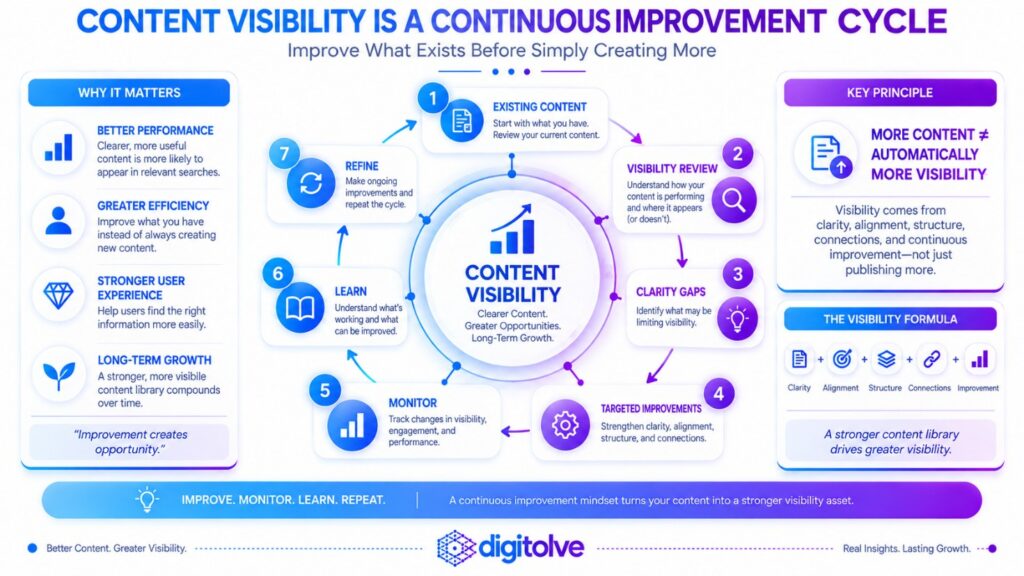
Turn Content Visibility Into a Continuous Improvement Cycle
Content visibility should not be treated as something you optimize once and then forget.
Search environments change, content accumulates, audience needs evolve, and existing pages can create new opportunities for improvement.
A continuous review cycle helps turn these changes into an ongoing learning process.
Existing Content → Visibility Review → Clarity Gaps → Targeted Improvements → Monitor Visibility → Learn → Refine ↺
Start With Existing Content
Begin with pages that already exist rather than automatically assuming that a new article is required.
Identify content that has a meaningful purpose but is not receiving the visibility you expected.
Review Visibility
Examine the available visibility signals and identify which pages deserve closer attention.
The objective is to find opportunities for investigation rather than immediately assigning a cause.
Identify Clarity Gaps
Review the page’s purpose, topic clarity, intended need, structure, focus, relationships, and readiness for improvement.
This helps turn a general concern such as “this page is invisible” into specific areas that can actually be examined.
Make Targeted Improvements
Improve the areas that have a clear reason for attention.
A targeted change is easier to understand and evaluate than changing everything on a page at once.
Monitor and Learn
Give improvements time to be observed and compare the results with the original situation.
Not every change will produce the same outcome, so the process should remain evidence-based rather than relying on assumptions.
Refine the Next Step
Use what you learn to decide whether the page needs another improvement, continued monitoring, or a different type of investigation.
This creates a cycle in which existing content can become progressively clearer and more useful over time.
The objective is not endless optimization. It is a structured cycle of review, improvement, observation, learning, and refinement.
From Content Visibility to Broader Search Growth
Content visibility is one part of a larger search growth system.
Improving the clarity and usefulness of individual pages can create a stronger foundation, but sustainable organic growth usually depends on how different parts of the website work together over time.
Clearer Content Supports Stronger Search Visibility
When a page has a clear purpose, focused information, understandable structure, and meaningful value, it has a stronger foundation for being understood and evaluated within search.
This does not guarantee rankings or traffic. It simply creates clearer conditions for ongoing improvement.
Improve Existing Content Instead of Always Replacing It
Not every visibility problem requires a new page.
Valuable existing content may benefit from clearer positioning, better organization, stronger relationships with related content, or targeted improvements based on what the review reveals.
Connected Content Contributes to a Stronger Environment
Individual pages become more useful when they have meaningful relationships with other relevant resources.
This helps visitors move through related information and creates a more connected content environment rather than a collection of isolated pages.
Visibility Is Part of a Broader SEO System
Content visibility should therefore be viewed as one component of broader search growth.
Content clarity, strategic direction, topical coverage, website structure, authority, and other SEO elements can interact with one another. A weakness in one area may require a different type of investigation than a visibility problem at the individual-content level.
Choose the Right Next Step
If your immediate problem is unclear or underperforming content visibility, start by diagnosing the content itself.
If you need a practical process for reviewing and improving content visibility, the Content Visibility Framework provides that focused implementation path.
For broader visibility management across a larger website ecosystem, a more comprehensive system may eventually be appropriate.
The important step is to match the solution to the size and nature of the problem rather than trying to solve every SEO problem with the same approach.
Conclusion — Make Your Content Visible, Not Just Published
Publishing content is only the beginning.
For content to have a meaningful opportunity to gain search visibility, it needs more than a live URL. It needs a clear purpose, a focused topic, alignment with the need it is designed to serve, understandable structure, meaningful relationships with related content, and a willingness to improve over time.
The process we explored can be summarized simply:
Published → Clear → Aligned → Connected → Stronger Visibility → Continuous Improvement
This does not mean that every visibility problem can be solved by changing the content itself. Search visibility is influenced by many factors, and different problems require different forms of investigation.
But starting with the content you already have can help you identify whether clarity, focus, structure, alignment, or content relationships are limiting its ability to communicate its value.
Instead of automatically responding to weak visibility by publishing more, review what already exists.
Find the pages worth improving. Identify the signals that need attention. Make targeted changes. Monitor what happens. Then use what you learn to decide what should happen next.
The goal is not simply to publish more content. It is to build clearer, more purposeful, better-connected content that can continue improving as your website grows.
CTA — Take the Next Step With a Structured Content Visibility Review
If your content is published but still feels difficult to find across search results, the next step is not necessarily to create more content.
Start by understanding where the visibility weakness may be coming from.
If you want to understand the diagnostic side of content visibility and identify why your content may still feel invisible even after being published, explore Why Your Content Feels Invisible (Even When It’s Properly Published) before deciding what to change.
If you need a practical implementation process for reviewing content signals, identifying visibility gaps, prioritizing improvements, and improving existing content, the Content Visibility Framework is the natural next step.
And when your needs extend beyond individual content pieces into broader website-wide visibility coordination, a more comprehensive content visibility system can provide the next level of structure.
The journey is simple: Understand the problem → Identify the weakness → Prioritize the improvement → Strengthen the content → Monitor → Refine.
FAQs
Why does my content feel invisible even when properly published?
Publishing a page does not automatically create meaningful search visibility. The content may need clearer purpose, stronger focus, better alignment with its intended need, clearer structure, or stronger relationships with relevant content.
What does content visibility actually mean?
Content visibility refers to the exposure your content receives across relevant search results. It is broader than a single ranking position and should be considered separately from traffic and other performance signals.
Is content visibility the same as Google rankings?
No. Rankings are one way to observe search performance, while visibility describes the broader opportunity for content to receive search exposure. A page can have visibility across different searches and positions without having one fixed ranking outcome.
Can indexed content still have weak visibility?
Yes. A page can be indexed and still receive limited search exposure. Indexing means the page is included in Google’s index; it does not guarantee meaningful visibility, rankings, or traffic.
How can I improve visibility of existing content?
Start by reviewing the page’s purpose, topic clarity, intended need, structure, content focus, relationships with relevant pages, and areas that may need improvement. Then make targeted changes and monitor the results.
Does publishing more content increase search visibility?
Not automatically. More content can expand a website, but publishing more pages does not necessarily resolve unclear content, weak alignment, duplication, or disconnected content. Existing valuable pages may sometimes deserve improvement first.
How does content clarity affect search visibility?
Clear content makes its purpose, topic, intended need, structure, and value easier to understand. This creates a stronger foundation for reviewing and improving search visibility, although clarity alone cannot guarantee rankings or traffic.
How can related content support visibility?
Meaningfully connected content can help readers discover relevant information and give individual pages better context within the wider website. Internal links should be used naturally where the relationship genuinely helps the reader.
Recommended Reading
If you want to explore the broader systems behind content visibility, these related guides provide the next steps: