Introduction — Why More Content Is Not Always the Answer to Low CTR
A website can already have meaningful search visibility without receiving as many organic clicks as it could. Pages may appear in search results, generate impressions, and reach potential visitors, yet the number of clicks remains relatively weak.
When this happens, the natural reaction is often to publish more content. More articles can certainly expand a website’s coverage, but creating additional URLs does not automatically improve the performance of pages that are already receiving search visibility.
In some cases, the opportunity already exists within the content a website has published. Existing impressions can reveal pages that are being seen but are not generating enough click response. Instead of immediately creating something new, those pages may deserve closer attention.
This creates an important distinction between publishing and optimizing.
Publishing creates more content opportunities. Optimization focuses on making existing opportunities more productive.
For organic CTR, the practical question is therefore not always:
“What should I publish next?”
It can also be:
“Where do I already have visibility that could become a better click opportunity?”
The shift is simple:
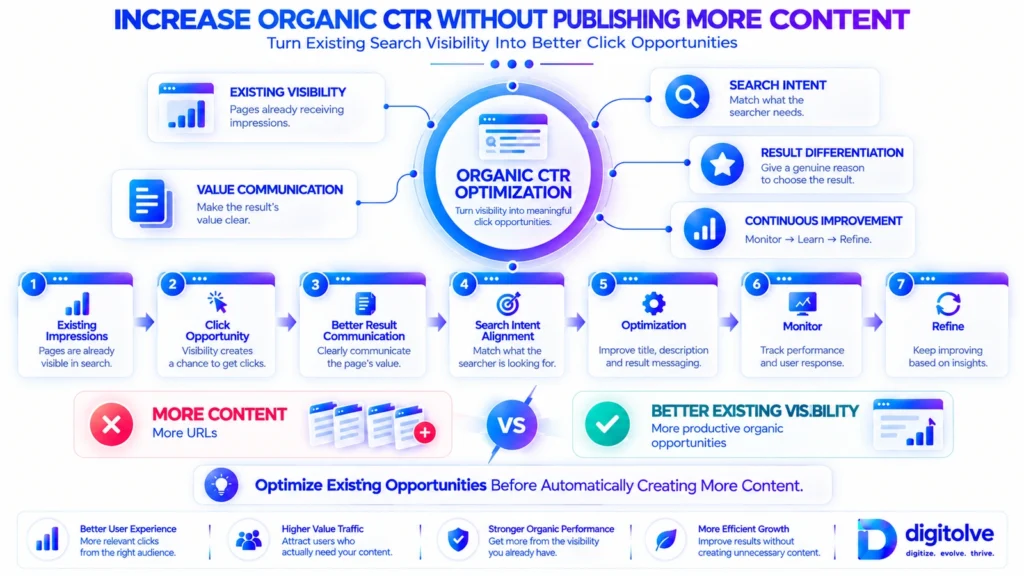
More Content → More URLs
versus
Existing Visibility → Better Click Opportunity → More Productive Organic Traffic
This does not mean every low-CTR page needs optimization, or that improving CTR will automatically increase rankings, conversions, or revenue. It means existing search visibility can sometimes contain opportunities worth understanding before automatically expanding the content library.
This article explores how to identify those opportunities, improve search-result communication, align results with search intent, and build a repeatable CTR optimization process without treating more content publishing as the default solution.
Table of Contents
2. What Organic CTR Actually Tells You
Organic click-through rate, or CTR, helps you understand the relationship between how often a page appears in search results and how often searchers click it.
2.1 Impressions vs Clicks
Impressions indicate that your page appeared in a search result, while clicks indicate that someone selected that result and visited your site.
A page can therefore receive a substantial number of impressions while generating relatively few clicks. That difference is where a potential CTR opportunity may exist.
2.2 What CTR Measures
CTR is calculated from clicks relative to impressions. In Google Search Console, the Performance report lets you examine clicks, impressions, CTR, and other search-performance dimensions such as queries and pages.
If you want to understand these measurements directly from Google, see Google Search Console’s Performance report.
2.3 Visibility vs Click Response
Search visibility and click response are related, but they are not the same thing.
A page may be visible enough to generate impressions while its result does not create a strong enough reason for the searcher to choose it. CTR helps reveal this difference between being seen and being selected.
2.4 Why Impressions Do Not Automatically Become Clicks
An impression only tells you that the result appeared. It does not tell you that the searcher found the result sufficiently relevant, clear, useful, or compelling to click.
This is why increasing impressions alone does not necessarily solve a weak click response. The next question is what happens between visibility and the decision to click.
2.5 Why CTR Should Be Interpreted in Context
CTR should not be treated as an isolated quality score. Search query, search intent, page, position, audience expectations, and the surrounding search results can all affect how users respond to a result.
CTR can help identify where click response deserves attention, but it does not independently explain rankings, search demand, content quality, conversions, or revenue.
The useful question is not simply “Is my CTR high or low?” but “What does the click response tell me about this existing visibility opportunity?”
3. Why a Page Can Get Impressions but Few Clicks
A page can appear in search results without generating the level of click response you expected. This does not automatically mean the page has no value. It may mean that the search result is not communicating that value clearly enough to the people seeing it.
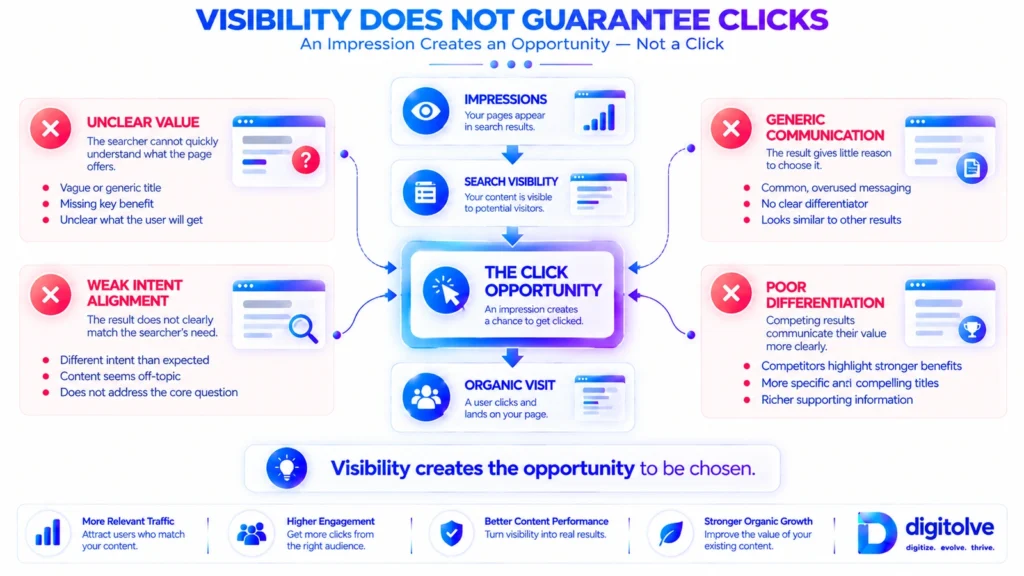
Visibility creates an opportunity to be chosen. It does not guarantee that the searcher will choose the result.
3.1 The Result Does Not Clearly Communicate Its Value
Searchers often make quick decisions about which result deserves attention. If the result does not make its purpose or useful value easy to understand, the opportunity created by the impression may be lost.
3.2 The Searcher Cannot Quickly Understand What the Page Offers
A result may technically match a topic while still leaving the searcher uncertain about what they will actually find after clicking.
When the purpose, answer, or useful angle is difficult to understand, the result has less opportunity to communicate why it deserves attention.
3.3 The Result Does Not Match the Searcher’s Expectation
A searcher comes to a results page with an expected need. If the title or supporting result information does not clearly reflect that need, the page may receive an impression without earning the click.
3.4 The Page May Be Visible for Queries With Different Intent
A single page can appear for multiple search queries, and those queries may not all represent exactly the same need.
This means a low CTR should not immediately lead to a title change. First, understand what searches are creating the visibility and whether the result is communicating an appropriate value for those searches.
3.5 Competing Results May Communicate Their Value More Clearly
Searchers make their choice within a results environment. Other results may communicate their purpose, usefulness, specificity, or relevance more clearly.
The goal is not to imitate competing results or manufacture curiosity. The goal is to make the genuine value of your own result easier to understand.
3.6 The Search Result May Need Better Positioning, Not More Content
When a page already has meaningful impressions, creating another article may not address the immediate opportunity.
The existing result may first need clearer communication, stronger alignment with the intended search need, or a more precise representation of what the page actually provides.
If your website is already receiving impressions but clicks remain weak, the diagnostic question becomes important: Why Your Content Gets Impressions But No Clicks?
4. Stop Treating Low CTR as a Traffic-Volume Problem
When clicks are weaker than expected, publishing more content can feel like the obvious solution. But more content and better performance from existing content are two different growth decisions.
4.1 Why Publishing More Content Can Miss the Actual Problem
Creating additional pages increases the number of URLs competing for attention, but it does not automatically improve the click response of pages that are already receiving impressions.
If the existing opportunity is weak result communication or poor alignment with search intent, adding more pages may leave the original problem untouched.
4.2 Existing Impressions Can Represent Untapped Opportunities
Impressions can show that a page is already entering the search environment. When those impressions are accompanied by weak click response, they can provide a starting point for investigation.
The opportunity is not to assume that every impression deserves optimization. It is to identify the pages and situations where existing visibility may be worth improving.
4.3 More URLs vs Better Performance From Existing URLs
Publishing creates new opportunities. Optimization works with opportunities that already exist.
These approaches can support different stages of organic growth, but they should not be treated as interchangeable.
More URLs: expands content coverage.
Existing-page optimization: seeks to make current search visibility more productive.
4.4 When Optimization Should Come Before Content Expansion
If a page already has meaningful visibility but weak click response, it can make sense to understand that opportunity before deciding that another page is needed.
This does not mean content expansion is unnecessary. It means the decision should come after understanding what the existing visibility is already telling you.
4.5 Why “Create More” and “Improve What Already Exists” Are Different Decisions
A strong organic growth process needs both creation and optimization. The important part is knowing which problem you are actually trying to solve.
If the opportunity is already present in existing search visibility, improving the current result may deserve attention before automatically adding another URL.
The smarter question is not always “How much more content can we publish?” It is “Where can existing visibility become more productive?”
5. Find Existing Click Opportunities Before Optimizing
CTR optimization should begin with opportunity identification, not with changing titles at random. A website may have many pages receiving impressions, but not every page represents the same optimization opportunity.
The first step is to identify where existing search visibility and weak click response appear together in a meaningful way.
5.1 Identify Pages Already Receiving Impressions
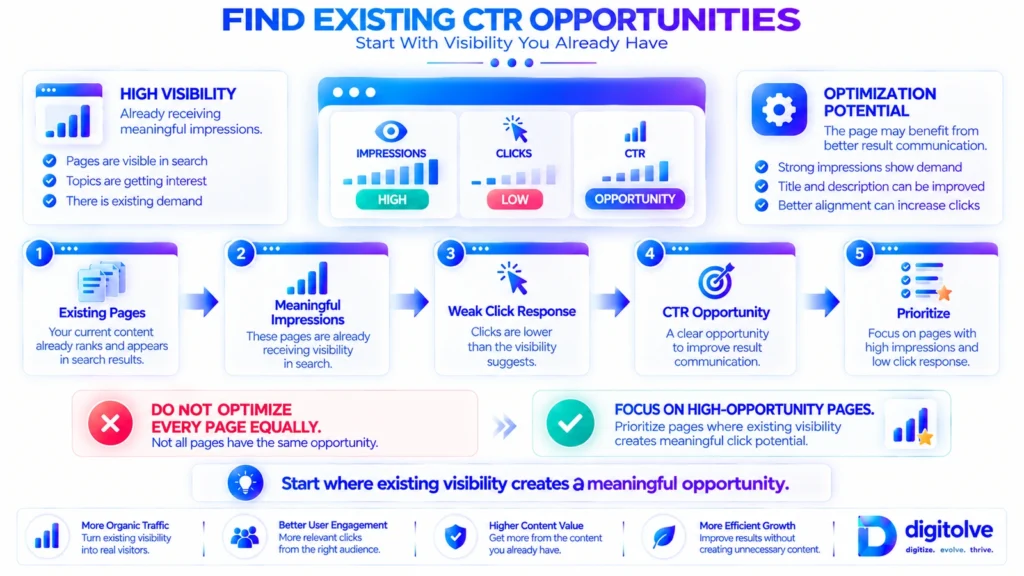
Start with pages that are already appearing in search results. Existing impressions provide evidence that the page is entering the search environment and therefore gives you something concrete to evaluate.
5.2 Look for Pages With Meaningful Visibility but Weak Click Response
Next, look for pages where search visibility exists but the click response appears weaker than expected. This creates a potential optimization opportunity that can be investigated before creating additional content.
5.3 Compare Visibility With Click Behavior
Impressions and clicks should be considered together rather than viewed separately. A page with visibility but limited click response tells a different story from a page that receives almost no search exposure at all.
5.4 Separate Strong Opportunities From Low-Value Impressions
Not every impression represents a valuable opportunity. Some visibility may come from queries that are only loosely related to the page or from situations where there is little realistic opportunity for improvement.
The goal is therefore not to optimize every page equally, but to identify the situations where existing visibility has meaningful potential.
5.5 Prioritize Pages That Can Actually Benefit From Optimization
Once potential opportunities are identified, prioritize the pages where improving result communication, relevance, or alignment could reasonably make the existing visibility more productive.
Do not optimize every page equally. Start where existing visibility creates a meaningful opportunity.
6. Strengthen the Search Result’s Value Proposition
Once a meaningful CTR opportunity has been identified, the next question is whether the search result clearly communicates why the page deserves attention.
A useful result should give the right searcher a clear and accurate reason to click without creating a promise that the page cannot satisfy.
6.1 Make the Page’s Purpose Clear
The searcher should be able to understand what the page is about and what kind of value it provides. A vague result can make an otherwise useful page difficult to choose.
6.2 Reflect the Searcher’s Actual Need
The result should connect naturally with the problem, question, or objective behind the search. When the message reflects the intended need, the searcher can more easily recognize its relevance.
6.3 Give the Searcher a Clear Reason to Click
A click should be supported by genuine value. The result can communicate a useful angle, a specific answer, a practical outcome, or another legitimate reason for the intended audience to explore the page.
6.4 Communicate Specific Value
Specific communication is generally more informative than vague claims. Instead of simply suggesting that a page is “helpful” or “complete,” the result should make its actual value easier to understand.
6.5 Keep the Promise Consistent With the Page
The search result and the landing page should tell the same story. If the result promises one thing but the page delivers something substantially different, a higher click response would not necessarily represent a better outcome.
6.6 Avoid Creating Curiosity That the Page Cannot Satisfy
Curiosity can attract attention, but CTR optimization should not depend on misleading or exaggerated promises. The strongest click opportunity comes when the searcher understands what they are likely to receive and the page actually delivers it.
The goal is not to win the click at any cost. The goal is to create a relevant reason for the right searcher to click.
7. Improve Title and Search-Result Communication
The title is one of the first pieces of information a searcher encounters. It therefore plays an important role in communicating what a page offers and whether it appears relevant to the searcher’s need.
7.1 Make Titles Clear
A clear title helps the searcher understand the subject without requiring unnecessary interpretation.
7.2 Make the Topic Immediately Understandable
The title should communicate the page’s central topic clearly enough that the intended searcher can quickly determine whether it relates to their need.
7.3 Use Specificity Where It Adds Meaning
Specific language can make the value of a page easier to understand when it accurately describes what the page provides. Specificity should clarify the offer rather than add unnecessary words.
7.4 Communicate the Page’s Actual Value
A title should represent the genuine value of the page. When the title communicates a useful and realistic outcome, the searcher has a clearer basis for deciding whether to click.
7.5 Differentiate Where Appropriate
When several results address a similar need, a genuine point of differentiation can help a page communicate why it may be relevant. Differentiation should come from actual value, not artificial claims.
7.6 Avoid Unnecessary Clickbait
Clickbait may create attention without creating the right expectation. CTR optimization should focus on relevant clicks rather than simply increasing the number of clicks.
7.7 Avoid Exaggerated Promises
Claims that the page cannot substantiate can create a mismatch between the search result and the actual experience. Clear and accurate communication is more useful than an exaggerated promise.
7.8 Keep the Title Aligned With the Actual Page
The title should accurately represent the content the searcher will encounter after clicking. This keeps the relationship between search-result communication and page experience consistent.
Clear communication should make the right page easier to recognize—not make every page look irresistible.
8. Strengthen Supporting Search-Result Information
The title is important, but the overall search-result message is not created by the title alone. Supporting information can help reinforce what the page is about and what the searcher can expect after clicking.
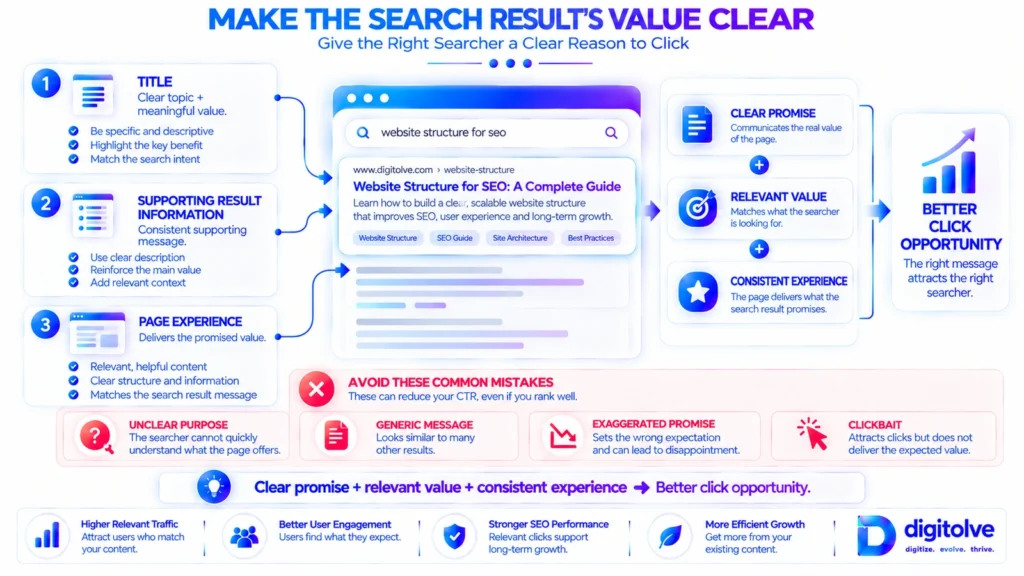
The strongest result communication is consistent across the title, supporting information, and the actual page experience.
8.1 Role of Supporting Search-Result Text
Supporting search-result information can add useful context around the main title. It can help clarify the page’s purpose, reinforce its relevance, and give the searcher a better understanding of what the result offers.
8.2 Keep Supporting Information Consistent With the Page
Supporting information should accurately reflect the page rather than introduce a separate or exaggerated promise.
8.3 Reinforce the Searcher’s Expected Need
When supporting information reflects the need behind the search, it can strengthen the connection between what the searcher wants and what the page offers.
8.4 Avoid Generic or Repetitive Messaging
Generic wording can make several search results appear interchangeable. Supporting information should add meaningful context rather than simply repeat the same message in different words.
8.5 Keep Overall Result Coherent
The title, supporting result information, and page content should work together as one consistent communication system.
Title + Supporting Result Information + Page Content should communicate a consistent promise.
9. Align the Search Result With Search Intent
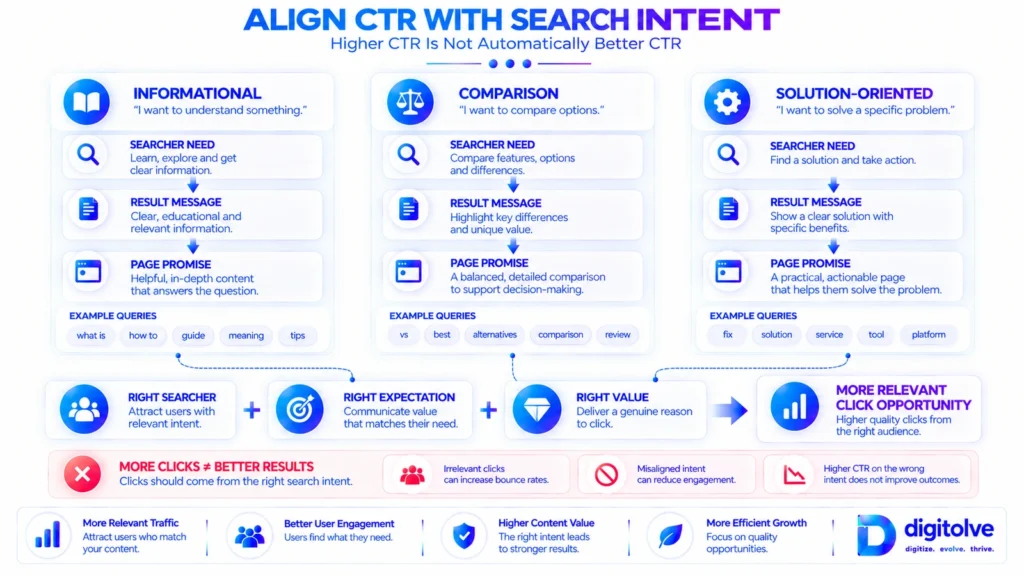
A search result becomes more useful when it reflects what the searcher is actually trying to accomplish. CTR optimization is therefore not simply about making a result more attractive; it is about making its relevance easier to recognize.
A higher CTR is not automatically better if the additional clicks come from people whose needs do not match the page.
9.1 Understand What the Searcher Is Trying to Accomplish
Before changing the result, consider the underlying purpose of the search. Is the person trying to understand something, compare options, solve a problem, or take another specific action?
9.2 Informational Searches
Informational searches generally reflect a need to understand a topic, answer a question, or learn how something works. The result should make that informational value clear when the page is designed to serve that need.
9.3 Comparison-Oriented Searches
Comparison-oriented searches reflect a different expectation. The searcher may be looking for distinctions, alternatives, features, or decision-support information. The result should communicate the page’s actual comparison value rather than simply using broad attention-grabbing language.
9.4 Solution-Oriented Searches
Solution-oriented searches often indicate that the searcher is trying to address a specific problem. A result can communicate relevance by making its practical problem-solving value clear.
9.5 Avoid Trying to Attract Every Possible Searcher
A result does not need to appeal to everyone. Broadening the message simply to generate more clicks can attract visitors whose expectations do not match the page.
9.6 Match the Result With the Intended Audience
The strongest click opportunity is usually based on relevance rather than maximum attention. When the result, search intent, and page experience are aligned, the click has a clearer purpose.
The goal is not simply more clicks. It is more relevant clicks from searchers the page is actually designed to help.
10. Differentiate the Result Without Misleading the Searcher
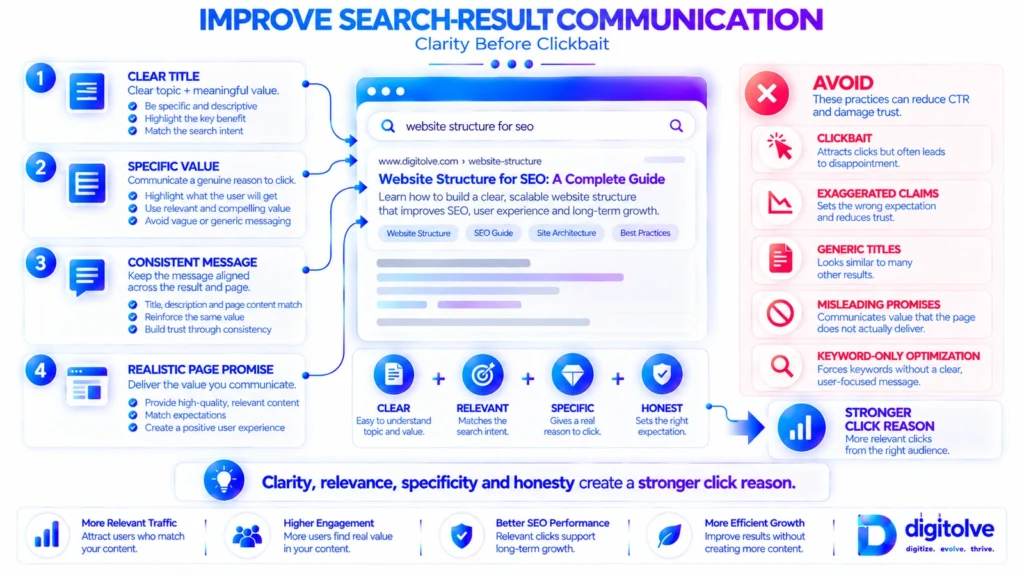
Search results often contain multiple pages addressing a similar topic. A clear point of differentiation can help a relevant page stand out, but differentiation should come from genuine value rather than artificial curiosity.
The objective is to make the result’s useful angle easier to recognize while keeping the promise accurate.
10.1 Why Differentiation Matters
When several results appear relevant, the searcher needs enough information to understand how each option may differ. Clear differentiation can help a page communicate its particular value.
10.2 Make the Result’s Useful Angle Clear
The useful angle might be a specific problem, perspective, outcome, process, comparison, or type of information. Whatever the angle is, it should reflect what the page genuinely provides.
10.3 Highlight Genuine Relevance
Relevance is stronger when it is based on the actual relationship between the searcher’s need and the page’s content. The result should make that relationship easier to recognize.
10.4 Avoid Artificial Curiosity
Creating mystery simply to encourage a click can produce the wrong expectation. Curiosity is useful only when the page can genuinely satisfy the interest it creates.
10.5 Avoid Clickbait and Unsupported Claims
Claims should remain accurate and supportable. A temporary increase in attention is not useful if the resulting click leads to disappointment or a mismatch with the page.
10.6 Make the Click Promise Match the Experience
The result should prepare the searcher for the experience they will receive after clicking. This keeps CTR optimization connected to relevance and usefulness rather than treating the click as the only objective.
Differentiate through genuine value—not through a promise the page cannot deliver.
11. Identify Where Click Opportunities Are Being Lost
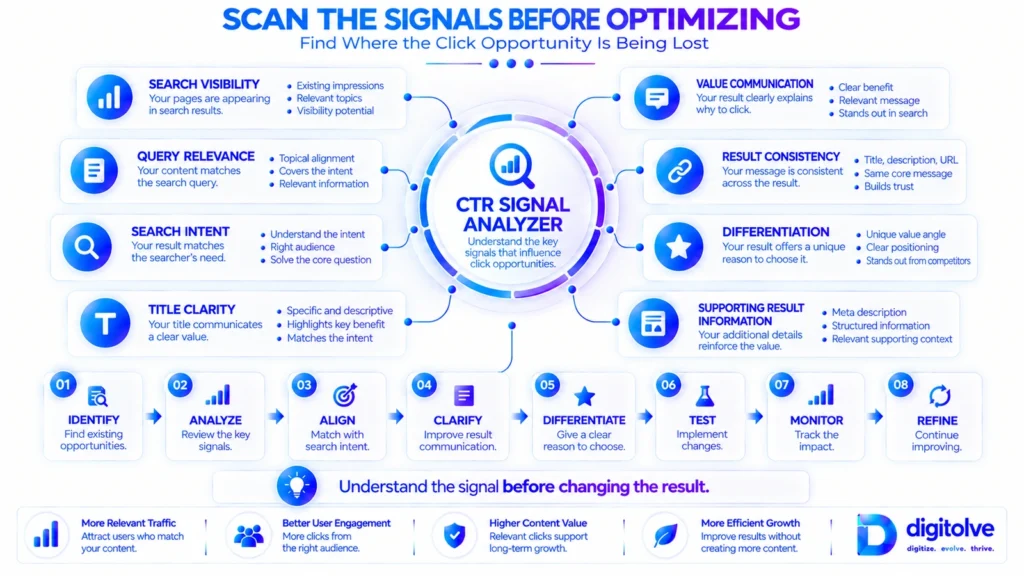
Once potential CTR opportunities have been identified, the next step is to understand what may be limiting the click response. A low CTR does not have one universal cause, so changing a title immediately may not address the actual issue.
A structured review can help separate different signals that may influence how a search result is understood and considered.
11.1 Search Visibility
First, consider whether the page has enough existing search visibility to make CTR optimization a meaningful opportunity.
11.2 Query Relevance
Look at the searches creating the visibility and consider whether they are meaningfully related to what the page is designed to provide.
11.3 Search Intent
Consider whether the result is aligned with the underlying purpose of the searches generating its impressions.
11.4 Title Clarity
Review whether the title makes the page’s subject and value understandable without relying on exaggerated language.
11.5 Value Communication
Ask whether the result gives the intended searcher a clear reason to explore the page.
11.6 Result Consistency
The search result should communicate a promise that remains consistent with the actual page experience.
11.7 Differentiation
Consider whether the result communicates a genuine useful angle that helps it stand apart from other relevant results.
11.8 Supporting Search-Result Information
Supporting information should reinforce the main message rather than introduce confusion, repetition, or an unrelated promise.
The purpose of this review is to understand the signal before deciding what to change.
12. Common CTR Optimization Mistakes
CTR optimization can become counterproductive when the focus shifts from understanding the existing opportunity to simply chasing more clicks. Several common approaches can make that mistake easier to repeat.
12.1 Publishing More Instead of Optimizing Existing Opportunities
Creating additional content does not automatically improve the click response of pages that are already receiving impressions.
12.2 Changing Titles Without Understanding the Problem
A title change may be useful in some situations, but changing it without understanding the underlying issue can make optimization less structured.
12.3 Optimizing Only for Keywords
A keyword may help describe a search topic, but CTR optimization also requires clear value communication and alignment with the searcher’s intended need.
12.4 Using Clickbait
Clickbait can attract attention without creating a useful or accurate expectation. The objective should be relevant clicks rather than clicks at any cost.
12.5 Making Exaggerated Promises
Overstated claims can create a mismatch between the search result and the page experience. Clear and accurate communication creates a more meaningful click opportunity.
12.6 Ignoring Search Intent
A result may receive clicks while still attracting the wrong audience. CTR should therefore be considered alongside the intent behind the searches generating the visibility.
12.7 Changing Too Many Variables at Once
When multiple elements are changed simultaneously, it becomes harder to understand what contributed to any observed change. A more controlled approach makes learning easier.
12.8 Treating Every Impression as Equal Opportunity
Not every impression represents the same potential. Some pages may have meaningful visibility and clear optimization potential, while others may have little practical opportunity.
12.9 Measuring CTR Without Context
CTR should be interpreted alongside the search environment, queries, page, visibility, and other relevant factors rather than treated as an isolated number.
12.10 Assuming Higher CTR Automatically Means Better Business Results
A click is not the final business outcome. Relevant traffic, useful page experiences, conversions, and broader business objectives still matter after the searcher arrives.
CTR optimization works best when the goal is better click opportunities—not simply a bigger click number.
13. Build a Repeatable CTR Optimization Framework
CTR optimization becomes easier to manage when it is treated as a repeatable process rather than a collection of isolated title changes.
A simple conceptual framework can keep the process focused from opportunity identification through continuous learning:
IDENTIFY → ANALYZE → ALIGN → CLARIFY → DIFFERENTIATE → TEST → MONITOR → REFINE
13.1 Identify
Find existing pages where meaningful search visibility and weak click response create a potential opportunity.
13.2 Analyze
Review the relevant signals around visibility, queries, intent, result communication, and the page experience.
13.3 Align
Make sure the search result reflects the searcher’s intended need and the audience the page is designed to serve.
13.4 Clarify
Make the page’s topic, purpose, and useful value easier to understand from the search result.
13.5 Differentiate
Communicate a genuine useful angle without relying on clickbait, exaggerated promises, or misleading curiosity.
13.6 Test
Make controlled improvements rather than changing every possible element at the same time. This makes the resulting learning easier to interpret.
13.7 Monitor
Observe how the result performs after an optimization. The purpose is not to assume that every change will increase CTR, but to learn what the observed response indicates.
13.8 Refine
Use what you learn to improve future optimization decisions and determine whether further refinement is appropriate.
This framework provides the direction of a repeatable process. The detailed implementation sequence, prioritization logic, worksheets, and execution tools belong inside the CTR Optimization Blueprint.
Identify → Analyze → Align → Clarify → Differentiate → Test → Monitor → Refine turns CTR optimization from a one-time change into a structured improvement process.
14. Turn Existing Impressions Into Better Click Opportunities
Once existing visibility has been identified, the next step is to turn that visibility into a clearer optimization opportunity. The objective is not to force every page to achieve a higher CTR, but to understand where better result communication may make existing visibility more productive.
14.1 Find Existing Visibility
Start with pages that are already appearing in search results and receiving impressions. This gives the optimization process an existing foundation rather than starting from zero.
14.2 Identify Potential CTR Opportunities
Look for situations where meaningful visibility exists but the click response appears weaker than the opportunity may justify.
14.3 Prioritize Which Pages Deserve Attention
Not every page should receive the same level of optimization effort. Prioritize pages where the existing visibility, relevance, and potential value make further review worthwhile.
14.4 Improve Search-Result Communication
Review how clearly the result communicates its topic, purpose, value, and relevance. Where appropriate, make targeted improvements that accurately represent what the page provides.
14.5 Keep Search Intent Central
Optimization should remain connected to the searcher’s intended need. A higher click response is not useful if the result attracts visitors who were never the right audience for the page.
14.6 Monitor the Result
After making an improvement, observe what happens rather than assuming the change will automatically produce a better CTR. Search environments and user behavior can vary.
14.7 Learn Before Expanding Content
The learning from existing pages can help inform the next content decision. Sometimes the result of optimization reveals that an existing page needs further improvement; sometimes it may reveal that genuinely new content is needed.
Existing Impressions → Better Result Communication → Better Click Opportunity
The goal is to make existing visibility more productive before automatically assuming that more content is required.
15. Build a Continuous CTR Improvement Cycle
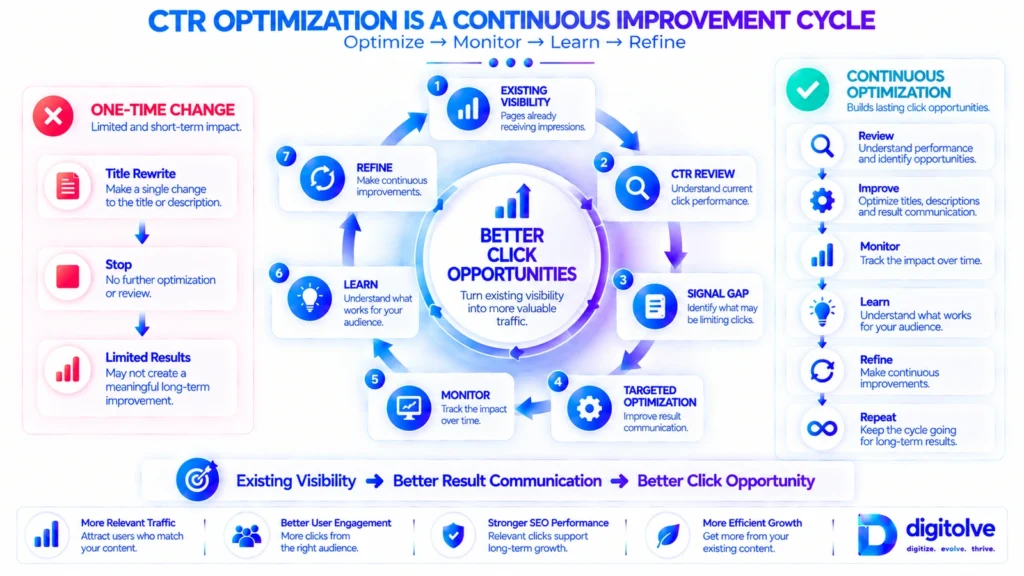
CTR optimization should not necessarily end after one title change or one round of improvements. Search queries, competing results, searcher expectations, and page performance can change over time.
A continuous cycle creates a more structured way to respond to those changes:
15.1 Existing Visibility
Begin with the pages and search visibility that already exist.
15.2 CTR Review
Review the relationship between impressions and clicks to identify situations that may deserve attention.
15.3 Signal Gap
Look for potential gaps in value communication, intent alignment, clarity, differentiation, or result consistency.
15.4 Targeted Optimization
Make focused improvements based on the opportunity identified rather than changing multiple unrelated elements without a clear reason.
15.5 Monitor
Observe the result after the change and allow enough context to understand what the observed response may indicate.
15.6 Learn
Use the observed outcome to understand what worked, what did not change, and what may require further investigation.
15.7 Refine
Apply the learning to future optimization decisions and continue the cycle when another meaningful opportunity appears.
Existing Visibility → CTR Review → Signal Gap → Targeted Optimization → Monitor → Learn → Refine ↺
This turns CTR optimization into an ongoing improvement process rather than a one-time attempt to rewrite search-result messaging.
16. From CTR Optimization to Broader Organic Growth
CTR is one layer of organic search performance. Improving the click opportunity can make existing search visibility more productive, but it does not replace the other parts of the organic growth system.
The broader relationship can be understood as:
Search Visibility → Click Opportunity → Organic Visit → On-Page Experience → Conversion / Business Outcome
16.1 Better CTR Does Not Replace Rankings
A stronger click response does not remove the importance of search visibility and ranking opportunities. Pages still need to appear where relevant searchers can find them.
16.2 Better CTR Does Not Replace Relevance
A result needs to be relevant to the searcher’s need. Increasing clicks without improving relevance can create a mismatch between the search result and the visitor.
16.3 Better CTR Does Not Replace Useful Content
The page still needs to deliver the value communicated by the search result. A click is only the beginning of the visitor’s experience.
16.4 Better CTR Does Not Guarantee Conversions
More organic clicks do not automatically mean more leads, sales, or other desired actions. What happens after the click remains important.
16.5 Better CTR Does Not Guarantee Revenue
Revenue depends on broader business and customer-journey factors beyond search-result click behavior.
CTR optimization makes existing search visibility more productive; it does not replace the broader SEO system.
This is why CTR optimization works best as one connected layer within a larger organic growth strategy rather than as a standalone replacement for visibility, relevance, useful content, or business optimization.
17. Build a Smarter Optimization Decision
Organic growth decisions do not always have to begin with another content idea. When a website already has search visibility, that existing visibility can provide useful opportunities to investigate first.
Instead of asking only:
“What content should we publish next?”
also ask:
“Where do we already have visibility that could become more productive?”
This creates a more deliberate decision path:
Existing Opportunity → Diagnose → Optimize → Learn → Decide Whether More Content Is Needed
The purpose is not to stop publishing content. It is to make sure content creation and existing-page optimization are treated as two different decisions based on the opportunity in front of you.
When existing visibility contains a meaningful CTR opportunity, optimization may deserve attention before automatically expanding the content library.
18. Conclusion — Improve the Click Opportunity Before Publishing More
A website does not always need more content to improve its organic performance. Sometimes the opportunity already exists in pages that are receiving search visibility but are not generating enough click response.
The practical approach is to identify existing visibility, understand where the click opportunity may be weak, improve result communication, align the result with search intent, differentiate through genuine value, and monitor what happens after optimization.
The goal is not simply to chase a higher CTR number. The goal is to make the search result clearer, more relevant, more useful, and more accurately connected to the page behind the click.
When existing opportunities are reviewed before automatically creating more content, organic growth decisions can become more deliberate:
Existing Visibility → Identify Opportunity → Optimize → Monitor → Learn → Refine
More content may still be the right decision in some situations. But it should be a decision based on the actual opportunity—not the automatic response to every CTR problem.
19. CTR Optimization Blueprint
If your pages are already receiving organic impressions but the click response is weaker than you want, the next step depends on how deeply you need to work on the problem.
“My content gets impressions but clicks are weak.”
Start with the diagnostic layer:
Why Your Content Gets Impressions But No Clicks (CTR Problem Explained)
SSL — CTR Optimization Toolkit
Use the diagnostic approach to understand why the CTR problem may be occurring.
“I understand the problem and want to improve my existing click opportunities.”
Digitolve — CTR Optimization Blueprint
Use the practical execution framework to identify opportunities, improve search-result communication, align with search intent, optimize existing visibility, and build a repeatable improvement process.
“I need a broader, ongoing system for organic click growth.”
Future — CTR Growth System (Core)
This represents the next level of the product path, where CTR optimization becomes part of a broader and continuously managed organic growth system.
Diagnosis → Optimization → Growth System
The right starting point depends on whether you first need to understand the problem, execute the optimization, or manage CTR improvement as part of a larger system.
20. FAQs — Organic CTR Optimization
1. What is organic click-through rate?
Organic click-through rate (CTR) is the relationship between how often a page appears in organic search results and how often searchers click that result. It helps show how effectively existing search visibility is generating clicks.
2. Why does my content get impressions but few clicks?
A page can receive impressions while generating fewer clicks when its search result does not clearly communicate its value, does not closely match the searcher’s intent, or does not give the right audience a clear reason to choose it.
3. Can I improve CTR without publishing more content?
Yes. If existing pages already receive meaningful search visibility, you can identify potential CTR opportunities and improve elements such as result communication, value clarity, differentiation, and search-intent alignment before deciding whether additional content is needed.
4. How can I improve my organic search result titles?
Start by making the title clear, specific where useful, aligned with the searcher’s need, and accurate to the page’s actual value. Avoid unnecessary clickbait, exaggerated promises, and titles that create expectations the page cannot satisfy.
5. Does a higher CTR always mean better SEO performance?
No. CTR is one part of organic search performance. A higher CTR does not automatically mean better rankings, stronger relevance, more conversions, or more revenue. CTR should be interpreted within the broader search and business context.
6. How does search intent affect organic CTR?
Search intent affects whether the result feels relevant to the searcher’s actual need. A result that communicates the right value to the right searcher can create a more relevant click opportunity, while attracting people with mismatched intent may produce clicks without meaningful results.
7. Should I change a page title if its CTR is low?
Not automatically. First understand the page’s existing visibility, queries, search intent, value communication, and other relevant signals. A title change may be useful when the title is part of the problem, but changing it without understanding the opportunity can make optimization less structured.
8. How can I find existing pages that have CTR optimization opportunities?
Start by identifying pages that already receive meaningful impressions and then compare their visibility with their click response. Prioritize pages where the existing visibility, relevance, and potential value suggest that improving search-result communication could be worthwhile.
21. Recommended Reading
- Why Your Content Gets Impressions But No Clicks (CTR Problem Explained) — Understand the diagnostic side of weak CTR and why impressions do not always become clicks.
- Why Your Content Gets Impressions But Traffic Is Not Growing — Explore the broader relationship between search visibility, impressions, and organic traffic growth.
- How to Build a Complete SEO Visibility System That Compounds Traffic, Authority, and Growth — Move from individual CTR optimization toward a broader SEO visibility system.